 Opel Astra F (1991–1998)
Specs, engines, safety and known problems
Published Sources (4) Report an error
By Felix Hartmann, Automotive Technology & EV Contributor Reviewed by Oleksandr Hnatiuk

- Power
- 42–110 kW (57–150 PS)
- Boot
- 500 l
- Generation
- 1 of 6
Model timeline
Where the F sits in the Astra story
Successor Astra G (1998–2004)


H and J overlapped in 2009–2010, so J sits on a second lane
Newest first · 6 generations since 1991
-
2021
-
2015
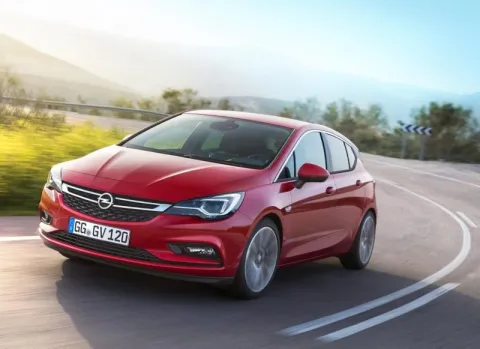 K 2015–2021 · Hatchback, Station wagon · 66–147 kW (90–200 PS)
-
2009
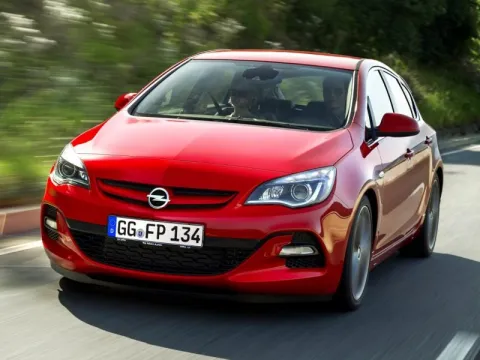 J 2009–2015 · Sedan, Hatchback · 64–206 kW (87–280 PS)
H and J overlapped in 2009–2010
-
2004
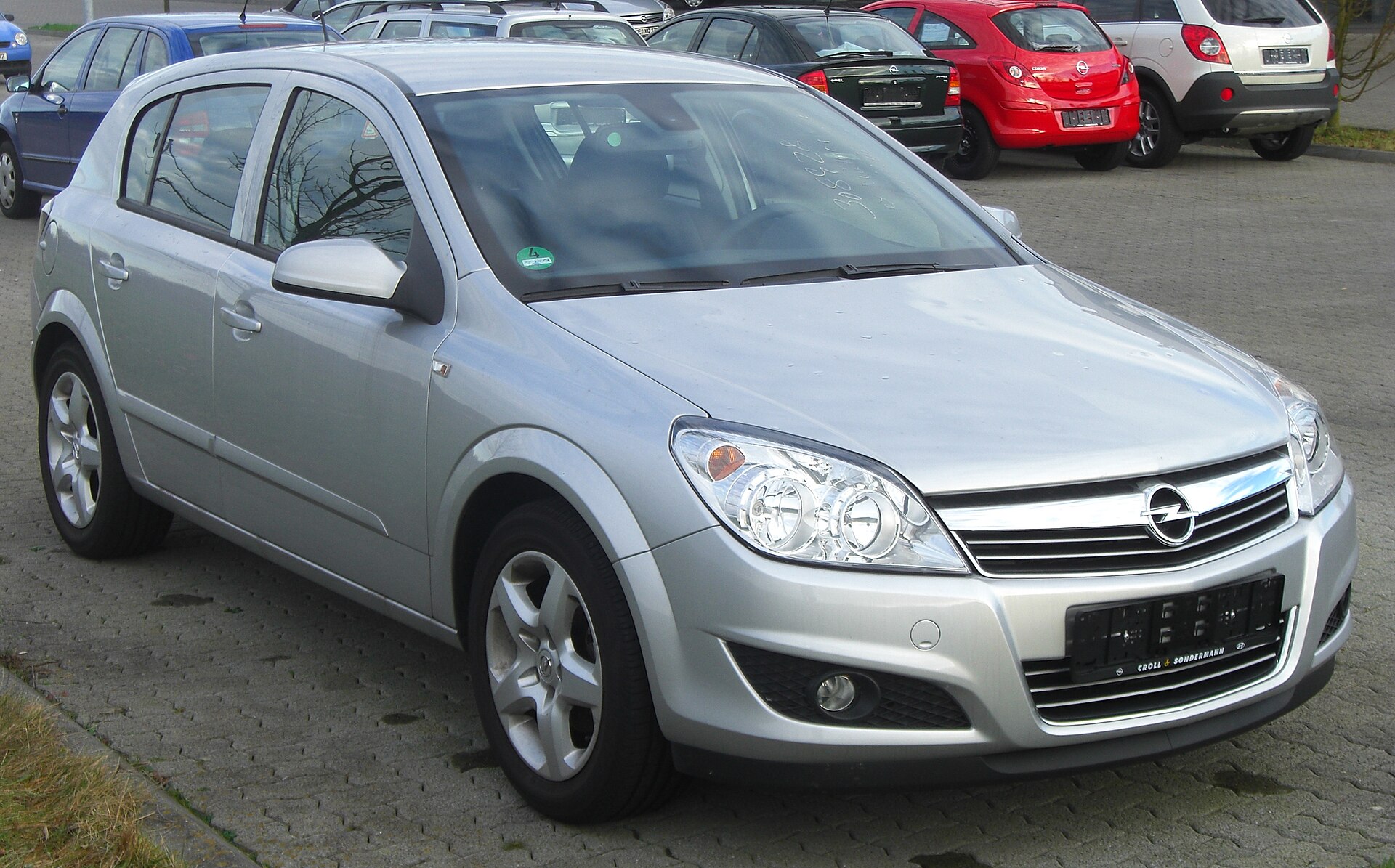
-
1998
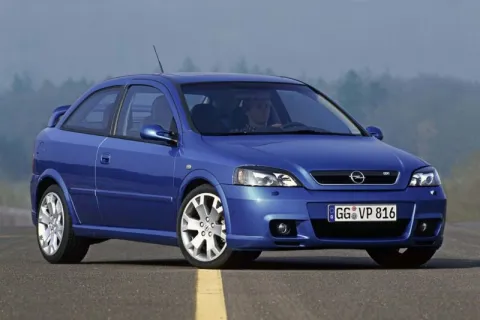 G 1998–2004 · Sedan, Hatchback · 48–147 kW (65–200 PS)
-
1991
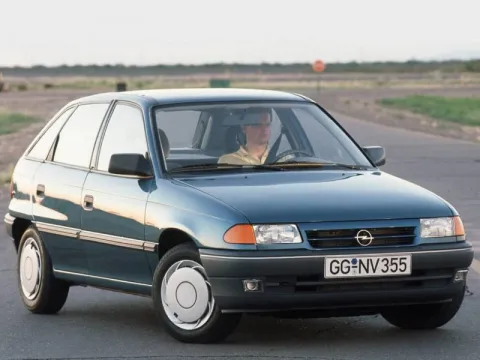 F You are here 1991–1998 · Sedan, Hatchback · 42–110 kW (57–150 PS)
All generations by year: Astra L (2021–now) · Astra K (2015–2021) · Astra J (2009–2015) · Astra H (2004–2010) · Astra G (1998–2004) · Astra F (1991–1998)
The Opel Astra F is the first car sold under the Astra name by Opel, built from summer 1991 to spring 1998 as the replacement for the Kadett E. It came as a hatchback, Caravan estate, saloon, van and Bertone-built cabriolet, with engines from a 42 kW diesel to the 110 kW GSi 16V. A Poland-built Astra Classic stayed on sale until about 2002.
In short
- Hatchback from September 1991, Caravan from October 1991, saloon from May 1992 and cabriolet from August 1993; the cabriolet was built until early 2000.
- Petrol engines from 1.4 to 2.0 litres with 44 to 110 kW (60 to 150 PS); 1.7 diesels with 42 to 60 kW (57 to 82 PS).
- The August 1994 facelift made two front airbags standard on German-market cars and improved rust protection.
- In Britain the F was the Vauxhall Astra Mk3, and the GSi name gave way to the SPORT in 1995.
Astra F specs by version
Engines
| Version | Engine | Power | Torque | Production years |
|---|---|---|---|---|
| Diesel · 2 versions | ||||
| 1.7 42 kW (57 PS) | 1.7 l · Diesel 1,700 cc | 42 kW 57 PS56 hp | — | — |
| 1.7 TD | 1.7 l · 4 cyl · Diesel X17DTL | 50 kW 68 PS67 hp | 132 Nm97 lb-ft | — |
| Petrol · 4 versions | ||||
| 1.4 i | 1.4 l · 4 cyl · Petrol C14NZ | 44 kW 60 PS59 hp | 103 Nm76 lb-ft | — |
| 1.4 55 kW (75 PS) | 1.4 l · Petrol 1,400 cc | 55 kW 75 PS74 hp | — | — |
| 1.4 Si | 1.4 l · 4 cyl · Petrol C14SE | 60 kW 82 PS80 hp | 114 Nm84 lb-ft | — |
| 2.0 C20XE 110 kW (150 PS) | 2.0 l · 4 cyl · Petrol C20XE | 110 kW 150 PS148 hp | — | 1991–1994 |
| Other · 4 versions | ||||
| 1.4 16V | — | 66 kW 90 PS89 hp | 125 Nm92 lb-ft | — |
| C20NE 85 kW (116 PS) | C20NE | 85 kW 116 PS114 hp | — | 1991–1994 |
| C18XE 92 kW (125 PS) | C18XE | 92 kW 125 PS123 hp | — | 1991–1996 |
| X20XEV 100 kW (136 PS) | X20XEV | 100 kW 136 PS134 hp | — | 1993–1994 |
Dimensions and weight
Show all 8 versions
| Version | Boot |
|---|---|
| Diesel · 1 version | |
| 1.7 TD | 500 l17.7 cu ft |
| Petrol · 3 versions | |
| 1.4 i | 500 l17.7 cu ft |
| 1.4 Si | 500 l17.7 cu ft |
| 2.0 C20XE 110 kW (150 PS) | 500 l17.7 cu ft |
| Other · 4 versions | |
| 1.4 16V | 500 l17.7 cu ft |
| C20NE 85 kW (116 PS) | 500 l17.7 cu ft |
| C18XE 92 kW (125 PS) | 500 l17.7 cu ft |
| X20XEV 100 kW (136 PS) | 500 l17.7 cu ft |
Verified Manufacturer and type-approval data from our catalog · Sources and methodology
From Kadett E to Astra F
The F was the sixth model in the Kadett and Astra line and the first to use the Astra name in Germany. German Wikipedia says the name was chosen because General Motors was aligning model names with Vauxhall, which had used "Astra" on its Kadett-based cars since 1980. The F kept the GM T platform of 1979 that had also carried its predecessor.
What was new was the body engineering. Opel used computer-calculated reinforcement points, double-tube door beams and stronger pillars, sills and door frames. Belt tensioners and height-adjustable front belts were standard from launch, the seat rails were designed to stop occupants sliding under the belt, and the rear head restraints had a frame design.
The F also served as a test bed. English Wikipedia lists two electric prototypes, the Impuls 2 with nickel-cadmium batteries and a range of 80 km (50 miles), and the Impuls 3 with sodium-nickel-chloride batteries and 140 km (87 miles). The Opel Astra overview of all generations covers the five Astras that followed; the Kadett years are part of the history of Opel.
Hatchback, Caravan, saloon, cabriolet and van
German Wikipedia gives this sequence of launches:
- September 1991: three- and five-door hatchback. Demand for the three-door was low, and it was later dropped.
- October 1991: Caravan estate.
- May 1992: four-door saloon.
- 1992 onwards: a three-door van with front seats only and metal rear side panels, registered as a commercial vehicle.
- August 1993: cabriolet, designed and built by Bertone on the basis of the saloon, with steel tubes in the windscreen frame and doors and fixed rear head restraints for rollover protection.
German production of the closed bodies ended in March 1998, while the cabriolet carried on into early 2000. The Astra Classic, built in Poland for Eastern Europe and Turkey from a mix of original and facelift parts, ran until July 2002 according to German Wikipedia; English Wikipedia dates it 1999 to 2003. The F was also assembled or sold under licence in South Africa, Brazil, Indonesia and India, and Holden imported British-built cars to New Zealand from 1995 and Australia from 1996 as the Astra TR.
What the 1994 facelift changed
The update of August 1994 was more than cosmetic. Two front airbags became standard on German-market cars, with volumes of 67 L for the driver and 120 L for the passenger; a driver's airbag had been optional since spring 1993. Rust protection was improved and gas dampers replaced oil dampers.
On the outside, the facelift brought a new grille and headlamps, clear fog-lamp lenses, white front indicators, revised mirrors, side mouldings, rear bumper and roof spoiler, and four- or five-chamber tail lamps. New door handles followed from late 1995, and ABS, optional from the start, became standard for model year 1996. The engine range also changed, with X-coded units meeting the Euro 2 standard.
Astra F engine range by code
Data is from German Wikipedia's engine table, cross-checked against the power ranges in English Wikipedia. Opel's engine code letter matters: "C" marks Euro 1 units and "X" Euro 2 units.
| Engine | Code | Years | Power | Torque |
|---|---|---|---|---|
| 1.4 i | C14NZ / X14NZ | 1991–1998 | 44 kW (60 PS) | 103 Nm (76 lb-ft) |
| 1.4 Si | C14SE | 1991–1996 | 60 kW (82 PS) | 114 Nm (84 lb-ft) |
| 1.4 16V | X14XE | 1996–2000 | 66 kW (90 PS) | 125 Nm (92 lb-ft) |
| 1.8 16V | C18XE | 1993–1994 | 92 kW (125 PS) | — |
| 2.0 8V | C20NE | 1991–1994 | 85 kW (115 PS) | — |
| 2.0 16V | X20XEV | 1995–1998 | 100 kW (136 PS) | — |
| 2.0 16V GSi | C20XE | 1991–1996 | 110 kW (150 PS) | — |
| 1.7 D | 17D / 17DR | 1991–1994 | 42 / 44 kW (57 / 60 PS) | 105 Nm (77 lb-ft) for 17D |
| 1.7 TD | X17DTL | 1994–1998 | 50 kW (68 PS) | 132 Nm (97 lb-ft) |
| 1.7 TDS (Isuzu) | X17DT | 1993–1998 | 60 kW (82 PS) | 168 Nm (124 lb-ft) |
German Wikipedia also lists 1.6 engines with 52 to 74 kW (71 to 100 PS) and a post-facelift 1.8 with 85 kW (115 PS); after 1994 the German cabriolet came only with the 55 kW (75 PS) 1.6 and that 1.8. Most versions had a five-speed manual, and a four-speed Aisin automatic was optional. Some export cars kept carburettor or non-catalyst engines.
According to German Wikipedia, many Euro 1 petrol engines can be upgraded to at least Euro 2 with a cold-start regulator or a small catalytic converter, which can matter for low-emission zones.
GSi 16V and the sporty models
GSi stands for Grand Sport injection. The first-series GSi was a three-door only, lowered by 15 mm (0.6 in), with a multi-function display and, on the 16V, a rear anti-roll bar and 50-series tyres. Electronic traction control was available only with the C20XE. From model year 1995 the GSi was also offered as a five-door and as a Caravan; a Caravan 16V with the 110 kW engine had already appeared for model year 1994.
GSi engines changed over time: the C20NE with 85 kW (115 PS) from 1991 to 1994, the C20XE with 110 kW (150 PS) from 1991 to 1996, the C18XE with 92 kW (125 PS) from 1993 to 1994 and the X20XEV with 100 kW (136 PS) from 1995. In the UK, English Wikipedia notes, the GSi was replaced in 1995 by the SPORT.
Astra F size and luggage space
Complete official dimensions were not available in our sources. Lengths are from English Wikipedia, boot volumes from German Wikipedia.
| Parameter | Metric | Imperial |
|---|---|---|
| Length: saloon and cabriolet | 4,239 mm | 166.9 in |
| Length: Caravan | 4,278 mm | 168.4 in |
| Boot: hatchback | 350–1,200 L | 12.4–42.4 cu ft |
| Boot: Caravan | 500–1,630 L | 17.7–57.6 cu ft |
| GSi lowering | 15 mm | 0.6 in |
The Caravan's 1,630 L with the rear seat folded makes it the most useful F today, and it sits among the older estate cars in our catalogue.
Rust, recalls and other known weak spots
German Wikipedia names rust as the main problem of the F, mostly at cut edges and traced to manufacturing faults; the 1994 facelift improved protection. The same source mentions a recall for a fuel tank design fault and a recall of GSi models with the C20XE for cylinder head gasket problems, handled under warranty. First-series cars also had weak timing belts, ignition distributor faults and alternator failures. Euro NCAP published its first results in 1997, and our sources list no test of the F.
Choosing an Astra F as a classic
The F now counts among the classic cars of the 1990s, and of its many versions the C20XE GSi, the Caravan 16V and the Bertone cabriolet stand out. For any F, check the cut edges, sills and wheel arches first, then the timing belt history. A post-August 1994 car brings dual airbags and better rust protection; a car from model year 1996 also has standard ABS. For the GSi, ask for proof that the head gasket recall was done.
Did you know?
- The Astra F is generation 1 of 6 of the Opel Astra in our catalog.
- Built for 7 years (1991–1998), it is the longest-running of the 6 generations in our catalog.
Image credits · Photos from Wikimedia Commons under free licences
- Opel Astra F · Photo: Mr.choppers / Wikimedia Commons, CC BY-SA 3.0
- Opel Astra G · Photo: The original uploader was Topfklao at German Wikipedia. / Wikimedia Commons, Attribution
- Opel Astra H · Photo: No machine-readable author provided. M 93 assumed (based on copyright claims). / Wikimedia Commons, CC BY-SA 3.0
- Opel Astra J · Photo: Acgskup / Wikimedia Commons, CC BY 4.0
- Opel Astra K · Photo: Danny Galvez from Pinoso, España / Wikimedia Commons, CC BY-SA 2.0
- Opel Astra L · Photo: Alexander Migl / Wikimedia Commons, CC BY-SA 4.0
F rivals
-
Ended 2021
- Years
- 2013–2021
- Body
- Hatchback
- Fuel
- Petrol, Diesel
- Power
- 60–199 kW (82–271 PS)
-
EV version
Ended 2025
- Years
- 1998–2025
- Body
- Sedan, Hatchback
- Fuel
- Petrol, Diesel, Electric
- Power
- 63–257 kW (86–349 PS)
4 generations
- I
- II
- C346
- IV
-
Ended 2004
- Years
- 1987–2004
- Body
- Hatchback
- Fuel
- Petrol
- Power
- 40–53 kW (54–72 PS)


FAQ
When did the Opel Astra F go on sale, and when did it end?
German production ran from summer 1991 to March 1998, the cabriolet until early 2000. The Poland-built Astra Classic was sold until about 2002.
What does GSi mean on the Astra F?
Grand Sport injection. The top GSi used the 2.0 16V C20XE with 110 kW (150 PS) and was lowered by 15 mm.
Who built the Astra F cabriolet?
Bertone designed and built it, based on the saloon. It arrived in August 1993 and was produced until early 2000.
Is the Astra F prone to rust?
Yes. German sources name cut-edge rust as its main weakness. Cars built after the August 1994 facelift have better rust protection.
Which diesel engines did the Astra F have?
All were 1.7 litres: the 17D with 42 kW (57 PS), the 17DR with 44 kW (60 PS), the X17DTL turbo with 50 kW (68 PS) and the Isuzu-built X17DT with 60 kW (82 PS).
Data sources
Data checked by an editor against the sources below.
- 1cars archive: Opel Astra: Generations, Specs and History
- The text of this article (1cars archive)
- Wikipedia — Opel Astra
- Wikipedia — Opel Astra F