
 Peugeot 308 II
Specs, engines and history
Updated Published Sources (3) Report an error
By Oleksandr Hnatiuk, Automotive Editor & Used Car Specialist Reviewed by Felix Hartmann

- Built
- 2013–2021
- Top power
- 199 kW (271 PS)
Which Peugeot 308 II to buy
Our verdict · Oleksandr Hnatiuk
The safest choices are a diesel (especially the 2.0 BlueHDi) or a post-facelift 1.2 PureTech with proof that the timing belt has been checked or replaced. Avoid the early 1.6 THP unless it has a full history. In the Netherlands in March 2024, a diesel with about 100,000 km cost from about €13,000 and a 1.2 PureTech 130 about €10,000–11,000. More French cars are listed among French cars and in the Peugeot catalogue.
The second-generation Peugeot 308 (T9) is a compact hatchback and estate built in France from 2013 to 2021 on the PSA EMP2 platform. About 140 kg lighter than its predecessor, it was named European Car of the Year 2014 and scored five Euro NCAP stars. Engines run from the 60 kW (82 PS) 1.2 PureTech to the 199 kW (270 PS) GTi.
In short
- Years: unveiled in May 2013, shown at Frankfurt, facelifted in 2017, replaced by the 308 III in 2021.
- Body styles: five-door hatchback and SW estate; a saloon was built for China.
- Engines: 1.2 PureTech three-cylinder 82–130 PS, 1.6 THP 125–165 PS, GTi 250–270 PS, diesels 92–180 PS.
- Weak points: the wet timing belt of the 1.2 PureTech and the 1.6 THP's chain and water pump.

Size at a glance
Kia Ceed JD
The Peugeot 308 II is 57 mm shorter, 24 mm wider and 13 mm lower than the Kia Ceed JD.
| Dimensions | Peugeot 308 II | Kia Ceed JD | Difference |
|---|---|---|---|
| Length | 4,253 mm167.4 in | 4,310 mm169.7 in | −57 mm−2.2 in |
| Width | 1,804 mm71.0 in | 1,780 mm70.1 in | +24 mm+0.9 in |
| Height | 1,457 mm57.4 in | 1,470 mm57.9 in | −13 mm−0.5 in |
| Wheelbase | 2,620 mm103.1 in | 2,650 mm104.3 in | −30 mm−1.2 in |
| Boot | 470 L16.6 cu ft | 380 L13.4 cu ft | +90 L+3.2 cu ft |
Opel Astra K
The Peugeot 308 II is 117 mm shorter, 5 mm narrower and 28 mm lower than the Opel Astra K.
| Dimensions | Peugeot 308 II | Opel Astra K | Difference |
|---|---|---|---|
| Length | 4,253 mm167.4 in | 4,370 mm172.0 in | −117 mm−4.6 in |
| Width | 1,804 mm71.0 in | 1,809 mm71.2 in | −5 mm−0.2 in |
| Height | 1,457 mm57.4 in | 1,485 mm58.5 in | −28 mm−1.1 in |
| Wheelbase | 2,620 mm103.1 in | 2,662 mm104.8 in | −42 mm−1.7 in |
| Boot | 470 L16.6 cu ft | 370 L13.1 cu ft | +100 L+3.5 cu ft |
Specs by version
Engines
| Version | Engine | Power |
|---|---|---|
| Diesel · 5 versions | ||
| 1.6 68 kW (92 PS) Hatchback | 1.6 l · Diesel 1,600 cc | 68 kW 92 PS91 hp |
| 81 kW (110 PS) Hatchback | Diesel | 81 kW 110 PS109 hp |
| 1.6 85 kW (116 PS) Hatchback | 1.6 l · Diesel 1,600 cc | 85 kW 116 PS114 hp |
| 1.6 110 kW (150 PS) Hatchback | 1.6 l · Diesel 1,600 cc | 110 kW 150 PS148 hp |
| 118 kW (160 PS) Hatchback | Diesel | 118 kW 160 PS158 hp |
| Petrol · 1 version | ||
| 1.2 60 kW (82 PS) Hatchback | 1.2 l · 3 cyl · Petrol 1,200 cc | 60 kW 82 PS80 hp |
| Other · 1 version | ||
| 1.6 92 kW (125 PS) Hatchback | 1.6 l 1,600 cc | 92 kW 125 PS123 hp |
Dimensions and weight
Show all 7 versions
| Version | Length | Width | Height | Wheelbase | Boot |
|---|---|---|---|---|---|
| Diesel · 5 versions | |||||
| 1.6 68 kW (92 PS) Hatchback | 4,253 mm167.4 in | 1,804 mm71.0 in | 1,457 mm57.4 in | 2,620 mm103.1 in | 470 l16.6 cu ft |
| 81 kW (110 PS) Hatchback | 4,253 mm167.4 in | 1,804 mm71.0 in | 1,457 mm57.4 in | 2,620 mm103.1 in | 470 l16.6 cu ft |
| 1.6 85 kW (116 PS) Hatchback | 4,253 mm167.4 in | 1,804 mm71.0 in | 1,457 mm57.4 in | 2,620 mm103.1 in | 470 l16.6 cu ft |
| 1.6 110 kW (150 PS) Hatchback | 4,253 mm167.4 in | 1,804 mm71.0 in | 1,457 mm57.4 in | 2,620 mm103.1 in | 470 l16.6 cu ft |
| 118 kW (160 PS) Hatchback | 4,253 mm167.4 in | 1,804 mm71.0 in | 1,457 mm57.4 in | 2,620 mm103.1 in | 470 l16.6 cu ft |
| Petrol · 1 version | |||||
| 1.2 60 kW (82 PS) Hatchback | 4,253 mm167.4 in | 1,804 mm71.0 in | 1,457 mm57.4 in | 2,620 mm103.1 in | 470 l16.6 cu ft |
| Other · 1 version | |||||
| 1.6 92 kW (125 PS) Hatchback | 4,253 mm167.4 in | 1,804 mm71.0 in | 1,457 mm57.4 in | 2,620 mm103.1 in | 470 l16.6 cu ft |
Verified Manufacturer and type-approval data from our catalog · Sources and methodology
Peugeot 308 II at a glance
The 308 II replaced the first 308 and moved Peugeot's compact car upmarket, with cleaner styling shared with the 208 and 508 and a cabin built around the i-Cockpit: a small steering wheel with the instruments viewed above it and a central touchscreen. It was assembled at Sochaux and Mulhouse in France.

Peugeot's vans include the Peugeot Partner.
| Generation | Code | Years | Body styles | Engines | Power (kW / PS) |
|---|---|---|---|---|---|
| 308 I | T7 | 2007–2013 | hatch, SW, CC | petrol and diesel | – |
| 308 II | T9 | 2013–2021 | 5-door hatch, SW estate (saloon in China) | 1.2 PureTech, 1.6 THP, 1.5–2.0 BlueHDi | 60–199 / 82–270 |
| 308 III | P51 | 2021– | hatch, SW | PureTech, BlueHDi, plug-in hybrids, electric | – |
Design, platform and the 2017 facelift
The EMP2 platform, shared with the Citroën C4 Picasso, cut weight by about 140 kg compared with the first 308. Peugeot launched the car on 13 May 2013 and showed it publicly at the Frankfurt Motor Show that September. In March 2014 it won European Car of the Year, ahead of the BMW i3 and Tesla Model S.

The 2017 facelift brought a new bonnet, bumper and grille with the Peugeot lion, sequential indicators, the eight-speed EAT8 automatic and the 1.5 BlueHDi diesel with 96 kW (130 PS). A 2020 update enlarged the digital instrument display.
308 II engines and gearboxes
| Engine | Power | Notes |
|---|---|---|
| 1.2 PureTech three-cylinder petrol | 60–96 kW (82–130 PS) | Turbo versions 110 and 130 PS; timing belt runs in oil |
| 1.6 THP petrol | 92–121 kW (125–165 PS) | Turbocharged four-cylinder |
| 1.6 THP GTi | 184 / 199 kW (250 / 270 PS) | GTi by Peugeot Sport |
| 1.6 e-HDi diesel | 68–85 kW (92–115 PS) | Early years |
| 1.6 BlueHDi diesel | 88 kW (120 PS) | Euro 6 |
| 1.5 BlueHDi diesel | 96 kW (130 PS) | From September 2017 |
| 2.0 BlueHDi diesel | 110–133 kW (150–180 PS) | Automatic available |
Gearboxes were five- and six-speed manuals, the six-speed EAT6 automatic and, from the 2017 facelift, the eight-speed EAT8.

Dimensions and boot space
The 308 II hatchback offers a 470-litre (16.6 cu ft) boot, rising to 1,228 litres (43.4 cu ft) with the rear seats folded and the parcel shelf removed, which is large for the class. The SW estate is longer and has more rear legroom, which is why Dutch used-car buyers' guides recommend it for families. The tailgate opening narrows at the bottom, which makes loading bulky items slightly harder.

308 II fuel economy and running costs
The 1.2 PureTech 110/130 and the BlueHDi diesels are the most economical choices; the diesels need AdBlue, which must be topped up roughly every 25,000 km. Real combined consumption of the turbo petrols can reach about 8 L/100 km (29.4 mpg US) in hard driving, well above official figures.

Peugeot 308 GTi by Peugeot Sport
The 308 GTi was the performance flagship of the second generation, developed by Peugeot Sport rather than the regular engineering team. It used a highly tuned 1.6 THP four-cylinder in two outputs, 184 kW (250 PS) and 199 kW (270 PS), with a six-speed manual gearbox, lowered sports suspension and larger brakes. For a used buyer it is the most entertaining 308 II, but it shares the THP family's need for careful servicing, so a complete history is essential. Peugeot's earlier hot hatches are part of the history of Peugeot.
308 II trims and equipment
Typical European trims were Access (15-inch steel wheels, manual air conditioning, basic radio), Active (16-inch alloys, cruise control, climate control, touchscreen, Bluetooth), Allure (LED headlights, sports seats, navigation, electric handbrake) and GT Line (larger wheels and a sportier interior), plus the GT and GTi.

308 II safety rating
Euro NCAP awarded the 308 five stars in 2013, with 92% for adult occupants, 79% for children, 64% for pedestrians and 81% for safety assist.

308 II reliability and known faults
The 308 II is generally solid, but some engines need care:
- 1.2 PureTech: the timing belt runs in oil and can break down with old, dirty or wrong-spec oil, blocking the oil supply. Cars built from spring 2017 to summer 2018 are most affected; check for Peugeot's workshop campaign and consider preventive belt replacement.
- 1.6 THP: stretched timing chains, failing ignition coils, worn injectors and turbos, and electric water pump control faults that can lead to overheating. Later e-THP engines are better.
- Diesels: generally reliable, but check for fuel line leaks and AdBlue system faults; disabling AdBlue is not legal.
- Body and electronics: infotainment glitches in early cars and a creaking rear axle, fixed with a sprayed coating.

Rivals: how the 308 II compares
The 308 competed with the Ford Focus Mk3, Opel Astra, Volkswagen Golf, Renault Mégane and Kia Ceed. It stood out for its boot, low weight and distinctive i-Cockpit; some drivers find the small wheel hides part of the instruments.

Rivals
Compare with…
Compare Peugeot 308 II with
- Opel Astra quick spec comparison
- Kia Ceed quick spec comparison
-
EV version
In production
- Years
- 1991–present
- Body
- Sedan, Hatchback
- Fuel
- Petrol, Diesel, LPG / CNG
- Power
- 42–206 kW (57–280 PS)
-
Ended 2025
- Years
- 2006–2025
- Body
- Hatchback, Station wagon
- Fuel
- Petrol, Diesel
- Power
- 66–150 kW (90–204 PS)
3 generations
- I
- JD
- III


Popular comparisons
Peugeot 308 II in our rankings
- No. 7 of 74 · Biggest boot: hatchbacks (470 l)
- No. 28 of 155 · Most powerful hatchbacks (199 kW · top 19%)
- No. 16 of 84 · Most powerful French cars (199 kW · top 20%)
- No. 23 of 99 · Widest hatchbacks (1,804 mm · top 25%)
- No. 150 of 584 · Smallest cars (4,253 mm · top 26%)
- No. 125 of 331 · Biggest boot: cars (470 l · top 39%)
Bigger boot than 90% of ranked hatchbacks in the 1CARS catalog (No. 7 of 74).
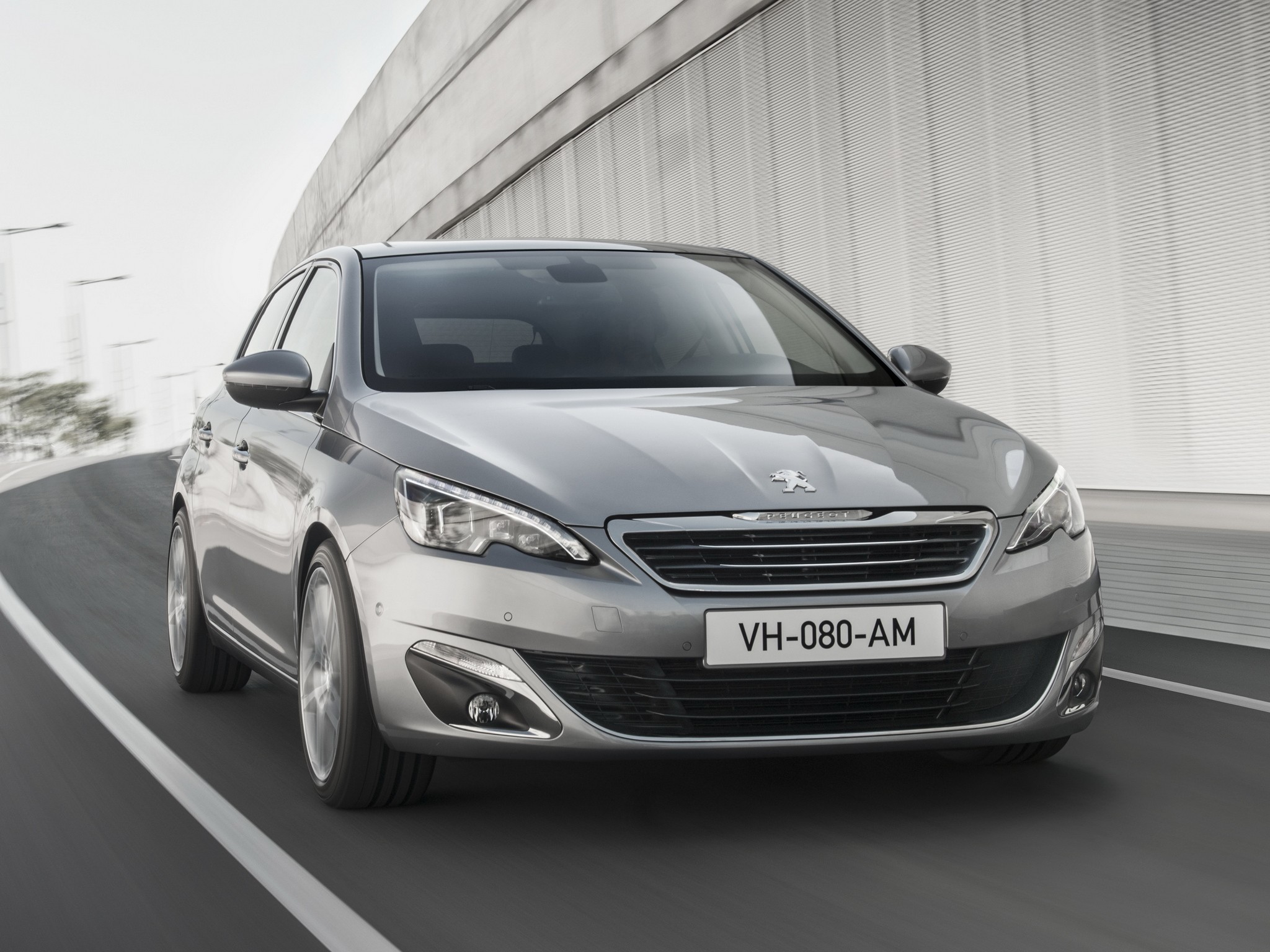
Peugeot 308 II photos 17


Peugeot 308 II videos 2

Peugeot 308 II video 1

Peugeot 308 II video 2
FAQ
What years was the Peugeot 308 II made?
The second-generation 308 (T9) was unveiled in May 2013 and built until 2021, with a facelift in 2017. The third-generation 308 was unveiled in March 2021 and launched in May 2021.
What are the common problems of the Peugeot 308 II?
The best-known issues are the oil-bathed timing belt of the 1.2 PureTech, timing chain and water pump faults on the 1.6 THP, AdBlue faults on diesels, infotainment glitches and a creaking rear axle.
Is the Peugeot 308 II safe?
Yes. Euro NCAP gave it five stars in 2013, with 92% for adult occupant protection and 81% for safety assist systems. It was also named European Car of the Year 2014.
How big is the Peugeot 308 boot?
The hatchback boot holds 470 litres, or 1,228 litres with the rear seats folded and the shelf removed. The SW estate offers more space and more rear legroom.
Which engine is best in the Peugeot 308 II?
Used-car guides recommend the BlueHDi diesels, especially the 2.0, or a well-maintained post-facelift 1.2 PureTech. The early 1.6 THP petrol carries the highest risk of expensive repairs.
Data sources
Data checked by an editor against the sources below.
- The text of this article (1cars archive)
- Wikipedia - Peugeot 308
- Euro NCAP - 0ea4bee8 C69e 41e9 Abf3 D6b9e88d8d89


