
 Peugeot Boxer
Specs, engines and history
Updated Published Sources (2) Report an error
By Oleksandr Hnatiuk, Automotive Editor & Used Car Specialist Reviewed by Felix Hartmann

- Built
- 1994–present
- Top power
- 132 kW (179 PS)
Which Peugeot Boxer to buy
Our verdict · Oleksandr Hnatiuk
For most operators, a 2019–2023 van with the 2.2 BlueHDi diesel and 103 kW (140 PS) is the best value. Buy a 2024-on van if you want the latest safety assistants and the eight-speed automatic. The E-Boxer with the 110 kWh battery suits regional delivery work with charging at the depot. Avoid high-mileage vans without service records. Other Peugeot models are on the Peugeot catalogue page. A smaller alternative is the Peugeot Expert, and the brand's story is in the history of Peugeot.
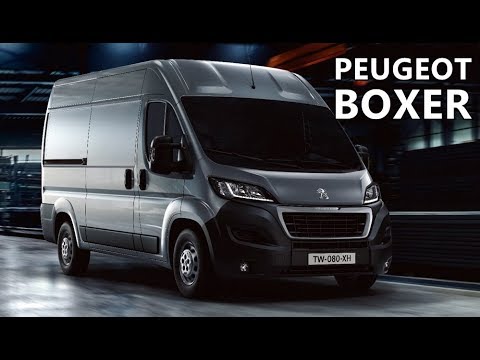
The Peugeot Boxer is a large van and chassis cab built in Italy by Sevel, a Fiat and PSA joint venture now owned by Stellantis. It replaced the Peugeot J5 in 1994 and is a twin of the Fiat Ducato and Citroën Jumper. The current Boxer, updated for 2024, uses a 2.2-litre diesel with 88–132 kW (120–180 PS) or an electric motor with 200 kW in the E-Boxer.
In short
- First generation (1994–2006): Van of the Year 1994, with diesel engines up to 94 kW and a 2002 facelift.
- Second generation (2006–today): a larger body and up to 17 cubic metres of cargo space, heavily updated in 2014 and again for 2024.
- Front-wheel drive, four lengths and three roof heights, gross weights from 3.0 to 4.0 tonnes.
- E-Boxer: a 110 kWh battery and about 420–430 km of WLTP range since the 2024 update.
Size at a glance
| Dimensions | Peugeot Boxer |
|---|---|
| Length | 4,963 mm195.4 in |
| Height | 2,254 mm88.7 in |
Specs by version
Engines
Performance
Show all 1 versions
| Version | Top speed |
|---|---|
| 96 kW (131 PS) Van | 155 km/h96 mph |
Dimensions and weight
Verified Manufacturer and type-approval data from our catalog · Sources and methodology
Boxer key facts and latest specifications

| Parameter | Metric | Imperial |
|---|---|---|
| Body styles | panel van, window van, minibus, chassis cab, platform cab | - |
| Built by | Sevel (Fiat and PSA, now Stellantis), Atessa, Italy | - |
| Diesel engine (2024–) | 2.2 BlueHDi: 88, 103 or 132 kW (120, 140 or 180 PS) | 118–177 hp |
| Gearboxes | 6-speed manual; 8-speed automatic on stronger versions | - |
| Electric (E-Boxer, 2024–) | 200 kW (272 PS), 400 Nm, 110 kWh battery | 268 hp, 295 lb-ft |
| Van lengths (L1–L4) | 4,963 / 5,413 / 5,998 / 6,363 mm | 195.4 / 213.1 / 236.1 / 250.5 in |
| Wheelbases | 3,000 / 3,450 / 4,035–4,050 mm | 118.1 / 135.8 / 159 in |
| Roof heights (vans) | about 2,250 / 2,500 / 2,750 mm | 88.6 / 98.4 / 108.3 in |
| Load volume | 8–17 m³ | 283–600 cu ft |
| Gross vehicle weight | 3.0 / 3.3 / 3.5 / 4.0 t | - |
Origins: Sevel and the Peugeot J5
In the late 1970s Fiat and PSA Peugeot Citroën agreed to develop a light commercial vehicle together. The joint venture, Sevel, began building the Fiat Ducato in 1981. Peugeot's version was the J5, built from October 1981 to 1993, and Citroën sold the C25.

The old 1cars text notes that the J5 sold well in France but lagged behind the Ducato in the rest of Europe. For the second-generation design of 1994, Peugeot chose a new name, Boxer. The three brands have shared bodies, engines and factory ever since, with differences mainly in the grille, badges and equipment. Most vans come from the Sevel Sud plant at Atessa in central Italy.
Boxer I (1994–2006)
Production of the first Boxer started in March 1994. The Boxer, Jumper and Ducato were together voted International Van of the Year 1994. Peugeot offered a 2.0-litre petrol engine and several diesels, from a 1.9-litre with about 51 kW (70 hp) to 2.5-litre units. From 2000, a 2.8-litre common-rail HDi diesel gave 94 kW (128 PS).

An April 2002 facelift brought a new front with clear-lens headlights, a new dashboard, a standard driver's airbag and ABS on the larger engines. The first generation ended in 2006. According to French production data, Peugeot built between 31,000 and 45,000 Boxers a year in this period.
Boxer II (2006–2014): a bigger van
The second-generation Boxer was launched on 15 June 2006, alongside the new Ducato and Jumper. It was larger, with up to 17 m³ of load space and a payload of up to 2,100 kg. At launch, three common-rail turbo diesels gave 74 to 116 kW (101 to 157 PS).

A 2011 update for Euro 5 brought 2.2 HDi engines with 81, 96 and 110 kW (110, 131 and 150 PS) and a 3.0-litre with 130 kW (177 PS). It also stretched the service interval to 48,000 km and added daytime running lights and hill-start assist. The old 1cars text gives a top speed of about 142 km/h for an early second-generation van and a combined fuel figure of about 7 l/100 km.
The 2014 facelift and later updates
In May 2014 Sevel gave the van a major facelift, which Fiat counts as a new generation (X290). The front, lights and cabin changed, and the doors gained reinforced hinges, according to the old 1cars text. It quotes 96 kW (130 hp) and 110 kW (150 hp) versions of the 2.2 diesel, with top speeds of 155 and 162 km/h, and a rare 3.0-litre with 180 hp. Later Euro 6 BlueHDi diesels replaced the HDi units.

For model year 2024 the range was updated again, with the announcement in October 2023. A new Euro 6e version of the 2.2 BlueHDi diesel comes in three outputs, listed in the table above. All have a six-speed manual, and the two stronger versions can have an eight-speed automatic. Full LED headlights, a 7-inch digital cluster and a 10-inch touchscreen with wireless smartphone mirroring arrived at the same time.
E-Boxer: the electric version
Peugeot first offered the e-Boxer around 2020–2021 with 37 or 75 kWh batteries and an electric motor of about 90 kW. WLTP ranges were 117 km and 248 km, which limited it to urban work.

The 2024 E-Boxer is a different proposition. Its 110 kWh battery feeds a 200 kW (272 PS) motor with 400 Nm, and the WLTP range is about 420–430 km, depending on the source. It charges at up to 11 kW on AC and 150 kW on DC, taking about 55 minutes from 0 to 80 %. Drive modes limit power to 160 kW in Normal and 120 kW in Eco, and top speed is 130 km/h.
By our calculation, the larger battery's figures equal roughly 26 kWh per 100 km. A DC charge from 0 to 80 % adds about 88 kWh in 55 minutes, an average of close to 96 kW. Cargo volume for the E-Boxer ranges from 13 to 17 m³ on two wheelbases.
Load space, sizes and payload
Vans come in four lengths, from 4,963 mm (L1) to 6,363 mm (L4), on three wheelbases and with up to three roof heights.

The old 1cars text describes eight body configurations with 8 to 17 m³ of space, which makes the Boxer one of the roomiest vans in its class. Four gross weight ratings, from three to four tonnes, let operators choose between a standard licence and higher payloads. In Europe a standard car licence usually covers vehicles up to 3.5 tonnes. The same text gives a ground clearance of 176 mm, a height of 2,254 mm and a width of 2,050 mm for a 2018 van.
About two-thirds of European motorhomes use the Ducato family as a base, and the Boxer shares that platform.
Fuel consumption and running costs
Official figures depend on body, weight and test cycle. The old 1cars text quotes about 7 l/100 km combined for a second-generation diesel, while real use with load and a roof box is often higher. Diesel versions run long service intervals, and the 2.2 engines are shared with millions of Ducatos and Jumpers, so parts are easy to find. To estimate yearly fuel spending, use the 1cars fuel cost calculator.

Cabin, equipment and owner experience
The old 1cars text praises the mobile-office features, such as a folding table in the centre seat and about 73 litres of storage in the cabin.

Owners quoted in the old text praised the large load space, easy loading and low running costs. One reported 195,000 km in a 2015 van with daily trips of 300–400 km. Common complaints were a noisy, rattling cabin, a handbrake mounted on the left side of the driver's seat and wear of clutches, wheel bearings and steering parts on hard-worked vans.
Safety and driver assistance
Large vans rarely get a Euro NCAP star rating, so check the equipment list. According to the old 1cars text, ESP and a driver's airbag were standard on the 2018–2019 van, which was not true of every rival. The 2024 update added a long list of assistants: automatic emergency braking with pedestrian and cyclist detection, lane-keeping assist, traffic-sign recognition, driver fatigue alert, an intelligent speed limiter and adaptive cruise control with stop-and-go.

Production of the Peugeot Boxer
| Year | Boxers built |
|---|---|
| 1994 | 31,181 |
| 1998 | 44,996 |
| 2002 | 41,547 |
| 2006 | 41,457 |
| 2009 | 23,194 |
| 2013 | 49,054 |
| 2017 | 67,736 |
By our calculation, annual output more than doubled from 1994 to 2017, despite a sharp fall during the 2009 financial crisis. French data put total Boxer production at more than one million by 2017.

Rivals of the Peugeot Boxer
| Model | Drive | Bodies | Where it is stronger |
|---|---|---|---|
| Peugeot Boxer / Citroën Jumper / Fiat Ducato | front-wheel drive | vans, chassis cabs, minibuses | low load floor, wide choice of sizes |
| Ford Transit | front, rear or all-wheel drive | vans, chassis cabs | driving dynamics, rear-drive option |
| Mercedes-Benz Sprinter | front, rear or all-wheel drive | vans, chassis cabs, minibuses | build quality, towing |
| Renault Master | front or rear-wheel drive | vans, chassis cabs | comfort, electric range |
| Volkswagen Crafter | front, rear or all-wheel drive | panel vans, chassis cabs | cabin quality |
The Ford Transit and the Mercedes-Benz Sprinter are the main rivals, with the Renault Master close behind. The old 1cars review gave the Boxer the edge for load space and economy, but criticised its paint quality, firm suspension and ergonomics. Compare the vans side by side in the 1cars comparison tool.

Rivals
Compare with…
Compare Peugeot Boxer with
- Mercedes-Benz Sprinter quick spec comparison
- Ford Transit quick spec comparison
-
EV version
Ended 2018
- Years
- 1995–2018
- Body
- Pickup, Van
- Fuel
- Petrol, Diesel
- Power
- 58–190 kW (79–258 PS)
2 generations
- T1N
- NCV3
-
EV version
In production
- Years
- 1965–present
- Body
- Pickup, Van
- Fuel
- Petrol, Diesel, Electric
4 generations
- Mk1/Mk2
- VE6
- V184
- IV


Peugeot Boxer in our rankings
More powerful than 55% of ranked vans and minibuses in the 1CARS catalog (No. 7 of 18).
Peugeot Boxer photos 17


Peugeot Boxer videos 2

Peugeot Boxer video 1
Video overview
FAQ
Is the Peugeot Boxer the same as the Fiat Ducato?
Yes, in all but details. Sevel builds the Boxer, the Fiat Ducato and the Citroën Jumper (Relay in the UK) on the same line, with shared bodies and engines. Since 2021 the Opel Movano has joined the family.
What engines does the Peugeot Boxer have?
Since the 2024 update it uses one 2.2-litre BlueHDi diesel in three outputs, the strongest with 132 kW (180 PS), or the electric E-Boxer with 200 kW. Earlier vans used HDi diesels of between 2.2 and 3.0 litres.
What is the fuel consumption of the Peugeot Boxer?
It depends on size, load and engine. Our earlier review put an older second-generation diesel at roughly seven litres per 100 km, and loaded vans in daily use usually need clearly more.
How much can a Peugeot Boxer carry?
Load volume ranges from about 8 to 17 m³ depending on length and roof height. Payload reaches about 2,100 kg on heavier versions, and gross weights run from 3.0 to 4.0 tonnes.
How far can the electric E-Boxer go?
The 2024 E-Boxer with its 110 kWh battery is rated at about 420–430 km under WLTP. Earlier e-Boxers with 37 or 75 kWh batteries managed 117 and 248 km.
Data sources
Data checked by an editor against the sources below.
- The text of this article (1cars archive)
- Wikipedia - Peugeot Boxer


Comments 2
As a working machine, he is not bad, only I don’t agree about the suspension, it is tough and punches on every unevenness, on a good road stiffness attaches to the dynamics, kills discs and stands on the bumps, on his boxer for 2 years he changed 3 pairs of racks. I would advise you to drive off diagnostics more often (at least once in half a year), it is better to invest in it a little bit than to stand up for 2 weeks at a time and get into debt, as it happened to me.
I advise you not to look at a used boxer. I sold my 2 year old boxer like that because I broke down constantly, it looks almost like a new one, and a lot of parts have already been changed, you have to maintain and maintain it, you can’t withstand daily operation and long runs.