
 Opel GT
Specs, engines and history
Published Sources (4) Report an error
By Felix Hartmann, Automotive Technology & EV Contributor
- Built
- 1968–1973
- Top power
- 66 kW (90 PS)
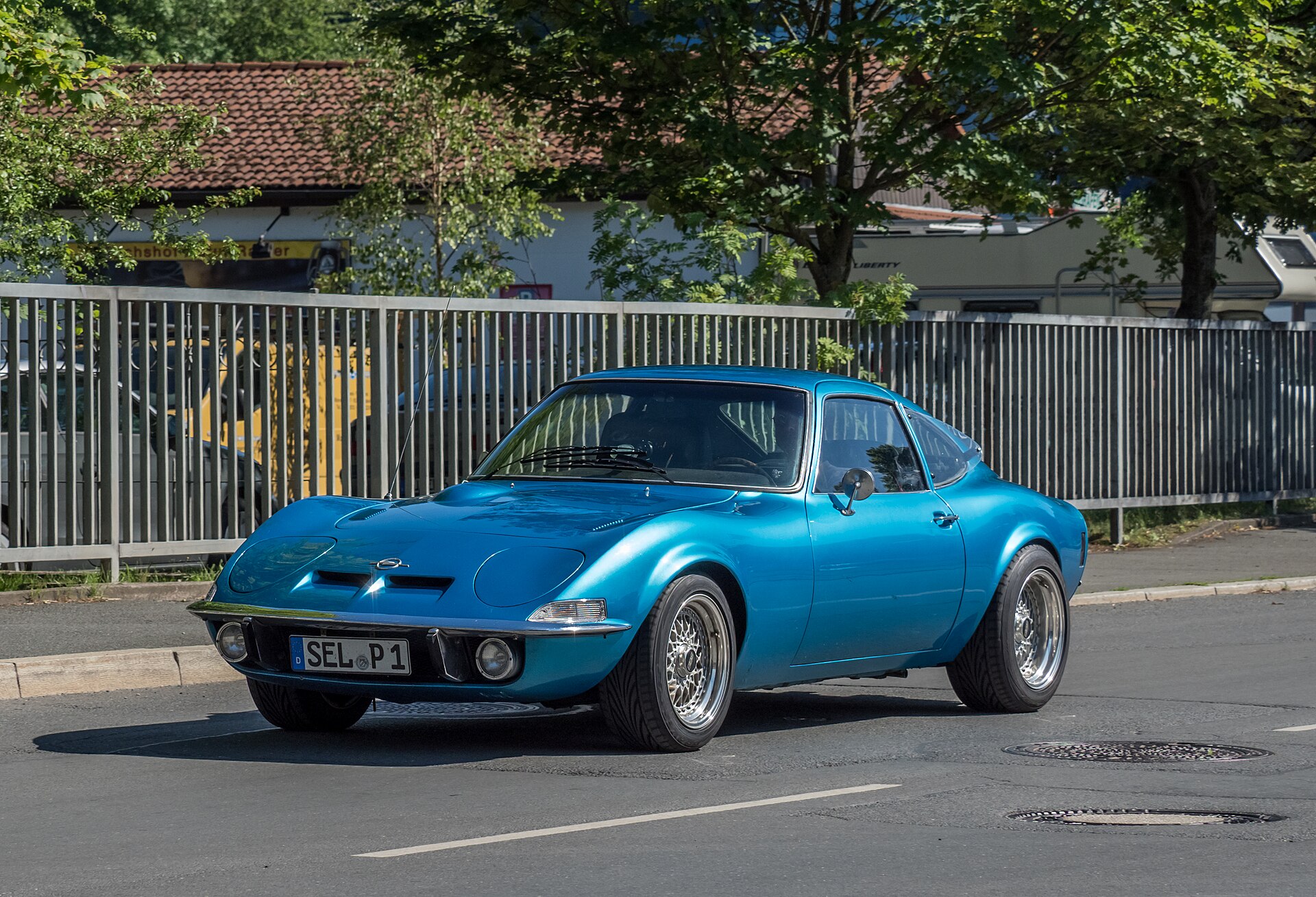
The Opel GT is a two-seat front-engined sports coupé that Opel sold from 1968 to 1973. Built on Kadett mechanicals with a body made in France, it was offered with a 1.1-litre engine of 44 kW (60 PS) or a 1.9-litre unit of 66 kW (90 PS). Its pop-up headlamps turn on their axis by hand lever, and 103,463 were built, most of them for the USA.
In short
- Built from August 1968 to July 1973; bodies came from Chausson and Brissonneau & Lotz in France, final assembly was at Bochum.
- 103,463 made in total, including 10,760 GT/J and 3,573 GT 1100.
- The GT 1900 reached 185 km/h and 0-100 km/h in 11.5 seconds, according to ADAC data.
- More than 70,000 were sold in the USA through Buick dealers.
Size at a glance
| Dimensions | Opel GT I |
|---|---|
| Length | 4,113 mm161.9 in |
| Width | 1,580 mm62.2 in |
| Height | 1,225 mm48.2 in |
| Wheelbase | 2,430 mm95.7 in |
Specs by version
Engines
| Version | Engine | Power | Torque | Gearbox | Drive | Production years |
|---|---|---|---|---|---|---|
| GT 1100 | 1.1 l · 4 cyl · Petrol 1,078 cc | 44 kW 60 PS59 hp | - | 4-sp Manual | Rear-wheel drive | 1968–1970 |
| GT 1900 | 1.9 l · 4 cyl · Petrol 1,897 cc | 66 kW 90 PS89 hp | 146 Nm108 lb-ft | 4-sp Manual | Rear-wheel drive | 1968–1973 |
| GT/J 1900 | 1.9 l · 4 cyl · Petrol 1,897 cc | 66 kW 90 PS89 hp | - | - | Rear-wheel drive | 1971–1973 |
Performance
Show all 3 versions
| Version | 0–100 km/h | Top speed |
|---|---|---|
| GT 1100 | - | 155 km/h96 mph |
| GT 1900 | 11.5 s 0–62 mph | 185 km/h115 mph |
| GT/J 1900 | - | 185 km/h115 mph |
Dimensions and weight
Verified Manufacturer and type-approval data from our catalog · Sources and methodology
Opel GT at a glance
| Item | Opel GT |
|---|---|
| Production | August 1968 to July 1973 |
| Numbers built | 103,463 (GT 1900 89,130; GT/J 10,760; GT 1100 3,573) |
| Plants | body shells by Chausson (Gennevilliers), paint and trim by Brissonneau & Lotz (Creil), final assembly Opel Bochum |
| Body style | two-seat steel coupé, no external boot lid |
| Designer | Erhard Schnell (Auto Express credits Clare MacKichan) |
| Layout | front engine set well back, rear-wheel drive, Kadett B running gear |
| Engines | 1,078 cc OHV four; 1,897 cc cam-in-head four |
| Power | 44 kW (60 PS) and 66 kW (90 PS) |
| Kerb weight | 860 kg (GT 1100); 940 kg (GT 1900) |
| Top speed | 155 km/h (GT 1100); 185 km/h (GT 1900) |
| 0-100 km/h | 11.5 s (GT 1900), ADAC |
| Price new | DM 10,780 (GT 1100 SR) and DM 11,880 (GT 1900 S) in 1968 |
From the 1965 show car to "Nur Fliegen ist schöner"
Opel showed the Experimental GT at the Frankfurt IAA in 1965, a styling study by Erhard Schnell, and the production car's shape is often compared with the 1968 Corvette C3. Auto Express credits former Corvette stylist Clare MacKichan, then head of Opel design, with the project. The production car was launched to the press at the Hockenheim circuit in 1968 with the slogan "Nur Fliegen ist schöner", only flying is more beautiful.
The body was made in France. Chausson in Gennevilliers pressed and welded the shells, Brissonneau & Lotz in Creil painted and trimmed them, and the finished bodies travelled to Bochum, where Opel installed the engine, gearbox and axles. In the first year about half of the cars were trimmed in Bochum instead of France. Parts also came from Kaiserslautern.
Kadett running gear and hand-turned headlamps
Underneath, the GT used the floorpan and suspension of the Opel Kadett B: upper A-arms with a transverse leaf spring at the front and a coil-sprung live axle at the rear. Brakes were servo-assisted with discs at the front and drums at the rear, and the steering was unassisted. The engine sat far back in the bay, giving a 54/46 front-to-rear weight split. The car was compact at 4,113 mm long, 1,580 mm wide and 1,225 mm high on a 2,430 mm wheelbase, with a 55-litre fuel tank.
Two details define the cabin. The headlamps are turned by a large lever beside the gear lever, and both rotate the same way, counterclockwise as seen from inside. There is no boot lid or hatch; luggage goes behind the seats, and a fold-up panel hides the spare wheel and jack. All GTs were built with left-hand drive, so only 148 went to the UK as official imports.

Engines: GT 1100, GT 1900 and the GT/J
| Version | Engine | Power | Top speed | Years | Built |
|---|---|---|---|---|---|
| GT 1100 | 1,078 cc OHV four | 44 kW (60 PS) | 155 km/h | 1968-1970 | 3,573 |
| GT 1900 | 1,897 cc CIH four | 66 kW (90 PS) | 185 km/h | 1968-1973 | 89,130 |
| GT/J | 1,897 cc CIH four | 66 kW (90 PS) | 185 km/h | 1971-1973 | 10,760 |
The base engine was the Kadett's 1,078 cc pushrod four with 44 kW (60 PS). Most buyers chose the 1,897 cc cam-in-head unit from the Rekord, which made 66 kW (90 PS) at 5,100 rpm and 146 Nm at 2,500 rpm. A four-speed manual was standard, and a three-speed automatic was available with the 1.9, mainly for American customers. The GT 1100 was dropped in 1970 and replaced in 1971 by the GT/J, a cheaper "Junior" version of the 1.9 with simpler trim, sold only in Europe.
For the USA the 1.9 was rated at 76 kW (102 hp SAE), until lower compression for emissions cut it to 62 kW (83 hp SAE) in 1971. The federal GT was launched in spring 1969 at USD 3,395, with the 1.9 a USD 99 option. Road & Track measured 0-96 km/h in 10.8 seconds and 182 km/h in June 1969, noting strong understeer and a comfortable ride. On 17 May 1971 an electrically powered GT reached 188 km/h in a record attempt, and Opel built two prototypes of a targa-roofed Aero GT that never reached production.

Why the Opel GT ended in 1973
Several factors stopped the GT in July 1973. Chausson, which had taken over the car business of Brissonneau & Lotz and worked closely with Renault, cancelled the body contract because the GT competed with the Renault-backed Alpine A110. New American bumper rules would have required major changes to the nose and tail, and the car needed a redesign to keep up with sports cars such as the Datsun 240Z. Some enthusiasts believe General Motors ended it to protect the Corvette, but German sources consider real overlap doubtful because the Corvette was much faster and dearer. Opel did not build a direct successor; the GT name returned in 2007 on a two-seat roadster derived from the Saturn Sky and built in the USA.
Among European sports cars of the time, the closest in concept was the two-seat Porsche 914, launched in 1969 with a mid-mounted engine.
Opel GT today: what to check when buying
Rust is the main enemy. Auto Express lists the sills, floorpans, valances, wheelarches including the inner bulkhead, rear panel and the area around the fuel filler. The bodies were rust-proofed in France, but once rot sets in the structure is hard to repair properly.
Check that both headlamps turn fully and look at the wiring around them, because Hagerty UK warns that the rotating motion cracks old insulation with a risk of fire. The 1.9 wears its contact-breaker points quickly, so electronic ignition is a common upgrade; the sump is small, so check the oil level often. A noisy timing chain is normal and hard to cure, but knocking bearings, smoke and rattling valve gear point to a tired engine. Many American survivors have the automatic, and some owners swap it for a manual or a five-speed ZF. Cracked dashboards and steering wheels are common and hard to replace, and right-hand-drive conversions need careful inspection.
Hagerty's US valuation tool put a 1972 GT 1900 in good condition at about EUR 10,200 (USD 11,600) in April 2025. Reproduction parts such as tail-light lenses are available from American specialists, and owners' clubs exist in the USA and the UK. The Opel catalogue lists the brand's other models, and our classic cars section covers more coupés of the period.
Opel GT in our rankings
- No. 3 of 94 · Lightest coupes (860 kg)
- No. 6 of 105 · Smallest coupes (4,113 mm)
- No. 13 of 414 · Lightest cars (860 kg · top 4%)
- No. 88 of 552 · Smallest cars (4,113 mm · top 16%)
- No. 12 of 31 · Fastest cars of the 1960s (185 km/h · top 39%)
- No. 17 of 34 · Fastest cars of the 1970s (185 km/h · top 53%)
Lighter than 96% of ranked coupes in the 1CARS catalog (No. 3 of 94).
FAQ
How many Opel GTs were built?
Opel built 103,463 GTs between August 1968 and July 1973. Auto Express splits the total into 89,130 GT 1900s, 10,760 GT/Js and 3,573 GT 1100s. Hagerty UK quotes a slightly lower 103,373, and more than 70,000 went to the USA.
What engine does the Opel GT have?
The Opel GT has a front-mounted four-cylinder: the 1,078 cc pushrod engine from the Kadett with 44 kW (60 PS), or the 1,897 cc cam-in-head engine from the Rekord with 66 kW (90 PS). The 1.9 was by far the more common choice.
How do the Opel GT headlights work?
They are turned by hand. A large lever next to the gear lever rotates both lamp units about their long axis, and both turn counterclockwise as seen from inside. Old wiring around the lamps can crack from this movement.
Why was the Opel GT discontinued?
Production ended in July 1973 because Chausson cancelled the body contract, new US bumper rules required costly changes, and the design needed renewing to compete with cars such as the Datsun 240Z.
Data sources
Data checked by an editor against the sources below.
- Wikipedia - Opel GT
- ADAC
- Ateupwithmotor
- Co - Opel Gt Buying Guide And Review 1968 1973


