
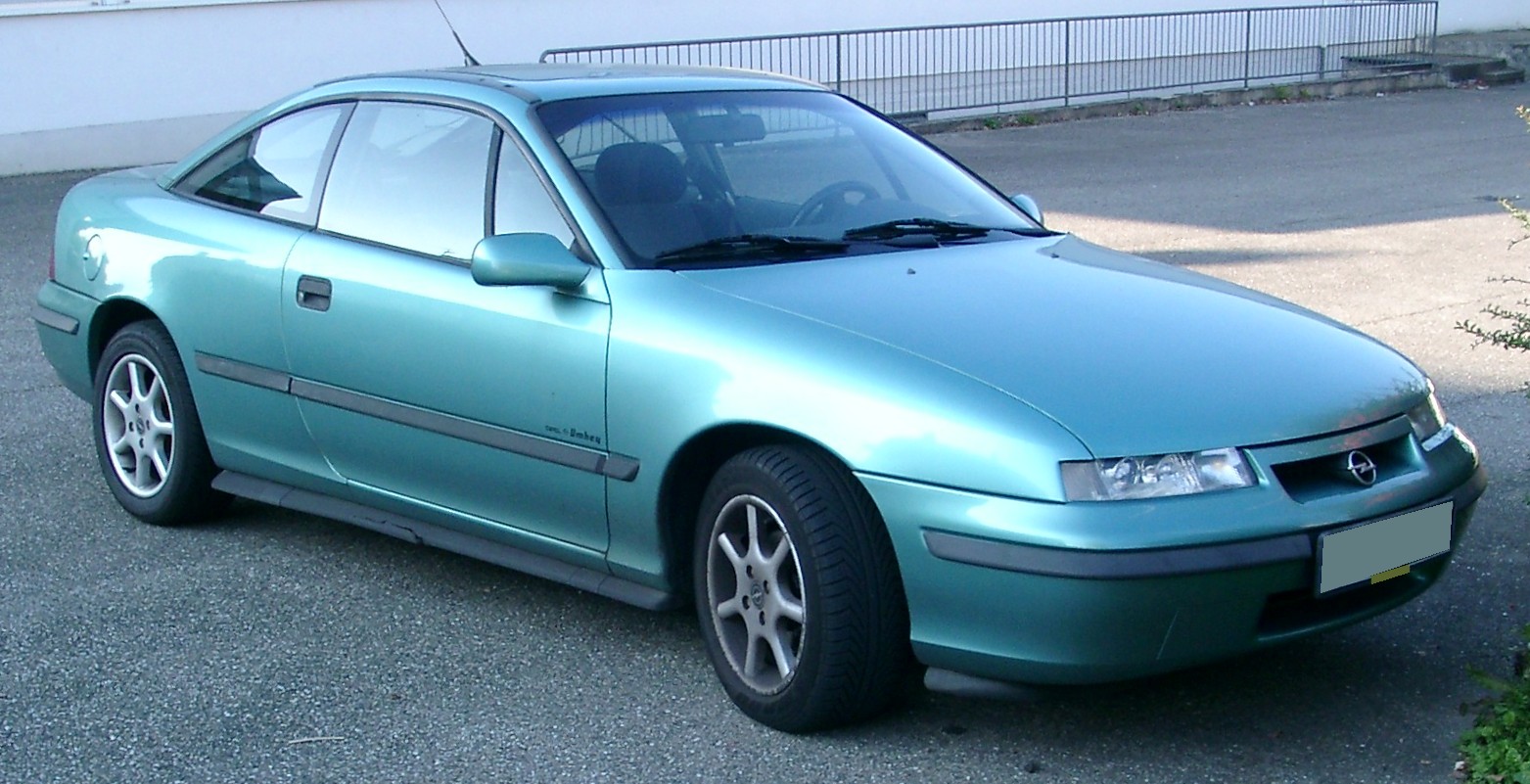
 Opel Calibra
Specs, engines and history
Published Sources (1) Report an error
By Felix Hartmann, Automotive Technology & EV Contributor
- Built
- 1989–1997
- Top power
- 150 kW (204 PS)
The Opel Calibra is the front-wheel-drive coupé that Opel unveiled at the Frankfurt motor show in September 1989 and built until 1997 on the mechanicals of the Vectra A. Its drag coefficient of 0.26 made it the most aerodynamic production car of its time, a record the Honda Insight only beat in 1999. Engines ran from an 85 kW (115 PS) 2.0 to a 150 kW (204 PS) turbo with four-wheel drive.
In short
- 238,647 built in Rüsselsheim, Germany, and from 1991 at Valmet Automotive in Uusikaupunki, Finland, which made 93,978 of them.
- Sold as the Vauxhall Calibra in the UK, the Holden Calibra in Australia and New Zealand and the Chevrolet Calibra in South America.
- Five engines: 2.0 8V, 2.0 16V, 2.0 16V Ecotec, 2.5 V6 and the 2.0 Turbo 4x4, from 85 kW (115 PS) to 150 kW (204 PS).
- Base price DM 36,900 in Germany at launch; the Turbo 4x4 cost DM 49,880 in 1992.
Size at a glance
| Dimensions | Opel Calibra I |
|---|---|
| Length | 4,492 mm176.9 in |
| Width | 1,688 mm66.5 in |
| Height | 1,320 mm52.0 in |
| Wheelbase | 2,600 mm102.4 in |
| Boot | 300 L10.6 cu ft |
Specs by version
Engines
| Version | Engine | Power | Torque | Gearbox | Drive | Production years |
|---|---|---|---|---|---|---|
| 2.0 8V C20NE | 2.0 l · 4 cyl · Petrol C20NE | 85 kW 116 PS114 hp | 170 Nm125 lb-ft | 5-sp Manual | Front-wheel drive | 1989–1996 |
| 2.0 16V Ecotec X20XEV | 2.0 l · 4 cyl · Petrol X20XEV | 100 kW 136 PS134 hp | 185 Nm136 lb-ft | - | Front-wheel drive | - |
| 2.0 16V C20XE | 2.0 l · 4 cyl · Petrol C20XE | 110 kW 150 PS148 hp | 196 Nm145 lb-ft | 5-sp Manual | Front-wheel drive | 1989 |
| 2.0 16V 4x4 C20XE | 2.0 l · 4 cyl · Petrol C20XE | 110 kW 150 PS148 hp | - | 5-sp Manual | All-wheel drive | 1990–1992 |
| 2.5 V6 C25XE | 2.5 l · 6 cyl · Petrol C25XE | 125 kW 170 PS168 hp | 227 Nm167 lb-ft | - | Front-wheel drive | 1993–1997 |
| 2.0 Turbo 4x4 C20LET | 2.0 l · 4 cyl · Petrol C20LET | 150 kW 204 PS201 hp | 280 Nm207 lb-ft | 6-sp Manual | All-wheel drive | 1992 |
Performance
Show all 6 versions
| Version | 0–100 km/h | Top speed |
|---|---|---|
| 2.0 8V C20NE | 10.0 s 0–62 mph | 205 km/h127 mph |
| 2.0 16V Ecotec X20XEV | 9.5 s 0–62 mph | 215 km/h134 mph |
| 2.0 16V C20XE | 8.5 s 0–62 mph | 223 km/h139 mph |
| 2.0 16V 4x4 C20XE | - | 215 km/h134 mph |
| 2.5 V6 C25XE | 7.8 s 0–62 mph | 237 km/h147 mph |
| 2.0 Turbo 4x4 C20LET | 6.8 s 0–62 mph | 245 km/h152 mph |
Dimensions and weight
Show all 5 versions
| Version | Length | Width | Height | Wheelbase | Kerb weight | Boot |
|---|---|---|---|---|---|---|
| 2.0 8V C20NE | 4,492 mm176.9 in | 1,688 mm66.5 in | 1,320 mm52.0 in | 2,600 mm102.4 in | 1,215 kg2,679 lb | 300 l10.6 cu ft |
| 2.0 16V Ecotec X20XEV | 4,492 mm176.9 in | 1,688 mm66.5 in | 1,320 mm52.0 in | 2,600 mm102.4 in | - | 300 l10.6 cu ft |
| 2.0 16V C20XE | 4,492 mm176.9 in | 1,688 mm66.5 in | 1,320 mm52.0 in | 2,600 mm102.4 in | 1,250 kg2,756 lb | 300 l10.6 cu ft |
| 2.5 V6 C25XE | 4,492 mm176.9 in | 1,688 mm66.5 in | 1,320 mm52.0 in | 2,600 mm102.4 in | 1,325 kg2,921 lb | 300 l10.6 cu ft |
| 2.0 Turbo 4x4 C20LET | 4,492 mm176.9 in | 1,688 mm66.5 in | 1,320 mm52.0 in | 2,600 mm102.4 in | 1,405 kg3,097 lb | - |
Verified Manufacturer and type-approval data from our catalog · Sources and methodology
Opel Calibra at a glance
| Specification | Opel Calibra |
|---|---|
| Years | shown September 1989 (Frankfurt), built to June 1997 |
| Production total | 238,647 (German and Italian Wikipedia); 238,164 in Classic & Sports Car |
| Plants | Rüsselsheim (Germany); Valmet Automotive, Uusikaupunki (Finland) from 1991 |
| Body | two-door 2+2 hatchback coupé |
| Designers | Erhard Schnell, Wayne Cherry |
| Platform and drive | GM2900 (Vectra A), transverse engine, front-wheel drive or 4x4 |
| Engines | 2.0 I4 8V and 16V, 2.0 16V turbo, 2.5 V6 24V |
| Power | 85 kW (115 PS) to 150 kW (204 PS) |
| Drag coefficient | Cd 0.26 (2.0 8V), 0.29 (other versions) |
| Length, wheelbase, boot | 4,492 mm, 2,600 mm, about 300 L |
| Kerb weight | 1,205-1,405 kg (Classic & Sports Car) |
| Top speed, 0-100 km/h | 205-245 km/h; 10.0 s (2.0 8V) to 6.8 s (Turbo) |
The Calibra sits with the rest of the range in the Opel catalogue.
How the Opel Calibra was designed around a Cd of 0.26
The Calibra was Opel's answer to an ageing Manta B, in production since 1975, at a time when Japanese coupés were selling well in Europe. It took the floorpan and running gear of the Opel Vectra launched in October 1988, the car British buyers knew as the Vauxhall Cavalier. Unlike the rear-drive Opel Manta, the new coupé had a transverse engine driving the front wheels. Because it kept the full-length GM2900 floorpan, Classic & Sports Car rates its rear seats the roomiest in the class.
Design was led by Erhard Schnell, Opel's head of design, with Wayne Cherry in the team, and the shape was refined in the wind tunnel. The 2.0 8V measured Cd 0.26, the best figure of any production car, while the 16V, V6, 4x4 and Turbo versions were rated at 0.29. The record stood until the Honda Insight arrived with 0.25 in November 1999.
The rear suspension used semi-trailing arms, where most Vectras made do with a torsion beam. ABS was standard on every engine, and the boot holds about 300 L, or 900 L with the rear seats folded. The name came from brand-name developer Manfred Gotta. In Germany the Calibra cost DM 36,900 at launch.
Opel Calibra engines, gearboxes and performance
All five engines had fuel injection and a catalytic converter; figures are the factory data quoted by English and German Wikipedia.
| Engine code | Type | Power | Torque | 0-100 km/h | Top speed |
|---|---|---|---|---|---|
| C20NE | 2.0 I4 8V | 85 kW (115 PS) | 170 Nm | 10.0 s | 205 km/h |
| C20XE | 2.0 I4 16V | 110 kW (150 PS) | 196 Nm | 8.5 s | 223 km/h |
| X20XEV | 2.0 I4 16V Ecotec | 100 kW (136 PS) | 185 Nm | 9.5 s | 215 km/h |
| C25XE | 2.5 V6 24V | 125 kW (170 PS) | 227 Nm | 7.8 s | 237 km/h |
| C20LET | 2.0 I4 16V turbo, 4x4 | 150 kW (204 PS) | 280 Nm | 6.8 s | 245 km/h |
The C20XE was Opel's first large-series engine with twin overhead camshafts and four valves per cylinder (German Wikipedia); Autocar calls it the Cosworth-designed Red Top. It gave way to the cleaner X20XEV Ecotec to meet Euro 2. German Wikipedia dates the change to August 1993, Classic & Sports Car to October 1994 for UK cars. The C25XE V6 joined in 1993, and UK V6 cars came with traction control and twin airbags. Opel dropped the 2.0 8V at the end of the 1996 model year.
Manual cars used Getrag five-speed gearboxes, and the Turbo had a Getrag six-speed. An Aisin four-speed automatic was offered on all models except the turbo, according to English Wikipedia. Classic & Sports Car quotes 25-35 mpg (UK), or 8.1-11.3 L/100 km, across the range.
Calibra 4x4 and Turbo 4x4
The Calibra 4x4 arrived in autumn 1990 as only the second Opel passenger car with four-wheel drive, after the Vectra 4x4. Its permanent system used a viscous coupling to send up to 90 per cent of the torque to the rear axle, and a multi-plate clutch opened the drive under braking. The 2.0 4x4 cost DM 44,215.
In March 1992 the Calibra Turbo 4x4 replaced the 16V 4x4 at DM 49,880. Its C20LET engine used a KKK K16 turbocharger built into the exhaust manifold plus an intercooler, for 150 kW (204 PS) and 280 Nm from 2,400 rpm. Power went through the Getrag F28 six-speed, and the rear axle came from the Opel Omega A. Autocar quotes 0-62 mph in six seconds and 152 mph (245 km/h). Classic & Sports Car counts 14,019 Turbos and 3,385 16V 4x4s, the latter included in its 16V total. Bruno Thiry took a rally Turbo to ninth overall at the 1992 Sanremo Rally.

Facelift, special editions and market names
The 1994 facelift moved the Opel badge from the bonnet into a reshaped grille; Classic & Sports Car adds full galvanising for UK cars from October 1994. A driver airbag became standard in 1993 and a passenger airbag followed in August 1993, with stronger doors and sills.
| Market | Name | On sale | Sales |
|---|---|---|---|
| Germany and continental Europe | Opel Calibra | 1989-1997 | around 100,000 in Germany, over 27,000 in Italy, over 17,000 in Spain (English Wikipedia) |
| United Kingdom | Vauxhall Calibra | from June 1990, on sale until 1999 | 40,460 UK-market cars (Classic & Sports Car) |
| Australia and New Zealand | Holden Calibra | not stated | not stated |
| South America, including Brazil | Chevrolet Calibra | not stated | not stated |
German special editions included the Keke Rosberg Edition and DTM Edition of 1995 (the DTM Turbo cost DM 59,775), the Cliff Motorsport Edition of April 1996 with an Irmscher bumper and sills, BBS wheels and lowered suspension, and the Last Edition from March 1997 at DM 41,415 to DM 55,800. English Wikipedia puts each of these editions at roughly 1,000 cars. Britain had its own SE1 to SE9 series from 1993 to 1997 and 26 Tickford conversions from October 1991.

Opel Calibra in the DTM and ITC
From 1993 to 1996 Opel raced Calibra-shaped prototypes in the German DTM and the international ITC. Their V6 rose from 309 kW (420 PS) to 353 kW (480 PS) between 1993 and 1995, and for 1996 Opel used a Cosworth KF V6 based on the Isuzu 6VD1. Klaus Ludwig finished third in the 1994 DTM in a Team Rosberg car. In 1996 Manuel Reuter won the drivers' championship in the prototype.

Production figures, the end and the successor
Rüsselsheim was planned for about 20,000 cars a year, but the first year alone brought 29,431, so from 1991 Valmet Automotive in Finland built Calibras too. Valmet made 93,978 of the 238,647 cars, and German Wikipedia says its cars carry a 9 after the model-year letter in the VIN where Rüsselsheim cars have a 1. Classic & Sports Car splits its slightly lower 238,164 total into 129,284 8V, 82,963 16V (including the 4x4s), 14,019 Turbo and 11,898 V6 cars.
The Vectra A was replaced in September 1995, yet the Calibra carried on until June 1997. Plans for a Saab-badged US version and a cabriolet went nowhere, and a successor on the Vectra B was dropped. The nearest replacement was the Astra Coupé of spring 2000, covered in the second-generation Opel Astra guide. In early 2021 the German KBA still had 5,150 Calibras registered.
Opel Calibra today: what to check when buying
Classic & Sports Car warns that parts are scarce and no dedicated specialists exist yet. Its checklist:
- Cambelt every 36,000 miles or four to five years on the 16V; on the V6 at 40,000 miles, with the tensioner at 100,000.
- Head-gasket weakness, especially on the 16V and V6.
- Blocked drains (two each for the windscreen, sunroof and tailgate) that let water rot the bulkhead.
- On the Turbo, the 4x4 warning light, the transfer box and the six-speed gearbox, which are weak and costly; all four tyres must match.
- Traction control on the V6 that can cut out under hard acceleration, plus worn dampers and lower-arm joints on lowered cars.
Later, fully galvanised cars survive better, and pre-facelift cars are now rare. In May 2022 Classic & Sports Car put an average 2.0 16V at GBP 2,000 (about EUR 2,400) and an average Turbo at GBP 8,000 (about EUR 9,400), with show-condition Turbos at GBP 14,000 (about EUR 16,500).
Photo gallery

Opel Calibra in our rankings
- No. 10 of 17 · Quickest cars of the 1980s, 0–100 (8.5 s)
- No. 135 of 585 · Lightest cars (1,215 kg · top 24%)
- No. 31 of 128 · Lightest coupes (1,215 kg · top 25%)
- No. 148 of 562 · Fastest cars (245 km/h · top 27%)
- No. 57 of 136 · Smallest coupes (4,492 mm · top 43%)
- No. 251 of 579 · Power-to-weight: cars (107 kW/t · top 44%)
Lighter than 76% of ranked cars in the 1CARS catalog (No. 135 of 585).
FAQ
What is the drag coefficient of the Opel Calibra?
The Calibra 2.0 8V has a drag coefficient of 0.26, the lowest of any production car when it was launched in 1989. The 16V, V6, 4x4 and Turbo versions are rated at 0.29. The Honda Insight beat the record with 0.25 in 1999.
How many Opel Calibras were made?
Opel built 238,647 Calibras between 1989 and 1997, according to German and Italian Wikipedia, of which 93,978 came from Valmet in Finland. Classic & Sports Car gives 238,164, including 14,019 Turbos and 11,898 V6 cars.
Is the Vauxhall Calibra the same car as the Opel Calibra?
Yes, the Vauxhall Calibra is the Opel Calibra with Vauxhall badges, sold in the UK from June 1990. Holden sold it in Australia and New Zealand and Chevrolet in South America, with the same body and engines.
How fast is the Calibra Turbo?
The Calibra Turbo 4x4 has a top speed of 245 km/h (152 mph) and needs 6.8 seconds from 0-100 km/h. Its C20LET 2.0 turbo gives 150 kW (204 PS) and 280 Nm, through a six-speed gearbox and permanent four-wheel drive.
What replaced the Opel Calibra?
No direct successor followed when production ended in June 1997. A Vectra B-based coupé was dropped, and the Astra Coupé of spring 2000 became the closest replacement, built on the Astra G.
Data sources
Data checked by an editor against the sources below.
- Wikipedia - Opel Calibra


