
 Opel Vectra
All generations, specs and history
Updated Published Sources (1) Report an error
By Felix Hartmann, Automotive Technology & EV Contributor Reviewed by Oleksandr Hnatiuk

- Built
- 1988–2008
- Generations
- 4
- Top power
- 206 kW (280 PS)
- New price
- from about €23,145 (2003)
Timeline
Vectra generations
Click a generation for its own page


B and Gen 3 overlapped in 1998–2002, so Gen 3 sits on a second lane
- Vectra A 1988–1995 · Sedan, Hatchback
- Vectra B 1995–2002 · Sedan, Hatchback
- Vectra in 1998 · Sedan, Hatchback · 42–206 kW (57–280 PS)
- Vectra C 2002–2008 · Sedan, Hatchback
Newest first · 4 generations since 1988
-
2002

-
1998
-
1995

-
1988

All generations by year: Vectra C (2002–2008) · Vectra (in 1998) · Vectra B (1995–2002) · Vectra A (1988–1995)
Which one is mine?
Pick the year of first registration to see which generation it is.
Check by VINWhich Vectra to buy
Our verdict · Felix Hartmann
A facelifted Vectra C from 2005 onwards is the most sensible used buy: it is safer, better built and easier to find with service history. Choose the 1.8 petrol for low running costs and easy servicing, or the 1.9 CDTI 120 PS for longer journeys. The OPC and 2.8 V6 turbo suit enthusiasts. The Vectra A 4x4 and Turbo 4x4 are now collector cars, best bought from owners' clubs. The story of the brand is in the history of Opel, and its smaller sibling is covered in the Opel Astra page.
The Opel Vectra is a mid-size family car built in three generations from October 1988 to July 2008: the Vectra A (1988–1995), Vectra B (1995–2002) and Vectra C (2002–2008). It was sold as a saloon, hatchback and estate, with petrol engines from 55 to 206 kW, diesels and, on the first car, four-wheel drive. The Insignia replaced it in November 2008.
In short
- Vectra A: saloon and hatchback, 1.4 to 2.5 V6 petrol, 4x4 and a 150 kW Turbo 4x4; sold in the UK as the Vauxhall Cavalier.
- Vectra B: from October 1995, first Vectra estate (1996), front-wheel drive only, facelift in 1999.
- Vectra C: on GM's Epsilon platform from 2002, Signum sister model, Fiat-designed 1.9 CDTI diesel and an OPC with up to 206 kW.
- Best used buy today: a post-2005 Vectra C with the 1.8 petrol or the 1.9 CDTI.

At a glance: three generations in 20 years
The model replaced the Opel Ascona and sat between the Kadett/Astra and the larger Omega in the Opel range. Its name was coined by Manfred Gotta, the naming specialist behind several car names of the period, and the first car was styled under Wayne Cherry, then head of design at Opel. All three generations were front-wheel drive as standard, with transverse engines and a choice of manual and automatic gearboxes.

Opel built the car at several plants: Rüsselsheim in Germany was the main one, Luton in England for the Vauxhall Vectra B until March 2002, and Ellesmere Port, Zaporizhzhia in Ukraine and GM Egypt for the Vectra C. In Brazil and other Latin American countries, Chevrolet sold the Vectra under its own badge, and in Australia and New Zealand the Vectra C was a Holden.
| Generation | Code | Years | Body styles | Engines | Power (kW / PS) |
|---|---|---|---|---|---|
| First | Vectra A | 1988–1995 | Saloon, hatchback | 1.4–2.5 V6 petrol, 1.7 diesel | 55–150 kW (75–204 PS) petrol; 42–60 kW (57–82 PS) diesel |
| Second | Vectra B | 1995–2002 | Saloon, hatchback, estate | 1.6–3.0 V6 petrol, 1.7–2.2 diesel | 55–162 kW (75–220 PS) petrol |
| Third | Vectra C | 2002–2008 | Saloon, hatchback (GTS), estate | 1.6–3.2 V6 and 2.8 V6 turbo petrol, 1.9–3.0 diesel | 74–206 kW petrol; 74–135 kW diesel |
First generation (1988–1995): saloon, hatchback and 4x4
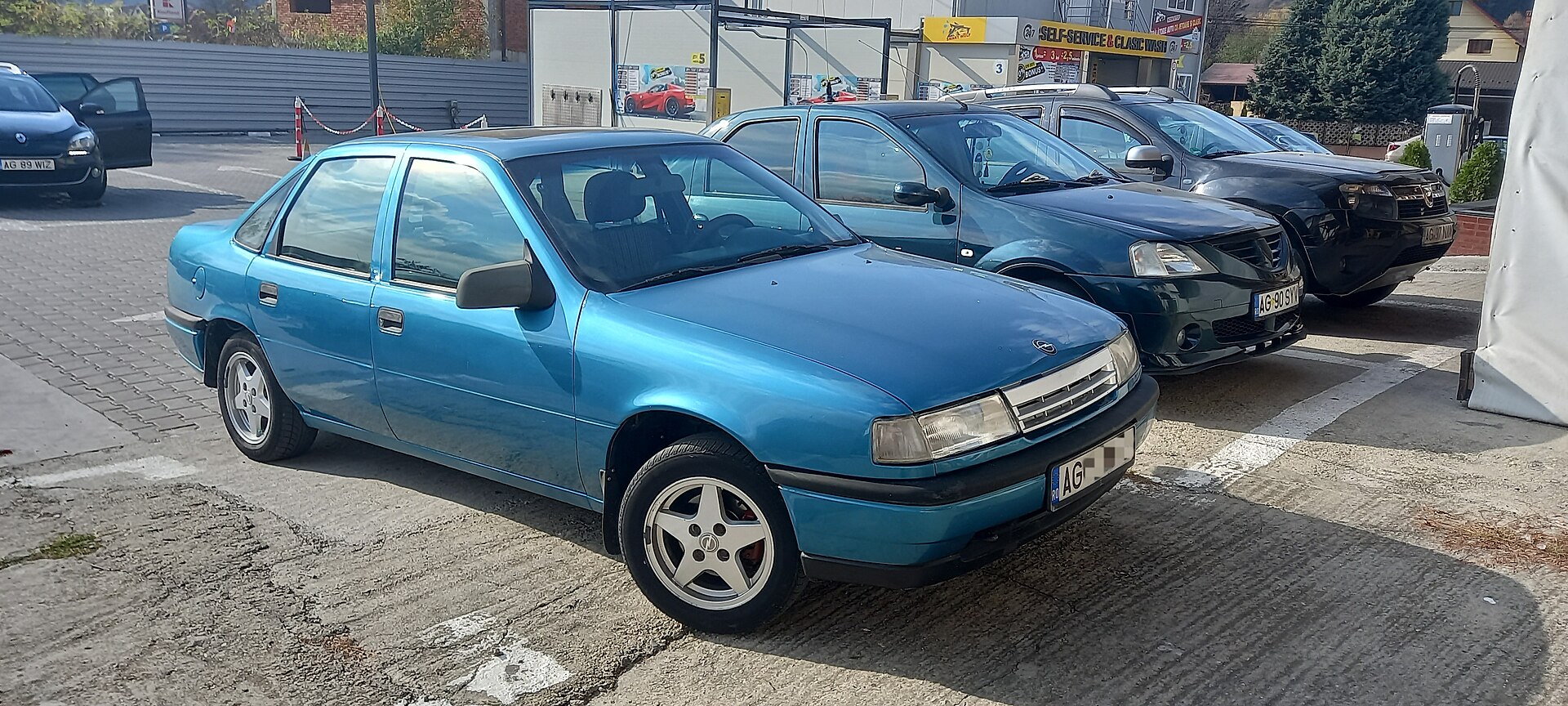
The Vectra A was launched as a saloon in October 1988 for the 1989 model year, followed by the hatchback in March 1989. The same underpinnings were used for the Calibra coupé, presented in late 1989. In Britain the car was sold as the third-generation Vauxhall Cavalier until 1995.
Petrol engines ran from a 1.4-litre of 55 kW (75 PS) to a 2.0-litre of 96 kW (130 PS), with a 2.0 16V of 110 kW (150 PS) in the sportier GT and GSi models. From January 1989, the 2.0 engines could be ordered with four-wheel drive. In September 1992 Opel added a limited 2.0 Turbo 4x4 with 150 kW (204 PS), and a 2.5-litre V6 of 125 kW (170 PS) followed. Diesels were slow by today's standards, with 42 to 60 kW (57 to 82 PS).
A facelift in September 1992 brought a new grille and stronger safety equipment, and driver airbags became available from 1993. The four-wheel-drive versions were more expensive to maintain and repair than the front-wheel-drive cars.
Second generation (1995–2002): the first estate
The second generation was unveiled at the Frankfurt Motor Show in October 1995 for the 1996 model year. The saloon and hatchback were joined by the Caravan estate in September 1996. There was no four-wheel-drive version, and the clutch was now hydraulically operated. Its best year was 1997, with 140,964 cars built.

| Engine | Code | Power |
|---|---|---|
| 1.6 8V | X16SZR | 55 kW (75 PS) |
| 1.8 16V | X18XE | 85 kW (116 PS) |
| 2.0 16V | X20XEV | 100 kW (136 PS) |
| 2.2 16V (from 2000) | Z22SE | 108 kW (147 PS) |
| 2.5 V6 | X25XE | 125 kW (170 PS) |
| 2.5 V6 (i500) | X25XEI | 143 kW (195 PS) |
| 3.0 V6 (i30) | X30XEI | 162 kW (220 PS) |
The diesel range started with a 1.7-litre turbodiesel from Isuzu, followed by Opel's own 2.0 DI and 2.2 DTI direct-injection engines built in Kaiserslautern. A facelift in early 1999 brought one-piece headlamps and revised bumpers. The second generation was criticised in Britain for its ordinary driving manners, but on the track it was a winner: John Cleland took the 1995 British Touring Car Championship in a Vauxhall Vectra.
Third generation (2002–2008): Epsilon platform, Signum and OPC
The Vectra C made its debut at the 2002 Geneva Motor Show, with production starting in March 2002. It was built on GM's Epsilon platform, shared with the Saab 9-3. The five-door GTS hatchback arrived in September 2002 and the estate in October 2003, with a longer wheelbase. The Signum, a more upmarket five-door hatchback, shared the estate's 2,830 mm wheelbase.

Trim levels in most markets were Essentia, Elegance and Cosmo. The third generation was larger, stiffer and better equipped than the B, with optional adaptive damping (IDS Plus) from 2004 and a five-speed automatic with Active Select manual mode. Aluminium was used for some parts to save weight.
Petrol engines started with a 1.8 of 90 kW, later replaced by the 103 kW (140 PS) Z18XER, and included a 2.2 of 108 kW (later the 2.2 Direct), a 2.0 turbo of 129 kW and a 3.2 V6 of 155 kW. The Fiat-designed 1.9 CDTI diesel delivered from 74 to 110 kW (100 to 150 PS), and a 3.0 V6 CDTI topped the diesel range. After the facelift of 2005, a 2.8 V6 turbo with 170 kW and later 185 kW (250 PS) became the top engine, and the OPC reached 206 kW (280 PS) in its final form.
Dimensions, space and boot
The car grew with each generation: by our count, the third-generation saloon is 261 mm longer than the first hatchback, and the post-facelift estate adds another 228 mm. The Vectra A hatchback was 4,350 mm long; the Vectra C saloon and hatchback measured 4,611 mm and the post-facelift estate 4,839 mm. The estate is the practical choice, with a long, flat load floor and the longer wheelbase also used for the Signum's roomy rear seats.

| Parameter | Vectra A hatchback | Vectra C saloon | Vectra C estate |
|---|---|---|---|
| Length | 4,350 mm (171.3 in) | 4,611 mm (181.5 in) | 4,839 mm (190.5 in) |
| Wheelbase | – | – | 2,830 mm (111.4 in) |
| Drive | FWD or 4x4 | FWD | FWD |
Fuel economy and reliability by generation
The 1.9 CDTI diesels are the most economical versions and the best choice for high mileage. The 1.8 petrol is a simple, economical engine for short trips. The V6 petrol engines and the OPC are much thirstier and need regular timing-belt and cooling-system maintenance. On a used Vectra C diesel, owners' clubs most often point to the EGR valve and the intake swirl flaps, and to the dual-mass flywheel on manual cars. Rust is a bigger issue on the older Vectra A and B than on the C.

ANCAP crash test and airbags
The Vectra C was tested by the Australian ANCAP programme in 2003 as the Holden Vectra. It scored 12.10 of 16 points in the frontal offset test and 15.76 of 16 in the side impact test, with pedestrian protection rated poor. Electronic stability control was optional at that time. The older Vectra A offered a driver airbag only from 1993.

Rivals and the Insignia successor
In its class, the car competed with the Ford Sierra and later the Ford Mondeo, the Volkswagen Passat, the Peugeot 406 and the Renault Laguna. It sold well in Germany and the UK: in 2007, its best British year, the Vauxhall Vectra was the tenth best-selling car there. In motor racing, Fabrizio Giovanardi won the BTCC titles of 2007 and 2008 in a Vectra.

Production of the Vectra C and Signum ended in July 2008, and the Opel Insignia replaced both in November 2008. The Insignia took over the Epsilon platform and won the European Car of the Year award for 2009. You can compare its size with today's cars using the 1cars size comparison tool, put it next to a rival in the comparison tool, and see the rest of the brand's range in the Opel catalogue.
Image credits · Photos from Wikimedia Commons under free licences
- Opel Vectra · Photo: ROCostiTheBunnyCZ / Wikimedia Commons, CC BY-SA 4.0
Rivals
Compare with…
Compare Opel Vectra with
- GAZ Volga quick spec comparison
- Nissan Cefiro quick spec comparison
- Audi 80 quick spec comparison
-
Ended 2009
- Years
- 1997–2009
- Body
- Sedan
- Fuel
- Petrol, Diesel
- Power
- 51–125 kW (69–170 PS)
2 generations
- 3110
- 31105
-
Ended 2003
- Years
- 1988–2003
- Body
- Sedan
- Fuel
- Petrol
- Power
- 103–141 kW (140–192 PS)
3 generations
- A31
- A32
- A33
-
Ended 2010
- Years
- 2008–2010
- Body
- Sedan
- Fuel
- Petrol
- Power
- 105–107 kW (143–145 PS)


Opel Vectra in our rankings
- No. 193 of 1172 · Longest-running car nameplates (20 years · top 18%)
- No. 116 of 459 · Cars with the most generations (4 generations · top 36%)
- No. 570 of 1111 · Most powerful cars (206 kW · top 52%)
- No. 108 of 165 · Most powerful German cars (206 kW · top 67%)
In production longer than 82% of ranked nameplates in the 1CARS catalog (No. 193 of 1172).
Opel Vectra photos 12


Opel Vectra videos 3

Opel Vectra video 1

Test drive

Opel Vectra video 3
FAQ
What is the fuel consumption of the Opel Vectra?
It depends on the engine. The 1.9 CDTI diesels of the Vectra C are the most economical, the 1.8 petrol is moderate, and the V6 petrol versions and the OPC use the most fuel, especially in town.
Was the Opel Vectra available with four-wheel drive?
Only the first generation. From January 1989 the Vectra A 2.0 could be ordered with four-wheel drive, and the 1992 Turbo 4x4 produced 150 kW (204 PS). The Vectra B and C were front-wheel drive only.
What is the difference between the Vectra A, B and C?
The Vectra A (1988–1995) was a saloon and hatchback with optional 4x4. The Vectra B (1995–2002) added the estate. The Vectra C (2002–2008) moved to GM's Epsilon platform and was larger and better equipped.
What are the main rivals of the Opel Vectra?
Its rivals were the Ford Sierra and Mondeo, Volkswagen Passat, Peugeot 406, Renault Laguna and Toyota Avensis. In the UK, the Vauxhall Vectra and Ford Mondeo were long-time rivals in company fleets.
What replaced the Opel Vectra?
The Opel Insignia replaced the Vectra and the Signum in November 2008. In the UK it was badged Vauxhall Insignia, and in Chile a rebadged Insignia was even sold as the Chevrolet Vectra.
Data sources
Data checked by an editor against the sources below.
- Wikipedia - Opel Vectra


