 Ford Mustang Cobra II
Specs, engines and history
Published Sources (3) Report an error
By Felix Hartmann, Automotive Technology & EV Contributor
- Built
- 1976–1978
- Top power
- 104 kW (141 PS)
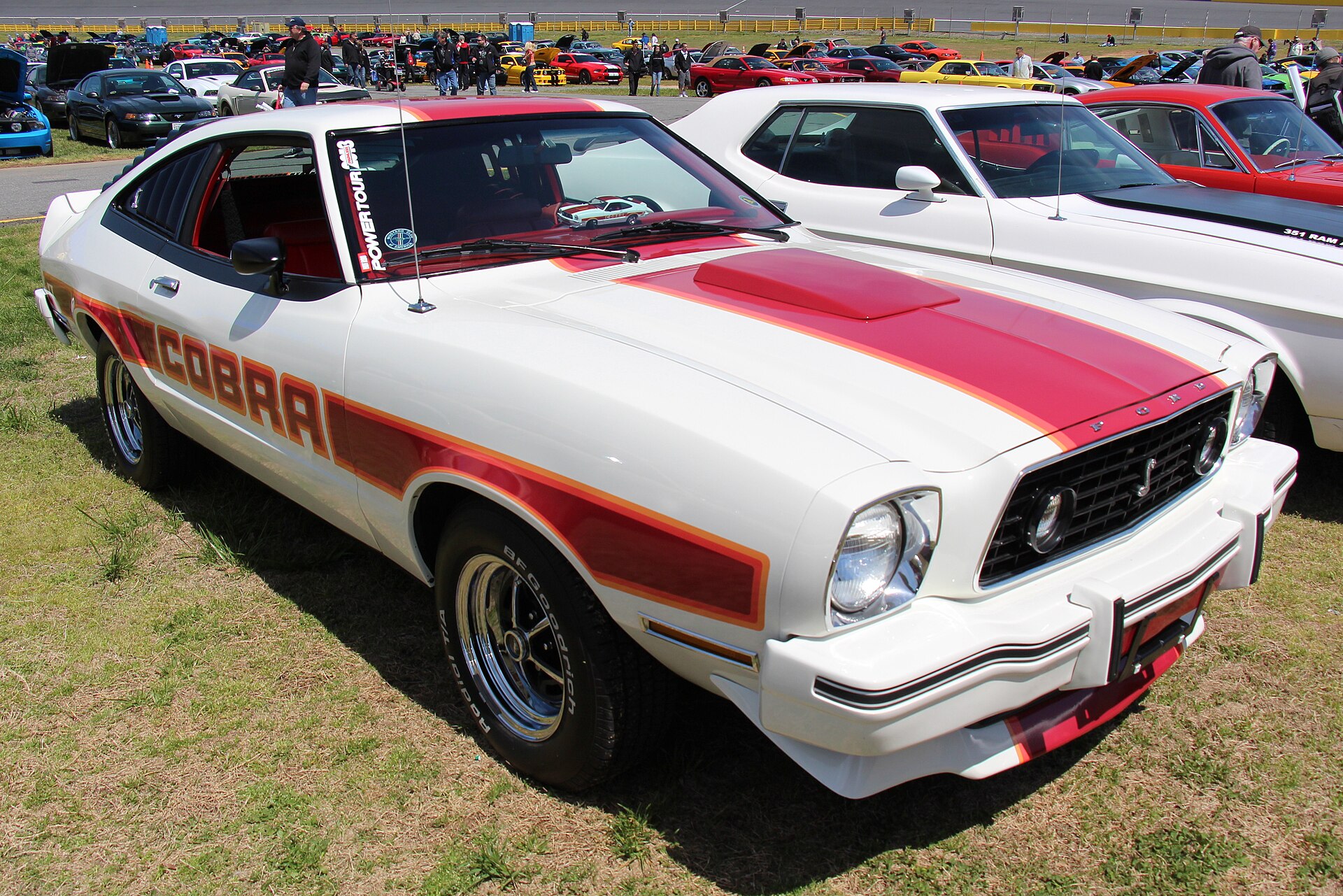
The Ford Mustang Cobra II was an appearance package for the Mustang II hatchback, sold from 1976 to 1978 with Shelby-style stripes, spoilers and a bonnet scoop. It could be ordered with any Mustang II engine, including the 4.9 L (302 cu in) V8 rated at about 100 kW (134 hp, SAE net). The 1978 King Cobra took the idea further and became the first Mustang badged 5.0.
In short
- Three-door Mustang II hatchback only; Jim Wangers' Motortown fitted the 1976 package, Ford built it in-house for 1977 and 1978.
- The 302 V8 was rated at 100 kW (134 hp) and 335 Nm (247 lb-ft) in 1976 and 104 kW (139 hp) and 339 Nm (250 lb-ft) in 1978, all SAE net.
- The package cost USD 535 in 1977 and USD 677 in 1978; a V8 Cobra II came close to USD 5,000.
- 1978 production: 4,049 Cobra IIs and 4,313 King Cobras by the most quoted counts.
Specs by version
| Version | Engine | Power | Torque | Drive | Production years |
|---|---|---|---|---|---|
| 2.3 I4 (92 hp) | 2.3 l · 4 cyl · Petrol 2,300 cc | 69 kW 94 PS93 hp | - | Rear-wheel drive | 1976 |
| 2.8 V6 (102 hp) | 2.8 l · 6 cyl · Petrol 2,800 cc | 76 kW 103 PS102 hp | - | Rear-wheel drive | 1976 |
| 302 V8 (134 hp) | 4.9 l · 8 cyl · Petrol 4,949 cc | 100 kW 136 PS134 hp | 335 Nm247 lb-ft | Rear-wheel drive | 1976 |
| King Cobra 302 V8 (139 hp) | 4.9 l · 8 cyl · Petrol 4,949 cc | 104 kW 141 PS139 hp | 339 Nm250 lb-ft | Rear-wheel drive | 1978 |
Verified Manufacturer and type-approval data from our catalog · Sources and methodology
Ford Mustang Cobra II at a glance
| Specification | Mustang Cobra II |
|---|---|
| Model years | 1976-1978 (King Cobra 1978 only) |
| Built | 4,049 Cobra II and 4,313 King Cobra in 1978; earlier years not confirmed |
| Body | three-door 2+2 hatchback |
| Platform | Mustang II (1974-1978) |
| Engines | 2.3 L four, 2.8 L V6, 4.9 L (302 cu in) V8; King Cobra V8 only |
| V8 power | 100 kW (134 hp, SAE net) in 1976; 104 kW (139 hp, SAE net) in 1978 |
| V8 torque | 335 Nm (247 lb-ft) in 1976; 339 Nm (250 lb-ft) in 1978 |
| Gearboxes | four-speed manual; three-speed C4 automatic with the V8 |
| Top speed | about 161 km/h (100 mph), Old Cars Weekly |
| 0-60 mph | 10.5 s for a 1976 302 Mustang II (Unique Cars and Parts) |
| Price new | package USD 535 in 1977, USD 677 in 1978; King Cobra package USD 1,253 in 1978 |
A Shelby look for a smaller Mustang
The Mustang II of 1974 was 483 mm (19 in) shorter and 222 kg (490 lb) lighter than the 1973 car, according to Ford, and it arrived without any V8 at all. The 302 returned for 1975 with a two-barrel carburettor and an automatic gearbox only. Ford Division then wanted what Wikipedia calls an image car, and for 1976 it hired Jim Wangers, the advertising man linked to the 1964 Pontiac GTO, to dress the hatchback.
Wangers' company Motortown fitted the 1976 package outside Ford's plants. Ford took the work in-house for 1977 and 1978, which explains the changes in stripes and details from year to year. The first colour schemes copied the Shelby GT350 directly: white with blue stripes, blue with white stripes, or black with gold stripes. Consumer Guide later called the Cobra II an instant success that probably helped sales of the whole Mustang II line.
Cobra II equipment and package prices
The 1976 Cobra II brought a black grille, a non-functional bonnet scoop, front and rear spoilers, louvres over the rear quarter windows and full instrumentation. Old Cars Weekly lists brushed-aluminium dash and door panels, Cobra emblems on the front wings, racing mirrors, raised-white-letter BR70 radial tyres and V8 badges on V8 cars. Dual stripes ran over the roof and matched stripes along the sills.
Nothing in the package touched the engine. The base Cobra II used the 2.3 L four, Unique Cars and Parts notes that enthusiast magazines criticised it for that, and the V6 and V8 were extra-cost options. For 1976 a Sports Performance Package allowed the 302 with a four-speed manual for the first time in a Mustang II.
CJ Pony Parts quotes the 1976 price as a USD 325 option plus a required USD 287 Cobra modification. Old Cars Weekly gives USD 535 for 1977 and USD 677 for 1978, on top of a V8 hatchback that cost just over USD 4,000.
Cobra II engines and the 302 V8 in net horsepower
The numbers belong to the period after 1972, when American makers quoted net output measured with accessories and exhaust fitted. Figures vary between sources by a few horsepower each year.
| Year | Source | V8 rating (SAE net) | Torque |
|---|---|---|---|
| 1975 | Ford fact sheet / Wikipedia | 97 kW (130 hp) / 104 kW (140 hp) | not given |
| 1975 | Road and Track, January 1975 test | 99 kW (133 hp) | not given |
| 1976 | Unique Cars and Parts | 100 kW (134 hp) at 3,600 rpm | 335 Nm (247 lb-ft) at 1,800 rpm |
| 1978 | Conceptcarz, Mustangspecs | 104 kW (139 hp) at 3,600 rpm | 339 Nm (250 lb-ft) at 1,600 rpm |
Brad Bowling sums up the four Mustang II years as a 302 range of 91-104 kW (122-139 hp). For 1978 Mustangspecs lists 8.4:1 compression, a Motorcraft 2150 two-barrel carburettor, a Borg-Warner four-speed with a 2.64:1 first gear and an 8-inch axle with 3.00:1 as standard on manual cars. Wikipedia cites Road and Track at 10.5 seconds to 60 mph and 171 km/h (106 mph) for a 1975 V8 car. Its January 1975 comparison found the V8 Mustang II faster than the Chevrolet Monza 2+2 V8, which needed 13.4 seconds to 60 mph. Consumer Guide measured the 1978 Cobra II as only slightly stronger than the Monza and ranked its ride and handling very low.

1977 and 1978 changes and the King Cobra
For 1977 Ford widened the colour choice. From mid-year a single stripe replaced the twin bands and large raised COBRA letters went into the bodyside stripe; Mustangspecs records the T-roof as a Cobra II option from mid-1977. The 1978 car turned the bonnet scoop to face rearwards, added louvres to the hatch, painted the window mouldings black and kept the side louvres in black only.
The King Cobra followed in the final Mustang II season, built from the first week of December 1977 to July 1978 according to Mustangspecs. It came with the 302 as standard, a four-speed manual, power steering and power brakes. In place of bodyside stripes it had pinstripes, a front air dam, a rear spoiler, flared rear quarters, King Cobra door nameplates, aluminium wheels and a large snake decal on the bonnet in the manner of the Pontiac Firebird Trans Am, whose story is in the Firebird Trans Am hub. Ford's press history records it as the first Mustang to carry a 5.0 badge, here on the rear-facing scoop.
Bowling gives the King Cobra package as USD 1,253; with the USD 587 T-top the sticker reached USD 5,638, and an automatic added USD 225. Production is usually quoted as 4,313, split by Mustangspecs into 2,017 four-speed and 2,289 automatic cars, while Bowling gives 4,318 and Old Cars Weekly 4,960.

Mustang II sales and the end in 1978
The Cobra II sold inside a Mustang II range that Wikipedia puts at 187,567 cars in 1976, 153,117 in 1977 and 192,410 in 1978, of which 68,408 were hatchbacks in the final year according to Old Cars Weekly. Ford replaced the Mustang II with the longer Fox-platform car for 1979. Its place in the long Mustang line is covered in the Ford Mustang overview, and the 1965 car it imitated in the Shelby GT350 history.
CJ Pony Parts also notes an unofficial racing career: a heavily modified Cobra II ran in the IMSA GT class without factory support.
Mustang Cobra II today: what to check when buying
Because any engine could wear the package, the first question is which one a car left the factory with. Old Cars Weekly's featured 1978 Cobra II is a typical case: it was believed to be a V6 car, and a previous owner had installed a period 302. The VIN engine code and the Marti Report settle this, and a factory V8 car is worth more than a later swap.
Next comes the trim. Stripes, louvres, spoilers and scoops changed from year to year and were easy to add, so a Cobra II should match its year: twin stripes for 1976 and early 1977, the single stripe with COBRA lettering after that, the reversed scoop for 1978. A King Cobra should have pinstripes and no bodyside stripes. Ford's other Mustangs and the rest of the range are listed in the Ford catalogue.
Photo gallery

Ford Mustang Cobra II in our rankings
- No. 3 of 116 · Biggest engines: hatchbacks (4,949 cc)
- No. 223 of 809 · Biggest engines: cars (4,949 cc · top 28%)
- No. 39 of 119 · Most torque: hatchbacks (339 Nm · top 33%)
- No. 97 of 175 · Most powerful hatchbacks (104 kW · top 56%)
- No. 431 of 686 · Most torque: cars (339 Nm · top 63%)
- No. 115 of 172 · Most powerful cars of the 1970s (104 kW · top 68%)
Bigger engine than 95% of ranked hatchbacks in the 1CARS catalog (No. 3 of 116).
FAQ
Was the Mustang Cobra II a real performance car?
No. It was an appearance package with no engine or chassis changes of its own. A Cobra II with the optional 302 V8 had 100-104 kW (134-139 hp, SAE net), and the base car used the 2.3 L four-cylinder.
Who designed the Cobra II?
Ford hired Jim Wangers, known for the Pontiac GTO marketing, and his company Motortown fitted the 1976 package. Ford brought production in-house for 1977 and 1978 and changed the stripes and details.
How many King Cobras were built?
The most quoted figure is 4,313, all in the 1978 model year. Brad Bowling gives 4,318 and Old Cars Weekly 4,960. Every King Cobra had the 302 V8, and Mustangspecs splits the run into 2,017 four-speed and 2,289 automatic cars.
What colours did the 1976 Cobra II come in?
Ford's press history lists white with blue stripes, blue with white stripes and black with gold stripes, all modelled on the Shelby Mustang. More colours were offered from 1977.
Data sources
Data checked by an editor against the sources below.
- Wikipedia - Ford Mustang (second generation)
- Uniquecarsandparts - Car Info Ford Mustang 1976
- Conceptcarz