
 Ford SSP
Specs, engines and history
Published Sources (2) Report an error
By Felix Hartmann, Automotive Technology & EV Contributor
- Built
- 1982–1993
- Top power
- 168 kW (228 PS)
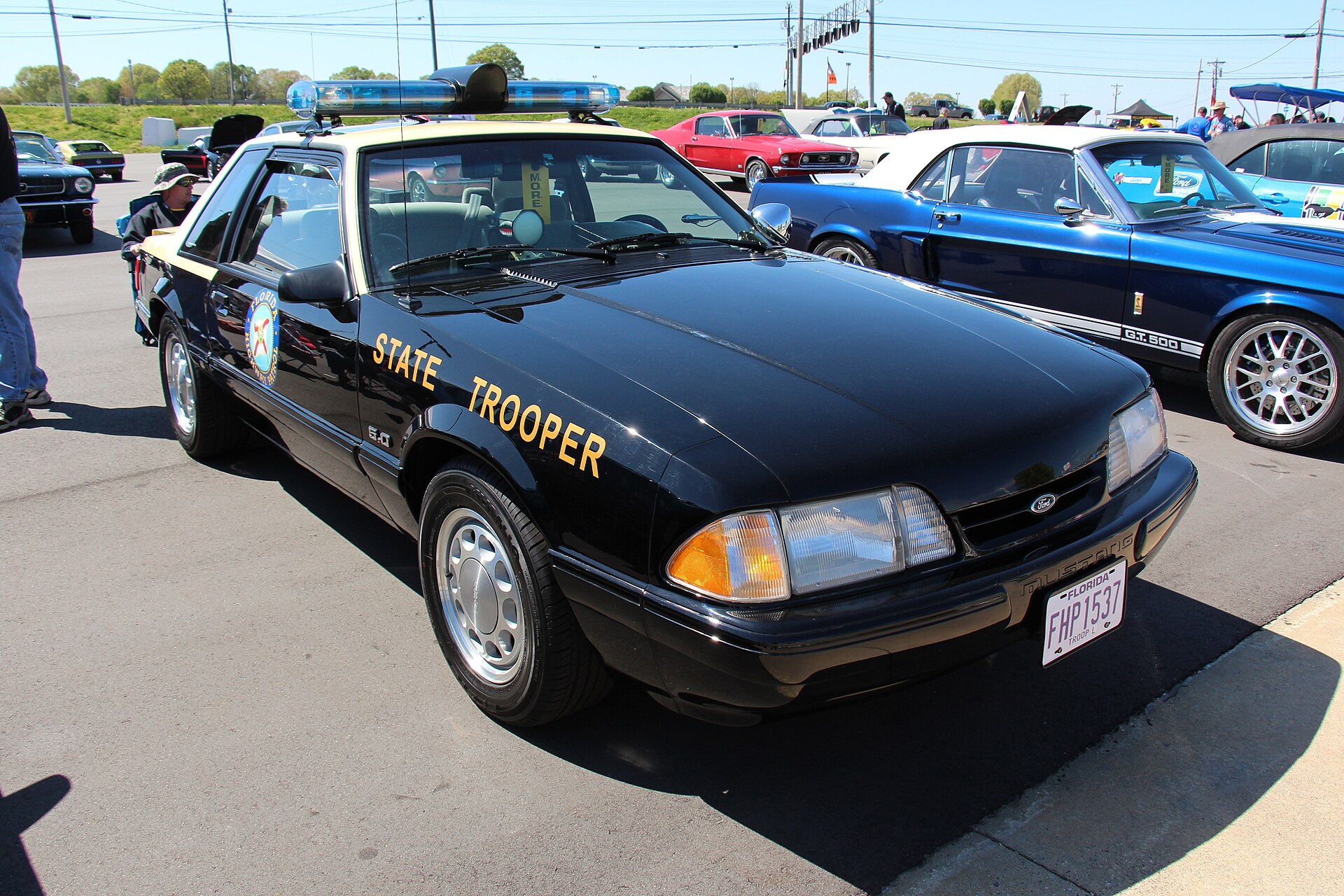
The Ford Mustang SSP was the police version of the Fox-body Mustang, sold to law-enforcement and government fleets from 1982 to 1993. SSP stands for Special Service Package. It used the 5.0 L (302 cu in) V8, rated from 117 kW (157 hp) in 1982 to 168 kW (225 hp) from 1989, and Ford built nearly 15,000 for more than 60 agencies, starting with the California Highway Patrol.
In short
- Launched with a 1982 California Highway Patrol order for about 400 notchback coupes; Ford's bid was USD 6,868 per car against USD 11,445 for a Camaro.
- Pursuit equipment: engine oil and transmission coolers, silicone hoses, a certified 140 mph (later 160 mph) speedometer, single-key locks, reinforced floor pans.
- Users included the Florida Highway Patrol, Texas Department of Public Safety, Utah Highway Patrol, Oregon State Police, the US Border Patrol and the US Air Force.
- Ended in 1993; Ford did not offer a police version of the SN95 Mustang for 1994.
Specs by version
| Version | Engine | Power | Torque | Drive | Production years |
|---|---|---|---|---|---|
| 5.0 V8 157 hp 4-speed (1982) | 4.9 l · 8 cyl · Petrol 4,949 cc | 117 kW 159 PS157 hp | 325 Nm240 lb-ft | Rear-wheel drive | 1982 |
| 5.0 V8 175 hp (1983-1985) | 4.9 l · 8 cyl · Petrol 4,949 cc | 130 kW 177 PS174 hp | 332 Nm245 lb-ft | Rear-wheel drive | 1983–1985 |
| 5.0 V8 200 hp (1986-1988) | 4.9 l · 8 cyl · Petrol 4,949 cc | 149 kW 203 PS200 hp | 359 Nm265 lb-ft | Rear-wheel drive | 1986–1988 |
| 5.0 V8 225 hp (1989-1993) | 4.9 l · 8 cyl · Petrol 4,949 cc | 168 kW 228 PS225 hp | 407 Nm300 lb-ft | Rear-wheel drive | 1989–1993 |
Verified Manufacturer and type-approval data from our catalog · Sources and methodology
Mustang SSP at a glance
| Specification | Ford Mustang SSP |
|---|---|
| Years | 1982-1993 |
| Built | nearly 15,000 |
| Body | two-door notchback coupe; 4-6 hatchbacks for the CHP in 1982 |
| Platform | Ford Fox body |
| Engine | 5.0 L (302 cu in) V8, carburettor at first, then fuel injection |
| Power | 117 kW (157 hp) in 1982 to 168 kW (225 hp) from 1989, SAE net |
| Torque | 325 Nm (240 lb-ft) in 1982 to 407 Nm (300 lb-ft) from 1989 |
| Gearboxes | four-speed manual (1982-1983), five-speed manual, four-speed automatic |
| Rear axle | 7.5 in, 8.8 in from 1986 |
| Performance | about 6 s to 60 mph, top speed 220 km/h (137 mph) (Autotrader Classics) |
| Price | USD 6,868 per car in the 1981 CHP bid; about USD 6,800 per Autotrader Classics |
Why the California Highway Patrol wanted a Mustang
In the early 1980s the usual police saloons, such as Chrysler's Diplomat and Gran Fury, ran a 5.2 L (318 cu in) V8 with about 116 kW (155 hp), according to Hagerty, and the CHP wanted something faster for freeway enforcement. It first tried twelve modified 1979 Camaro Z28s for 18 months, assigned to Redding, Bakersfield, El Centro and West Los Angeles. Their 5.7 L (350 cu in) V8s made 127 kW (170 hp), and nine of the twelve reportedly suffered engine failures before 42,000 km (26,000 miles), according to The Autopian.
In 1981 the CHP asked Ford for Mustangs to test as high-speed enforcement cars. When bids were taken, Ford offered its car at USD 6,868 each and GM quoted USD 11,445 for a Camaro. The CHP ordered 400 Mustangs, and between 394 and 406 were delivered depending on the source. All were notchback coupes except four to six hatchbacks built under a separate fleet order. Ford offered the package to other agencies about a year later.
What the Special Service Package added
The SSP combined the Mustang GT drivetrain with the lighter notchback body, which most agencies preferred. Ford added the equipment a car needed for long shifts and pursuits:
- an engine oil cooler and an automatic transmission fluid cooler;
- silicone radiator hoses with aircraft-style clamps and a heavy-duty 130 or 135 amp alternator;
- a certified speedometer reading to 140 mph (2 mph steps) until early 1989, then to 160 mph, with a two-piece VASCAR cable;
- single-key locks for doors and boot, a relocated boot release and disabled courtesy lights;
- reinforced floor pans and, from 1984, a welded plate under the seat mounts and extra welds in the seatback frame;
- a full-size spare and radio noise suppression.
Agencies chose the rest. New York asked for power windows, and some fleets fitted roll cages. Early cars had roll-up windows and manual locks, and the rear seat was not meant to carry passengers. Wheels went from black steel rims with small chrome caps to ten-hole aluminium wheels painted black, and to bright aluminium after 1990.

Mustang SSP engine, power and changes by year
The SSP never had more power than the civilian Mustang GT; it followed the GT's engine changes year by year. Figures below are from Code 3 Garage, a site run by a former state trooper. Other sources list different ratings for 1983-1985 depending on carburettor and gearbox, so figures vary between sources.
| Years | Power | Torque | Main changes |
|---|---|---|---|
| 1982 | 117 kW (157 hp) | 325 Nm (240 lb-ft) | four-speed manual, 7.5 in axle with 3.08 ratio |
| 1983-1985 | 130 kW (175 hp) | 332 Nm (245 lb-ft) | five-speed manual or automatic (four-speed also in 1983) |
| 1986-1988 | 149 kW (200 hp) | 359 Nm (265 lb-ft) | 8.8 in rear axle after early failures |
| 1989-1993 | 168 kW (225 hp) | 407 Nm (300 lb-ft) | 160 mph speedometer from late 1989 |
Most agencies picked the automatic, because a driver working the radio and equipment had one hand free. Autotrader Classics quotes about 6 seconds to 60 mph and a top speed of 220 km/h (137 mph); Wikipedia states about 225 km/h (140 mph).

Which police forces used the Mustang SSP
California bought the most cars, the Florida Highway Patrol was the second-largest user and the Texas Department of Public Safety the third; a 1994 article counted 157 Mustangs in the Texas fleet. The Utah Highway Patrol used them for traffic work, and one Utah trooper kept pace with a fleeing motorcyclist at up to 209 km/h (130 mph) in early 1986, Hagerty reports. The Oregon State Police ordered 34 in 1988 and cancelled at the last minute; Saleen took 14 of those cars, upgraded them and returned them to Ford for resale.
Federal users ran the cars in unusual roles. The US Air Force tested the SSP against the Chevrolet El Camino and ordered 20 in 1986 as chase cars for U-2 spy planes, which needed a fast car to follow them on landing. The FBI, the US Border Patrol and the US Postal Service also bought SSPs. For the state patrols, Hagerty notes, a Mustang was sometimes a reward for good work, since it suited pursuit and traffic duty and little else.
Why the SSP ended
The Mustang had the pursuit market to itself until Chevrolet launched the B4C police Camaro in 1991; the third-generation Camaro hub covers that car. The SSP continued with few changes until the Fox body ended in 1993. Ford did not develop a police version of the SN95 Mustang that followed, and in 1994 the Caprice police saloon arrived with a Corvette-derived V8, covered in the Chevrolet Caprice hub. The Air Force later replaced its U-2 chase Mustangs with B4C Camaros.
Ford Mustang SSP today: how to spot a genuine car
Washington agencies usually retired their SSPs after 89,000 to 97,000 km (55,000 to 60,000 miles), and the cars sold cheaply; one collector interviewed by Hagerty bought his first in 1997 for USD 2,000. A Fox Mustang is easy to dress as a police car, so documents matter. A genuine SSP should show a fleet order (DSO) number on its paperwork, a notchback body in almost all cases, the certified speedometer, the coolers and the single-key locks. Preserved cars include one at the US Border Patrol Museum in Texas and a 1988 U-2 chase car now in a private collection. The civilian side of the story is in the Mustang GT hub, and the SSP is listed with the other variants in the Ford Mustang catalogue. The SSP also appears among the best malaise-era muscle cars.
Ford SSP in our rankings
- No. 201 of 772 · Biggest engines: cars (4,949 cc · top 27%)
- No. 30 of 99 · Most powerful cars of the 1980s (168 kW · top 32%)
- No. 429 of 1242 · Longest-running car nameplates (11 years · top 38%)
- No. 123 of 250 · Biggest engines: coupes (4,949 cc · top 50%)
- No. 325 of 640 · Most torque: cars (407 Nm · top 51%)
- No. 727 of 1190 · Most powerful cars (168 kW · top 62%)
Bigger engine than 73% of ranked cars in the 1CARS catalog (No. 201 of 772).
FAQ
What does SSP stand for on a Mustang?
Special Service Package, Ford's code for the police and government version of the Fox-body Mustang sold from 1982 to 1993. It was ordered by fleets, not sold to private buyers.
How fast was the Mustang SSP?
Autotrader Classics quotes about 6 seconds to 60 mph and a top speed of 220 km/h (137 mph); Wikipedia gives about 225 km/h (140 mph). The certified speedometer read to 140 mph, and to 160 mph from late 1989.
How many Mustang SSPs were built?
Nearly 15,000 from 1982 to 1993, for more than 60 law-enforcement and government agencies. The California Highway Patrol ordered the first 400 in 1982 and bought the most.
Which engine did the Mustang SSP use?
The 5.0 L V8 of the Mustang GT, rated at 117 kW (157 hp) in 1982, 149 kW (200 hp) from 1986 and 168 kW (225 hp) from 1989. Automatic and manual gearboxes were offered.
Data sources
Data checked by an editor against the sources below.
- Wikipedia - Ford Mustang SSP
- Code3garage - History Of The Ssp Ford Mustang


