 Ford Mustang
All generations, specs and history
Published Sources (7) Report an error
By Sarah Whitmore, Senior Automotive Writer
- Built
- 1964–present
- Generations
- 7
- Top power
- 608 kW (827 PS)
Timeline
Mustang generations
Click a generation for its own page
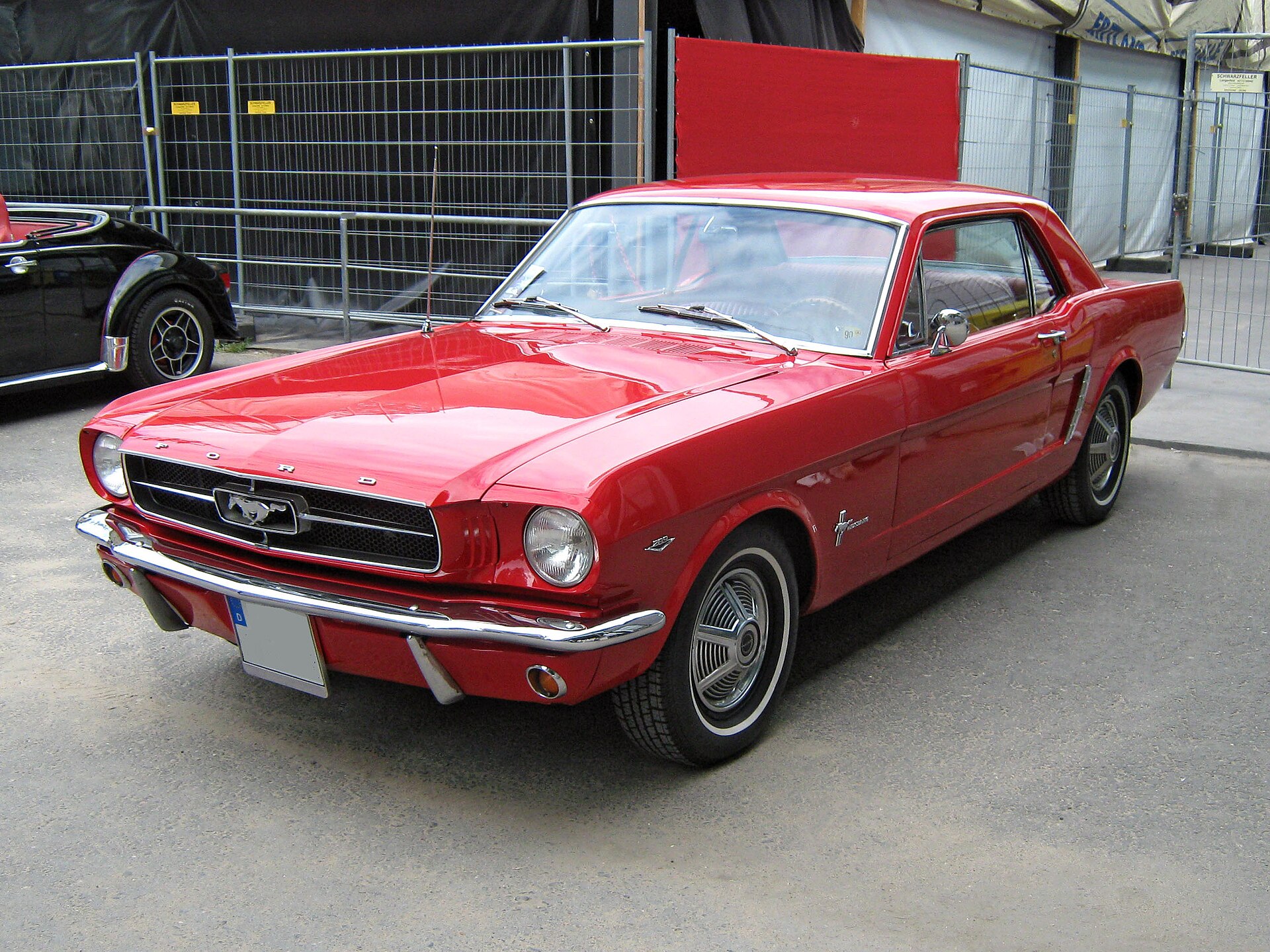
- Mustang I 1964–1973 · Coupe, Convertible · 78–280 kW (106–381 PS)
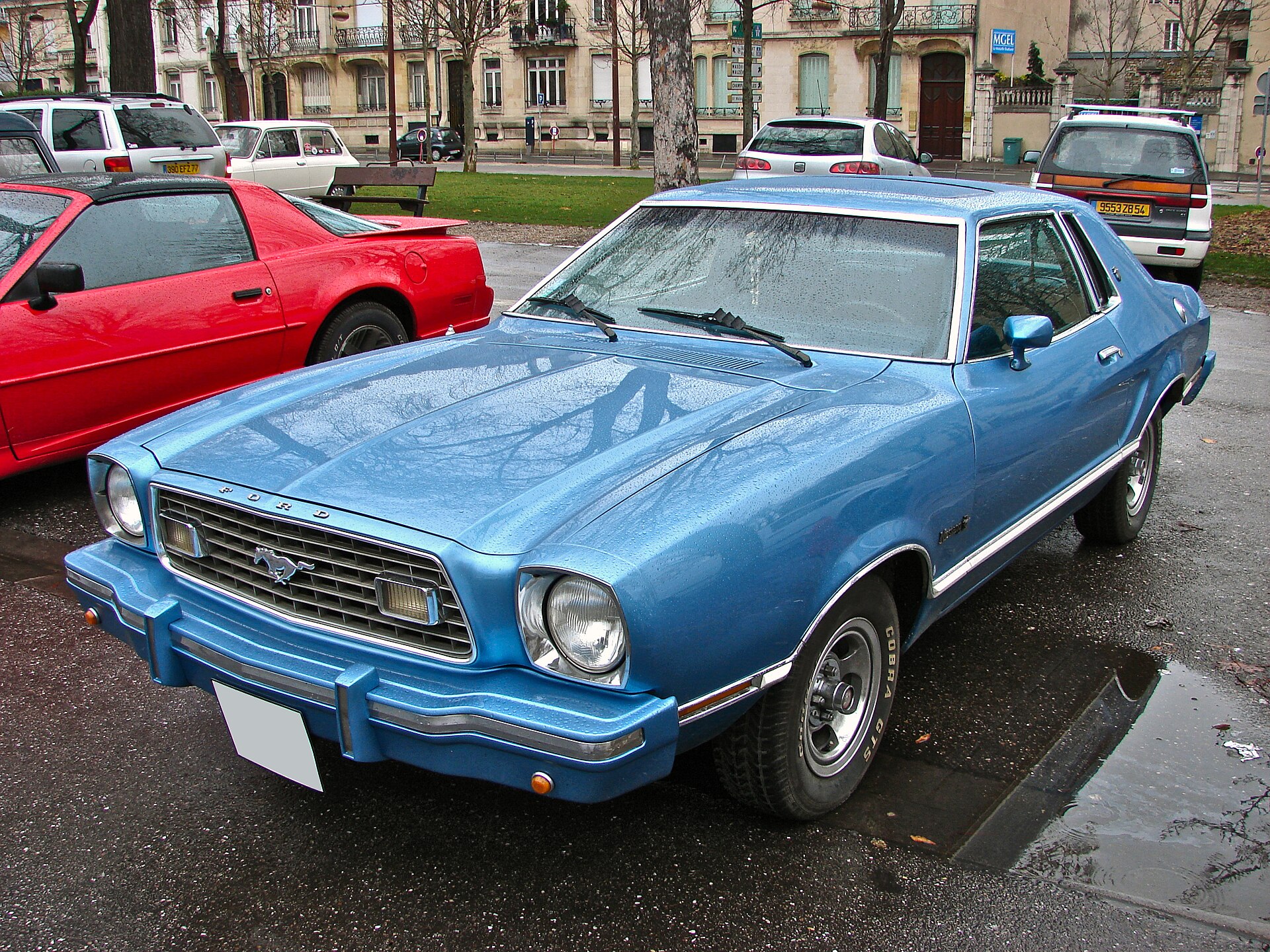
- Mustang II 1974–1978 · Hatchback, Coupe · 66–104 kW (90–141 PS)
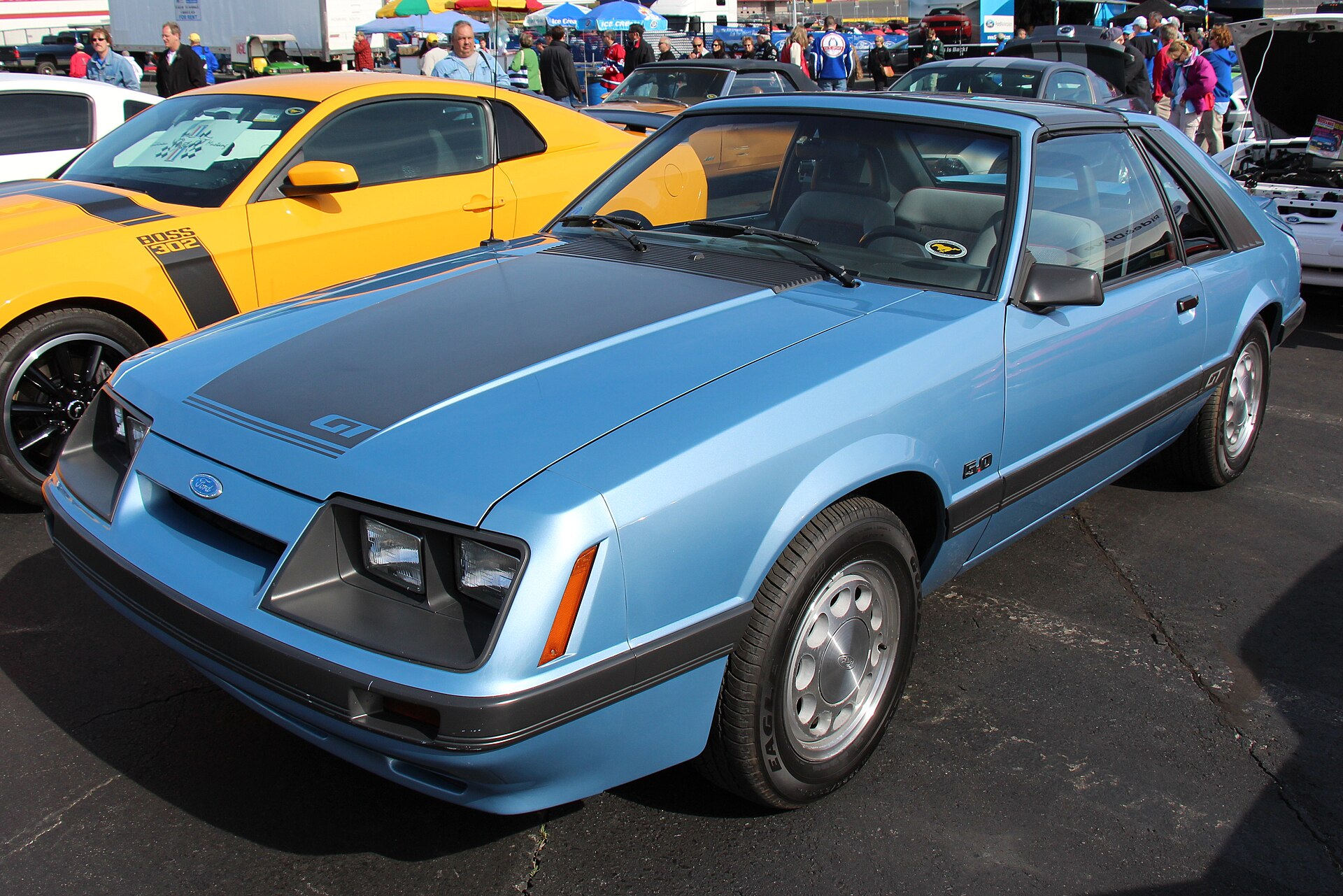
- Mustang Fox 1979–1993 · Hatchback, Coupe · 66–175 kW (90–238 PS)
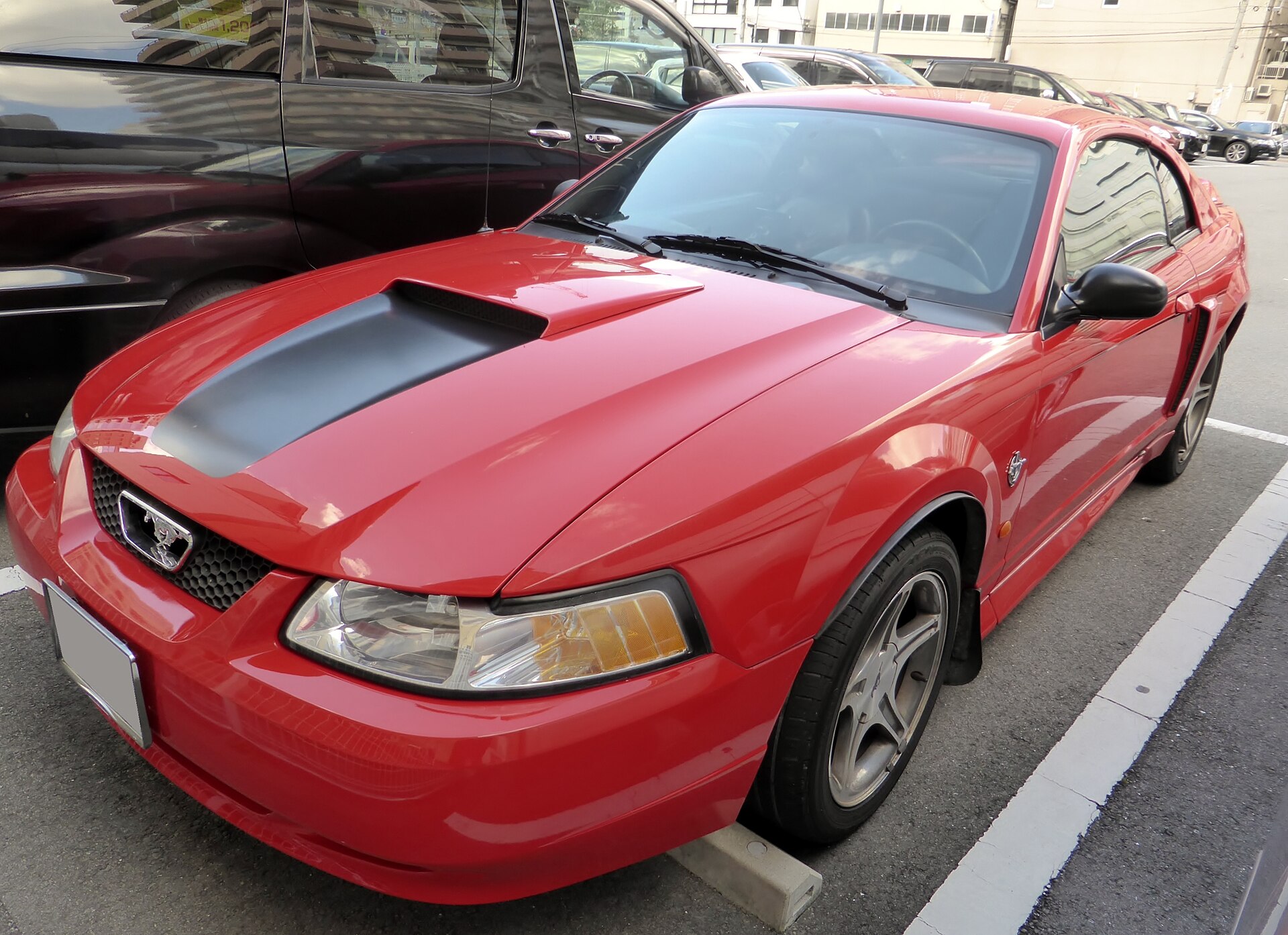
- Mustang SN95 1994–2004 · Coupe, Convertible · 108–291 kW (147–396 PS)
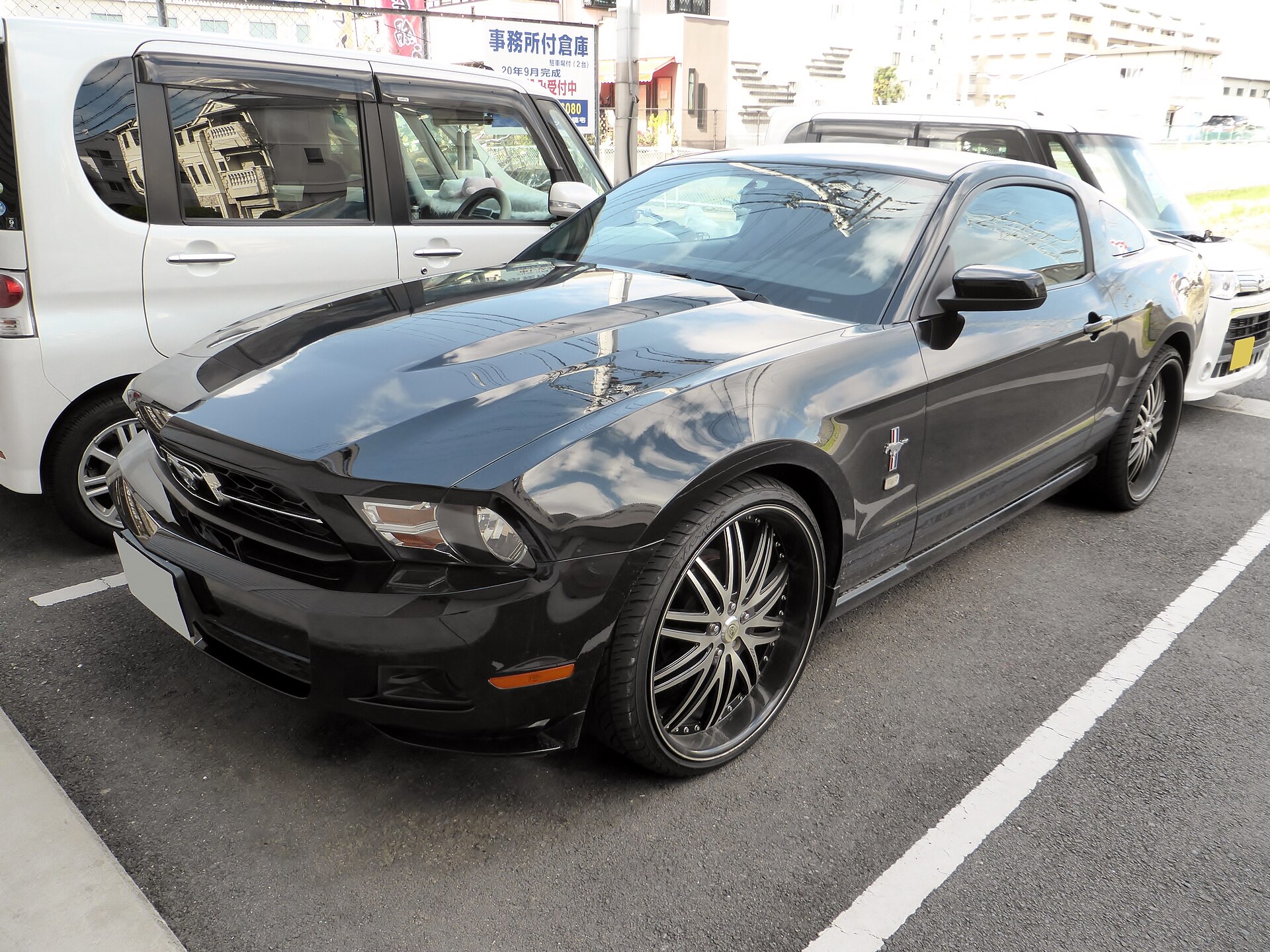
- Mustang S197 2004–2014 · Coupe, Convertible · 157–494 kW (213–672 PS)
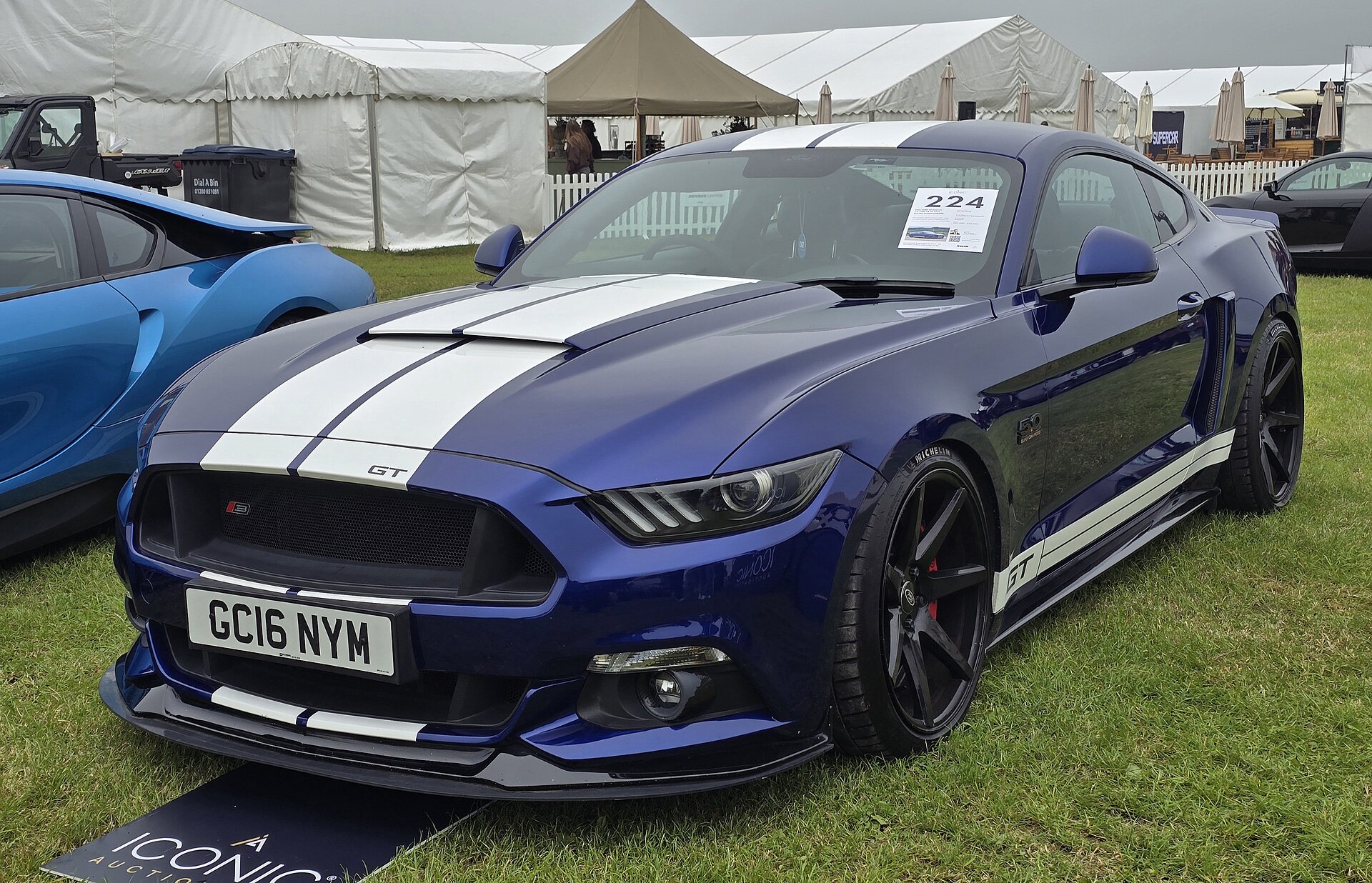
- Mustang S550 2014–2023 · Coupe, Convertible · 227–567 kW (309–771 PS)
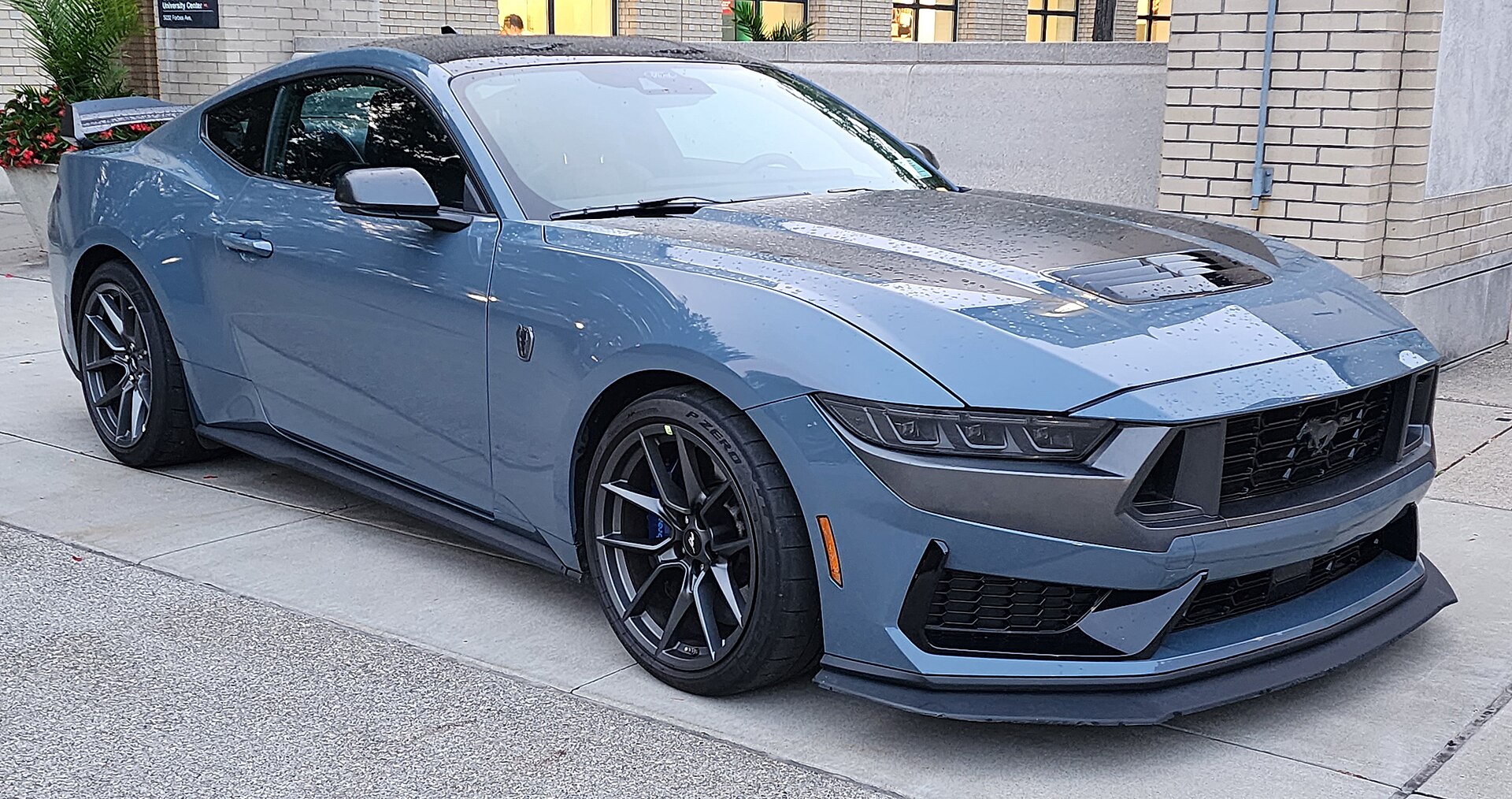
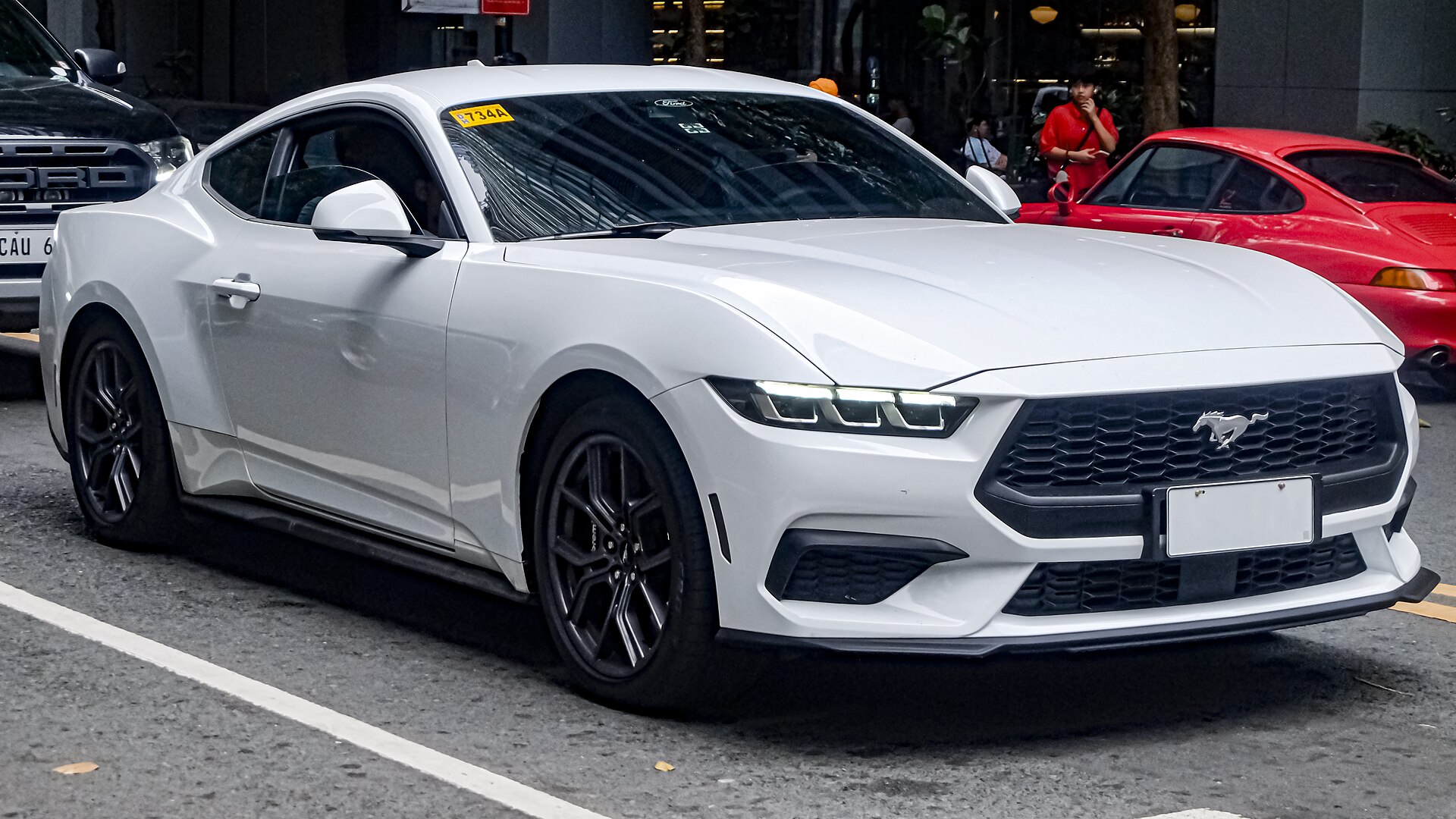
- Mustang S650 Current 2023–now · Coupe, Convertible · 235–608 kW (320–827 PS)
Newest first · 7 generations since 1964
-
2023
-
2014
-
2004
-
1994
-
1979
-
1974
-
1964
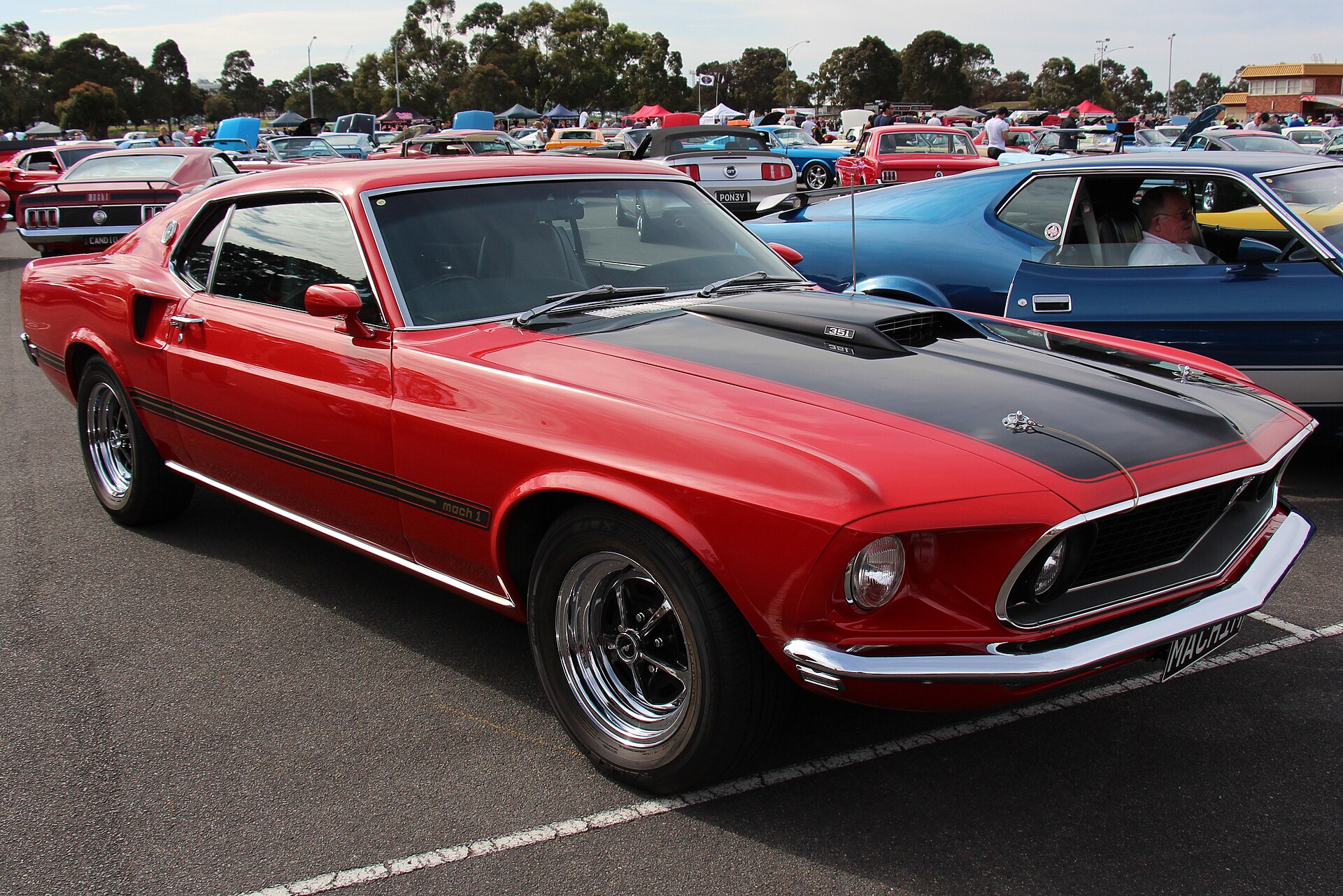


All generations by year: Mustang S650 (2023–now) · Mustang S550 (2014–2023) · Mustang S197 (2004–2014) · Mustang SN95 (1994–2004) · Mustang Fox (1979–1993) · Mustang II (1974–1978) · Mustang I (1964–1973)
Which one is mine?
Pick the year of first registration to see which generation it is.
Check by VINThe Ford Mustang is the car that gave the pony car class its name. Launched in April 1964 on the platform of the compact Falcon, it sold far beyond Ford's forecasts. Its V8 versions — GT, Mach 1, Boss and the Shelby models — made it a central name of the muscle car era. Seven generations later it is still in production at Flat Rock, Michigan, and the ten-millionth Mustang was built in August 2018.
In short
- Unveiled on 17 April 1964 at the New York World's Fair; more than a million were built in the first 18 months.
- First generation (1964–1973) peaked with the Boss 429 and the 1971 429 Super Cobra Jet: 280 kW (375 hp, SAE gross).
- Seven generations: Falcon-based (1964–1973), Mustang II (1974–1978), Fox (1979–1993), SN95 (1994–2004), S197 (2005–2014), S550 (2015–2023) and S650 (from 2023).
- The supercharged 5.2-litre V8 tops the range: 567 kW (760 hp) in the 2020 Shelby GT500 and 608 kW (815 hp) in the 2025 Mustang GTD.
Size at a glance
Ford Mustang S550
The Ford Mustang S650 is 32 mm longer, 5 mm wider and 21 mm taller than the Ford Mustang S550.
| Dimensions | Ford Mustang S650 | Ford Mustang S550 | Difference |
|---|---|---|---|
| Length | 4,820 mm189.8 in | 4,788 mm188.5 in | +32 mm+1.3 in |
| Width | 1,920 mm75.6 in | 1,915 mm75.4 in | +5 mm+0.2 in |
| Height | 1,400 mm55.1 in | 1,379 mm54.3 in | +21 mm+0.8 in |
| Wheelbase | 2,720 mm107.1 in | 2,720 mm107.1 in | Same |
Running cost
Fuel · Mustang S550 GT 5.0 V8
about 3,000 EUR fuel a year at 15,000 km
11.5 l/100 km · petrol at 1.75 EUR/l · change mileage, fuel price or version
Specs by version
Engines
| Version | Engine | Power | Torque | Drive | Production years |
|---|---|---|---|---|---|
| Mustang I · 200 I6 (SAE gross) | 3.3 l · 6 cyl · Petrol 3,300 cc | 89 kW 121 PS119 hp | 258 Nm190 lb-ft | Rear-wheel drive | 1965–1966 |
| Mustang I · 289 V8 4-barrel (SAE gross) | 4.7 l · 8 cyl · Petrol 4,700 cc | 168 kW 228 PS225 hp | 414 Nm305 lb-ft | Rear-wheel drive | 1965–1967 |
| Mustang I · 289 Hi-Po K-code V8 (SAE gross) | 4.7 l · 8 cyl · Petrol 4,700 cc | 202 kW 275 PS271 hp | 423 Nm312 lb-ft | Rear-wheel drive | 1965–1967 |
| Mustang I · Boss 302 V8 (SAE gross) | 4.9 l · 8 cyl · Petrol 4,900 cc | 216 kW 294 PS290 hp | 393 Nm290 lb-ft | Rear-wheel drive | 1969–1970 |
| Mustang I · 428 Cobra Jet V8 (SAE gross) | 7.0 l · 8 cyl · Petrol 7,000 cc | 250 kW 340 PS335 hp | 597 Nm440 lb-ft | Rear-wheel drive | 1968–1970 |
| Mustang I · Boss 429 V8 (SAE gross) | 7.0 l · 8 cyl · Petrol 7,000 cc | 280 kW 381 PS375 hp | 610 Nm450 lb-ft | Rear-wheel drive | 1969–1970 |
| Mustang II · 2.3 I4 (SAE net) | 2.3 l · 4 cyl · Petrol 2,300 cc | 66 kW 90 PS89 hp | — | Rear-wheel drive | 1974 |
| Mustang II · 2.8 V6 (SAE net) | 2.8 l · 6 cyl · Petrol 2,800 cc | 78 kW 106 PS105 hp | — | Rear-wheel drive | 1974 |
| Mustang II · 302 V8 (SAE net) | 4.9 l · 8 cyl · Petrol 4,900 cc | 104 kW 141 PS139 hp | — | Rear-wheel drive | 1975 |
| Fox · 1979–1993 | |||||
| Fox · 2.3 I4 | 2.3 l · 4 cyl · Petrol 2,300 cc | 66 kW 90 PS89 hp | — | Rear-wheel drive | 1979–1982 |
| Fox · SVO 2.3 Turbo | 2.3 l · 4 cyl · Petrol 2,300 cc | 153 kW 208 PS205 hp | — | Rear-wheel drive | 1985 |
| Fox · 5.0 V8 | 5.0 l · 8 cyl · Petrol 5,000 cc | 168 kW 228 PS225 hp | 407 Nm300 lb-ft | Rear-wheel drive | 1987–1992 |
| Fox · SVT Cobra 5.0 V8 | 5.0 l · 8 cyl · Petrol 5,000 cc | 175 kW 238 PS235 hp | 386 Nm285 lb-ft | Rear-wheel drive | 1993 |
| SN95 · 1994–2004 | |||||
| SN95 · 3.8 V6 | 3.8 l · 6 cyl · Petrol 3,800 cc | 108 kW 147 PS145 hp | 291 Nm215 lb-ft | Rear-wheel drive | 1994–1995 |
| SN95 · GT 5.0 V8 | 5.0 l · 8 cyl · Petrol 5,000 cc | 160 kW 218 PS215 hp | 386 Nm285 lb-ft | Rear-wheel drive | 1994–1995 |
| SN95 · GT 4.6 V8 | 4.6 l · 8 cyl · Petrol 4,600 cc | 194 kW 264 PS260 hp | 409 Nm302 lb-ft | Rear-wheel drive | 1999–2004 |
| SN95 · Bullitt GT 4.6 V8 | 4.6 l · 8 cyl · Petrol 4,600 cc | 198 kW 269 PS266 hp | — | Rear-wheel drive | 2001 |
| SN95 · SVT Cobra 4.6 V8 | 4.6 l · 8 cyl · Petrol 4,600 cc | 227 kW 309 PS304 hp | 407 Nm300 lb-ft | Rear-wheel drive | 1996–1998 |
| SN95 · Mach 1 4.6 V8 | 4.6 l · 8 cyl · Petrol 4,600 cc | 227 kW 309 PS304 hp | — | Rear-wheel drive | 2003–2004 |
| SN95 · SVT Cobra 4.6 V8 supercharged | 4.6 l · 8 cyl · Petrol 4,600 cc | 291 kW 396 PS390 hp | 529 Nm390 lb-ft | Rear-wheel drive | 2003–2004 |
| S197 · 2004–2014 | |||||
| S197 · 4.0 V6 | 4.0 l · 6 cyl · Petrol 4,000 cc | 157 kW 213 PS211 hp | 325 Nm240 lb-ft | Rear-wheel drive | 2005–2010 |
| S197 · GT 4.6 V8 | 4.6 l · 8 cyl · Petrol 4,600 cc | 224 kW 305 PS300 hp | 434 Nm320 lb-ft | Rear-wheel drive | 2005–2009 |
| S197 · 3.7 V6 | 3.7 l · 6 cyl · Petrol 3,700 cc | 227 kW 309 PS304 hp | 380 Nm280 lb-ft | Rear-wheel drive | 2011–2014 |
| S197 · GT 5.0 V8 | 5.0 l · 8 cyl · Petrol 5,000 cc | 313 kW 426 PS420 hp | 529 Nm390 lb-ft | Rear-wheel drive | 2013–2014 |
| S197 · Boss 302 | 5.0 l · 8 cyl · Petrol 5,000 cc | 331 kW 450 PS444 hp | 515 Nm380 lb-ft | Rear-wheel drive | 2012–2013 |
| S197 · Shelby GT500 5.4 supercharged | 5.4 l · 8 cyl · Petrol 5,400 cc | 373 kW 507 PS500 hp | 651 Nm480 lb-ft | Rear-wheel drive | 2007–2009 |
| S197 · Shelby GT500 5.8 supercharged | 5.8 l · 8 cyl · Petrol 5,800 cc | 494 kW 672 PS662 hp | 856 Nm631 lb-ft | Rear-wheel drive | 2013–2014 |
| S550 · 2014–2023 | |||||
| S550 · 2.3 L 4 cyl Automatic (S10) · 2022 (EPA) | 2.3 l · 4 cyl 2,300 cc | — | — | Rear-wheel drive | 2022 |
| S550 · 2.3 L 4 cyl Automatic 10-spd · 2022 (EPA) | 2.3 l · 4 cyl 2,300 cc | — | — | Rear-wheel drive | 2022 |
| S550 · 2.3 L 4 cyl Manual 6-spd · 2022 (EPA) | 2.3 l · 4 cyl 2,300 cc | — | — | Rear-wheel drive | 2022 |
| S550 · 2.3 L 4 cyl Automatic (S10) · 2021 (EPA) | 2.3 l · 4 cyl 2,300 cc | — | — | Rear-wheel drive | 2021 |
| S550 · 2.3 L 4 cyl Automatic 10-spd · 2021 (EPA) | 2.3 l · 4 cyl 2,300 cc | — | — | Rear-wheel drive | 2021 |
| S550 · 2.3 L 4 cyl Manual 6-spd · 2021 (EPA) | 2.3 l · 4 cyl 2,300 cc | — | — | Rear-wheel drive | 2021 |
| S550 · 5 L 8 cyl Automatic (S10) · 2022 (EPA) | 5.0 l · 8 cyl 5,000 cc | — | — | Rear-wheel drive | 2022 |
| S550 · 5 L 8 cyl Manual 6-spd · 2022 (EPA) | 5.0 l · 8 cyl 5,000 cc | — | — | Rear-wheel drive | 2022 |
| S550 · 5 L 8 cyl Automatic (S10) · 2021 (EPA) | 5.0 l · 8 cyl 5,000 cc | — | — | Rear-wheel drive | 2021 |
| S550 · GT 5.0 V8 | 5.0 l · 8 cyl · Petrol 5,000 cc | 343 kW 466 PS460 hp | 569 Nm420 lb-ft | Rear-wheel drive | 2018–2021 |
| S650 · 2023–present | |||||
| S650 · 2.3 EcoBoost | 2.3 l · 4 cyl · Petrol 2,300 cc | 235 kW 320 PS315 hp | 475 Nm350 lb-ft | Rear-wheel drive | 2023 |
| S650 · GT 5.0 V8 | 5.0 l · 8 cyl · Petrol 5,000 cc | 358 kW 487 PS480 hp | 567 Nm418 lb-ft | Rear-wheel drive | 2023 |
| S650 · Dark Horse 5.0 V8 | 5.0 l · 8 cyl · Petrol 5,000 cc | 373 kW 507 PS500 hp | 567 Nm418 lb-ft | Rear-wheel drive | 2023 |
Performance
Show all 11 versions
| Version | Fuel consumption |
|---|---|
| Mustang II · 302 V8 (SAE net) | — |
| S550 · 2014–2023 | |
| S550 · 2.3 L 4 cyl Automatic (S10) · 2022 (EPA) | 9.4 l/100 km25.0 mpg US · 30.1 mpg UK |
| S550 · 2.3 L 4 cyl Automatic 10-spd · 2022 (EPA) | 9.4 l/100 km25.0 mpg US · 30.1 mpg UK |
| S550 · 2.3 L 4 cyl Manual 6-spd · 2022 (EPA) | 9.8 l/100 km24.0 mpg US · 28.8 mpg UK |
| S550 · 2.3 L 4 cyl Automatic (S10) · 2021 (EPA) | 9.4 l/100 km25.0 mpg US · 30.1 mpg UK |
| S550 · 2.3 L 4 cyl Automatic 10-spd · 2021 (EPA) | 9.4 l/100 km25.0 mpg US · 30.1 mpg UK |
| S550 · 2.3 L 4 cyl Manual 6-spd · 2021 (EPA) | 9.8 l/100 km24.0 mpg US · 28.8 mpg UK |
| S550 · 5 L 8 cyl Automatic (S10) · 2022 (EPA) | 12.4 l/100 km19.0 mpg US · 22.8 mpg UK |
| S550 · 5 L 8 cyl Manual 6-spd · 2022 (EPA) | 13.1 l/100 km18.0 mpg US · 21.6 mpg UK |
| S550 · 5 L 8 cyl Automatic (S10) · 2021 (EPA) | 12.4 l/100 km19.0 mpg US · 22.8 mpg UK |
| S550 · GT 5.0 V8 | 11.5 l/100 km20.5 mpg US · 24.6 mpg UK |
Dimensions and weight
Show all 16 versions
| Version | Length | Width | Height | Wheelbase | Kerb weight |
|---|---|---|---|---|---|
| Mustang I · 200 I6 (SAE gross) | 4,613 mm181.6 in | 1,732 mm68.2 in | 1,308 mm51.5 in | 2,743 mm108.0 in | 1,172 kg2,584 lb |
| Fox · 1979–1993 | |||||
| Fox · 2.3 I4 | 4,562 mm179.6 in | 1,712 mm67.4 in | 1,308 mm51.5 in | 2,553 mm100.5 in | 1,183 kg2,608 lb |
| Fox · SVO 2.3 Turbo | 4,562 mm179.6 in | 1,755 mm69.1 in | 1,323 mm52.1 in | 2,553 mm100.5 in | — |
| Fox · 5.0 V8 | 4,562 mm179.6 in | — | 1,323 mm52.1 in | 2,553 mm100.5 in | 1,262 kg2,782 lb |
| Fox · SVT Cobra 5.0 V8 | 4,562 mm179.6 in | 1,735 mm68.3 in | 1,323 mm52.1 in | 2,553 mm100.5 in | — |
| SN95 · 1994–2004 | |||||
| SN95 · 3.8 V6 | 4,610 mm181.5 in | 1,824 mm71.8 in | 1,344 mm52.9 in | 2,573 mm101.3 in | — |
| SN95 · GT 5.0 V8 | 4,610 mm181.5 in | 1,824 mm71.8 in | 1,344 mm52.9 in | 2,573 mm101.3 in | — |
| SN95 · GT 4.6 V8 | 4,653 mm183.2 in | 1,857 mm73.1 in | 1,349 mm53.1 in | 2,573 mm101.3 in | — |
| SN95 · Bullitt GT 4.6 V8 | 4,653 mm183.2 in | 1,857 mm73.1 in | — | 2,573 mm101.3 in | — |
| SN95 · SVT Cobra 4.6 V8 | 4,636 mm182.5 in | 1,824 mm71.8 in | — | 2,573 mm101.3 in | — |
| SN95 · Mach 1 4.6 V8 | 4,653 mm183.2 in | 1,857 mm73.1 in | 1,331 mm52.4 in | 2,573 mm101.3 in | — |
| SN95 · SVT Cobra 4.6 V8 supercharged | 4,661 mm183.5 in | 1,857 mm73.1 in | 1,334 mm52.5 in | 2,573 mm101.3 in | — |
| S550 · 2014–2023 | |||||
| S550 · GT 5.0 V8 | 4,788 mm188.5 in | 1,915 mm75.4 in | — | 2,720 mm107.1 in | 1,832 kg4,039 lb |
| S650 · 2023–present | |||||
| S650 · 2.3 EcoBoost | 4,810 mm189.4 in | 1,915 mm75.4 in | — | 2,720 mm107.1 in | 1,627 kg3,587 lb |
| S650 · GT 5.0 V8 | 4,810 mm189.4 in | 1,915 mm75.4 in | — | 2,720 mm107.1 in | 1,736 kg3,827 lb |
| S650 · Dark Horse 5.0 V8 | 4,820 mm189.8 in | 1,920 mm75.6 in | 1,400 mm55.1 in | 2,720 mm107.1 in | 1,791 kg3,948 lb |
Verified Manufacturer and type-approval data from our catalog · Sources and methodology
Safety
-
S650 · NHTSA 2025
US NCAP (NHTSA)
-
S550 · NHTSA 2022
US NCAP (NHTSA)
-
S197 · NHTSA 2013
US NCAP (NHTSA)
Stars from different years and organisations are not directly comparable: test protocols change every few years.
Ford Mustang at a glance
| Specification | Ford Mustang |
|---|---|
| Production | since March 1964 (model year 1965 on) |
| Built | more than 10 million (August 2018) |
| Plants | Dearborn, Michigan; Flat Rock, Michigan (from the fifth generation) |
| Body | hardtop coupé, fastback, convertible; hatchback in the Fox era |
| Drive | rear-wheel drive, front engine |
| Engines | four-cylinder, straight-six, V6 and V8 engines |
| Most powerful version | 2025 Mustang GTD, 5.2-litre supercharged V8, 608 kW (815 hp) and 900 Nm |
| Awards | Tiffany Gold Medal 1965; Motor Trend Car of the Year 1974 and 1994 |
| Related electric model | Mustang Mach-E crossover (2019), not part of the pony car line |
The Mustang has its own page in our Ford catalogue, and the early years are told in detail in the history of the Ford Mustang. For the place of the car among its rivals, see the American muscle car guide.
How the pony car began
The project, known inside Ford as T-5, was pushed by Lee Iacocca, then general manager of the Ford Division, with Donald N. Frey as chief engineer. Gale Halderman drew the side view that became the first clay model. Ford credits John Najjar with the name; he had also co-designed the 1961 Mustang I prototype with Philip T. Clark. In Germany the car was sold as the T-5 until December 1978, because the Mustang name there belonged to Krupp.
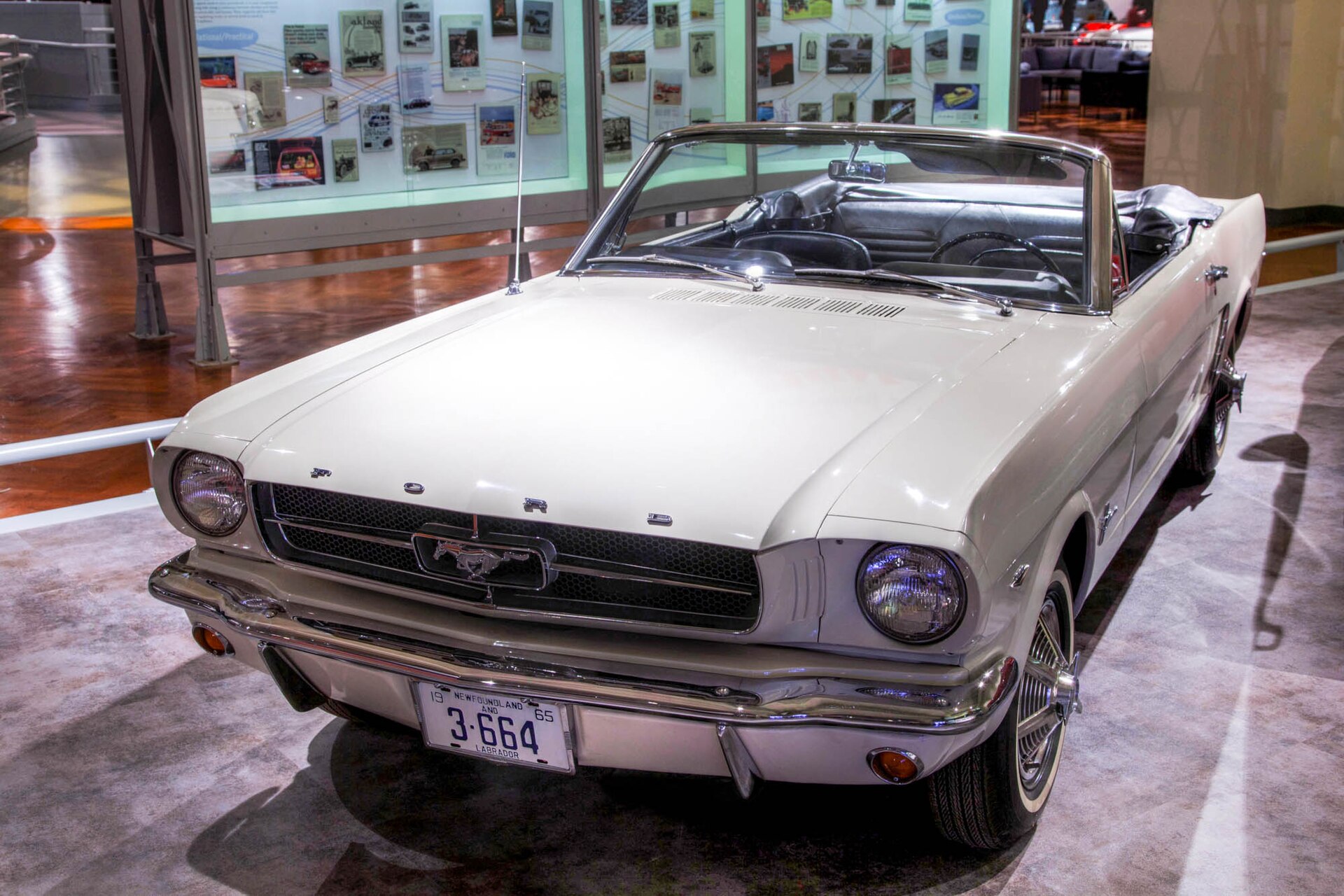
Production started in Dearborn on 9 March 1964, and the first public sale took place in St. John's, Newfoundland, on 14 April. Three days later the Mustang was shown at the New York World's Fair — sixteen days after the Plymouth Barracuda. The early cars are known as "1964½" models, although Ford sold and titled them as 1965 models; 121,538 of them found buyers in that short period.
Ford had expected fewer than 100,000 sales in the first year. More than 400,000 were sold, and over a million cars were built in the first 18 months. The 1965 model year alone accounts for 559,451 cars and 1966 for 607,568. The Mustang was also the first automobile to receive the Tiffany Gold Medal for American design.

The first generation (1964–1973)
The first Mustang used the running gear of the Falcon compact under a long-bonnet, short-deck body. Buyers could choose a hardtop, a convertible or, from August 1964, a 2+2 fastback, which Ford called SportsRoof from 1969. The engine range ran from straight-six engines to V8s. The long options list was part of the idea: the same body could be an economical commuter or a fast car.
Performance came quickly. The 289 cu in Hi-Po V8 (K-code) was rated at 202 kW (271 hp) from 1964 to 1967. Car and Driver tested a 1965 HiPo with a 4.11 axle: 60 mph came up in 5.2 seconds, and the quarter mile took 14.0 seconds. The 390 FE V8 followed, and from 1968 the 428 Cobra Jet with 250 kW (335 hp) turned the Mustang into a proper muscle car.
The body grew with the engines. The 1967 car was larger inside and out. The 1969 update added 97 mm of length on an unchanged 108-inch wheelbase, and for 1971 the car became 3 inches wider so that the big 429 V8 would fit. The first generation ended in June 1973.

Boss, Mach 1 and Shelby: the V8 Mustangs
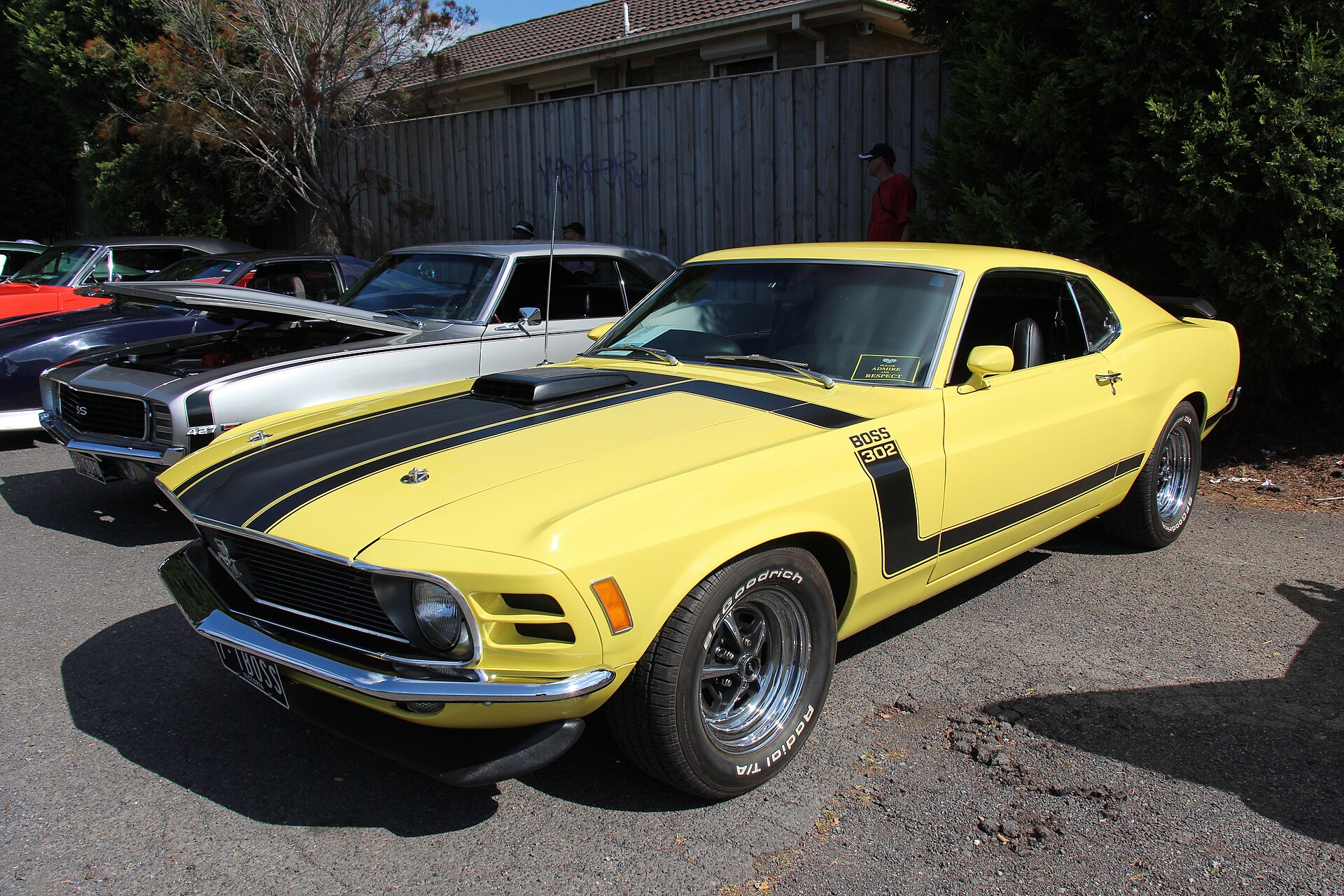
The Mach 1 package arrived for the 1969 model year and became the best-known sporty Mustang of the period. The same year Ford built two Boss models to homologate engines for racing: the small-block Boss 302, rated at 216 kW (290 hp), and the big-block Boss 429, rated at 280 kW (375 hp). Wikipedia gives 1,628 Boss 302s and 859 Boss 429s sold through 1969.
For 1971 the top engines were the 429 Cobra Jet with 276 kW (370 hp) and the 429 Super Cobra Jet with 280 kW (375 hp). A Boss 351 rated at 246 kW (330 hp) replaced both Boss models. These were the last gross ratings. From 1972 American makers quoted SAE net power, and the 1972 Mustang's strongest engine, the 351 HO, was listed at 205 kW (275 hp) net.
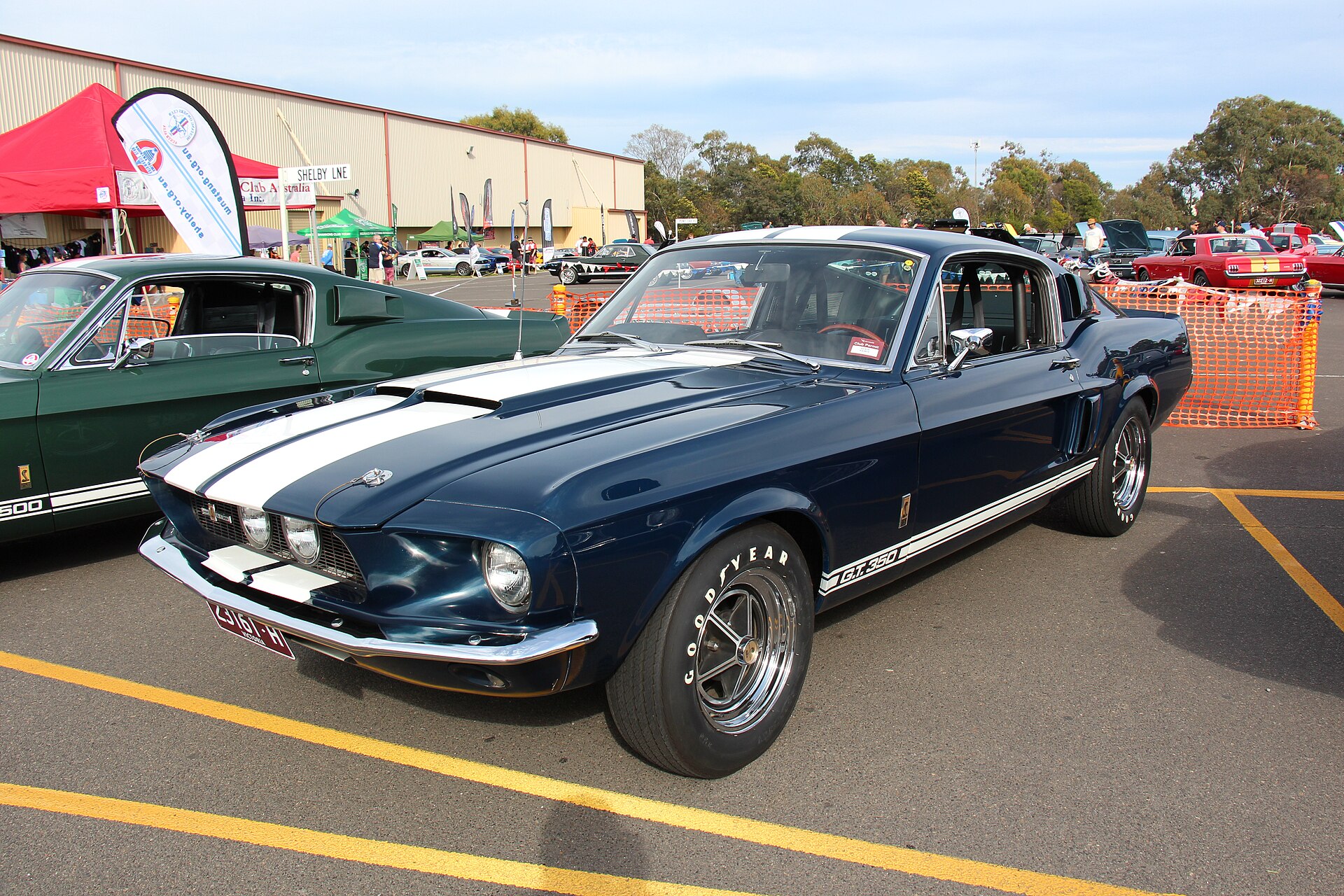
Carroll Shelby's versions began in 1965 as a fastback, the GT350. The racing GT350R won five of six SCCA divisions in its first season. Later came the GT500 with a big-block V8; for 1969 the GT-350 used the 351 Windsor rated at 216 kW (290 hp) and the GT-500 the 428 Cobra Jet. Shelby production ended in 1969, and 789 leftover cars were retitled as 1970 models. The 1967 Shelby GT500 has its own article on 1CARS.

Mustang II, Fox and SN95
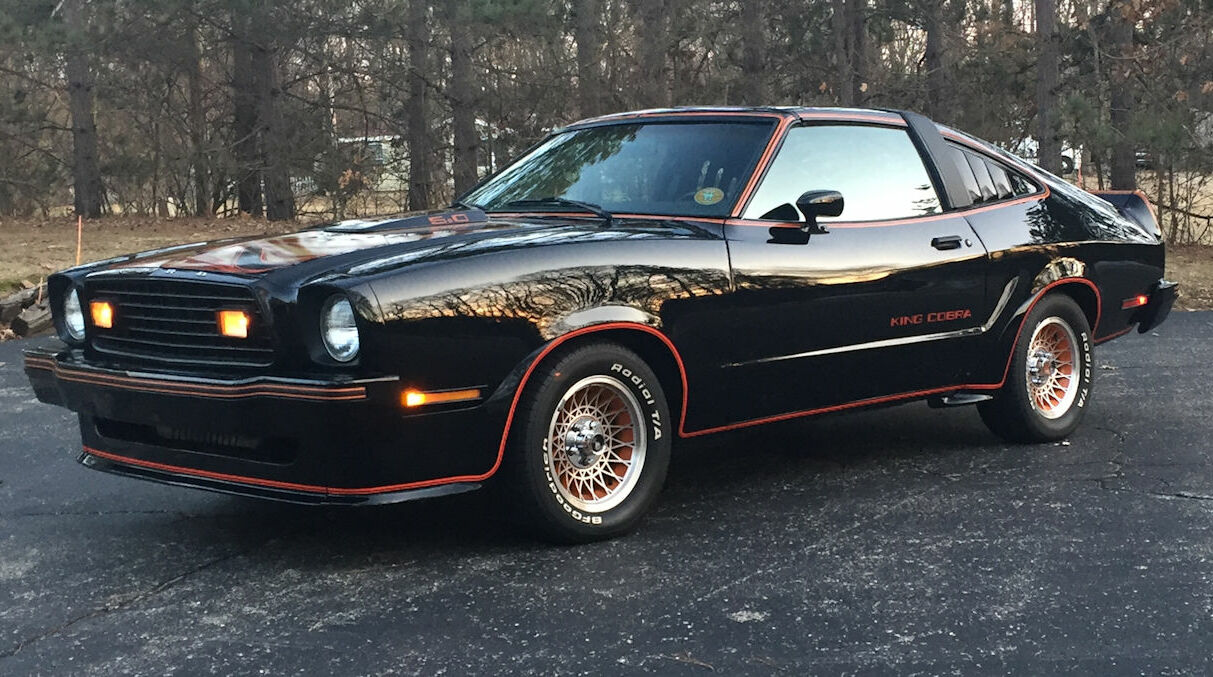
The 1974 Mustang II was a different car: smaller, and built on a longer-wheelbase version of the Ford Pinto. It sold 385,993 cars in its first year — close to the original car's twelve-month record of 418,812 — and it was Motor Trend's Car of the Year for 1974. The "5.0" badge first appeared on the 1978 King Cobra.
The third generation of 1979 moved to the Fox platform, which the Mustang shared with 14 other Ford vehicles. The GT returned in 1982 with a high-output 302 cu in (4.9-litre) V8 marketed as the 5.0, and the turbocharged, intercooled 2.3-litre SVO of 1984–1986 showed another way to performance. The Fox Mustang lasted until 1993 and ended with the Cobra R.
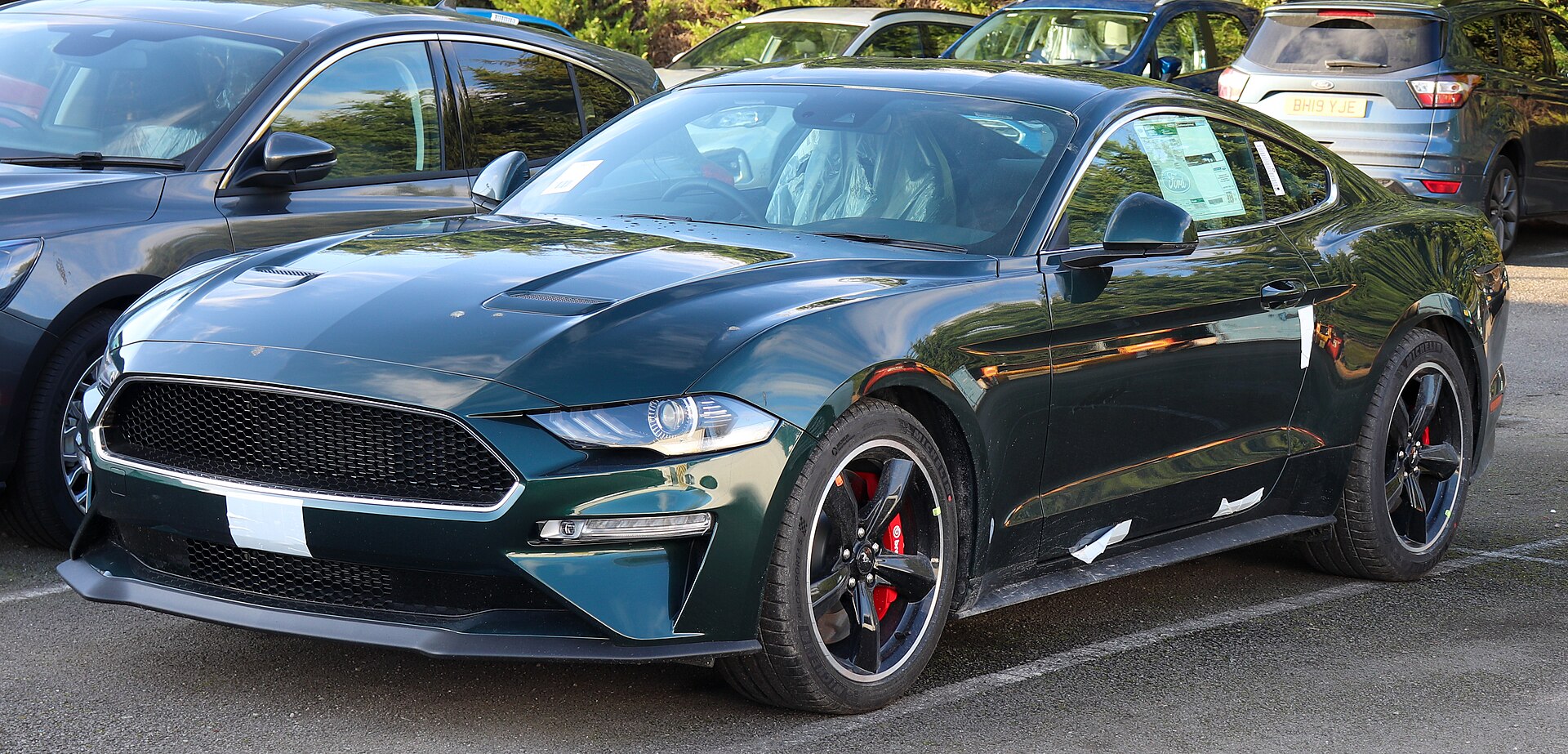
The SN95 car of 1994 kept a modified Fox chassis, known as Fox-4, and was again Motor Trend's Car of the Year. Its best-known performance version was the SVT Cobra; the supercharged 2003–2004 model was rated at 291 kW (390 hp). A Bullitt edition appeared in 2001.

The modern Mustang
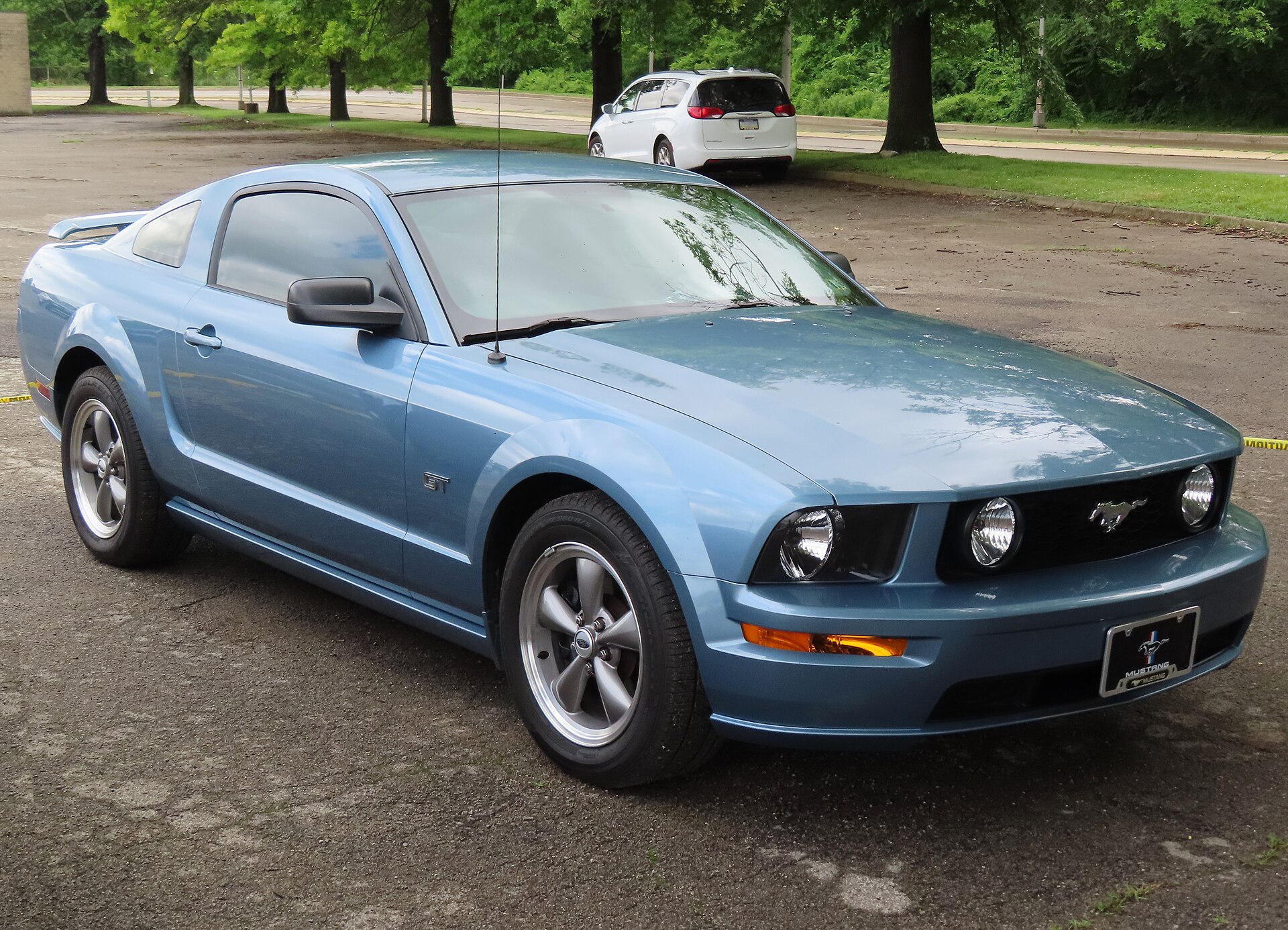
The fifth generation (S197) of 2005 moved to Ford's D2C platform, used only by the Mustang, and production moved to Flat Rock. Its styling brought back the lines and colours of the original car. The GT had a 4.6-litre V8 with 224 kW (300 hp), and from 2011 the new 5.0-litre "Coyote" V8 gave 307 kW (412 hp). The 2012 Boss 302 was rated at 331 kW (444 hp), and the 2013 Shelby GT500 with a supercharged 5.8-litre V8 reached 494 kW (662 hp).
The sixth generation (S550), unveiled on 5 December 2013, was the first Mustang designed for right-hand drive and sold globally. Its GT reached 343 kW (460 hp) in 2018, and the Mach 1 returned for 2021 with 358 kW (480 hp). The 2020 Shelby GT500 with the supercharged 5.2-litre "Predator" V8 reached 567 kW (760 hp). The GT350 was dropped after 2020.
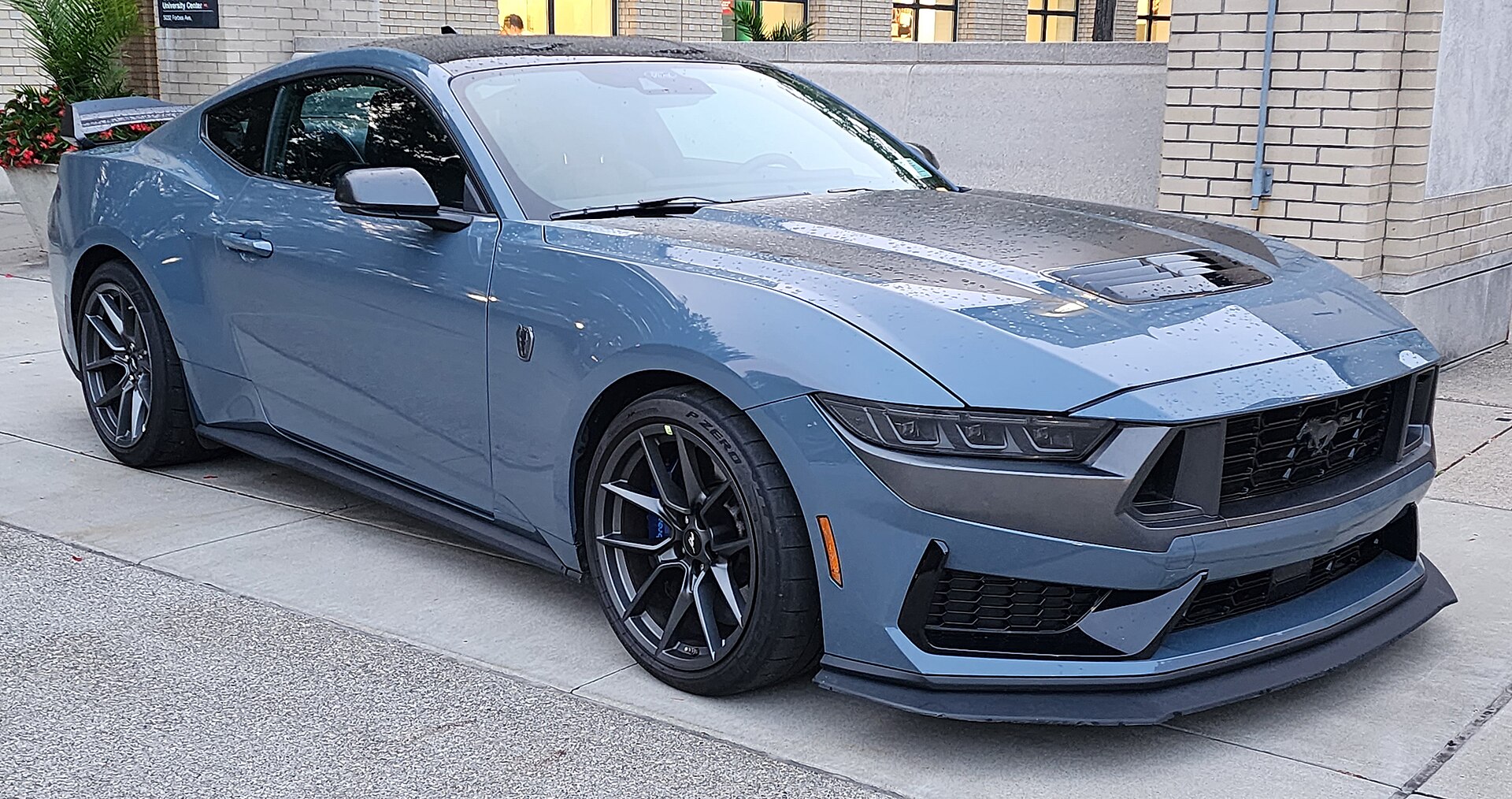
The seventh generation (S650) went into production on 1 May 2023. The GT has 358–362 kW (480–486 hp), and the Dark Horse 373 kW (500 hp). The road-going Mustang GTD of the 2025 model year uses a supercharged 5.2-litre Predator V8 with 608 kW (815 hp) and 900 Nm, the highest output of any Mustang so far. Sales in calendar year 2025 were 45,333 cars. The electric Mustang Mach-E of 2019 is a crossover that shares only the name.

Racing and recognition
Racing was part of the Mustang story from the start: the Shelby GT350R won five of six SCCA divisions in 1965, and the Boss models of 1969 existed to homologate engines for competition. On the road, the car won Car and Driver's Ten Best award in 1983, 1987, 1988, 2005, 2006, 2011 and 2016.
Its rivals defined the segment. The Chevrolet Camaro arrived in 1966 as a direct answer, followed by the Pontiac Firebird, the Plymouth Barracuda and the Dodge Challenger. Unlike the Camaro, Firebird, Barracuda and Challenger, the Mustang has stayed in production since 1964.
Which Mustang to look at
For a classic with muscle car credentials, the 1967–1970 fastbacks with the 428 Cobra Jet, the Mach 1 and the two Boss models are the reference points; the Boss 429 is the rarest of them. The Fox-body 5.0 GT of the 1980s is the simplest way into a V8 Mustang with rear-wheel drive and a light body. Among modern cars the 5.0-litre GT is the core model, while the Shelby GT500 and the Dark Horse are the track-oriented versions. Figures for every generation can be compared in our car rankings.
Photo gallery


Ford Mustang evolution in numbers
Did you know?
- The Ford Mustang has been around for 62 years: 7 generations in our catalog since 1964.
- The longest-running generation is the Mustang Fox (1979–1993): 14 years.
- The biggest jump in power came with the Mustang S197: up to 494 kW (672 PS), 203 kW more than the Mustang SN95.
Most powerful version, kW
Length, mm
Figures from the 1cars catalog: power is the strongest version of each generation; generations without the figure are left out.
Ford Mustang: first vs latest generation
| Spec | Mustang I | Mustang S650 | Change |
|---|---|---|---|
| Years | 1964–1973 | 2023–present | 59 years apart |
| Most powerful version | 280 kW (381 PS) | 608 kW (827 PS) | +328 kW (+117%) |
| Length | 4,613 mm | 4,820 mm | +207 mm |
| Width | 1,732 mm | 1,920 mm | +188 mm |
| Wheelbase | 2,743 mm | 2,720 mm | −23 mm |
| Lightest kerb weight | 1,172 kg | 1,627 kg | +455 kg |
Oldest and newest generation in the 1cars catalog. Power is the strongest version of each; other rows are shown only when both generations have the figure.
Image credits · Photos from Wikimedia Commons under free licences
- Ford Mustang II · Photo: Alexandre Prévot from Nancy, France / Wikimedia Commons, CC BY-SA 2.0
- Ford Mustang SN95 · Photo: Tokumeigakarinoaoshima / Wikimedia Commons, CC0
- Ford Mustang S197 · Photo: Tokumeigakarinoaoshima / Wikimedia Commons, CC0
- Ford Mustang S550 · Photo: Calreyn88 / Wikimedia Commons, CC BY-SA 4.0
- Ford Mustang S650 · Photo: Ethan Llamas / Wikimedia Commons, CC BY-SA 4.0
Popular comparisons
Ford Mustang in our rankings
- No. 1 of 70 · Biggest engines: hatchbacks (5,000 cc)
- No. 3 of 305 · Oldest car models still on sale (62 years)
- No. 4 of 912 · Longest-running car nameplates (62 years)
- No. 5 of 36 · Fastest American cars (325 km/h)
- No. 8 of 105 · Fastest cars of the 2020s (325 km/h)
- No. 9 of 154 · Most powerful V8 cars (608 kW)
In production longer than 99% of ranked nameplates in the 1CARS catalog (No. 4 of 912).
Ford Mustang photos 7
FAQ
Why is the first Mustang called a 1964½?
The car went on sale in April 1964, months before the normal start of the 1965 model year. Ford titled the early cars as 1965 models, but collectors call them 1964½.
What was the most powerful classic Mustang?
The Boss 429 of 1969–1970 and the 1971 429 Super Cobra Jet were both rated at 280 kW (375 hp, SAE gross).
Is the Mustang a muscle car or a pony car?
It is the original pony car. Its V8 versions — GT, Mach 1, Boss and Shelby — are counted as muscle cars.
Which Mustang has the most power?
The 2025 Mustang GTD with 608 kW (815 hp) from a supercharged 5.2-litre V8. Among the Shelby models, the 2020 GT500 has 567 kW (760 hp).
Data sources
Data checked by an editor against the sources below.
- Wikipedia — Ford Mustang
- Wikipedia — Ford Mustang (first generation)
- Wikipedia — Ford Mustang II
- Wikipedia — Ford Mustang (third generation)
- Wikipedia — Ford Mustang (fourth generation)
- EEA CO₂ monitoring (European Environment Agency, CC BY 4.0)
- NHTSA 5-Star Safety Ratings (US NCAP) — U.S. Government work, public domain