Fastest-accelerating cars for the money 2026: 0–100 km/h under €63,000
Electric motors have changed which are the fastest-accelerating cars for the money. In 2026 a family saloon that reaches 100 km/h in 3.1 seconds costs less than €60,000 in Germany, while a V8 coupé with 328 kW needs 5.3 seconds for the same sprint. This list compares six of the quickest new cars sold in Europe for up to about €63,000, using the 0–100 km/h times and list prices that ADAC, Germany's motoring club, publishes for each version.
Acceleration is not everything. The petrol cars are lighter, sound and feel different, and their performance does not depend on battery charge or temperature. Each entry therefore notes what else the car offers and the honest drawback.
Quick picks
- Quickest for the money: Tesla Model 3 – Performance, 3.1 s for €58,490.
- Quickest small car: Volvo EX30 – 3.6 s in a 4.2-metre SUV.
- Quickest family car: Tesla Model Y – 3.5 s and an 822-litre boot.
- Best petrol-engined choice: Ford Mustang – V8 GT, 5.3 s.
- Cheapest here: Volkswagen Golf GTI – €46,865.
| Model (version) | Power | 0–100 km/h | Kerb weight | Germany, from | Euros per kW |
|---|---|---|---|---|---|
| Tesla Model 3 Performance AWD | 338 kW (460 PS) | 3.1 s | 1,929 kg | €58,490 (10/2025) | 173 |
| Volvo EX30 P8 AWD | 315 kW (428 PS) | 3.6 s | 1,960 kg | €54,190 (04/2026) | 172 |
| Tesla Model Y Performance AWD | 338 kW (460 PS) | 3.5 s | 2,108 kg | €62,990 (08/2025) | 186 |
| Ford Mustang 5.0 V8 GT | 328 kW (446 PS) | 5.3 s | 1,808 kg | €62,400 (09/2025) | 190 |
| Mercedes-AMG A 35 4MATIC | 235 kW (320 PS) | 4.7 s | 1,645 kg | €62,059 (01/2025) | 264 |
| Volkswagen Golf GTI DSG | 195 kW (265 PS) | 5.9 s | 1,454 kg | €46,865 (07/2024) | 240 |
Euros per kW is the German list price divided by the maximum power; a lower figure means more power for the money. All figures are manufacturer data as listed by ADAC. For more expensive cars, see the most powerful supercars and the best sports cars.
-
1. Tesla Model 3
Fastest-accelerating car for the money
- Production years
- 2016–present
- Body type
- Sedan
- Fuel
- Electric
- Power output
- 170–393 kW (231–534 PS)
The facelifted Model 3 Performance has two motors with 338 kW (460 PS) and 660 Nm. ADAC lists 3.1 s from 0 to 100 km/h, the quickest time in this list, and a top speed of 262 km/h, for €58,490 in Germany. It remains a practical saloon with a 594-litre boot and 600 km of WLTP range. Buyers on a tighter budget can choose the Premium AWD with 324 kW (440 PS): 4.4 s for €49,990. The drawback: the Performance gives up 150 km of WLTP range compared with the rear-wheel-drive Premium.
Pros
- 0–100 km/h in 3.1 s (Performance)
- 4.4 s for €49,990 (Premium AWD)
- 594-litre boot
Cons
- 600 km WLTP range, 150 km less than the RWD Premium
Spec sheet: Tesla Model 3 RWD (2023 refresh) 208 kW (283 PS)
Full review: Tesla Model 3 -
2. Volvo EX30 I
Quickest small car
- Production years
- 2023–present
- Body type
- Crossover
- Fuel
- Electric
- Power output
- 200–315 kW (272–428 PS)
The EX30 is only 4,233 mm long, yet the twin-motor P8 has 315 kW (428 PS) and 543 Nm. ADAC lists 3.6 s to 100 km/h, quicker than the Mustang V8 by 1.7 seconds, for €54,190 in Germany. At 172 euros per kW it is the best value for power here. Euro NCAP awarded five stars in December 2024, and the battery is covered for eight years or 160,000 km. The drawbacks: the top speed is 180 km/h, the boot holds 318 litres and WLTP range is 450 km from a 65 kWh battery.
Pros
- 0–100 km/h in 3.6 s
- Lowest price per kW here
- Compact 4,233 mm body
Cons
- 318-litre boot and 450 km WLTP range
Spec sheet: Volvo EX30 I Single Motor 200 kW (272 PS)
Full review: Volvo EX30 I -
3. Tesla Model Y I
Quickest family car
- Production years
- 2020–present
- Body type
- SUV
- Fuel
- Electric
- Power output
- 324 kW (441 PS)
The Model Y Performance uses the same 338 kW (460 PS) twin-motor drive as the Model 3, in an SUV with an 822-litre boot. ADAC lists 3.5 s from 0 to 100 km/h and a 250 km/h top speed. WLTP range is 580 km, and the car charges at up to 250 kW DC. Euro NCAP awarded five stars in November 2025, with 90 out of 100 points. The drawbacks: at €62,990 in Germany it is the most expensive car here, and at 2,108 kg also the heaviest.
Full review: Tesla Model Y IPros
- 0–100 km/h in 3.5 s
- 822-litre boot
- Five-star Euro NCAP (2025)
Cons
- Most expensive here at €62,990 (2025)
-
4. Ford Mustang S650
Best petrol-engined choice
- Production years
- 2023–present
- Body type
- Coupe, Convertible
- Fuel
- Petrol
- Power output
- 235–608 kW (320–827 PS)
The seventh-generation Mustang keeps a V8. The 5.0-litre GT has 328 kW (446 PS) and 540 Nm, drives the rear wheels and comes with a six-speed manual from €62,400 in Germany, or with an automatic for €65,900. ADAC lists 5.3 s to 100 km/h and 250 km/h. Its appeal lies in the engine and the driving experience rather than in the stopwatch. The drawbacks: 12.0 l/100 km WLTP, four seats and a 381-litre boot.
Pros
- 5.0-litre V8 with 328 kW (446 PS)
- Manual gearbox available
- 250 km/h top speed
Cons
- 12.0 l/100 km WLTP combined
Spec sheet: Ford Mustang S650 5.0 l Dark Horse V8 373 kW (507 PS)
Full review: Ford Mustang S650 -
5. Mercedes-Benz A35
Quickest compact petrol
- Production years
- 2018–present
- Body type
- Sedan, Hatchback
- Fuel
- Petrol
- Power output
- 225 kW (306 PS)
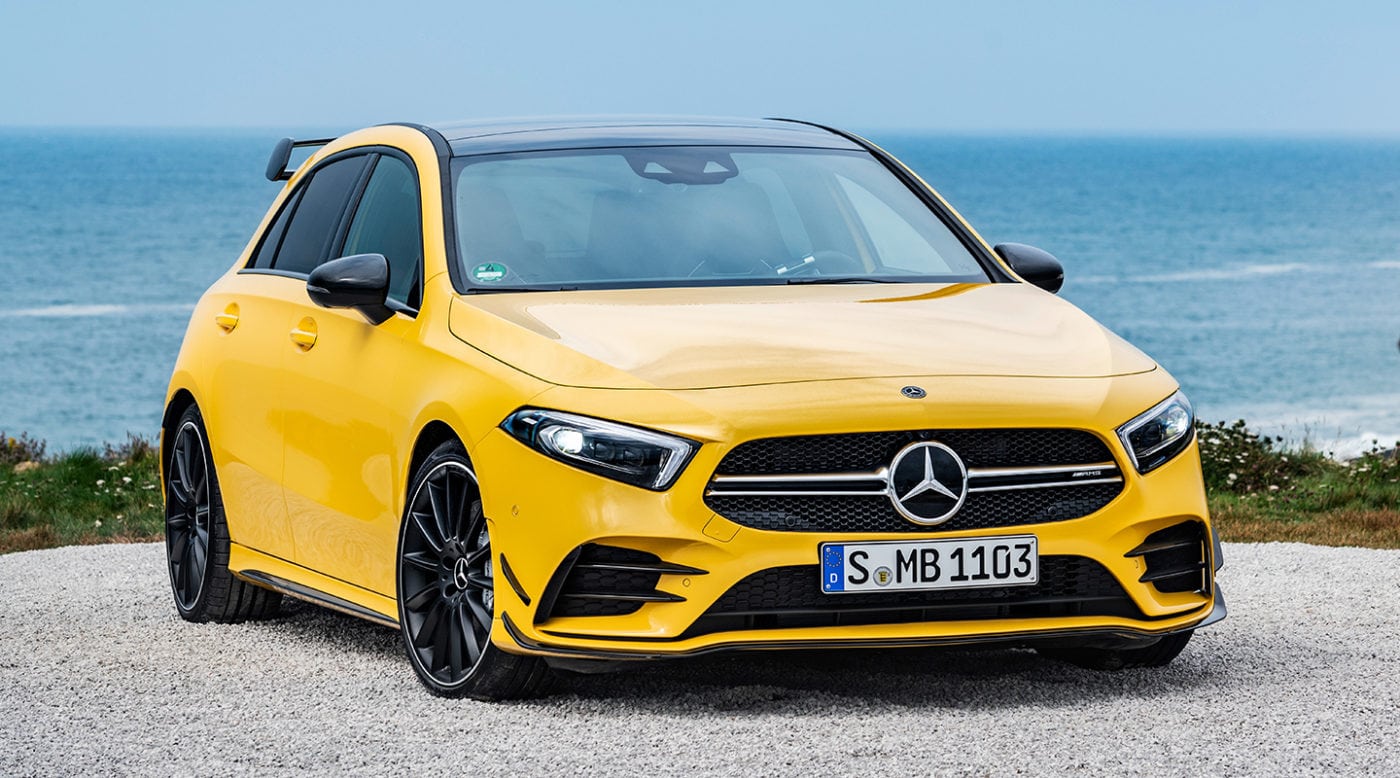
The Mercedes-AMG A 35 4MATIC puts 235 kW (320 PS) and 400 Nm through all four wheels and an eight-speed dual-clutch gearbox. ADAC lists 4.7 s to 100 km/h, the quickest time among the petrol cars here, and a top speed of 250 km/h. At 1,645 kg it is far lighter than the electric cars, and the hatchback still offers a 350-litre boot. The drawbacks: at €62,059 in Germany it costs 264 euros per kW, the highest figure here, and it uses 8.3 l/100 km WLTP.
Full review: Mercedes-Benz A35Pros
- 0–100 km/h in 4.7 s
- All-wheel drive
- 1,645 kg kerb weight
Cons
- Highest price per kW here (€264)
-
6. Volkswagen Golf Mk8
Cheapest quick car here
- Production years
- 2019–present
- Body type
- Hatchback, Station wagon
- Fuel
- Petrol, Diesel, Hybrid, Plug-in hybrid
- Power output
- 66–235 kW (90–320 PS)
The facelifted Golf GTI is the cheapest car in this list at €46,865 in Germany with its seven-speed DSG. Its 2.0-litre turbo petrol has 195 kW (265 PS) and 370 Nm, and ADAC lists 5.9 s from 0 to 100 km/h with front-wheel drive. It is also the lightest car here, at 1,454 kg, and keeps the Golf's 374-litre boot. Running costs are lower than for the AMG: ADAC lists 7.0 l/100 km WLTP. The drawback: it is the slowest car in this list, 2.8 seconds behind the Model 3 Performance.
Pros
- From €46,865 in Germany (2024)
- Lightest car here at 1,454 kg
- 374-litre boot
Cons
- Slowest here at 5.9 s
Spec sheet: Volkswagen Golf Mk8 1.4 l TSI eHybrid 150 kW (204 PS)
Full review: Volkswagen Golf Mk8



Data ranking: Quickest cars, 0–100 - all 250 models in our catalog with a figure, ranked by the numbers.
How we chose
Selection. The list covers new cars on sale in Germany in October 2026 with a list price up to about €63,000, a manufacturer 0–100 km/h time and a published model page on 1cars. Cars that have left the German price list, such as the Honda Civic Type R (December 2025) and the Volkswagen Golf R (2026), are not included, and the Audi S3 and Škoda Enyaq RS could not be compared because their ADAC version pages were not available.
Data sources. Power, torque, kerb weight, 0–100 km/h times, top speeds, WLTP consumption and range, boot volumes and German list prices come from the ADAC Autokatalog pages for the named versions, accessed in October 2026. Acceleration times are manufacturer figures, not independent tests. Euros per kW is a calculation from two ADAC figures.
Ranking. The order is editorial: acceleration for the price comes first, then practicality and running costs. More on the two Teslas is on the 1cars pages for the Tesla Model 3 and the Tesla Model Y.
Frequently asked questions
What is the fastest-accelerating car for the money in 2026?
In this comparison, the Tesla Model 3 Performance: 3.1 s from 0 to 100 km/h for €58,490 in Germany. For €49,990 the Model 3 Premium AWD still reaches 100 km/h in 4.4 s, according to ADAC.
Why are electric cars so quick off the line?
Electric motors deliver their full torque from standstill, and the dual-motor versions here put it down through all four wheels. The Model 3 Performance has 660 Nm, the EX30 P8 543 Nm, more than the Mustang V8 GT's 540 Nm.
Which is the quickest petrol car under €63,000?
In this list, the Mercedes-AMG A 35 4MATIC, at 4.7 s to 100 km/h. The Ford Mustang V8 GT has more power, 328 kW (446 PS), but needs 5.3 s with rear-wheel drive and a manual gearbox.
Do fast electric cars lose range?
Yes, a little. ADAC lists 600 km of WLTP range for the Model 3 Performance against 750 km for the rear-wheel-drive Model 3 Premium, and 450 km for the EX30 P8. Hard acceleration uses more energy in any car.
Is 0–100 km/h the best measure of performance?
It is a useful headline, but not the whole picture. Overtaking at 80–120 km/h, braking, handling and how long a car can sustain its performance matter on the road, and manufacturer times are measured under ideal conditions.