SSC Tuatara
Specs, engines and history
Published Sources (1) Report an error
By Felix Hartmann, Automotive Technology & EV Contributor
- Built
- 2020–present
- Top power
- 1,300 kW (1,768 PS)
Verdict
Our verdict · Felix Hartmann
The Tuatara shows that a small American company can build a car with performance figures that rival the best European hypercars. Its slippery carbon-fibre body, enormous power on E85 and verified speeds above 450 km/h make it one of the most remarkable cars of its era — even if its first record claim turned out to be premature.
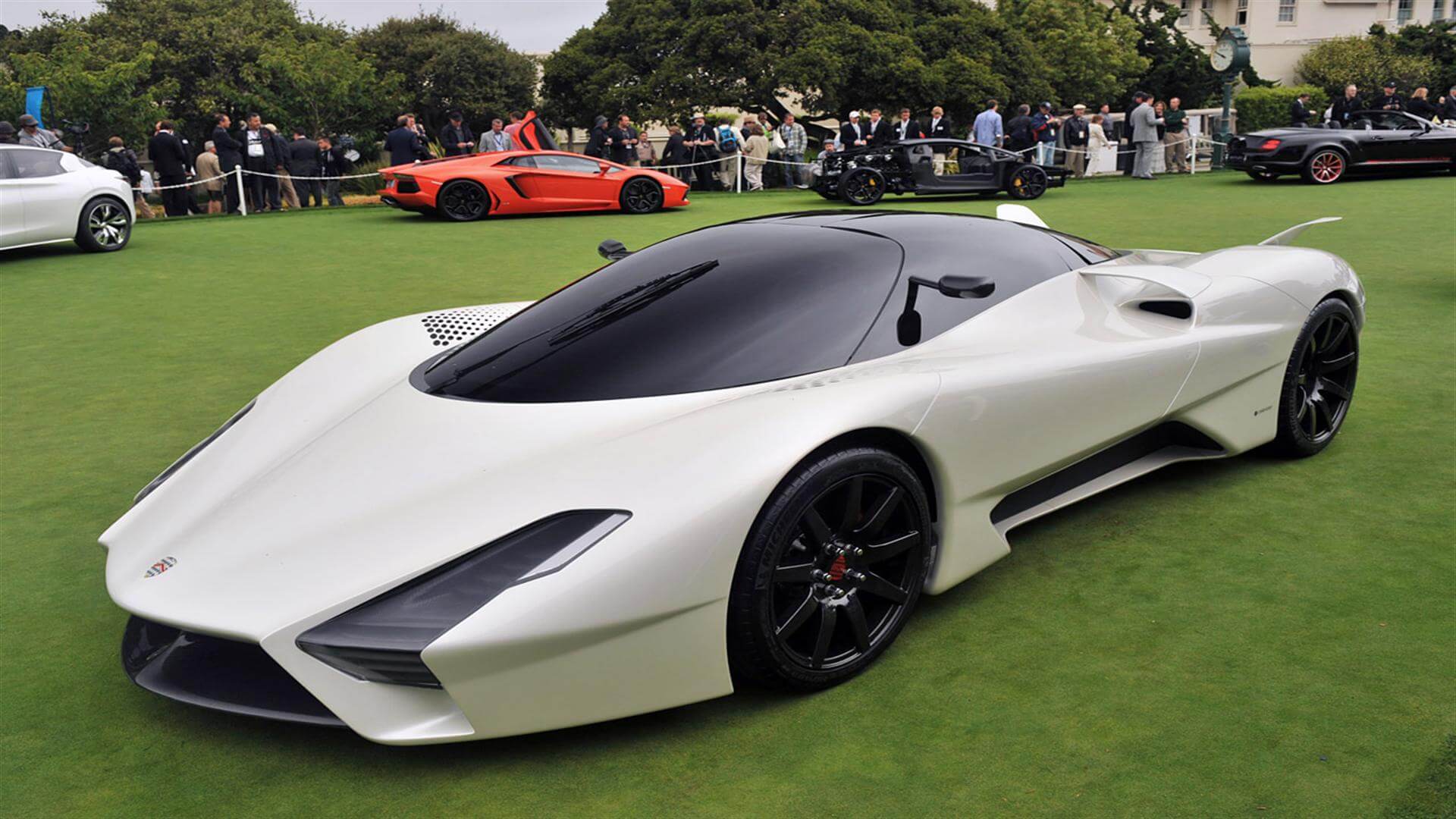
The SSC Tuatara is a hypercar from the American company SSC North America (formerly Shelby SuperCars) of Richland, Washington. A concept version was shown at the Pebble Beach Concours d'Elegance in 2011, the production design followed in 2018, and the first customer car was unveiled in early 2020 after years of delays. SSC positions the Tuatara as a contender for the title of the world's fastest production car, and only 100 are planned.
In short
- Concept at Pebble Beach in 2011, production version in 2018, first customer car in 2020; 100 cars to be built in Richland, Washington.
- 5.9-litre twin-turbo flat-plane-crank V8 with 1,007 kW (1,369 PS) on petrol and 1,305 kW (1,774 PS) on E85.
- Seven-speed CIMA automated manual gearbox, carbon-fibre body and monocoque, drag coefficient of 0.279.
- A verified two-way average of 455.3 km/h in January 2021, after a disputed earlier record claim.
Specs by version
Verified Manufacturer and type-approval data from our catalog · Sources and methodology
SSC Tuatara at a glance
| Item | Detail |
|---|---|
| Maker | SSC North America, Richland, Washington (USA) |
| Designer | Jason Castriota |
| Engine | 5.9 V8, twin-turbo, flat-plane crank |
| Power | 1,007 kW (1,369 PS) on 91-octane petrol; 1,305 kW (1,774 PS) on E85 |
| Torque | 1,334 Nm on petrol; 1,792 Nm on E85 |
| Gearbox | 7-speed CIMA automated manual |
| Drag coefficient | 0.279 |
| Dry weight | About 1,247 kg |
| Production | 100 cars |
Other hypercars and smaller brands are collected in our car catalogue, and one of the Tuatara's European rivals is covered in our Koenigsegg Agera R article.
Exterior
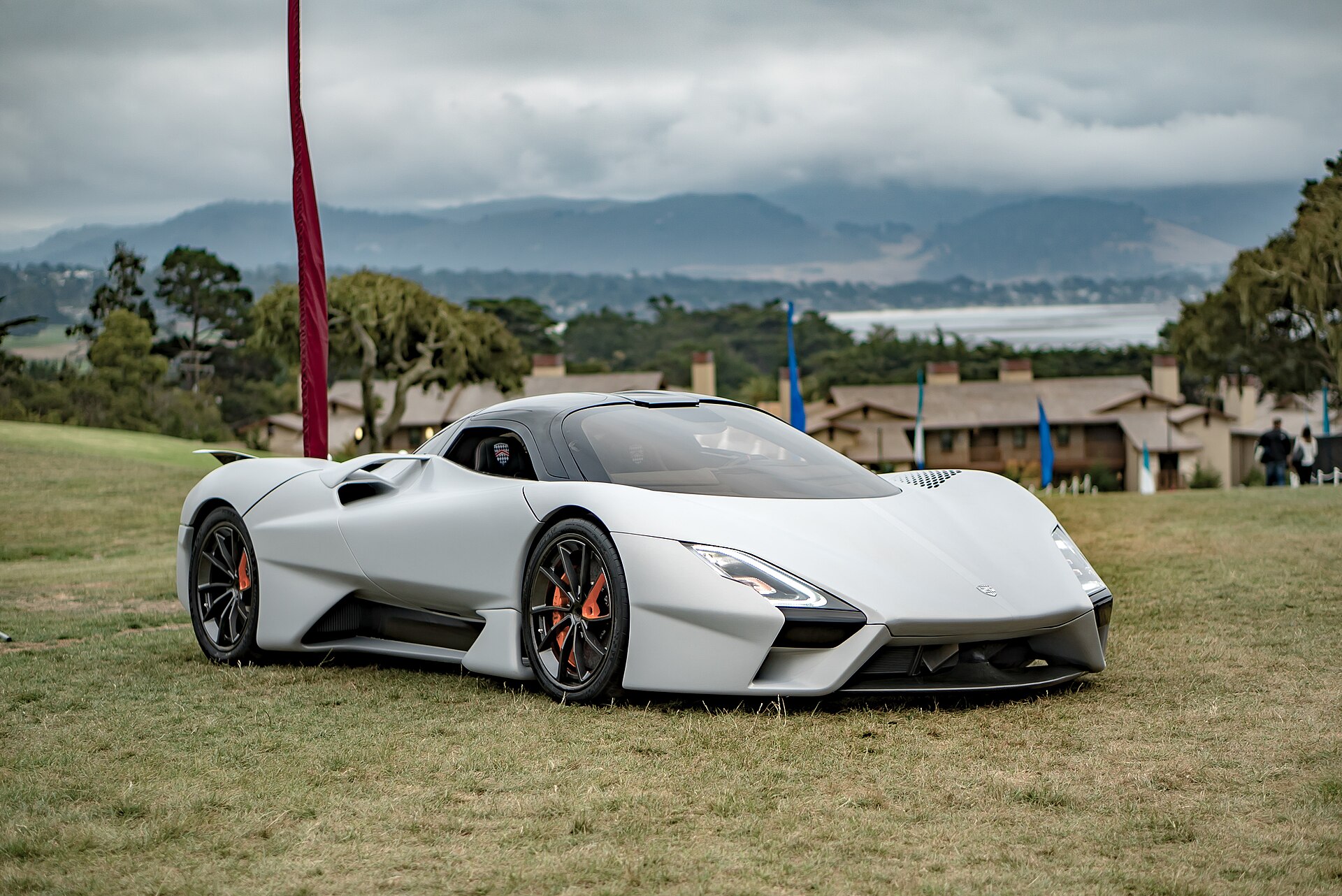
The Tuatara was designed by Jason Castriota, a former Pininfarina designer who worked on Ferrari and Maserati projects. Its body and monocoque are carbon fibre, and many exterior parts are left in bare carbon. The whole shape is devoted to aerodynamics, which in turn helps acceleration: the drag coefficient is just 0.279, which SSC says is the lowest in its class.
The car has smooth forms, large air intakes and plenty of sculpting that serves both practical and decorative purposes. The front is short, sharp and steeply raked, as the engine sits behind the occupants. The huge windscreen, also steeply raked, flows into the roof, with a single large wiper. Groups of small openings at its sides feed air towards the engine bay. There is no luggage compartment at the front. The bonnet is deeply recessed in the centre with raised, sculpted sides, and slim strip-shaped headlights flank the SSC badge at the tip of the nose. The lower front has a single large opening, split by a vertical body section, for cooling the brakes and radiators, all finished in gloss black.
The sides have stepped and wave-like sculpting and several intakes in the sills and towards the rear. The doors open together with sections of the roof. The windows also form part of the roof, the compact rectangular mirrors are mounted high up, and the door handles are barely visible at the rear of the doors. The Tuatara rides on 20-inch carbon-fibre wheels.
The rear is the widest part of the car, because it houses the engine. A triangular glass roof section sits above the engine, the body flares out over rear arches with many small vents, and active flaps and a spoiler at the tail improve stability under acceleration, cornering and braking. Most of the bumper is taken up by a fine-mesh diffuser divided into several sections, with distinctive lights and a twin central exhaust.
Interior
The cabin has climate control, a premium audio system and a steering wheel with paddle shifters, plus a touchscreen that controls entertainment functions, switches driving modes and runs diagnostics of the car's systems. SSC says the cabin was designed to be roomy, so that a person around 185 cm tall can sit comfortably wearing a racing helmet. Sports seats with good side support hold the occupants, and the air vents — plastic on early prototypes — are now aluminium. Carbon fibre and Alcantara are used throughout.
Engine and transmission
The Tuatara is powered by a 5.9-litre twin-turbocharged V8 with a flat-plane crankshaft, reduced from the 6.9 litres planned at first. On 91-octane petrol it produces 1,007 kW (1,369 PS) and 1,334 Nm; on E85 ethanol, 1,305 kW (1,774 PS) and 1,792 Nm. A non-road-legal methanol upgrade raises output even further.
Power goes to the rear wheels through a seven-speed automated manual gearbox from the Italian specialist CIMA, which SSC says shifts in under 100 milliseconds. The brakes are carbon-ceramic discs with six-piston calipers at the front and four-piston calipers at the rear.
Top-speed runs
SSC originally aimed for around 300 mph (about 483 km/h). In October 2020 it announced a two-way average of 316.11 mph (508.7 km/h), but the claim was widely disputed because of inconsistencies in the video evidence, and in July 2021 SSC acknowledged that the original attempt had not exceeded 300 mph. In January 2021, on the Space Florida runway at the Kennedy Space Center, a Tuatara achieved a verified two-way average of 282.9 mph (455.3 km/h). In May 2022 an owner reached a one-way speed of 295 mph (about 475 km/h), verified by GPS timing.
Versions
- Tuatara — the road car, limited to 100 units.
- Tuatara Striker — adds aerodynamic parts that generate about 500 kg of downforce.
- Tuatara Aggressor — shares the Striker's body and offers non-road-legal equipment such as racing seats and the highest-output engine; ten are planned.
Rivals
The Tuatara competes with the fastest cars in the world, including the Bugatti Chiron, Koenigsegg Jesko Absolut and Hennessey Venom F5.
SSC Tuatara in our rankings
- No. 2 of 154 · Most powerful V8 cars (1,300 kW)
- No. 2 of 154 · Most powerful American cars (1,300 kW)
- No. 2 of 106 · Most torque: coupes (1,800 Nm)
- No. 2 of 368 · Most torque: cars (1,800 Nm)
- No. 5 of 239 · Most powerful cars of the 2020s (1,300 kW)
- No. 6 of 313 · Most powerful coupes (1,300 kW)
More torque than 99% of ranked cars in the 1CARS catalog (No. 2 of 368).
FAQ
How powerful is the SSC Tuatara?
Its 5.9-litre twin-turbo V8 produces 1,007 kW (1,369 PS) on petrol and 1,305 kW (1,774 PS) on E85.
How fast is the SSC Tuatara?
Its verified two-way average is 455.3 km/h (282.9 mph), set in January 2021; an owner later reached about 475 km/h one way.
How many SSC Tuataras will be built?
100 cars, built in Richland, Washington.
Who designed the SSC Tuatara?
Jason Castriota, a former Pininfarina designer.
Data sources
Data checked by an editor against the sources below.