
 Pontiac GTO
All generations, specs and history
Updated Published Sources (6) Report an error
By Sarah Whitmore, Senior Automotive Writer Reviewed by Oleksandr Hnatiuk
- Built
- 1964–2006
- Generations
- 5
- Top power
- 298 kW (405 PS)
Timeline
GTO generations
Click a generation for its own page
- GTO I 1964–1967 · Coupe, Convertible · 198–270 kW (269–367 PS)
- GTO II 1968–1972 · Coupe, Convertible · 186–276 kW (253–375 PS)
- GTO III 1973 · Coupe · 172–186 kW (234–253 PS)
- GTO IV 1974 · Hatchback, Coupe · 149 kW (203 PS)
- GTO V 2004–2006 · Coupe · 261–298 kW (355–405 PS)
Newest first · 5 generations since 1964
-
2004

- 1974 IV 1974 · Hatchback, Coupe · 149 kW (203 PS)
- 1973 III 1973 · Coupe · 172–186 kW (234–253 PS)
-
1968

-
1964


All generations by year: GTO V (2004–2006) · GTO IV (1974) · GTO III (1973) · GTO II (1968–1972) · GTO I (1964–1967)
Which one is mine?
Pick the year of first registration to see which generation it is.
Check by VINVerdict: which Pontiac GTO to buy
Our verdict · Sarah Whitmore
The 1964 to 1967 cars are the purest GTOs and the most sought-after. A 1966 or 1967 with the 389 or 400 and Tri-Power or HO engine is a classic choice. A 1969–1970 Judge is one of the most sought-after second-generation cars, and originality and documented options matter a great deal. Because the early GTO was an option package on the LeMans, converted cars exist, so buyers should have the build documents of a car checked before paying a classic GTO price. The 1973 and 1974 cars are rare but less desirable. The 2004–2006 GTO offers modern V8 performance and reliability for a much lower outlay, though it looks less distinctive.
Rivals of the era included the Chevrolet Chevelle SS, the Plymouth Road Runner and the Plymouth Barracuda, while Pontiac's own Firebird took the pony-car role. Any two of them can be set side by side in the comparison tool. More classics of the decade are in the best classic cars of the 1960s and the 1960s classics.
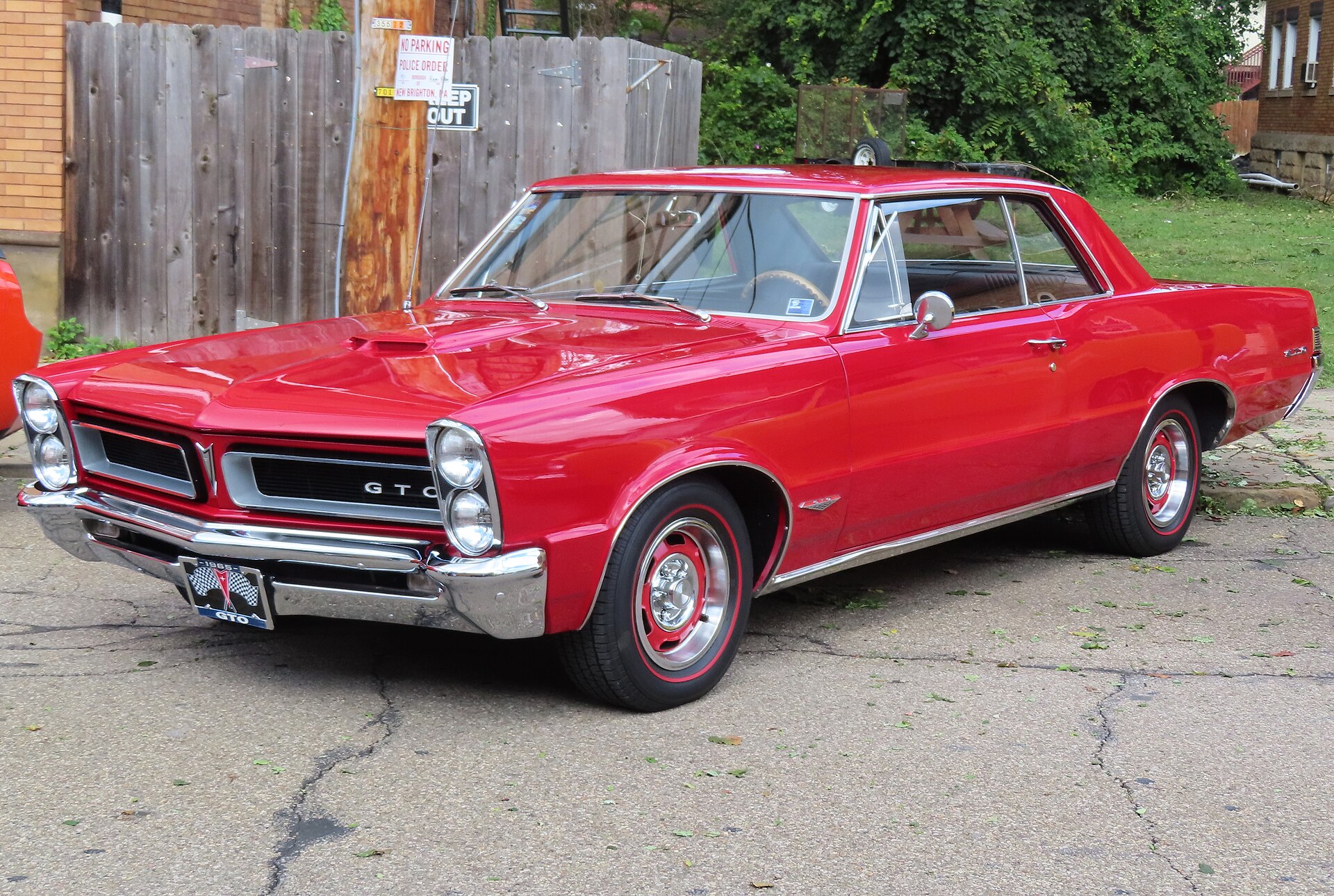
The Pontiac GTO is an American muscle car built from 1964 to 1974 and revived from 2004 to 2006. It began as an option package that put a big 389 cu in (6.4-litre) V8 into the mid-size Pontiac Tempest LeMans. Pontiac planned 5,000 cars for 1964 and sold 32,450, which set off the muscle-car boom of the 1960s.
In short
- 1964–1967: Tempest-based GTO with the 389 V8, from 242 kW (325 hp gross); 96,946 sold in 1966, the best year.
- 1968–1972: new body with the Endura nose, The Judge from 1969, 400 and 455 V8s up to 276 kW (370 hp gross).
- 1973 and 1974: Colonnade LeMans and compact Ventura versions with 149–186 kW (200–250 hp net) before the name was dropped.
- 2004–2006: Holden Monaro-based coupé built in Australia, 5.7 and 6.0 V8s with 261 and 298 kW (350 and 400 hp); 40,808 built.

Specs by version
Engines
| Version | Engine | Gearbox | Drive | Production years |
|---|---|---|---|---|
| GTO I · 6.4 265 kW (360 PS) | 6.4 l 6,400 cc | - | - | - |
| GTO IV · 350 V8 | 5.7 l · 8 cyl · Petrol 5,700 cc | - | - | 1974 |
| GTO V · 5.7 L 8 cyl Automatic 4-spd · 2004 (EPA) | 5.7 l · 8 cyl 5,700 cc | 4-sp Automatic | Rear-wheel drive | 2004 |
| GTO V · 5.7 L 8 cyl Manual 6-spd · 2004 (EPA) | 5.7 l · 8 cyl 5,700 cc | 6-sp Manual | Rear-wheel drive | 2004 |
| GTO V · 6 L 8 cyl Automatic 4-spd · 2006 (EPA) | 6.0 l · 8 cyl 6,000 cc | 4-sp Automatic | Rear-wheel drive | 2006 |
| GTO V · 6 L 8 cyl Manual 6-spd · 2006 (EPA) | 6.0 l · 8 cyl 6,000 cc | 6-sp Manual | Rear-wheel drive | 2006 |
| GTO V · 6 L 8 cyl Automatic 4-spd · 2005 (EPA) | 6.0 l · 8 cyl 6,000 cc | 4-sp Automatic | Rear-wheel drive | 2005 |
| GTO V · 6 L 8 cyl Manual 6-spd · 2005 (EPA) | 6.0 l · 8 cyl 6,000 cc | 6-sp Manual | Rear-wheel drive | 2005 |
Performance
Show all 6 versions
| Version | Fuel consumption |
|---|---|
| GTO V · 5.7 L 8 cyl Automatic 4-spd · 2004 (EPA) | 13.8 l/100 km17.0 mpg US · 20.5 mpg UK |
| GTO V · 5.7 L 8 cyl Manual 6-spd · 2004 (EPA) | 12.4 l/100 km19.0 mpg US · 22.8 mpg UK |
| GTO V · 6 L 8 cyl Automatic 4-spd · 2006 (EPA) | 14.7 l/100 km16.0 mpg US · 19.2 mpg UK |
| GTO V · 6 L 8 cyl Manual 6-spd · 2006 (EPA) | 13.1 l/100 km18.0 mpg US · 21.6 mpg UK |
| GTO V · 6 L 8 cyl Automatic 4-spd · 2005 (EPA) | 14.7 l/100 km16.0 mpg US · 19.2 mpg UK |
| GTO V · 6 L 8 cyl Manual 6-spd · 2005 (EPA) | 13.1 l/100 km18.0 mpg US · 21.6 mpg UK |
Verified Manufacturer and type-approval data from our catalog · Sources and methodology
Pontiac GTO generations
| Generation | Years | Basis | Engines | Power (kW / hp) |
|---|---|---|---|---|
| First | 1964–1967 | Tempest / LeMans (A-body) | 389 and 400 V8 | 198–270 kW (265–360 hp gross) |
| Second | 1968–1972 | LeMans (A-body), new body | 400 and 455 V8 | 186–276 kW (250 net–370 hp gross) |
| Third | 1973 | Colonnade LeMans | 400 and 455 V8 | 172–186 kW (230–250 hp net) |
| Fourth | 1974 | Ventura (X-body) | 350 V8 | 149 kW (200 hp net) |
| Fifth | 2004–2006 | Holden Monaro (Australia) | 5.7 LS1 and 6.0 LS2 V8 | 261–298 kW (350–400 hp) |
Gross ratings were used until 1971 and net ratings from 1972, so the drop in the table partly reflects the new way of measuring. The story of the brand is in Pontiac's history.

Origins: an option package that broke the rules (1964)
The GTO is credited to John DeLorean, Bill Collins and Russ Gee, with Jim Wangers of Pontiac's advertising agency promoting it. The team offered the big 389 V8 as an option package on the Tempest LeMans rather than as a separate model. Production began on 3 September 1963 for the 1964 model year. The name came from the Ferrari 250 GTO, the initials standing for Gran Turismo Omologato.

The package added sports tyres, quicker steering and dual exhausts to the 389 V8, and a low price did the rest. Pontiac had planned 5,000 cars and sold 32,450 in the first year. Of these, 24,205 had the four-barrel 389 and 8,245 the Tri-Power version with three two-barrel carburettors; by our count, the more powerful option made up about 25% of first-year sales.
First generation (1964–1967)
| Year | Engine | Power (SAE gross) |
|---|---|---|
| 1964 | 389 V8 (6.4 l), four-barrel | 242 kW (325 hp) |
| 1964 | 389 V8 Tri-Power | 260 kW (348 hp) |
| 1965 | 389 V8 / Tri-Power | 250 / 268 kW (335 / 360 hp) |
| 1967 | 400 V8 (6.6 l) economy / standard / HO | 198 / 250 / 268 kW (265 / 335 / 360 hp) |
For 1965 the car received a new body with vertically stacked quad headlights. In 1966 the GTO became a model in its own right and had its best year, with 96,946 cars sold. Compared with 1964, that was 199% more. The 1966–1967 cars have the "Coke bottle" side profile with curved rear wings. In 1967 the 389 was enlarged to 400 cu in. A bonnet-mounted tachometer, lit at night, arrived as an option. Buyers could choose three- and four-speed manual gearboxes or two- and later three-speed automatics.

Second generation (1968–1972)
The 1968 GTO had a new body and a body-coloured Endura front bumper made of energy-absorbing plastic, which could take small knocks without damage. Hidden headlights were optional but fitted to most cars. The 1968 GTO was Motor Trend's Car of the Year, and 87,684 were built.

| Year | Engine | Power |
|---|---|---|
| 1968 | 400 V8 | 261 kW (350 hp gross) |
| 1969 | 400 Ram Air III / Ram Air IV | 273 / 276 kW (366 / 370 hp gross) |
| 1970 | 455 V8 HO (7.5 l) | 268 kW (360 hp gross) |
| 1971 | 400 / 455 HO | 224 / 250 kW (300 / 335 hp gross) |
| 1972 | 400 / 455 HO | 186 / 224 kW (250 / 300 hp net) |
In 1969 Pontiac added The Judge, a performance and appearance package. It accounted for 6,833 of the 72,287 GTOs sold that year, or about 9.5%, and returned in 1970, when Pontiac built 3,797 Judges, and in 1971. From 1969 the ignition lock moved to the steering column as an anti-theft measure. Tighter emissions rules and higher insurance costs for muscle cars cut output and demand from 1971, and in 1972 the GTO became an option package on the LeMans again.
Gross and net horsepower explained
Pontiac, like other American makers, quoted SAE gross horsepower until 1971. Gross figures were measured on an engine running on a test stand without the full exhaust system, air cleaner and driven accessories, so they flattered the output. From 1972 the industry switched to SAE net ratings, measured with the engine as installed in the car. That change explains part of the fall from 276 kW (370 hp) in 1969 to 186–224 kW (250–300 hp) in 1972; tighter emissions rules explain the rest. Comparing a 1969 and a 1972 GTO on paper therefore overstates the real difference.

| Rating system | Years | Typical GTO figure |
|---|---|---|
| SAE gross | 1964–1971 | 242–276 kW (325–370 hp) |
| SAE net | 1972–1974 | 149–224 kW (200–300 hp) |
The final years: 1973 and 1974
For 1973 the GTO moved to the new Colonnade-style LeMans body with a 400 V8 of 172 kW (230 hp net) or a 455 with 186 kW (250 hp net), and sales fell to 4,806. In 1974 Pontiac moved the name to the compact Ventura, with a 350 V8 (5.7 l) of 149 kW (200 hp net); 7,058 were sold. The option was then dropped, and the muscle-car era ended with it.

Production by year
| Year | Built |
|---|---|
| 1964 | 32,450 |
| 1965 | 75,352 |
| 1966 | 96,946 |
| 1967 | 81,722 |
| 1968 | 87,684 |
| 1969 | 72,287 |
| 1970 | 40,149 |
| 1973 | 4,806 |
| 1974 | 7,058 |
| 2004–2006 | 40,808 |
By our count, the classic years listed here add up to more than 498,000 cars, and 1971–1972 production comes on top.

The 2004–2006 GTO revival
The name returned in 2004 on a coupé imported from GM's Australian division Holden, based on the Holden Monaro and built at Holden's Elizabeth plant. It had rear-wheel drive and a GM V8. The 2004 car used the 5.7-litre LS1 with 261 kW (350 hp). From 2005 the 6.0-litre LS2 gave 298 kW (400 hp), 37 kW more. Of 15,728 cars imported for 2004, 13,569 were sold. Production was 11,069 in 2005 and 13,948 in 2006. GM stopped imports in September 2006 because the car would not meet new airbag rules for 2007. The last GTO was built on 14 June 2006. Compared with the 1974 Ventura-based car, the 2005 GTO had twice the power: 298 kW against 149 kW.

Pontiac GTO evolution in numbers
Did you know?
- The Pontiac GTO ran for 42 years, from 1964 to 2006, over 5 generations in our catalog.
- The longest-running generation is the GTO II (1968–1972): 4 years.
- The biggest jump in power came with the GTO V: up to 298 kW (405 PS), 149 kW more than the GTO IV.
Most powerful version, kW
Figures from the 1cars catalog: power is the strongest version of each generation; generations without the figure are left out.
Pontiac GTO: first vs latest generation
| Spec | GTO I | GTO V | Change |
|---|---|---|---|
| Years | 1964–1967 | 2004–2006 | 40 years apart |
| Most powerful version | 270 kW (367 PS) | 298 kW (405 PS) | +28 kW (+10%) |
Oldest and newest generation in the 1cars catalog. Power is the strongest version of each; other rows are shown only when both generations have the figure.
Rivals
Compare with…
Compare Pontiac GTO with
- Ford Gran Torino quick spec comparison
- Dodge Charger Daytona quick spec comparison


Pontiac GTO in our rankings
- No. 72 of 627 · Biggest engines: cars (6,400 cc · top 12%)
- No. 24 of 97 · Most powerful cars of the 1960s (270 kW · top 25%)
- No. 97 of 411 · Cars with the most generations (5 generations · top 25%)
- No. 52 of 201 · Most powerful cars of the 2000s (298 kW · top 26%)
- No. 318 of 1011 · Most powerful cars (298 kW · top 32%)
- No. 59 of 181 · Biggest engines: coupes (6,000 cc · top 33%)
Bigger engine than 88% of ranked cars in the 1CARS catalog (No. 72 of 627).
Pontiac GTO photos 14


Pontiac GTO videos 2

Test drive

Video overview
FAQ
What does GTO stand for?
GTO stands for Gran Turismo Omologato, Italian for a grand touring car homologated for racing. Pontiac took the name from the Ferrari 250 GTO when it launched its muscle car in 1964.
Was the Pontiac GTO the first muscle car?
The 1964 GTO is widely regarded as the car that started the muscle-car boom. It put a big 389 V8 into a mid-size body at a low price, and its sales of 32,450 in the first year prompted rivals to follow.
What engines did the Pontiac GTO have?
The classic GTO used V8s of 389, 400, 455 and finally 350 cu in, from 149 kW (200 hp net) to 276 kW (370 hp gross). The 2004–2006 car had a 5.7 LS1 or 6.0 LS2 with up to 298 kW (400 hp).
How many Pontiac GTOs were made?
Adding up the published yearly figures gives more than 498,000 classic GTOs from 1964 to 1974, not counting 1971 and 1972. The 2004–2006 revival added 40,808 cars built in Australia.
What is the Pontiac GTO Judge?
The Judge was a performance and appearance package offered from 1969 to 1971. In 1969 it made up 6,833 of the 72,287 GTOs sold, and in 1970 Pontiac built 3,797 Judges.
Data sources
Data checked by an editor against the sources below.
- The text of this article (1cars archive)
- Wikipedia - Pontiac GTO
- US EPA fueleconomy.gov - 21855.shtml
- US EPA fueleconomy.gov - 21856.shtml
- US EPA fueleconomy.gov - 21556.shtml
- US EPA fueleconomy.gov - 20763.shtml


