
 Pontiac Bonneville Special
Specs, engines and history
Updated Published Sources (3) Report an error
By Sarah Whitmore, Senior Automotive Writer Reviewed by Oleksandr Hnatiuk

- Built
- 1954
- Top power
- 172 kW (234 PS)
The Pontiac Bonneville Special is a two-seat concept car that General Motors built for its 1954 Motorama show. Only two were made, one metallic bronze and one emerald green. Harley Earl conceived the car, and designers Homer LaGassey and Paul Gillan shaped it. It had a fibreglass body, a Plexiglas bubble canopy and a tuned 4.4-litre straight-eight rated at 172 kW (230 hp). It also gave Pontiac the Bonneville name.
In short
- Built for GM's travelling Motorama in 1954 and shown first at the Waldorf-Astoria in New York.
- A sports-racer shape with gull-wing roof panels, tail fins and a jet-style spare-wheel housing.
- Engine: Pontiac's 268 cu in straight-eight with four carburettors, almost doubled in output.
- Both cars survive; the restored green one changed hands for over three million US dollars in 2006.

Size at a glance
| Dimensions | Pontiac Bonneville Special |
|---|---|
| Length | 4,021 mm158.3 in |
| Height | 1,219 mm48.0 in |
| Wheelbase | 2,540 mm100.0 in |
Specs by version
Engines
Dimensions and weight
Verified Manufacturer and type-approval data from our catalog · Sources and methodology
Bonneville Special in brief

| Fact | Value |
|---|---|
| Maker | Pontiac Motor Division, General Motors |
| Type | two-seat concept car (show car) |
| Year | 1954 |
| Number built | 2 (metallic bronze and emerald green) |
| Concept by | Harley J. Earl, GM vice-president of styling |
| Designed and built by | Homer C. LaGassey Jr. and Paul Gillan |
| First shown | GM Motorama, Waldorf-Astoria, New York, January 1954 |
| Body | fibreglass, Plexiglas canopy |
| Engine | 4.4-litre (268 cu in) straight-eight, 172 kW (230 hp) |
| Name | after the Bonneville Salt Flats in Utah |
Development: a dream car for the Motorama
General Motors ran its Motorama from 1953 to 1961. It was a touring show of new models and futuristic "dream cars", and the 1954 edition visited six cities with 13 new concepts. Harley Earl, who led GM styling for 31 years, gave each division its own dream cars. For Pontiac, he imagined a low two-seat sports-racer.
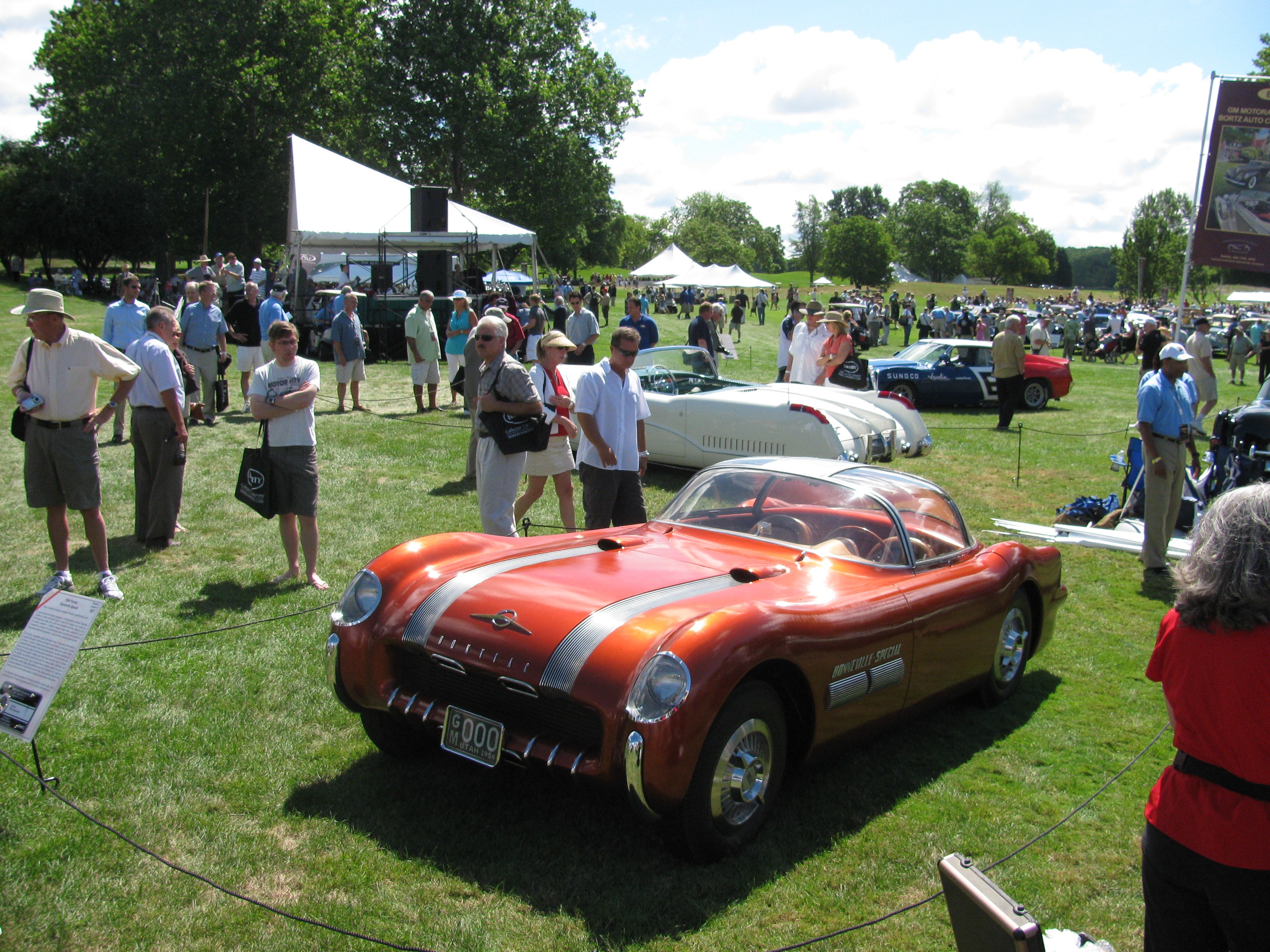
Earl took the idea from a trip to the Bonneville Salt Flats in Utah, where he watched speed trials. Homer LaGassey and Pontiac chief designer Paul Gillan turned it into a full-size car. The old 1cars text credits LaGassey with the wings that seem to hug the wheels. A wind tunnel helped refine the lines.
The two cars may not have been built at exactly the same time. One account says the bronze car appeared in New York in January 1954 and the green car at the Pan-Pacific Auditorium in Los Angeles around March. Another says both were unveiled together. The Motorama also stopped at the International Amphitheatre in Chicago from 24 April to 2 May 1954.
According to SlashGear, the build cost was between 350,000 and 400,000 US dollars in 1953 money. It is not clear whether that figure covers one car or both. For years GM's records showed only one Bonneville Special, until the second car surfaced in the late 1980s.
Fibreglass body and bubble canopy
The body was made of fibreglass, like the Chevrolet Corvette shown at the Motorama a year earlier. It was very compact: 4,021 mm (158.3 in) long on a 2,540 mm (100 in) wheelbase. By our calculation, that is about 221 mm shorter than a 1954 Corvette, which measured 167 inches.

The most striking feature is the Plexiglas canopy. Its roof panels opened upwards like gull wings, while the frameless doors were hinged in the normal way. According to the old 1cars text, the doors had no external handles and opened with a button near the window.
Several details became Pontiac trademarks. Two five-band chrome "Silver Streaks" ran over the bonnet, a Pontiac feature since 1935. Rectangular louvres sat on each wing, and the headlights were recessed behind glass covers. At the rear, small tail fins framed a round housing for the spare wheel, which looked like the exhaust of a jet engine.
Cabin and instruments
The cockpit looked like an aircraft's. A large central pod held a speedometer reading to 120 mph (193 km/h). To its right sat smaller round dials in brushed stainless steel for the ammeter, fuel level, manifold temperature, oil pressure, fuel pressure and oil temperature.

A centre console carried a small lever for the automatic gearbox, two levers for the ventilation and the ignition key. The two wide bucket seats were trimmed in leather, bronze in the bronze car, and the driver held a three-spoke racing-style wheel. The old 1cars text describes the dashboard's purely horizontal layout as giving the cabin a futuristic look.
A tuned straight-eight instead of a V8
Pontiac had planned a V8, but its new engine was not ready in 1954. Instead, the car used the brand's familiar 268 cu in (4.4-litre) straight-eight, bored out and fitted with high-compression heads. A long-duration camshaft and four Carter YH side-draft single-barrel carburettors helped it breathe. The cylinder head was chrome-plated, and the engine and carburettors were painted bright red for the shows.
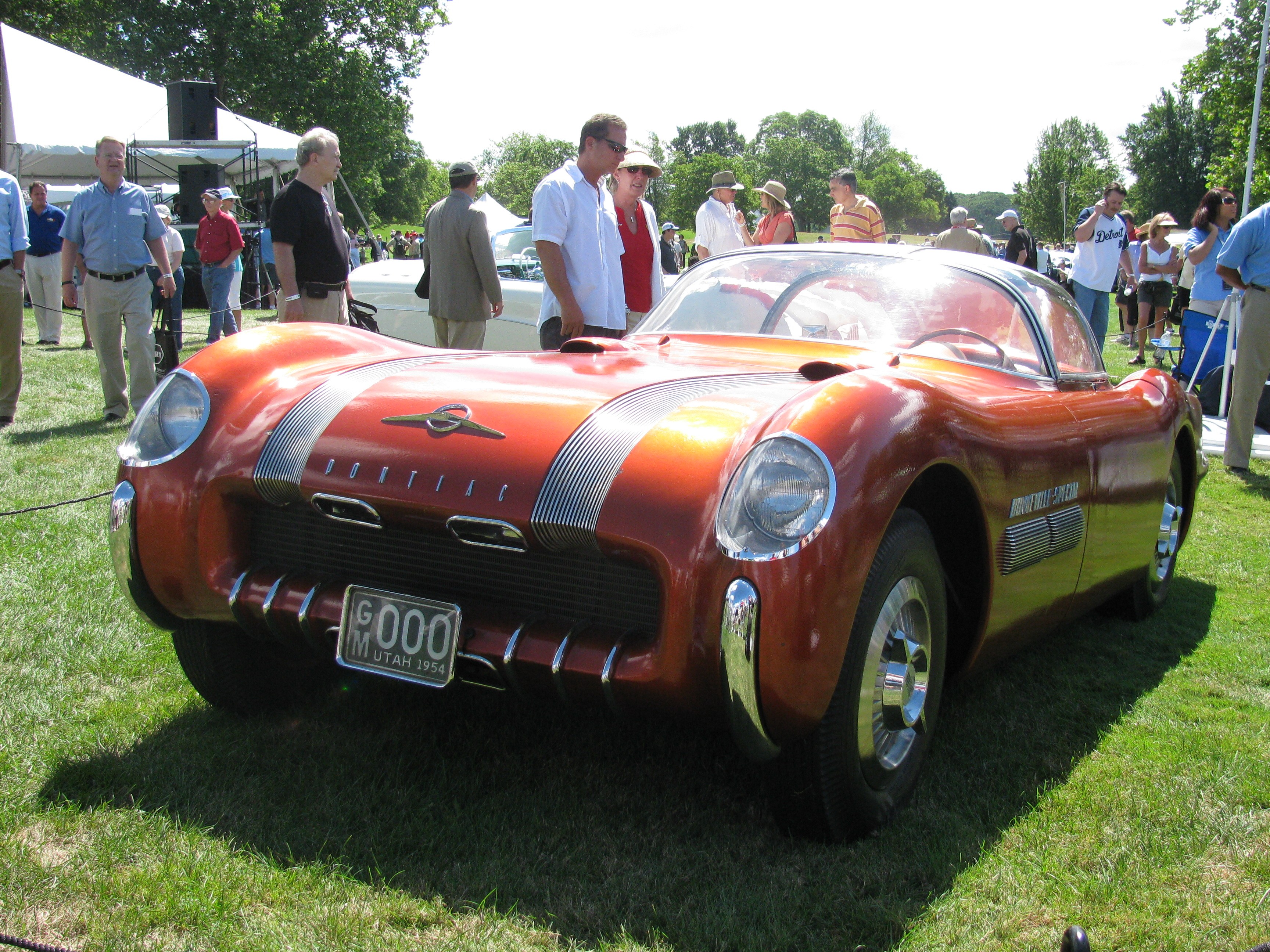
Pontiac claimed 172 kW (230 hp), the highest rating ever given to its eight-cylinder engine. A standard version of the engine gave about 91 kW (122 hp), so by our calculation the show car nearly doubled the output, a gain of about 89 %. Some observers believed the real figure was closer to 220 kW (300 hp). Power went to the rear wheels through a four-speed Hydra-Matic automatic.
To translate period horsepower ratings into kilowatts, use the 1cars power converter. The old 1cars text gave the output as 209 hp and also mentioned a manual gearbox, but the published GM data show 230 hp and the Hydra-Matic only.
Technical data of the 1954 show car

| Parameter | Metric | Imperial |
|---|---|---|
| Engine | straight-eight, 4.4 l, four carburettors | 268 cu in |
| Power (claimed) | 172 kW | 230 hp |
| Gearbox | 4-speed Hydra-Matic automatic | - |
| Drive | rear-wheel drive | - |
| Body | fibreglass two-seater with Plexiglas canopy | - |
| Length | 4,021 mm | 158.3 in |
| Wheelbase | 2,540 mm | 100 in |
| Height | about 1,220–1,230 mm | 48–48.5 in |
| Speedometer range | 0–193 km/h | 0–120 mph |
| Colours | metallic bronze; emerald green | - |
Timeline of the two cars

| Year | Event |
|---|---|
| 1953 | design and build for the 1954 Motorama |
| 1954 | shown in New York (January), Los Angeles and Chicago (April–May) |
| 1957 | Pontiac launches the production Bonneville |
| 1958 | bronze car loaned to the Detroit Historical Society |
| 1985 | Joe Bortz buys the bronze car |
| late 1980s | the green car resurfaces and joins the Bortz collection |
| 2005 | last production Bonneville built, ending the name after 47 years |
| 2006 | green car sells at Barrett-Jackson for 3.08 million US dollars |
| 2015 | a Bonneville Special sells for a reported 3.3 million US dollars |
Legacy: from show car to production Pontiacs
The Bonneville Special never went into production, but its ideas did. The Silver Streaks stayed on the 1955 and 1956 Chieftain and Star Chief. Softer versions of its tail fins appeared on the same cars. The Strato-Streak V8 that the show car had missed arrived in 1955 with 129 kW (173 hp).

The name had the longest life. In 1957 Pontiac launched the Bonneville as a limited fuel-injected convertible, with about 630 built. It had vertical wing slits inspired by the show car's louvres. The 1958 Bonneville used a stainless-steel dashboard style taken from the Special, and the finned wheel covers led to Pontiac's eight-lug aluminium wheels of 1960. The Bonneville name ran on full-size Pontiacs until 2005. The whole story of the brand is in the history of Pontiac.
Where the two cars are now
Both cars survive. In 1958 the bronze car went on loan to the Detroit Historical Society, where it stayed until 1985. That year the collector Joe Bortz bought it for his concept-car collection. He added the green car a few years later, after a call in the late 1980s told him where it was.

The bronze car remains unrestored. It has covered only 474.2 miles, and its owner has claimed that about 90 % of the air in its tyres dates from 1954. It has been displayed at the Petersen Automotive Museum in Los Angeles, in an exhibition of Motorama dream cars from the Bortz collection.
The restored green car sold at the 2006 Barrett-Jackson auction to an anonymous buyer. The hammer price was 2.8 million US dollars, or 3.08 million including fees (about €2.5 million at the time). A further sale in 2015 was reported at 3.3 million US dollars (about €2.8 million). That makes the Bonneville Special the most expensive Pontiac ever sold, and the old 1cars text also gave a value of about 3.3 million.
Collecting value and why it matters
The Bonneville Special is one of the few surviving GM Motorama dream cars, because many show cars of the period were later scrapped. It links the 1953 Corvette, Pontiac's later performance image and the jet-age styling of the late 1950s. For collectors, originality matters: the unrestored bronze car is valued for its untouched condition, the green car for its quality restoration.

Among its contemporaries, the Chevrolet Corvette C1 is the obvious comparison. The history of the Corvette shows how GM turned a Motorama car into a production model, and other Pontiacs are listed on the Pontiac catalogue page. More 1950s cars are in the 1cars classics of the 1950s, and the size comparison tool helps put a 4-metre sports car into perspective.
Pontiac Bonneville Special in our rankings
- No. 10 of 32 · Smallest convertibles and roadsters (4,021 mm)
- No. 55 of 531 · Smallest cars (4,021 mm · top 11%)
- No. 180 of 627 · Biggest engines: cars (4,400 cc · top 29%)
- No. 17 of 49 · Biggest engines: convertibles and roadsters (4,400 cc · top 35%)
- No. 49 of 81 · Most powerful convertibles and roadsters (172 kW · top 61%)
- No. 629 of 1011 · Most powerful cars (172 kW · top 63%)
Shorter than 89% of ranked cars in the 1CARS catalog (No. 55 of 531).
Pontiac Bonneville Special photos 13


Pontiac Bonneville Special videos 2

Pontiac Bonneville Special video 1

Pontiac Bonneville Special video 2
FAQ
How many Pontiac Bonneville Specials were built?
Two. GM made a metallic bronze car and an emerald green one for the 1954 show season. Its own files listed a single example for decades, and both cars are now known to survive.
What engine did the Bonneville Special have?
It used Pontiac's 268 cu in (4.4-litre) straight-eight, tuned with four side-draft carburettors, a long-duration camshaft and high compression. Pontiac rated it at 172 kW (230 hp), with a four-speed Hydra-Matic automatic.
Who designed the Pontiac Bonneville Special?
The idea came from Harley Earl, GM's head of styling. The detailed design and the hand-built bodies were the work of Homer LaGassey together with Pontiac's chief designer, Paul Gillan.
How much is a Pontiac Bonneville Special worth?
Public sales put it in the multi-million class. The restored green car fetched just over three million US dollars with fees in 2006, and a later deal in 2015 reportedly reached 3.3 million, a record for the brand.
Why is it called Bonneville?
The name honours the salt-flat speed course in Utah that inspired Earl. It was the first GM car to carry it, and Pontiac reused the name on production models from 1957 to 2005.
Data sources
Data checked by an editor against the sources below.
- The text of this article (1cars archive)
- Wikipedia - Pontiac Bonneville
- Wikipedia - Pontiac Bonneville Special


