 Pontiac Firebird
All generations, specs and history
Updated Published Sources (6) Report an error
By Sarah Whitmore, Senior Automotive Writer Reviewed by Oleksandr Hnatiuk

- Built
- 1967–2002
- Generations
- 4
- Top power
- 276 kW (375 PS)
- Used price today
- about €6,000–19,000 (AutoScout24, Nov 2026)
Timeline
Firebird generations
Click a generation for its own page
- Firebird I 1967–1969 · Coupe, Convertible · 123–257 kW (167–349 PS)
- Firebird II 1970–1981 · Coupe · 75–276 kW (102–375 PS)
- Firebird III 1982–1992 · Hatchback · 67–186 kW (91–253 PS)
- Firebird IV 1993–2002 · Coupe, Convertible · 119–257 kW (162–349 PS)
Newest first · 4 generations since 1967
-
1993

-
1982

-
1970

-
1967


All generations by year: Firebird IV (1993–2002) · Firebird III (1982–1992) · Firebird II (1970–1981) · Firebird I (1967–1969)
Which one is mine?
Pick the year of first registration to see which generation it is.
- Firebird IV 1993–2002
- Firebird III 1982–1992
- Firebird II 1970–1981
- Firebird I 1967–1969
Which Pontiac Firebird to buy
Our verdict · Sarah Whitmore
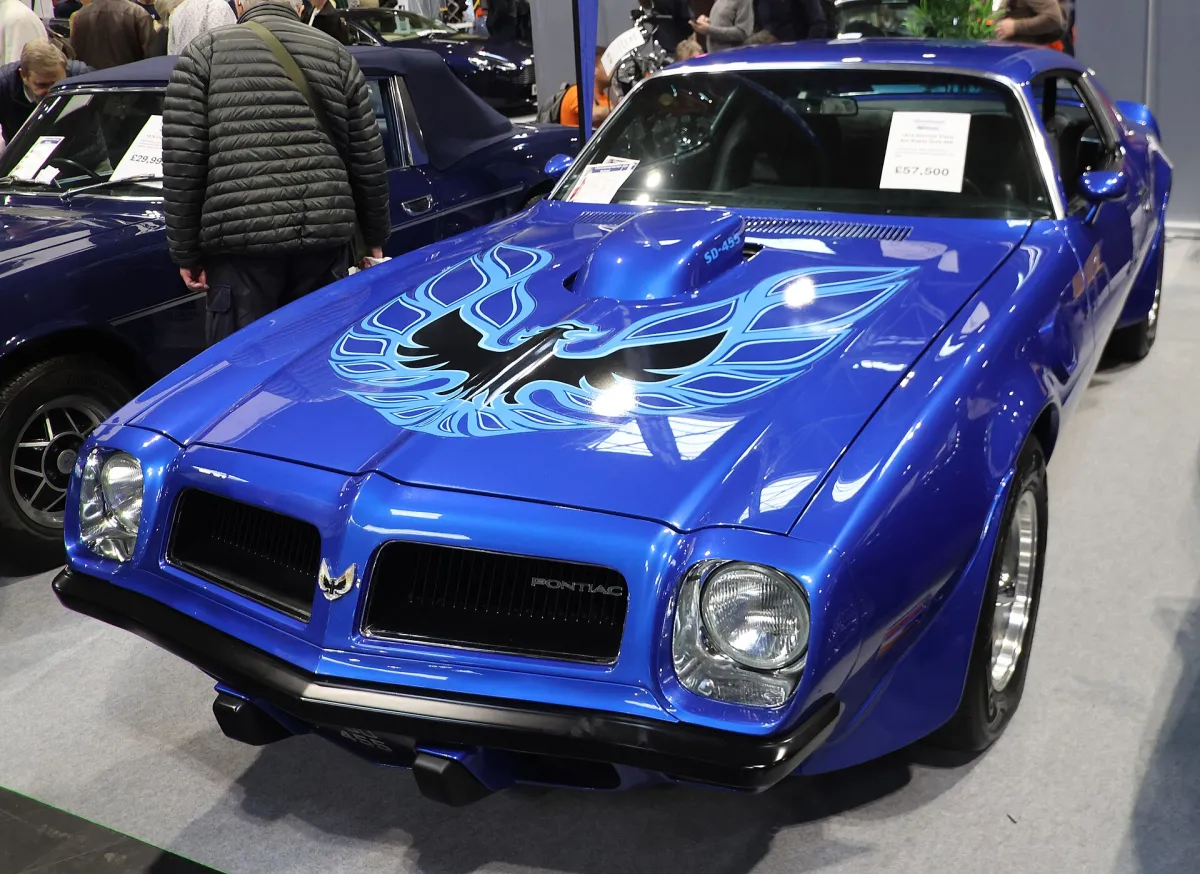
For a classic to show and enjoy, the second-generation Trans Am of 1977–1979 is the most recognisable choice, and the 1973–1974 Super Duty 455 is the most valuable of that era. For driving, the 1998–2002 Trans Am WS6 with the LS1 V8 is the fastest and most usable Firebird, with modern reliability. The 1989 Turbo Trans Am is a rare collector's car. The first Firebirds and the 1969 Trans Am are for experienced collectors with deep pockets. All Pontiac models on 1cars are in the Pontiac catalogue, other cars of the period are collected in the 1970s classics section, and any two can be put side by side in the 1cars comparison tool.
The Pontiac Firebird is a rear-wheel-drive pony car built by General Motors from 23 February 1967 to 30 August 2002 on the F-body platform shared with the Chevrolet Camaro. Over four generations it offered six-cylinder and V8 engines, from a 123 kW overhead-cam six to the 242 kW LS1 V8, and the Trans Am became its best-known version.
In short
- Generations: 1967–1969, 1970–1981, 1982–1992 and 1993–2002; coupé throughout, convertible in 1967–1969 and again from 1989.
- Best year: 1979, with 211,453 Firebirds built, more than half of them Trans Ams.
- Landmark versions: the 1969 Trans Am, the 1973 Super Duty 455, the 1977 "Smokey and the Bandit" Trans Am, the 1989 Turbo Trans Am and the LS1 WS6.
- Power figures before 1972 are gross SAE ratings; later figures are net and look lower.

Specs by version
Engines
| Version | Engine | Gearbox | Drive | Production years |
|---|---|---|---|---|
| Firebird IV · 3.8 L 6 cyl Automatic 4-spd · 2002 (EPA) | 3.8 l · 6 cyl 3,800 cc | 4-sp Automatic | Rear-wheel drive | 2002 |
| Firebird IV · 3.8 L 6 cyl Manual 5-spd · 2002 (EPA) | 3.8 l · 6 cyl 3,800 cc | 5-sp Manual | Rear-wheel drive | 2002 |
| Firebird IV · 5.7 L 8 cyl Automatic 4-spd · 2002 (EPA) | 5.7 l · 8 cyl 5,700 cc | 4-sp Automatic | Rear-wheel drive | 2002 |
| Firebird IV · 5.7 L 8 cyl Manual 6-spd · 2002 (EPA) | 5.7 l · 8 cyl 5,700 cc | 6-sp Manual | Rear-wheel drive | 2002 |
| Firebird IV · 3.4 V6 | 3.4 l · 6 cyl · Petrol 3,400 cc | - | Rear-wheel drive | 1993–1995 |
Performance
Show all 5 versions
| Version | Fuel consumption |
|---|---|
| Firebird IV · 3.8 L 6 cyl Automatic 4-spd · 2002 (EPA) | 11.2 l/100 km21.0 mpg US · 25.2 mpg UK |
| Firebird IV · 3.8 L 6 cyl Manual 5-spd · 2002 (EPA) | 11.2 l/100 km21.0 mpg US · 25.2 mpg UK |
| Firebird IV · 5.7 L 8 cyl Automatic 4-spd · 2002 (EPA) | 12.4 l/100 km19.0 mpg US · 22.8 mpg UK |
| Firebird IV · 5.7 L 8 cyl Manual 6-spd · 2002 (EPA) | 11.8 l/100 km19.9 mpg US · 23.9 mpg UK |
| Firebird IV · 3.4 V6 | - |
Dimensions and weight
Verified Manufacturer and type-approval data from our catalog · Sources and methodology
Pontiac Firebird at a glance
Pontiac launched the Firebird a few months after Chevrolet's Camaro, as its answer to the Ford Mustang. Both cars shared the F-body structure, but Pontiac gave the Firebird its own front end, interior and, in early years, its own engines. Assembly took place mainly at Norwood, Ohio, and at Van Nuys, California; from 1972 to 1977 Norwood was the only Firebird plant.

| Generation | Years | Body styles | Engines | Power (kW / hp) |
|---|---|---|---|---|
| First | 1967–1969 | Coupé, convertible | 3.8 OHC I6, 5.3–6.6 V8 | 123–257 kW (165–345 hp, gross) |
| Second | 1970–1981 | Coupé | I6, V6, 4.9–7.5 V8, 301 Turbo | up to 216 kW (290 hp, net) for the SD-455 |
| Third | 1982–1992 | Hatchback coupé, convertible from 1989 | I4, 2.8–3.1 V6, 5.0–5.7 V8, 3.8 turbo V6 | up to 186 kW (250 hp) |
| Fourth | 1993–2002 | Coupé, T-top, convertible | 3.4 and 3.8 V6, 5.7 LT1 and LS1 V8 | up to 242 kW (325 hp) |
First generation (1967–1969): six-cylinder and Ram Air V8
The first Firebird was offered as a two-door hardtop coupé and a convertible. Its base engine was unusual for an American car of the time: a 230 cu in (3.8-litre) overhead-camshaft straight-six of 123 kW (165 hp). The V8 range ran up to the 400 cu in (6.6-litre) with 242 kW (325 hp), and Ram Air versions used working bonnet scoops. The 1969 Ram Air IV produced 257 kW (345 hp).

Production was 82,560 in 1967, 107,112 in 1968 and 87,708 in 1969. In 1969 Pontiac added the Trans Am, a handling and appearance package named after the SCCA racing series. Only 689 hardtops and 8 convertibles were built that year, which makes the first Trans Am one of the rarest Pontiacs.
Second generation (1970–1981): Super Duty and the Bandit years
The second Firebird arrived in early 1970 as a coupé only, with a longer, lower and wider-looking body. Emission rules soon cut engine outputs, but Pontiac kept performance alive longer than most: the 1973–1974 Super Duty 455 produced 216 kW (290 hp) net, an unusually high figure for that era. The 455 High Output engine was another strong option.

The turning point for sales was the 1977 film "Smokey and the Bandit", which starred a black-and-gold 1977 Trans Am. Production rose year after year, from 48,739 in 1970 to a record 211,453 in 1979, when about 117,000 Trans Ams were sold; by our count, that means more than half of all 1979 Firebirds were Trans Ams. Special editions included the 1976 50th anniversary Trans Am and the 1979 10th Anniversary Trans Am, of which 7,500 were built. For 1980–1981, Pontiac offered a turbocharged 301 cu in (4.9-litre) V8 with 157 kW (210 hp), as sales fell to 70,899 in 1981.
Third generation (1982–1992): lighter, aerodynamic and turbocharged
The 1982 Firebird was smaller, lighter and more aerodynamic, with pop-up headlamps and a large glass hatch. Engines ranged from a four-cylinder to V6 and V8 units, and from 1987 the 5.7-litre L98 V8 gave 175 kW (235 hp). A convertible returned in 1989, and a notchback option of 1988 found only 718 buyers.
The most famous car of this generation is the 1989 20th Anniversary Turbo Trans Am. It used a Buick-sourced 3.8-litre turbocharged V6 officially rated at 186 kW (250 hp), though independent dyno tests often showed more than 300 hp. Only 1,555 were built, and one was chosen as the pace car of the Indianapolis 500. This generation is also the Firebird most people know from the television series "Knight Rider".
Fourth generation (1993–2002): LT1 and LS1 V8 power
The last Firebird appeared for the 1993 model year with a smooth, wedge-shaped body that used composite panels for parts of the bodywork. Coupé, T-top coupé and, from 1994, convertible versions were offered. Base cars had a 3.4-litre V6, replaced in 1995 by a 3.8-litre V6. The Formula and Trans Am used the 5.7-litre LT1 V8 with 205–213 kW (275–285 hp), or 227 kW (305 hp) with Ram Air in 1996–1997.

From 1998 the LS1 V8, shared with the Corvette, brought 239 kW (320 hp) and, for 2001–2002, 242 kW (325 hp) in the WS6 Ram Air package. Anniversary models included the 25th Anniversary Trans Am of 1994 in white with a blue stripe, the 30th Anniversary of 1999 and a yellow Collector's Edition for the final year.
| Parameter (fourth generation) | Metric | Imperial |
|---|---|---|
| Length | 4,968 mm | 195.6 in |
| Width | 1,893 mm | 74.5 in |
| Height | 1,321 mm | 52.0 in |
| Wheelbase | 2,566 mm | 101.0 in |
| Kerb weight | about 1,530 kg | about 3,370 lb |
| Boot | about 365 l | about 12.9 cu ft |
Thirst and parts supply
All Firebirds are thirsty by modern standards. The V6 cars of the 1990s are the most economical, while the big V8s of the 1970s use the most fuel, especially in town. The LS1 is efficient for its size thanks to a six-speed manual with tall top gears, but it still prefers premium fuel. Parts are easy to find in North America because most mechanical components are shared with the Camaro and other GM models. To compare fuel costs at your own mileage, use the fuel cost calculator. On our power-to-weight calculation, a 2001–2002 LS1 Trans Am of about 1,530 kg carries roughly 6.3 kg per kW, close to many modern sports cars.

Safety and reliability by generation
None of the Firebirds was crash-tested by Euro NCAP. The fourth generation had dual front airbags as standard and anti-lock brakes, making it the only Firebird with modern passive safety. On older cars, check for rust in the rear wheel arches, floors and the lower doors, the condition of the T-top seals and the originality of the engine and drivetrain, which strongly affects value. On fourth-generation cars the composite panels resist rust, so attention turns to the steel structure underneath.

Why the Firebird ended in 2002
Sales of large rear-wheel-drive coupés had fallen through the 1990s, and GM decided to end the F-body when it closed its Sainte-Thérèse plant in Quebec, where the fourth-generation Firebird and Camaro were built. The last Firebird was completed on 30 August 2002. Pontiac later sold the GTO, and the brand itself was closed by GM in 2010; its story is in the history of Pontiac.

Rivals: how the Firebird compares

| Model | Relationship | Notes |
|---|---|---|
| Chevrolet Camaro | F-body twin | Same platform, more versions sold |
| Ford Mustang | Main rival | Created the pony-car class in 1964 |
| Plymouth Barracuda | Rival until 1974 | Hemi versions for collectors |
| Pontiac GTO | In-house muscle car | Larger A-body, the first muscle car |
Pontiac Firebird evolution in numbers
Did you know?
- The Pontiac Firebird ran for 35 years, from 1967 to 2002, over 4 generations in our catalog.
- The longest-running generation is the Firebird II (1970–1981): 11 years.
- The biggest jump in power came with the Firebird IV: up to 257 kW (349 PS), 71 kW more than the Firebird III.
- The most powerful Pontiac Firebird is not the newest: the Firebird II (1970–1981) offered up to 276 kW (375 PS), the Firebird IV up to 257 kW (349 PS).
Most powerful version, kW
Figures from the 1cars catalog: power is the strongest version of each generation; generations without the figure are left out.
Pontiac Firebird: first vs latest generation
| Spec | Firebird I | Firebird IV | Change |
|---|---|---|---|
| Years | 1967–1969 | 1993–2002 | 26 years apart |
| Most powerful version | 257 kW (349 PS) | 257 kW (349 PS) | same (0%) |
Oldest and newest generation in the 1cars catalog. Power is the strongest version of each; other rows are shown only when both generations have the figure.
Rivals
Compare with…
Compare Pontiac Firebird with
- Plymouth Barracuda quick spec comparison
- Chevrolet Camaro quick spec comparison
-
Classic
- Years
- 1964–1974
- Body
- Coupe, Convertible
- Fuel
- Petrol
- Power
- 75–317 kW (102–431 PS)
3 generations
- I
- II
- III
-
Ended 2024
- Years
- 1966–2024
- Body
- Coupe, Convertible
- Fuel
- Petrol
- Power
- 66–485 kW (90–659 PS)


Pontiac Firebird in our rankings
- No. 51 of 1175 · Longest-running car nameplates (35 years · top 5%)
- No. 137 of 731 · Biggest engines: cars (5,700 cc · top 19%)
- No. 33 of 156 · Most powerful hatchbacks (186 kW · top 22%)
- No. 39 of 144 · Most powerful cars of the 1960s (257 kW · top 29%)
- No. 376 of 1114 · Most powerful cars (276 kW · top 34%)
- No. 107 of 459 · Cars with the most generations (4 generations · top 36%)
In production longer than 95% of ranked nameplates in the 1CARS catalog (No. 51 of 1175).
Pontiac Firebird photos 14


Pontiac Firebird videos 2

Pontiac Firebird video 1

Video overview
FAQ
What engines were in the Pontiac Firebird?
Every generation had a six-cylinder base engine and V8 options. Highlights are the 1967 overhead-cam six, the 400 Ram Air V8, the 1973 Super Duty 455, the 1989 3.8 turbo V6 and the 1998–2002 LS1 V8 with up to 242 kW (325 hp).
What is the difference between a Firebird and a Trans Am?
The Trans Am is the top performance and handling version of the Firebird, introduced in 1969 and named after the SCCA Trans-Am racing series. It usually had the strongest V8, firmer suspension and distinctive bodywork.
How many Pontiac Firebirds were made in 1979?
1979 was the record year, with 211,453 Firebirds built. Of these, about 117,000 were Trans Ams, the highest figure for any model year, helped by the success of the 1977 film "Smokey and the Bandit".
Is the Pontiac Firebird rear-wheel drive?
Yes. Every Firebird from 1967 to 2002 is rear-wheel drive with a front-mounted engine. There was no all-wheel-drive or hybrid version, and most V8 cars had a limited-slip differential available.
Why did Pontiac stop making the Firebird?
Sales of large sporty coupés had fallen, and GM closed the Sainte-Thérèse plant in Quebec where the Firebird and Camaro were built. Production ended on 30 August 2002, and the Pontiac brand itself was shut down in 2010.
Data sources
Data checked by an editor against the sources below.
- The text of this article (1cars archive)
- Wikipedia - Pontiac Firebird
- US EPA fueleconomy.gov - 17451.shtml
- US EPA fueleconomy.gov - 17453.shtml
- US EPA fueleconomy.gov - 17452.shtml
- US EPA fueleconomy.gov - 17454.shtml