
 Ferrari 458 Italia
Specs, engines and history
Updated Published Sources (5) Report an error
By Felix Hartmann, Automotive Technology & EV Contributor Reviewed by Oleksandr Hnatiuk

- Built
- 2009–2015
- Top power
- 445 kW (605 PS)
- New price
- from about €199,200 (2009)
Which Ferrari 458 to buy
Our verdict · Felix Hartmann
For most buyers, a 2011–2015 coupé or Spider with a full Ferrari dealer history is the right choice: by then the fire recall had been done and early faults were fixed. The Spider loses little in stiffness and gives the V8 sound an open-air stage. The Speciale and Speciale A are collectors' cars and usually trade well above the standard car.
Check for proof of the 2010 recall work, a clean gearbox and paddle operation, and the condition of the carbon-ceramic brakes, which are expensive to replace. Also inspect the soft-touch interior trim and the seat bolsters, which are costly to refurbish. More about the maker is in the history of Ferrari, and its other models are listed in the Ferrari section of the 1cars catalogue.
The Ferrari 458 Italia is a mid-engined two-seat sports car built in Maranello from 2009 to 2015. Shown at the Frankfurt Motor Show in September 2009 to replace the F430, it has a 4.5-litre naturally aspirated V8 with 419 kW (570 PS) at 9,000 rpm and a seven-speed dual-clutch gearbox. Ferrari quoted 0–100 km/h in 3.4 seconds and more than 325 km/h.
In short
- Body by Pininfarina under Donato Coco; Michael Schumacher advised on the cabin and steering wheel.
- Versions: Italia coupé, Spider with a folding aluminium roof, Speciale (445 kW) and Speciale A convertible (499 cars).
- Its successor, the 488 GTB of 2015, switched to a twin-turbo V8, so the 458 is the last of its kind.
- Won the GT2 class at Le Mans in 2012 and 2014.

Size at a glance
| Dimensions | Ferrari 458 Italia F142 |
|---|---|
| Length | 4,527 mm178.2 in |
| Width | 1,937 mm76.3 in |
| Height | 1,213 mm47.8 in |
| Wheelbase | 2,650 mm104.3 in |
Specs by version
Engines
| Version | Engine | Gearbox | Drive | Production years |
|---|---|---|---|---|
| 4.5 L 8 cyl Automatic (AM7) · 2015 (EPA) | 4.5 l · 8 cyl 4,500 cc | 7-sp Dual-clutch | Rear-wheel drive | 2015 |
| 4.5 L 8 cyl Automatic (AM7) · 2015 (EPA) | 4.5 l · 8 cyl 4,500 cc | 7-sp Dual-clutch | Rear-wheel drive | 2015 |
| 4.5 L 8 cyl Automatic (AM7) · 2014 (EPA) | 4.5 l · 8 cyl 4,500 cc | 7-sp Dual-clutch | Rear-wheel drive | 2014 |
| 4.5 L 8 cyl Automatic (AM7) · 2014 (EPA) | 4.5 l · 8 cyl 4,500 cc | 7-sp Dual-clutch | Rear-wheel drive | 2014 |
| 4.5 L 8 cyl Automatic (AM7) · 2013 (EPA) | 4.5 l · 8 cyl 4,500 cc | 7-sp Dual-clutch | Rear-wheel drive | 2013 |
| 4.5 L 8 cyl Automatic (AM7) · 2013 (EPA) | 4.5 l · 8 cyl 4,500 cc | 7-sp Dual-clutch | Rear-wheel drive | 2013 |
| 4.5 L 8 cyl Automatic (AM7) · 2011 (EPA) | 4.5 l · 8 cyl 4,500 cc | 7-sp Dual-clutch | Rear-wheel drive | 2011 |
| 4.5 L 8 cyl Automatic (AM7) · 2010 (EPA) | 4.5 l · 8 cyl 4,500 cc | 7-sp Dual-clutch | Rear-wheel drive | 2010 |
| 458 Italia | 4.5 l · 8 cyl · Petrol 4,497 cc | 7-sp Dual-clutch | Rear-wheel drive | 2009–2015 |
| 458 Speciale | 4.5 l · 8 cyl · Petrol 4,497 cc | 7-sp Dual-clutch | Rear-wheel drive | 2013–2015 |
Performance
Show all 10 versions
| Version | Fuel consumption |
|---|---|
| 4.5 L 8 cyl Automatic (AM7) · 2015 (EPA) | 16.8 l/100 km14.0 mpg US · 16.8 mpg UK |
| 4.5 L 8 cyl Automatic (AM7) · 2015 (EPA) | 15.7 l/100 km15.0 mpg US · 18.0 mpg UK |
| 4.5 L 8 cyl Automatic (AM7) · 2014 (EPA) | 16.8 l/100 km14.0 mpg US · 16.8 mpg UK |
| 4.5 L 8 cyl Automatic (AM7) · 2014 (EPA) | 15.7 l/100 km15.0 mpg US · 18.0 mpg UK |
| 4.5 L 8 cyl Automatic (AM7) · 2013 (EPA) | 15.7 l/100 km15.0 mpg US · 18.0 mpg UK |
| 4.5 L 8 cyl Automatic (AM7) · 2013 (EPA) | 16.8 l/100 km14.0 mpg US · 16.8 mpg UK |
| 4.5 L 8 cyl Automatic (AM7) · 2011 (EPA) | 16.8 l/100 km14.0 mpg US · 16.8 mpg UK |
| 4.5 L 8 cyl Automatic (AM7) · 2010 (EPA) | 16.8 l/100 km14.0 mpg US · 16.8 mpg UK |
| 458 Italia | - |
| 458 Speciale | - |
Dimensions and weight
Show all 1 versions
| Version | Length | Width | Height | Wheelbase | Kerb weight |
|---|---|---|---|---|---|
| 458 Italia | 4,527 mm178.2 in | 1,937 mm76.3 in | 1,213 mm47.8 in | 2,650 mm104.3 in | 1,565 kg3,450 lb |
Verified Manufacturer and type-approval data from our catalog · Sources and methodology
The 458 Italia at a glance

| Fact | Value |
|---|---|
| Debut | Frankfurt Motor Show, September 2009 |
| Production | 2009–2015, Maranello, Italy |
| Layout | Mid-engined, rear-wheel drive, two seats |
| Body | Aluminium coupé (Italia), retractable hard top (Spider) |
| Design | Pininfarina, Donato Coco; interior by Bertrand Rapatel |
| Predecessor / successor | Ferrari F430 / Ferrari 488 |
Design and aerodynamics
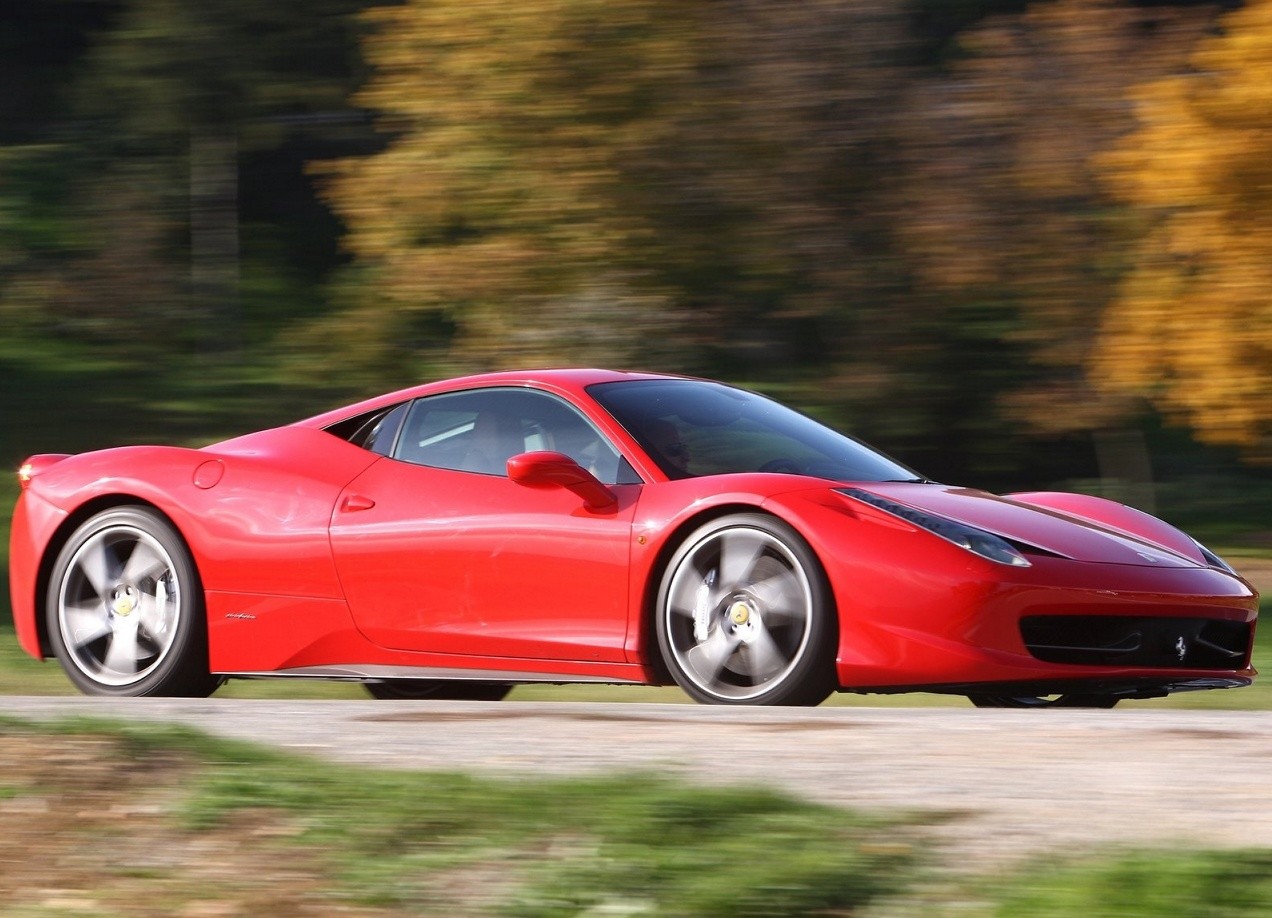
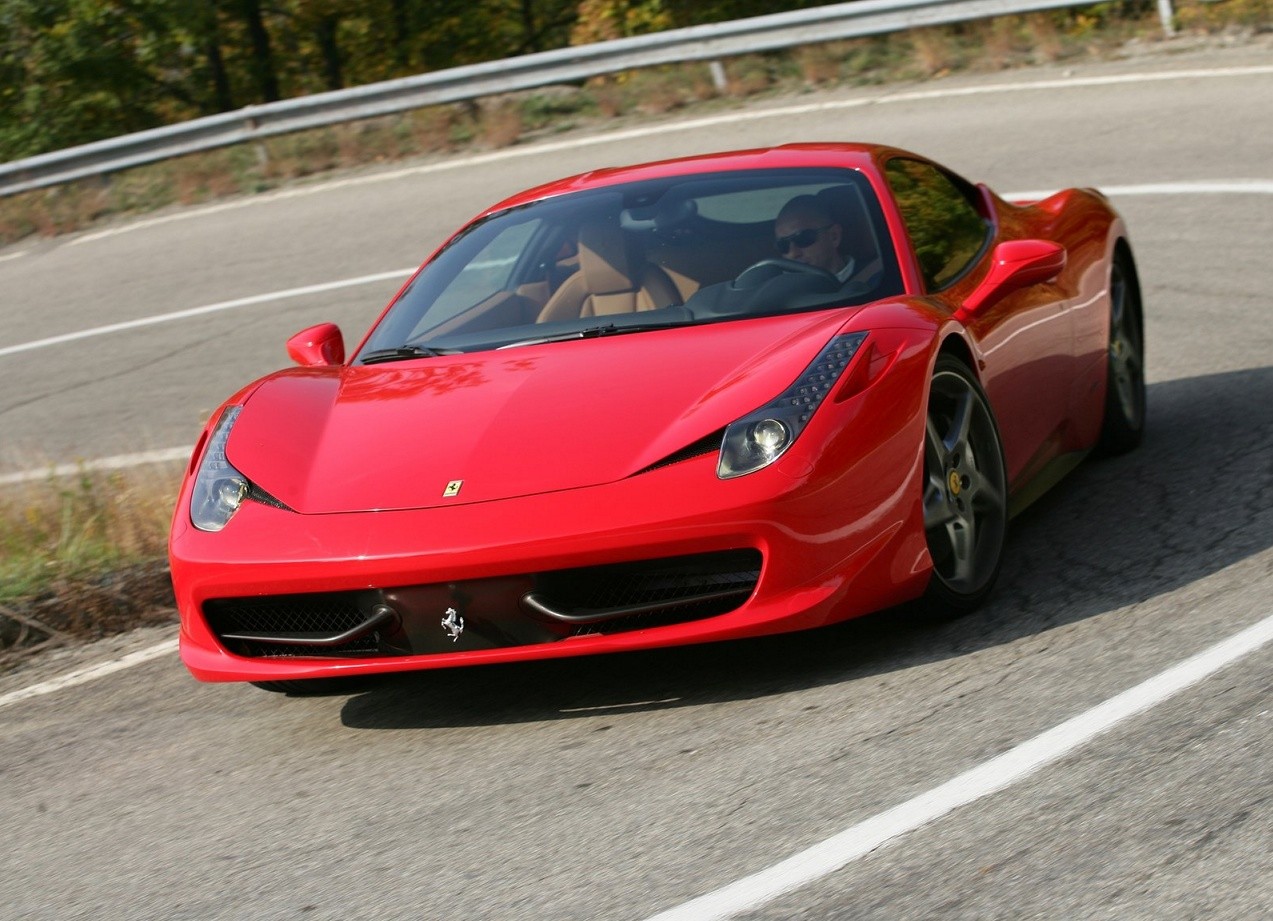
Pininfarina shaped the 458 under Donato Coco, then Ferrari's design director. The large headlights reach back along the front wings, and the nose has no conventional spoiler. Instead, small winglets in the front grille bend under air pressure at speed to cut drag, while the shape of the floor and the rear diffuser work to keep the car on the road. At 200 km/h the body produces about 140 kg of downforce.

At the rear, three exhaust outlets sit in the middle of the bumper, a clear reference to the F40. The body uses aerospace-grade aluminium alloys, and period data quoted a drag coefficient of 0.33 and a torsional stiffness about 15 % higher than the F430. Ground clearance is only about 113 mm, so steep ramps and speed bumps need care.
Engine, gearbox and performance
| Parameter | Metric | Imperial |
|---|---|---|
| Engine | 4,497 cc V8, F136 family, direct injection | 274 cu in |
| Power | 419 kW (570 PS) at 9,000 rpm | 562 hp |
| Torque | 540 Nm at 6,000 rpm (80 % from 3,250 rpm) | 398 lb-ft |
| Gearbox | Seven-speed Getrag dual-clutch | - |
| 0–100 km/h | 3.4 s | 0–62 mph 3.4 s |
| Top speed | more than 325 km/h | more than 202 mph |
| Fuel use (combined) | 13.3 l/100 km, CO2 307 g/km | 17.7 mpg US |
| Kerb weight | 1,565 kg (dry about 1,380 kg) | 3,450 lb |
| Length / width / height | 4,527 / 1,937 / 1,213 mm | 178.2 / 76.3 / 47.8 in |
| Wheelbase | 2,650 mm | 104.3 in |
The V8 revs to 9,000 rpm and is famous for its sound, which rises sharply above 6,000 rpm. There was no manual gearbox: the Getrag dual-clutch unit shifts with paddles behind the wheel and was the only option. Compared with the F430's 360 kW, the 458 has 59 kW more, an increase of about 16 %. With 1,565 kg to carry, it offers about 268 kW per tonne. Its place among later supercars is shown in the 1cars ranking of the most powerful coupés.

The chassis uses double wishbones at the front and a multi-link rear, with magnetorheological dampers and Ferrari's E-Diff and F1-Trac electronics working together. Carbon-ceramic brakes, 398 mm at the front and 360 mm at the rear, stop the car from 100 km/h in 32.5 m.
Cabin and the "racing" steering wheel
The interior is built around the driver. Former Formula One champion Michael Schumacher advised on the layout, and the steering wheel carries the indicators, wipers, lights, engine start button and the manettino switch for the driving modes. Without stalks, the controls take time to learn, especially the indicator buttons in a roundabout.

A large analogue rev counter sits in the middle of the instrument cluster, flanked by two screens for speed, navigation and vehicle data such as tyre and brake temperatures. Leather seats with strong side support make long trips comfortable for a car of this type. Luggage space is small: period data quoted about 200 litres in the nose and roughly 140 litres behind the seats.
Spider, Speciale and racing versions
| Version | Years | Power | Notes |
|---|---|---|---|
| 458 Italia | 2009–2015 | 419 kW (570 PS) | Coupé |
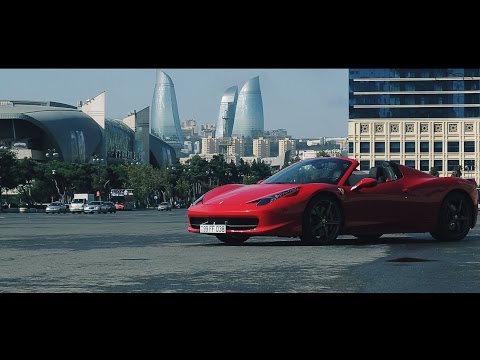
| 458 Spider | 2011–2015 | 419 kW (570 PS) | Aluminium folding hard top, 14 s to open; 320 km/h |
| 458 Speciale | 2013–2015 | 445 kW (605 PS) | 0–100 km/h in 3.0 s, side-slip control, Fiorano 1:23.5 |
| 458 Speciale A | 2014–2015 | 445 kW (605 PS) | Convertible Speciale, 499 built |
| 458 Challenge | 2011–2015 | - | One-make racing car; about 150 built with the Evo |
| 458 Italia GT2 / GT3 | 2011 on | - | GT2 class winner at Le Mans 2012 and 2014 |
The Spider's roof folds into the space in front of the engine and weighs about 25 kg less than a soft top, according to Ferrari. The Speciale is the most focused road version, with sharper aerodynamics and a lap time at Ferrari's Fiorano track of 1:23.5. Sources credit about 1,309 Speciale coupés, but this figure is not confirmed by Ferrari. Special projects based on the 458 included a one-off for Eric Clapton (the SP12 EC) and the Pininfarina Sergio, of which six cars were built.

Safety, recalls and known problems
Like most supercars, the 458 was not crash-tested by Euro NCAP. It has front and side airbags, ABS with brake prefill, stability control and adaptive suspension as standard.

In August 2010 several cars caught fire, and on 1 September 2010 Ferrari recalled all 1,248 cars sold to that date. An adhesive in the rear wheel-arch assemblies could overheat, smoke and catch fire, so Ferrari replaced it with mechanical fasteners. In 2012 some US cars of the 2011–2012 model years were recalled for incorrectly fitted crankshaft parts that could cause engine failure.
Rivals: how the 458 compares
| Model | Engine | Power (hp) | 0–100 km/h (claimed) |
|---|---|---|---|
| Ferrari 458 Italia | 4.5 V8, naturally aspirated | 562 | 3.4 s |
| McLaren MP4-12C | 3.8 V8 twin-turbo | 592 | 3.3 s |
| Lamborghini Gallardo LP 560-4 | 5.2 V10 | 552 | 3.7 s |
| Audi R8 V10 | 5.2 V10 | 518 | 3.9 s |
| Porsche 911 GT3 (991) | 3.8 flat-six | 469 | 3.5 s |
Against the McLaren, the 458 offered a more emotional engine and a sharper front end, while the 12C rode more comfortably and was quicker in a straight line. The Gallardo and R8 had all-wheel drive or a manual option but felt heavier. The 1cars comparison tool sets any two of these supercars side by side.

Popular comparisons
Ferrari 458 Italia in our rankings
- No. 3 of 59 · Quickest cars of the 2000s, 0–100 (3.4 s)
- No. 6 of 57 · Fastest cars of the 2000s (325 km/h)
- No. 10 of 45 · Fastest Italian cars (325 km/h)
- No. 24 of 379 · Quickest cars, 0–100 (3.0 s · top 7%)
- No. 32 of 434 · Fastest cars (325 km/h · top 9%)
- No. 20 of 207 · Most powerful cars of the 2000s (419 kW · top 10%)
Quicker from 0 to 100 km/h than 94% of ranked cars of the 2000s in the 1CARS catalog (No. 3 of 59).
Ferrari 458 Italia photos 18




Ferrari 458 Italia videos 3
Ferrari 458 Italia video 1
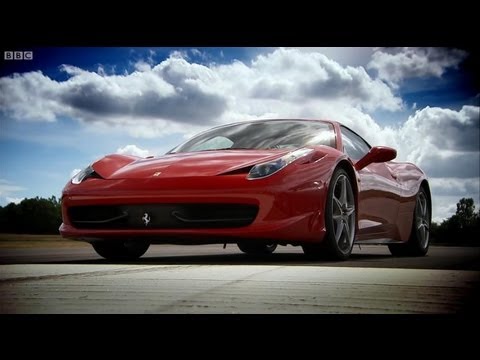
Test drive
Video overview
FAQ
How much power does the Ferrari 458 Italia have?
The 4.5-litre naturally aspirated V8 delivers its peak of 419 kW (570 PS) right at the 9,000 rpm limit, with 540 Nm of torque at 6,000 rpm. The 458 Speciale and Speciale A raise the output to 445 kW (605 PS) with the same torque.
How fast is the Ferrari 458 Italia?
The factory figures for the coupé are 3.4 seconds from rest to 100 km/h and a top speed above 325 km/h. The Spider reaches 320 km/h, and the Speciale cuts the 0–100 km/h time to 3.0 seconds.
What is the fuel consumption of the Ferrari 458 Italia?
The official combined figure is 13.3 l/100 km with CO2 emissions of 307 g/km. In fast road or track driving, real consumption is far higher, because the V8 does its best work above 6,000 rpm.
Does the Ferrari 458 have a manual gearbox?
No. Every 458 uses a seven-speed Getrag dual-clutch gearbox with paddle shifters. Ferrari offered no manual option, and the 458 drives only the rear wheels; there was no all-wheel-drive or hybrid version.
What replaced the Ferrari 458 Italia?
The Ferrari 488 GTB replaced the 458 Italia in 2015. It kept the basic layout but switched to a 3.9-litre twin-turbo V8, which makes the 458 the last naturally aspirated mid-engined V8 Ferrari.
Data sources
Data checked by an editor against the sources below.
- Wikipedia - Ferrari 458
- US EPA fueleconomy.gov - 35528.shtml
- US EPA fueleconomy.gov - 35529.shtml
- US EPA fueleconomy.gov - 33765.shtml
- US EPA fueleconomy.gov - 33766.shtml


