
 Ferrari 250 Testa Rossa
Specs, engines and history
Updated Published Sources (2) Report an error
By Felix Hartmann, Automotive Technology & EV Contributor Reviewed by Oleksandr Hnatiuk

- Built
- 1957–1961
- Top power
- 221 kW (300 PS)
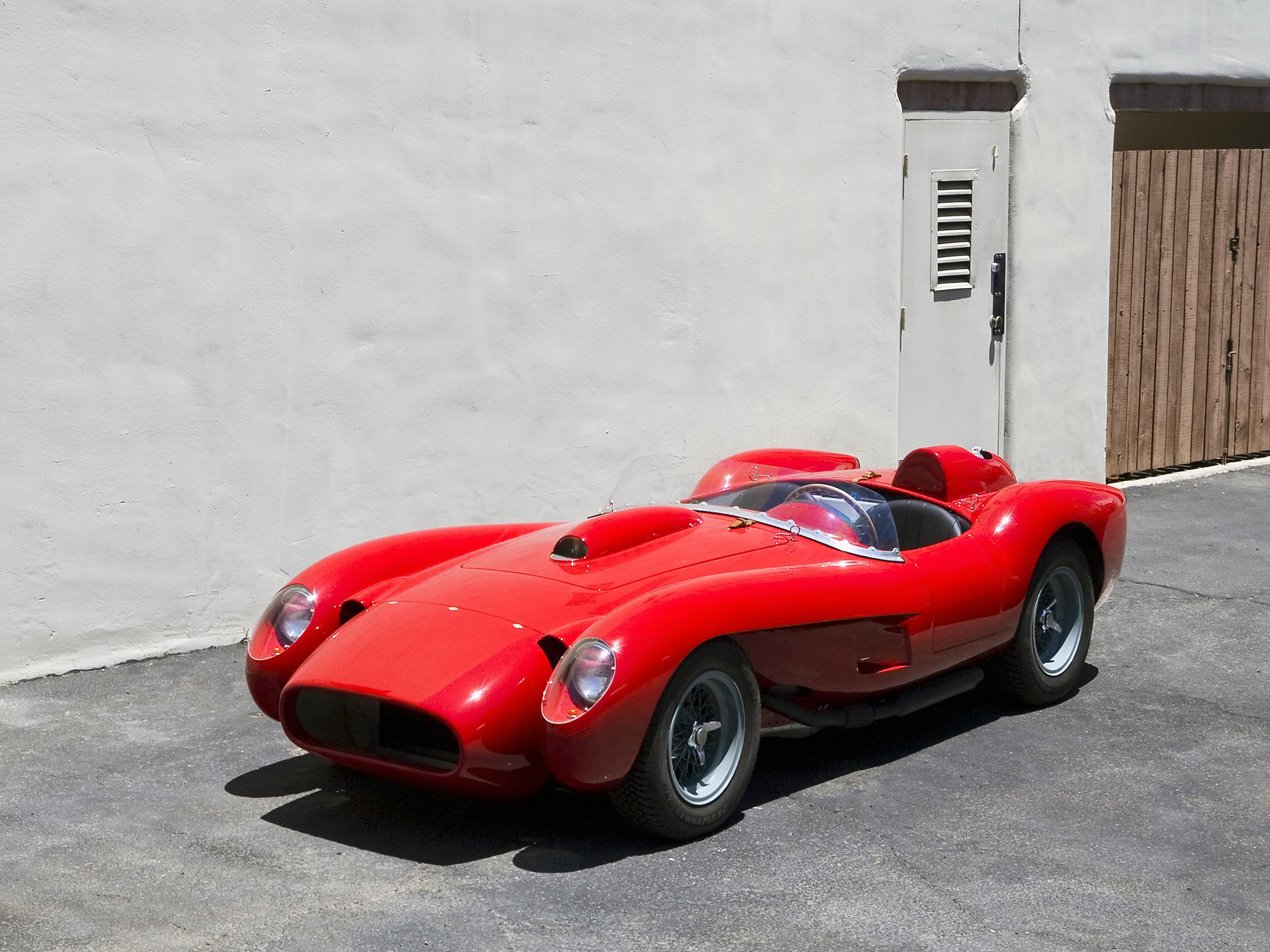
The Ferrari 250 Testa Rossa is a front-engined sports racing car built in Maranello from 1957 to 1961 for the new 3-litre rules of world sports car racing. Its 2,953 cc Colombo V12 produced about 221 kW (300 PS). Only 33 or 34 cars were made, and they won Le Mans in 1958, 1960 and 1961.
In short
- Designed under Carlo Chiti for the 1958 season; the prototype 0666TR raced at the Nürburgring 1000 km in 1957.
- Tipo 128 Colombo V12 with six Weber carburettors, red cam covers that gave it the name, and a dry weight of 800 kg.
- Ten World Sportscar Championship race wins and constructors' titles for Ferrari in 1958, 1960 and 1961.
- Today one of the most valuable cars in the world: a customer car sold for 9.02 million euros in 2009, and later sales went far higher.
Specs by version
Engines
Performance
Show all 1 versions
| Version | Top speed |
|---|---|
| 3.0 221 kW (300 PS) Roadster | 259 km/h161 mph |
Dimensions and weight
Verified Manufacturer and type-approval data from our catalog · Sources and methodology
Ferrari 250 Testa Rossa at a glance
"Testa Rossa" is Italian for "red head", a reference to the bright red cam covers of the engine. Ferrari had used the name on the four-cylinder 500 TR, and the 250 TR carried the tradition to the V12. The car was built for one job: endurance racing under the 1958 rules which limited sports prototypes to 3.0 litres.
| Fact | Value |
|---|---|
| Maker | Ferrari, Maranello, Italy |
| Built | 1957–1961 (works and customer cars) |
| Number built | 33–34 (sources differ), including 19 customer cars |
| Purpose | Sports racing car for the World Sportscar Championship |
| Chief designer | Carlo Chiti |
| Body builders | Scaglietti (1957–1958), Fantuzzi (1959–1961) |
The older 1cars text gave "about 40 cars"; current registers count 33 or 34, depending on how rebuilt chassis are counted. Ferrari's broader story is told in the history of Ferrari.
From prototype 0666TR to the TRI61
Ferrari started work in 1957, once it was clear that the 1958 season would cap engine size at 3 litres. Andrea Fraschetti helped develop the first prototype but was killed in a test accident in 1957. Carlo Chiti then led the project. The prototype, chassis 0666TR, used a 290 MM chassis and a Scaglietti body similar to the 500 TR's, and it made its debut at the 1957 Nürburgring 1000 km.

| Year | Event |
|---|---|
| 1957 | Prototype 0666TR races at the Nürburgring 1000 km |
| 1958 | TR58 with Scaglietti pontoon-fender body; wins at Buenos Aires, Sebring, the Targa Florio and Le Mans |
| 1959 | TR59 by Pinin Farina and Fantuzzi; disc brakes and a five-speed gearbox on works cars; Aston Martin wins the title |
| 1960 | TR60 with dry-sump lubrication and a taller windscreen; TRI60 with independent rear suspension wins Le Mans |
| 1961 | TRI61 "sharknose" body by Chiti and Giotto Bizzarrini; Le Mans and Sebring wins |
| 1962 | The 4.0-litre 330 TRI/LM, rebuilt from a damaged TRI60 chassis, wins Le Mans |
Customer cars replaced the 500 TRC for private teams, and all of them had the 1958-style body. The works team developed the car every season, so almost every chassis differs in detail.
Spaceframe chassis and pontoon-fender bodywork
The 250 TR uses a tubular steel spaceframe related to the 500 TR's, with a wheelbase 10 cm longer at 2,350 mm. Front suspension is independent on all cars. Customer cars kept a live rear axle, while works cars tried both live and de Dion axles until the TRI60 brought independent rear suspension in 1960.

The 1958 Scaglietti body is the best-known shape. Its "pontoon" front fenders are cut away behind the front wheels to let air reach the drum brakes, which overheated in long races. The shape looked dramatic but caused drag and instability at high speed. For 1959 Pinin Farina drew a cleaner body without pontoons, built by Fantuzzi. The 1961 TRI61 added a split "sharknose" nose, a Kamm tail and a rear deflector that made the car more stable.
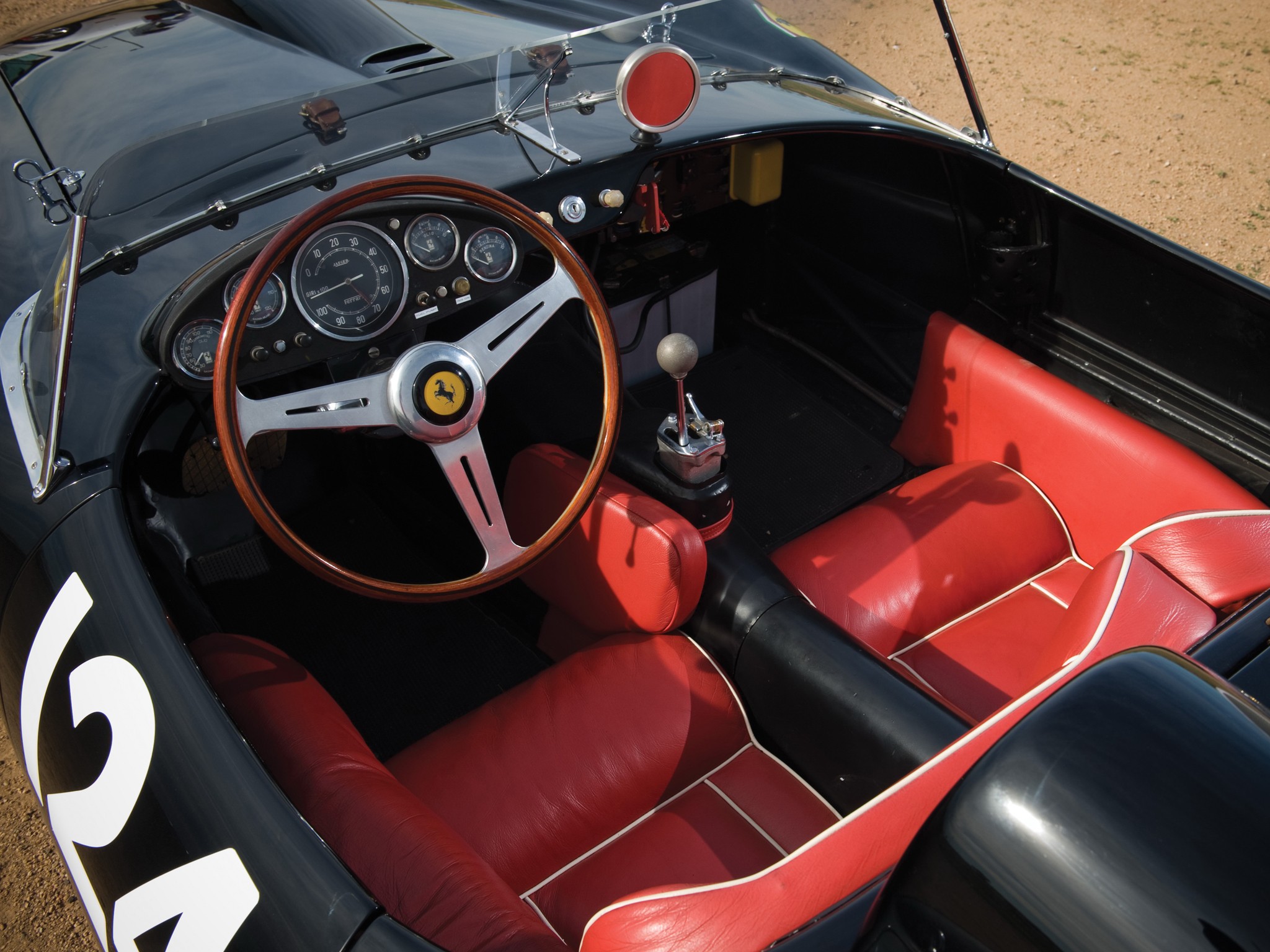
The cockpit is simple: a three-spoke wooden wheel, a large tachometer reading to 8,000 rpm, a full-width windscreen and a pad on the driver's side against the transmission tunnel. Customer cars had left-hand drive.
The Tipo 128 Colombo V12
The engine is the Tipo 128 version of Gioachino Colombo's 60-degree V12. Ferrari derived it from the 250 GT road-car engine but fitted six Weber 38 DCN twin-choke carburettors instead of the three used on the road cars.

| Parameter | Metric | Imperial |
|---|---|---|
| Engine | Tipo 128 Colombo V12, single overhead cam per bank, 2 valves per cylinder | – |
| Displacement | 2,953 cc | 180.2 cu in |
| Bore × stroke | 73 × 58.8 mm | 2.87 × 2.31 in |
| Power | about 221 kW (300 PS) at 7,000 rpm | 296 hp |
| Carburettors | 6 × Weber 38 DCN | – |
| Gearbox | 4-speed (1957–1958), 5-speed (from 1959) | – |
| Wheelbase | 2,350 mm | 92.5 in |
| Length / width | 3,959 / 1,523 mm | 155.9 / 60.0 in |
| Dry weight | 800 kg | 1,764 lb |
| Top speed | about 259 km/h, depending on gearing | about 161 mph |
The engine was the first Ferrari unit with coil valve springs instead of hairpin springs. With roughly 0.28 kW per kg of dry weight, or 276 kW per tonne, the 250 TR had a strong power-to-weight ratio for a 3-litre car of its time. From 1960 the works engines used dry-sump lubrication.
TR58 to TRI61: the variants compared
| Variant | Years | Body / purpose | Engine | Notes |
|---|---|---|---|---|
| 250 TR prototype (0666TR) | 1957 | Scaglietti spider, works | 3.0 V12 | Based on a 290 MM chassis |
| 250 TR (TR58) | 1958 | Scaglietti pontoon-fender spider; works and customer | 3.0 V12 | Live rear axle on customer cars |
| 250 TR59 | 1959 | Pinin Farina design, Fantuzzi body; works | 3.0 V12, 5-speed | Dunlop disc brakes |
| 250 TR59/60 and TRI60 | 1960 | Updated works cars | 3.0 V12, dry sump | TRI60 with independent rear suspension |
| 250 TRI61 | 1961 | Fantuzzi "sharknose" spider; works | 3.0 V12 | Le Mans winner 1961 |
| 330 TRI/LM | 1962 | Works spider rebuilt from a TRI60 | 4.0 V12 | Last front-engined Le Mans winner |
The 1984 Ferrari Testarossa road car borrowed the name as a tribute, but it is a mid-engined flat-12 grand tourer with no technical link to the racer.

Racing record and legacy
The 250 TR won ten World Sportscar Championship races: Le Mans in 1958, 1960 and 1961; Sebring in 1958, 1959 and 1961; the Targa Florio in 1958; the Buenos Aires 1000 km in 1958 and 1960; and the Pescara 4 Hours in 1961. Ferrari took the constructors' title in 1958, 1960 and 1961. In 1959 the Aston Martin DBR1 beat it to the title.

Its drivers included Phil Hill, Olivier Gendebien, Peter Collins, Mike Hawthorn, Luigi Musso, Wolfgang von Trips and Dan Gurney. Gendebien and Hill won Le Mans together in 1958 and 1961. The 250 TR also marked the end of an era: the 1962 Le Mans win by its 4.0-litre derivative was the last for a front-engined car, before mid-engined prototypes took over. Ferrari's earlier sports racers, such as the 750 Monza, and the road-going 250 GT Tour de France show where its engineering came from.
Collecting a 250 TR today: values, provenance and replicas
Genuine 250 TRs rarely come to market. In 2009 chassis 0714TR sold for 9,020,000 euros at RM Sotheby's Maranello auction. In 2011 the prototype 0666TR sold at Gooding & Co.'s Pebble Beach auction for one of the highest prices ever paid for a car at the time, and in 2014 chassis 0704 reportedly changed hands privately for more than twice as much. Ralph Lauren's collection includes a 1958 Scaglietti car (0734TR) and a 1961 TRI61 (0792TR). Only the Ferrari 250 GTO is generally valued higher.

For a buyer, provenance is everything. Many replicas exist, some of them sold as originals, and rebuilt cars have led to disputes in which two cars claim the same chassis number. Any purchase needs factory records, the race history of the chassis and an independent marque expert. More cars of the decade are in the 1950s classics section, the specifications section and the comparison tool cover Ferrari's road cars, and the full range is in the Ferrari catalogue.
Ferrari 250 Testa Rossa photos 13


FAQ
When was the Ferrari 250 Testa Rossa produced, and where?
Ferrari built it in Maranello, Italy, from 1957 to 1961, with bodies by Scaglietti and later Fantuzzi. The prototype raced in 1957, and the first customer cars followed for the 1958 season.
How many Ferrari 250 Testa Rossas were built?
Sources count 33 or 34 cars, depending on how rebuilt chassis are treated. Nineteen were customer cars sold to private teams, and the rest were works cars developed by Scuderia Ferrari each season.
What engine does the Ferrari 250 Testa Rossa have?
It has the Tipo 128 Colombo V12 of 2,953 cc with six Weber 38 DCN carburettors. It produces about 221 kW (300 PS) at 7,000 rpm and drives the rear wheels through a four- or five-speed gearbox.
What variants of the Ferrari 250 Testa Rossa were made?
The main versions are the 1958 pontoon-fender TR58, the Pinin Farina-designed TR59, the TR59/60 and TRI60 of 1960 and the "sharknose" TRI61. The 4.0-litre 330 TRI/LM of 1962 grew out of a TRI60 chassis.
Is the Ferrari 250 Testa Rossa collectable, and what should buyers check?
It is among the most valuable cars in the world, with sales from 9 million euros in 2009 to far higher private deals. Buyers must check factory records, chassis history and originality, because replicas and disputed chassis numbers exist.
Data sources
Data checked by an editor against the sources below.
- The text of this article (1cars archive)
- Wikipedia - Ferrari 250 Testa Rossa


