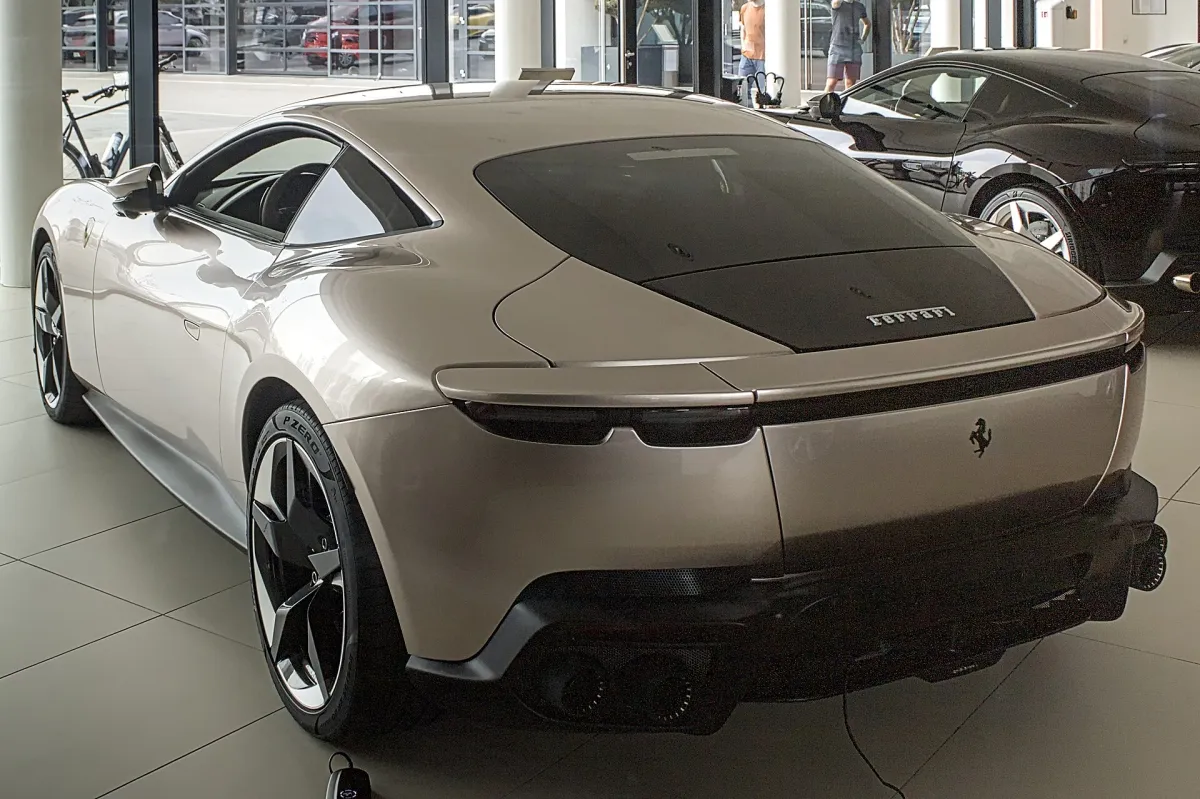
 Ferrari F430
Specs, engines and history
Updated Published Sources (6) Report an error
By Felix Hartmann, Automotive Technology & EV Contributor Reviewed by Oleksandr Hnatiuk

- Built
- 2004–2009
- Top power
- 375 kW (510 PS)
- New price
- from about €169,600 (2005)
- Used price today
- about €115,000–159,000 (AutoScout24, Nov 2026)
Which F430 to choose: who each version suits
Our verdict · Felix Hartmann
- Coupé with the manual gearbox: the purest and rarest standard car, for drivers who value involvement over lap times.
- Coupé or Spider with the F1 gearbox: the most common choice and the easiest to find; the Spider gives up about 5 km/h of top speed and adds 52 kg.
- 430 Scuderia: about 10% less weight per kW than the coupé and 60 ms shifts, for track days.
- Scuderia Spider 16M: one of 499 cars, bought as a collector's piece rather than a daily car.
The Ferrari F430 is the mid-engined V8 sports car that Ferrari built from 2004 to 2009, between the 360 and the 458 Italia. Shown at the Paris motor show in 2004, it used a new 4.3-litre V8 with 360 kW (490 PS) and brought the E-Diff electronic differential and the steering-wheel manettino switch. About 16,750 were built, including the Spider and the lighter 430 Scuderia.
In short
- Versions: F430 coupé (2004), F430 Spider (2005), 430 Scuderia (2007) and Scuderia Spider 16M (2008, 499 cars).
- Engine: 4,308 cc naturally aspirated V8, 360 kW (490 PS) at 8,500 rpm; 375 kW (510 PS) in the Scuderia.
- Gearbox: six-speed manual or six-speed F1 automated manual; the Scuderia's shifts took 60 milliseconds.

Size at a glance
| Dimensions | Ferrari F430 |
|---|---|
| Length | 4,511 mm177.6 in |
| Width | 1,923 mm75.7 in |
| Height | 1,214 mm47.8 in |
| Wheelbase | 2,601 mm102.4 in |
Specs by version
Engines
| Version | Engine | Gearbox | Drive | Production years |
|---|---|---|---|---|
| 4.3 L 8 cyl Automatic 6-spd · 2009 (EPA) | 4.3 l · 8 cyl 4,300 cc | 6-sp Automatic | Rear-wheel drive | 2009 |
| 4.3 L 8 cyl Manual 6-spd · 2009 (EPA) | 4.3 l · 8 cyl 4,300 cc | 6-sp Manual | Rear-wheel drive | 2009 |
| 4.3 L 8 cyl Automatic 6-spd · 2008 (EPA) | 4.3 l · 8 cyl 4,300 cc | 6-sp Automatic | Rear-wheel drive | 2008 |
| 4.3 L 8 cyl Manual 6-spd · 2008 (EPA) | 4.3 l · 8 cyl 4,300 cc | 6-sp Manual | Rear-wheel drive | 2008 |
| 4.3 L 8 cyl Automatic 6-spd · 2007 (EPA) | 4.3 l · 8 cyl 4,300 cc | 6-sp Automatic | Rear-wheel drive | 2007 |
| 4.3 L 8 cyl Manual 6-spd · 2007 (EPA) | 4.3 l · 8 cyl 4,300 cc | 6-sp Manual | Rear-wheel drive | 2007 |
| 4.3 L 8 cyl Automatic 6-spd · 2006 (EPA) | 4.3 l · 8 cyl 4,300 cc | 6-sp Automatic | Rear-wheel drive | 2006 |
| 4.3 L 8 cyl Manual 6-spd · 2006 (EPA) | 4.3 l · 8 cyl 4,300 cc | 6-sp Manual | Rear-wheel drive | 2006 |
| 4.3 L 8 cyl Automatic 6-spd · 2005 (EPA) | 4.3 l · 8 cyl 4,300 cc | 6-sp Automatic | Rear-wheel drive | 2005 |
| 4.3 L 8 cyl Manual 6-spd · 2005 (EPA) | 4.3 l · 8 cyl 4,300 cc | 6-sp Manual | Rear-wheel drive | 2005 |
| F430 | 4.3 l · 8 cyl · Petrol 4,308 cc | 6-sp | Rear-wheel drive | - |
| 430 Scuderia | 4.3 l · 8 cyl · Petrol 4,308 cc | 6-sp Automated manual | Rear-wheel drive | - |
Performance
Show all 12 versions
| Version | Fuel consumption |
|---|---|
| 4.3 L 8 cyl Automatic 6-spd · 2009 (EPA) | 18.1 l/100 km13.0 mpg US · 15.6 mpg UK |
| 4.3 L 8 cyl Manual 6-spd · 2009 (EPA) | 18.1 l/100 km13.0 mpg US · 15.6 mpg UK |
| 4.3 L 8 cyl Automatic 6-spd · 2008 (EPA) | 18.1 l/100 km13.0 mpg US · 15.6 mpg UK |
| 4.3 L 8 cyl Manual 6-spd · 2008 (EPA) | 18.1 l/100 km13.0 mpg US · 15.6 mpg UK |
| 4.3 L 8 cyl Automatic 6-spd · 2007 (EPA) | 18.1 l/100 km13.0 mpg US · 15.6 mpg UK |
| 4.3 L 8 cyl Manual 6-spd · 2007 (EPA) | 18.1 l/100 km13.0 mpg US · 15.6 mpg UK |
| 4.3 L 8 cyl Automatic 6-spd · 2006 (EPA) | 18.1 l/100 km13.0 mpg US · 15.6 mpg UK |
| 4.3 L 8 cyl Manual 6-spd · 2006 (EPA) | 18.1 l/100 km13.0 mpg US · 15.6 mpg UK |
| 4.3 L 8 cyl Automatic 6-spd · 2005 (EPA) | 19.6 l/100 km12.0 mpg US · 14.4 mpg UK |
| 4.3 L 8 cyl Manual 6-spd · 2005 (EPA) | 19.6 l/100 km12.0 mpg US · 14.4 mpg UK |
| F430 | - |
| 430 Scuderia | - |
Dimensions and weight
Verified Manufacturer and type-approval data from our catalog · Sources and methodology
Ferrari F430 at a glance
| Item | F430 coupé |
|---|---|
| Production | 2004–2009 (model years 2005–2009) |
| Design | Pininfarina, with Frank Stephenson |
| Engine | F136 V8, 4,308 cc, naturally aspirated |
| Power / torque | 360 kW (490 PS) at 8,500 rpm / 465 Nm at 5,250 rpm |
| Gearbox | 6-speed manual or 6-speed F1 (Graziano) |
| Kerb weight | 1,517 kg (Spider 1,569 kg) |
| 0–60 mph / top speed | 3.6 s / over 315 km/h |
| Length / width / height | 4,511 / 1,923 / 1,214 mm |
| Wheelbase | 2,601 mm |
| Price (Germany, 2005) | €169,600 with the manual gearbox |
By our calculation, the coupé carries about 4.2 kg per kW, and its V8 gives about 84 kW per litre.

From the 360 to the F430
The F430 kept the aluminium construction of the Ferrari 360 but changed almost everything that mattered for speed. The engine grew from 3.6 to 4.3 litres and from 294 to 360 kW, an increase of about 22% by our calculation. Frank Stephenson's body at Pininfarina reshaped the nose with two large oval intakes, a nod to the 1961 Ferrari 156 Formula 1 car, and the rear gained a diffuser between four round exhaust tips. The car was unveiled at the Paris motor show in 2004.

The F136 engine replaced the 360's V8, and the same engine family later powered the 458 Italia. Its peak power came at 8,500 rpm, with maximum torque of 465 Nm at 5,250 rpm.
E-Diff and the manettino
Two features made the F430 a technical milestone for Ferrari road cars. The E-Diff was an electronically controlled limited-slip differential that varied its locking effect according to grip and driving style. The manettino, a rotary switch on the steering wheel, appeared here for the first time on a Ferrari road car. Its five settings link the stability control, traction control, E-Diff, suspension and F1 gearbox:
| Manettino setting | Intended use |
|---|---|
| Low | Low grip: wet asphalt or gravel |
| Sport | Dry roads, default for fast driving |
| Race | Smooth, dry circuits with reduced intervention |
| CT | Traction control off, stability control still active |
| CST | Stability and traction control switched off |

The old 1cars review reported F1 gear changes of 150 milliseconds in the standard car. Carbon-ceramic brakes developed with Brembo were available.
F430 Spider
The F430 Spider was unveiled at the Geneva motor show in March 2005. Ferrari counted it as its 21st road-going convertible. The open car weighs 1,569 kg, 52 kg more than the coupé. Top speed is 5 km/h lower than the coupé's.

430 Scuderia and Scuderia Spider 16M
Michael Schumacher unveiled the 430 Scuderia at the Frankfurt motor show in 2007. The engine produced 375 kW (510 PS) and 471 Nm, the car weighed 100 kg less than the standard coupé, and the F1 gearbox software cut shift times to 60 milliseconds. Ferrari quoted a power-to-weight ratio of 2.5 kg per hp, 0–60 mph in 3.1 seconds and 319 km/h.

The Scuderia Spider 16M was revealed at Mugello in 2008 to celebrate Ferrari's 16th Formula 1 constructors' title. All 499 cars were sold before production began. It reached 0–60 mph in 3.4 seconds and 315 km/h.
| Version | Debut | Power | Torque | Weight | Top speed | Built |
|---|---|---|---|---|---|---|
| F430 | Paris, 2004 | 360 kW (490 PS) | 465 Nm | 1,517 kg | over 315 km/h | – |
| F430 Spider | Geneva, 2005 | 360 kW (490 PS) | 465 Nm | 1,569 kg | about 310 km/h | – |
| 430 Scuderia | Frankfurt, 2007 | 375 kW (510 PS) | 471 Nm | 1,429 kg | 319 km/h | – |
| Scuderia Spider 16M | Mugello, 2008 | 375 kW (510 PS) | 471 Nm | – | 315 km/h | 499 |
By our calculation, the Scuderia's 1,429 kg and 375 kW give about 3.8 kg per kW, roughly 10% better than the standard coupé.
Racing record
The F430 was designed with racing in mind from the start. The F430 Challenge, shown in January 2005, ran in Ferrari's one-make series. The F430 GTC for the GT2 class, built from 2006, used a 4.0-litre version of the V8 with 327 kW (445 PS) and won the GT2 class at Le Mans in 2008 and 2009, at Sebring in 2007, 2009 and 2010 and at the Spa 24 Hours in 2006, 2008 and 2009. It also took class championships in the American Le Mans Series and the FIA GT Championship. JMB Racing developed an F430 GT3 in 2006 with 410 kW, followed by a 430 GT3 Scuderia for 2009.

Buying an F430
An F430 is now an approachable classic supercar, but repairs are priced at Ferrari level. Points to check:
- F1 gearbox clutch: wear can be read out by a dealer; a manual car avoids the issue and is rarer.
- Service history: a full record of annual services, including the F1 gearbox hydraulics.
- Brakes: carbon-ceramic discs, where fitted, are expensive to replace, so measure their wear.
- Body: the aluminium panels are expensive to repair after accidents.
- Originality: limited versions such as the 16M lose value with non-original parts.

The Ferrari F430 vs Lamborghini Gallardo comparison sets it against its direct rival, and the Lamborghini Gallardo page tells the Italian rival's story. You can check performance figures against other cars with the power-to-weight calculator.
The F430 in the V8 line
| Model | Years | Engine | Power |
|---|---|---|---|
| 360 Modena | 1999–2005 | 3.6 l V8 | 294 kW (400 PS) |
| F430 | 2004–2009 | 4.3 l V8 | 360 kW (490 PS) |
| 458 Italia | 2009–2015 | 4.5 l V8 | 419 kW (570 PS) |
| 488 GTB | 2015–2020 | 3.9 l twin-turbo V8 | 493 kW (670 PS) |
The F430 was replaced by the 458 Italia, unveiled on 28 July 2009, which in turn gave way to the turbocharged Ferrari 488. Every other Ferrari road car has an entry in our Ferrari catalogue.

Popular comparisons
Ferrari F430 in our rankings
- No. 8 of 57 · Fastest cars of the 2000s (319 km/h)
- No. 46 of 460 · Power-to-weight: cars (262 kW/t · top 10%)
- No. 44 of 455 · Fastest cars (319 km/h · top 10%)
- No. 33 of 207 · Most powerful cars of the 2000s (375 kW · top 18%)
- No. 224 of 1129 · Most powerful cars (375 kW · top 21%)
- No. 130 of 577 · Widest cars (1,923 mm · top 23%)
Better power-to-weight than 90% of ranked cars in the 1CARS catalog (No. 46 of 460).
Ferrari F430 photos 17


Ferrari F430 videos 2

Ferrari F430 video 1

Ferrari F430 video 2
FAQ
How much horsepower does the Ferrari F430 have?
The standard F430 coupé and Spider produce 360 kW (490 PS, 483 hp) at 8,500 rpm and 465 Nm at 5,250 rpm. The 430 Scuderia and Scuderia Spider 16M raise this to 375 kW (510 PS) and 471 Nm.
How many Ferrari F430s were made?
An estimate puts total production at about 16,750 cars from 2004 to 2009, including coupés, Spiders and the 430 Scuderia. The Scuderia Spider 16M was limited to 499 cars, all sold before production started.
Is the F430 a manual car?
Both were offered: a six-speed manual with Ferrari's open gate and the six-speed F1 automated manual with paddles. Most cars were ordered with the F1 gearbox, which makes manual cars the rarer choice today.
What is the difference between the F430 and the 430 Scuderia?
The 430 Scuderia of 2007 has 15 kW more, weighs about 100 kg less and shifts gears in 60 milliseconds. It reaches 319 km/h and 60 mph in 3.1 seconds, against 3.6 seconds for the F430.
What replaced the Ferrari F430?
Ferrari presented its successor, the 458 Italia, in the summer of 2009. It kept a naturally aspirated V8 but enlarged it to 4.5 litres and 419 kW and switched to a seven-speed dual-clutch gearbox.
Data sources
Data checked by an editor against the sources below.
- The text of this article (1cars archive)
- Wikipedia - Ferrari F430
- US EPA fueleconomy.gov - 25785.shtml
- US EPA fueleconomy.gov - 25784.shtml
- US EPA fueleconomy.gov - 24754.shtml
- US EPA fueleconomy.gov - 24755.shtml