
 Ferrari 375 MM Berlinetta
Specs, engines and history
Updated Published Sources (2) Report an error
By Felix Hartmann, Automotive Technology & EV Contributor Reviewed by Oleksandr Hnatiuk

- Built
- 1953–1955
- Top power
- 250 kW (340 PS)
Our verdict: who this Ferrari suits
Our verdict · Felix Hartmann
The 375 MM Berlinetta suits a collector who wants a works-era Ferrari sports racer with a closed body and a strong race record. It is rougher and more demanding than the GT cars of the late 1950s, and parts for the Lampredi V12 are scarce. For the bigger picture, read the history of Ferrari and the profile of Battista Pininfarina, whose firm bodied most of these cars.
The Ferrari 375 MM Berlinetta is the closed version of the 375 MM sports racing car, built from 1953 to 1955. It has a 4.5-litre Lampredi V12 rated at 250 kW (340 PS), a four-speed gearbox and a tubular steel chassis. Of the 26 cars in the 375 MM series, about ten carried Pinin Farina berlinetta bodies, and one sold for €9.86 million in 2013.
In short
- Series: 26 cars of the 375 MM type in 1953–1955, including four converted from the 340 MM; roughly ten were berlinettas.
- Engine: Lampredi V12 derived from Ferrari's 375 Formula One unit, 4,494 cc in works cars and 4,522 cc in customer cars.
- Results: Spa 24 Hours, Nürburgring 1000 km, Pescara 12 Hours and Buenos Aires 1000 km wins for the 375 MM family.
- Show car: a one-off "Berlinetta Speciale", chassis 0490AM, appeared at the 1955 Turin motor show.

Specs by version
Verified Manufacturer and type-approval data from our catalog · Sources and methodology
375 MM Berlinetta at a glance

| Fact | Detail |
|---|---|
| Maker | Ferrari, Maranello |
| Built | 1953–1955 |
| Series total | 26 (spiders, berlinettas and two coupés) |
| Berlinettas | about ten Pinin Farina bodies, plus the one-off Speciale 0490AM |
| Engine | Lampredi 60° V12, 4.5 litres |
| Power | 250 kW (340 PS) |
| Gearbox | four-speed manual, rear-wheel drive |
| Name | "MM" stands for the Mille Miglia road race |
From the 340 MM and the Formula One V12
Ferrari named several sports cars after the Mille Miglia, and the 375 MM followed the 340 MM of 1953. Its engine came from the 375 Formula One single-seater. Aurelio Lampredi designed this "long-block" V12, which was larger and heavier than Gioacchino Colombo's earlier unit.

For the sports car, Ferrari fitted a new crankshaft with a shorter 68 mm stroke and a larger bore. Ferrari's own history page notes that the enlarged engine first raced in a 340 berlinetta at Le Mans in 1953, driven by Alberto Ascari and Luigi Villoresi. The road-going counterpart of the racer was the 375 America.
Four of the 26 cars were converted from 340 MM chassis. One of them, 0320AM, had raced at Le Mans with a 4.1-litre engine and was then enlarged to 4.5 litres and rebodied. The mixture of conversions and new chassis is one reason why sources give slightly different counts for each body style.
Pinin Farina berlinettas and the Turin show car
Pinin Farina bodied 24 of the 26 cars. According to the chassis table on English Wikipedia, the series included 14 spiders, ten Pinin Farina berlinettas and two coupés. Vignale built one spider, and Ghia built one coupé.

The berlinetta body was derived from Pinin Farina's design for the 250 MM. RM Sotheby's describes how 0320AM later received a more streamlined nose with recessed, covered headlamps, and a smaller rear window in place of the wraparound glass. Apart from the badges and the body maker's emblem, these cars carry almost no chrome.
| Variant | Years | Body / purpose | Engine | Notes |
|---|---|---|---|---|
| 375 MM Spider | 1953–1955 | open two-seat racer, mostly Pinin Farina | 4.5-litre V12 | 14 cars, one by Vignale (0286AM) |
| 375 MM Berlinetta | 1953–1955 | closed Pinin Farina racer | 4.5-litre V12 | about ten cars, several converted from the 340 MM |
| 375 MM Coupé Ghia | 1955 | Michelotti-designed coupé, 0476AM | 4.5-litre V12 | last Ferrari bodied by Ghia; shown in Turin and New York |
| 375 MM Berlinetta Speciale | 1955 | Pinin Farina show coupé, 0490AM | 4.5-litre V12 | one-off exhibit for the Turin show |
| 375 MM Coupé Scaglietti | 1955 | crashed spider 0402AM rebodied for Roberto Rossellini | 4.5-litre V12 | Pebble Beach Best of Show 2014 |
The old version of this page mixed up the series with the Turin show car of 1955. The figure of 26 cars covers every 375 MM, not just the closed cars. The story of the Rossellini car is told in our page on the 375 MM Coupé Scaglietti.
Inside the racing berlinetta
The cabin is built for long road races rather than comfort. Earlier descriptions of the car mention right-hand drive, which was usual for Ferrari's racing cars of the period, a three-spoke wheel, a speedometer marked to 300 km/h and a rev counter reading to 8,000 rpm. The rear-view mirror sits on the dashboard, and folding sun visors were fitted above the windscreen.
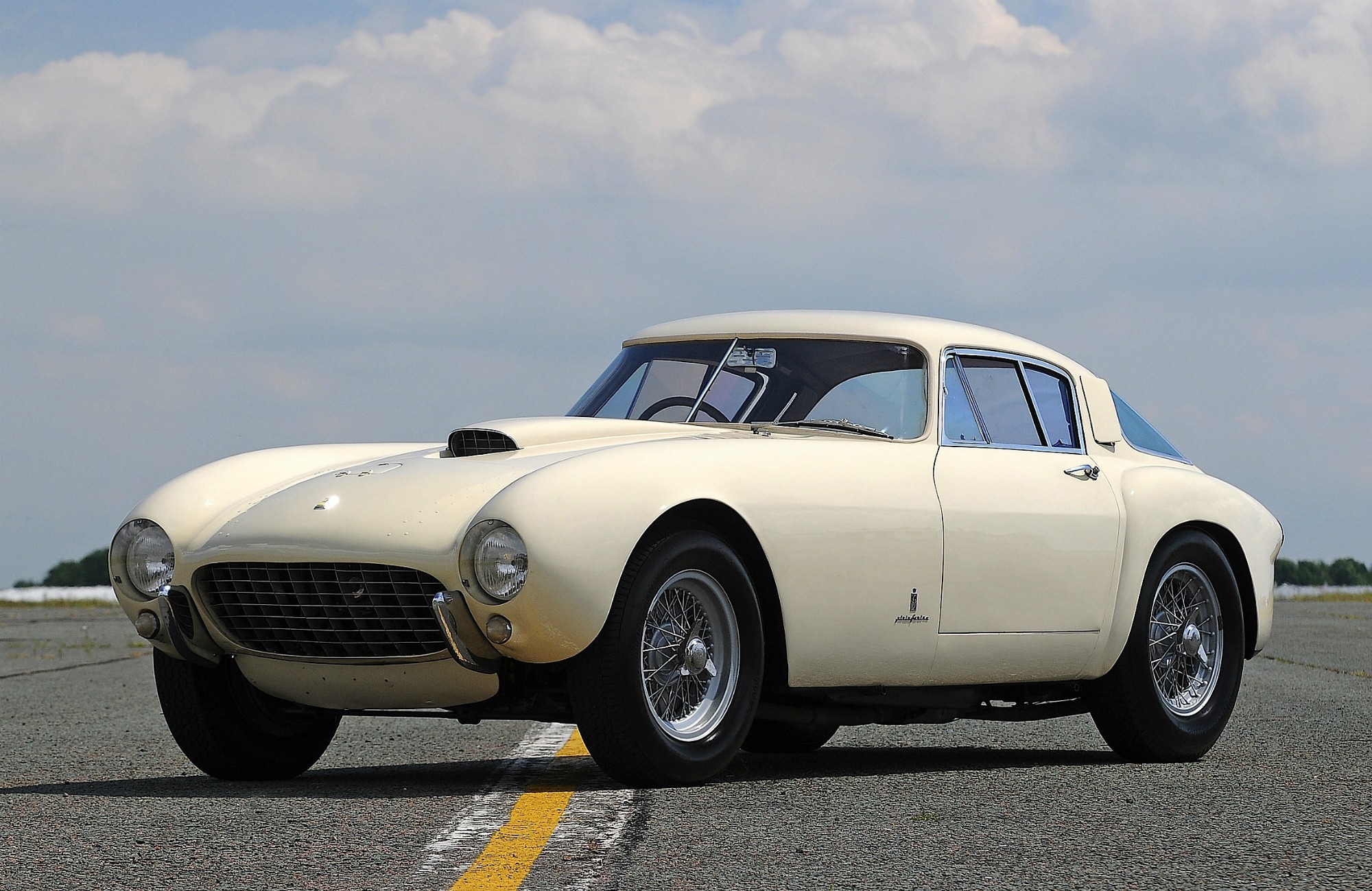
A box-shaped air intake sits on a removable bonnet panel rather than on a hinged bonnet. Side vents behind the front wheels release hot air from the engine bay. These details varied from car to car, because many berlinettas were modified during their racing lives.
Lampredi V12 and chassis data
| Parameter | Metric | Imperial |
|---|---|---|
| Engine | Lampredi 60° V12, single overhead camshaft per bank | - |
| Displacement, works (tipo 102) | 4,494 cc, 80 × 74.5 mm | 274 cu in |
| Displacement, customer (tipo 108) | 4,522 cc, 84 × 68 mm | 276 cu in |
| Power | 250 kW (340 PS) at 7,000 rpm | 335 hp |
| Carburettors | three Weber 40 IF/4C or 42 DCZ | - |
| Gearbox | four-speed manual | - |
| Front suspension | independent, transverse leaf spring | - |
| Rear suspension | live axle, semi-elliptic leaf springs | - |
| Brakes | drums all round | - |
| Wheelbase | 2,600 mm | 102.4 in |
| Dry weight | about 900 kg | about 1,984 lb |
By our calculation, the 375 MM carries about 3.6 kg per kW in dry form. That is better than the roughly 4 kg per kW of the four-cylinder 750 Monza that followed in 1954, using our figures of 191 kW and about 760 kg. Try other figures in the power-to-weight calculator, or convert PS, hp and kW with the power converter.

Racing record, 1953–1954
The berlinettas raced alongside the spiders, and Ferrari often entered both at the same event. The main results below cover the whole 375 MM family.

| Year | Event |
|---|---|
| June 1953 | Le Mans 24 Hours: three works berlinettas start; 0320AM runs second but is disqualified for adding brake fluid; Ascari and Villoresi retire with clutch trouble |
| July 1953 | Spa 24 Hours: win for Giuseppe Farina and Mike Hawthorn |
| August 1953 | Nürburgring 1000 km: win for Farina and Ascari |
| August 1953 | Pescara 12 Hours: win for Hawthorn and Umberto Maglioli in berlinetta 0320AM |
| November 1953 | Carrera Panamericana: fourth place; 0318AM crashes, killing Antonio Stagnoli and Giuseppe Scotuzzi |
| December 1953 | Casablanca 12 Hours: win for Farina and Piero Scotti |
| January 1954 | Buenos Aires 1000 km: win for Farina and Maglioli |
| 1954 | Carrera Panamericana: second place for Phil Hill in spider 0286AM |
The Spa and Nürburgring wins counted towards the 1953 World Sportscar Championship, the first season of that series. After the 4.9-litre 375 Plus arrived in 1954, the 375 MM scored no more championship points for the works team.
Le Mans 1953 and three world champions
Chassis 0320AM shows how hard these cars were used. At Le Mans in 1953 it ran as number 14 for Hawthorn and Farina and was second after 12 laps. The team then topped up its brake fluid during a stop, which the rules did not allow, and the car was disqualified.
Two months later the same car won the Pescara 12 Hours. In the Carrera Panamericana, Maglioli took over from Mario Ricci and set a stage record at an average of 138 mph, about 222 km/h, over 223 miles, roughly 359 km. RM Sotheby's calls it the only works racer driven in the World Sportscar Championship by three world champions: Hawthorn, Ascari and Farina.
Compared with the 375 Plus and the 250 GT TdF
| Point | 375 MM Berlinetta | 375 Plus | 250 GT Tour de France |
|---|---|---|---|
| Years | 1953–1955 | 1954 | 1956–1959 |
| Engine | 4.5-litre Lampredi V12 | 4.9-litre Lampredi V12 | 3.0-litre Colombo V12 |
| Purpose | sports-car racing | sports-car racing | GT racing |
Compared with the later 250 GT Tour de France, the 375 MM has 50 % more displacement and comes from an era when Ferrari still sold almost pure racing cars to private owners. The GT car that followed is described in our page on the 250 GT Berlinetta Tour de France.

Collecting a 375 MM Berlinetta
Almost every surviving car has a documented chassis history, which is essential because many were rebuilt. At RM Sotheby's Villa Erba sale in 2013, berlinetta 0320AM sold for €9,856,000. In the same year the spider 0364AM was reported sold for 9 million US dollars, about €6.8 million at the time. Points to check:
- Chassis and engine numbers: matching numbers, as on 0320AM, add a lot of value.
- Conversions: whether the car started as a 340 MM, and which body it wore in period.
- Restorations: earlier rebuilds sometimes changed the nose, the rear window or the wheel-arch vents.
- Race history: works entries at Le Mans, Spa or the Carrera Panamericana must be backed by period records.


Ferrari 375 MM Berlinetta in our rankings
- No. 180 of 642 · Biggest engines: cars (4,500 cc · top 29%)
- No. 412 of 1019 · Most powerful cars (250 kW · top 42%)
- No. 75 of 146 · Most powerful Italian cars (250 kW · top 52%)
- No. 104 of 189 · Biggest engines: coupes (4,500 cc · top 57%)
- No. 214 of 333 · Most powerful coupes (250 kW · top 66%)
- No. 22 of 28 · Most powerful V12 cars (250 kW · top 79%)
Bigger engine than 71% of ranked cars in the 1CARS catalog (No. 180 of 642).
Ferrari 375 MM Berlinetta photos 13


FAQ
How many Ferrari 375 MM Berlinettas were built?
The whole series came to 26 chassis between 1953 and 1955. Roughly ten of them were Pinin Farina berlinettas, and several started life as 340 MM cars. Two further closed cars, by Ghia and Pinin Farina, were one-offs.
What engine does the 375 MM have?
It uses Aurelio Lampredi's V12, derived from the 375 Formula One engine. Works cars had 4,494 cc and customer cars 4,522 cc, and Ferrari quoted the same 250 kW for both, fed by three Weber carburettors.
What does "MM" stand for?
MM stands for Mille Miglia, the 1,000-mile Italian road race. Ferrari used the letters on several sports racing cars of the early 1950s, including the 340 MM that preceded this model.
What did the 375 MM win?
The family won the 1953 Spa 24 Hours and Nürburgring 1000 km, both championship rounds, plus the Pescara and Casablanca 12-hour races and the 1954 Buenos Aires 1000 km.
What is a 375 MM Berlinetta worth?
Prices are in the multi-million range. Berlinetta 0320AM, with matching numbers and a works history, sold for €9,856,000 at RM Sotheby's Villa Erba auction in 2013.
Data sources
Data checked by an editor against the sources below.
- The text of this article (1cars archive)
- Wikipedia - Ferrari 375 MM


