
 Ferrari 750 Monza
Specs, engines and history
Updated Published Sources (3) Report an error
By Felix Hartmann, Automotive Technology & EV Contributor Reviewed by Oleksandr Hnatiuk

- Built
- 1954–1955
- Top power
- 191 kW (260 PS)
The Ferrari 750 Monza is a two-seat sports racing car built in 1954 and 1955, with a 3.0-litre four-cylinder engine designed by Aurelio Lampredi and about 191 kW (260 PS). It took its name from its first race, the Supercortemaggiore at Monza on 27 June 1954, which Mike Hawthorn and Umberto Maglioli won. Roughly 30 were built, most with Scaglietti barchetta bodies.
In short
- Engine: 2,999 cc twin-cam inline four, 103 × 90 mm, two Weber carburettors, five-speed transaxle.
- Light and simple: about 760 kg, a 2,250 mm wheelbase, de Dion rear axle and drum brakes.
- Alberto Ascari was killed testing a 750 Monza at Monza in May 1955.
- Today the surviving cars are rare collector's pieces worth several million euros.
Specs by version
Engines
Performance
Show all 1 versions
| Version | Top speed |
|---|---|
| 3.0 191 kW (260 PS) Roadster | 260 km/h162 mph |
Verified Manufacturer and type-approval data from our catalog · Sources and methodology
The 750 Monza at a glance

| Fact | Value |
|---|---|
| Type | Two-seat sports racing car (barchetta) |
| Built | 1954–1955, Maranello |
| Number made | about 29–35 (sources differ) |
| Engine | 3.0-litre inline four (Lampredi design) |
| Power | about 191 kW (260 PS) |
| Debut | Supercortemaggiore, Monza, 27 June 1954 (1st and 2nd) |
| Bodies | Scaglietti; design credited to Pinin Farina or Dino Ferrari |
| Successors | 857 S (1955) and 860 Monza (1956) |
Why Ferrari built a four-cylinder racer
In the early 1950s Ferrari's chief engineer Aurelio Lampredi argued that a four-cylinder engine with big cylinders and high torque could beat a V12 on twisty circuits. His 2.0-litre Tipo 500 won the 1952 and 1953 Formula One world titles under Formula Two rules with Alberto Ascari. For 1954 Ferrari bored the engine out to 2.5 litres for the new Formula One rules and built sports cars around the same family: the 625 TF, the 735 S and the 2.0-litre 500 Mondial.

The 750 Monza was the 3.0-litre development of the Mondial for the World Sportscar Championship. Its name follows Ferrari's old system: each cylinder displaced about 750 cc. The car was shown to the public at the Brussels Motor Show in 1955, but by then it had already raced for a season.
Engine, gearbox and chassis
| Parameter | Metric | Imperial |
|---|---|---|
| Engine | 2,999 cc inline four, twin overhead camshafts, dry sump | 183 cu in |
| Bore × stroke | 103 × 90 mm | 4.06 × 3.54 in |
| Fuel system | Two Weber 58 DCOA/3 twin-choke carburettors | - |
| Compression ratio | 9.2:1 | - |
| Power | about 184–191 kW (250–260 PS) at about 6,000 rpm | 247–256 hp |
| Gearbox | Five-speed manual in a rear transaxle | - |
| Front suspension | Unequal-length wishbones, coil springs | - |
| Rear suspension | De Dion axle, transverse leaf spring | - |
| Brakes | Hydraulic drums on all four wheels | - |
| Wheelbase | 2,250 mm | 88.6 in |
| Dry weight | about 760 kg | about 1,675 lb |
| Top speed | about 265 km/h (period figure) | about 165 mph |
The chassis is a tubular steel frame, made by the specialist Gilco, covered by thin aluminium panels. Placing the gearbox at the rear axle was meant to improve weight distribution compared with the earlier sports cars. With about 191 kW and 760 kg, the 750 Monza has roughly 251 kW per tonne, close to a modern supercar; the 1cars power-to-weight calculator shows how that compares with any other car.

The four-cylinder engine gave strong pull out of slow corners, the quality Lampredi had designed it for. The short-wheelbase car also had a reputation for being tricky at the limit on fast circuits.
Design: Scaglietti's barchetta
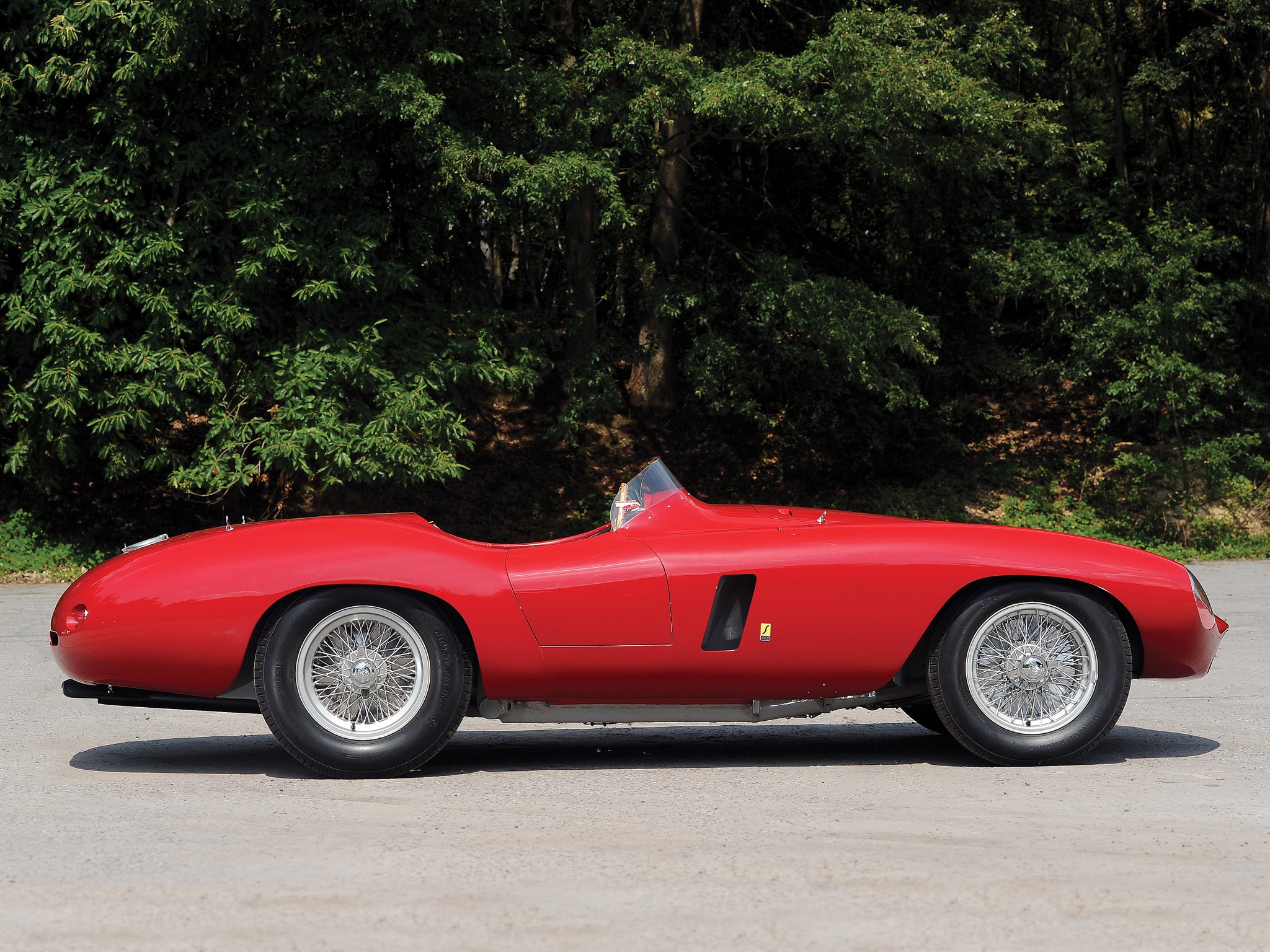
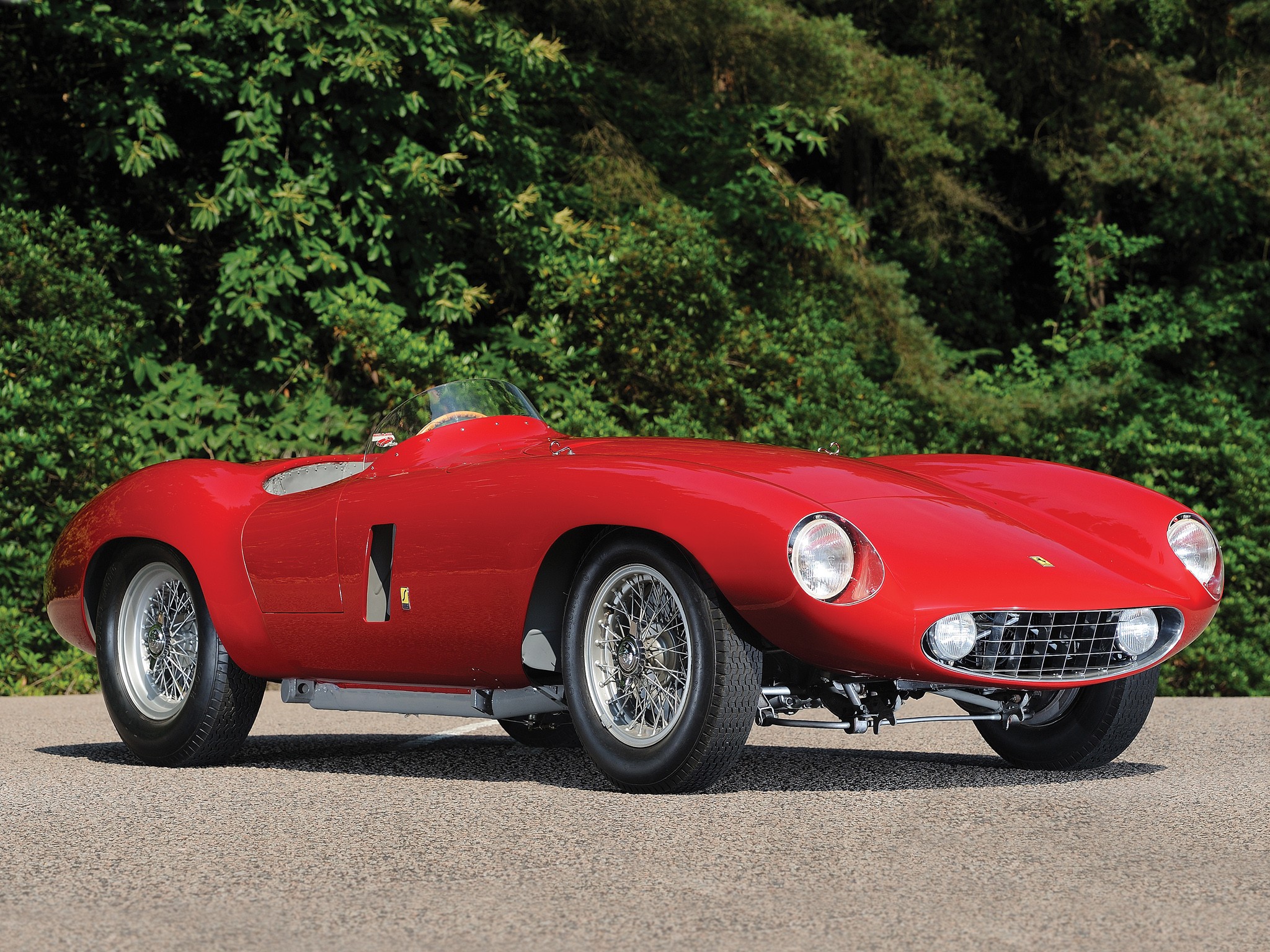
Most cars carry open barchetta bodies built by Carrozzeria Scaglietti in Modena, with a faired-in headrest behind the driver. Sources disagree about the design: some credit Pinin Farina, others attribute the shape to Enzo Ferrari's son Dino. A few cars received other bodies, and several were rebodied during their racing lives.
The front shows a wide oval grille, often with extra driving lamps for endurance races, and the car runs on wire-spoked wheels. The cockpit is purely functional: a small wrap-around screen in front of the driver, a large rev counter and a three-spoke steering wheel with the Ferrari horse in its centre.
Racing history
| Date | Event | Result |
|---|---|---|
| 27 June 1954 | Supercortemaggiore, Monza | 1st (Hawthorn / Maglioli) and 2nd |
| 1954 | Tourist Trophy, Dundrod | Win credited to the 750 Monza in period records |
| 26 May 1955 | Private test, Monza | Alberto Ascari killed in a 750 Monza |
| 1955 | World Sportscar Championship | Title lost to Mercedes-Benz and its 300 SLR |
| 1955 | California club races | A privately run car won eight races in a row |
The 1955 season was difficult. Mercedes-Benz took the championship with the 300 SLR, and Ascari's death at Monza, in a borrowed 750 Monza during an unofficial test four days after his crash into Monaco harbour, shocked Italy. Ferrari answered with the bigger 857 S, and the 860 Monza of 1956, with 206 kW (280 PS) from 3.4 litres, won the Sebring 12 Hours with Juan Manuel Fangio and Eugenio Castellotti.

Many 750 Monzas were sold to private teams in the United States, where they raced successfully in club events into the late 1950s.
Rivals in the mid-1950s
| Model | Engine | Power (hp) | Best-known result |
|---|---|---|---|
| Ferrari 750 Monza | 3.0 I4 | about 255 | Supercortemaggiore win, 1954 |
| Mercedes-Benz 300 SLR | 3.0 straight-eight | about 300 | 1955 World Sportscar champion |
| Jaguar D-Type | 3.4 I6 | about 250 | Le Mans winner 1955–1957 |
| Maserati 300S | 3.0 I6 | about 245 | Front-runner in 1955–1956 |
Compared with the Jaguar, the Ferrari had a similar output but weighed less, while the Mercedes had far more engineering and money behind it. Ferrari's own sports-car line is easy to trace through the 375 MM Berlinetta, the six-cylinder 121 LM of 1955 and the 250 Testa Rossa that followed. The 1cars comparison tool helps line up classic and modern cars, and the 750 Monza also appears among open cars in the ranking of the most powerful convertibles.

Fuel use, equipment and safety
There are no official fuel figures: like other racing cars of its day, the 750 Monza was tuned for power, not economy. It has no safety equipment in the modern sense, with no roll-over bar or seat belts as built, and no crash testing. Equipment is limited to what racing needed: lamps, a minimal screen and the instruments.

Buying and collecting a 750 Monza
With so few cars built and many rebuilt after accidents, history is everything. Before any purchase, an expert should confirm the chassis number, the engine number and the race record. Ferrari Classiche certification and an unbroken ownership history add value, and original bodywork matters more than cosmetic perfection. Prices at public auctions have run from under two million to several million euros, depending on history and originality.

As a buy, the car suits only experienced collectors and historic racers. Events such as historic Mille Miglia retrospectives and concours shows are where these cars appear today. More about the maker is in the history of Ferrari, and other early Ferraris are in the 1cars catalogue.

Ferrari 750 Monza photos 13



FAQ
How much power does the Ferrari 750 Monza have?
The 3.0-litre four-cylinder produces about 191 kW (260 PS) according to most sources, with some period data quoting 184 kW (250 PS) at 6,000 rpm. Earlier claims of 306 hp for this car are too high.
How many Ferrari 750 Monzas were made?
Sources give between 29 and 35 cars, built in 1954 and 1955. The exact number is hard to fix because several chassis were rebodied, re-engined or rebuilt during their racing careers.
Why is it called the 750 Monza?
The number refers to the displacement of each cylinder, about 750 cc, so four cylinders give about 3.0 litres. Monza comes from its first race, the Supercortemaggiore at Monza in June 1954, which it won.
What is the fuel consumption of the Ferrari 750 Monza?
No official figure exists. The 750 Monza was a racing car with large twin-choke carburettors, and like its rivals it used fuel at a rate measured for endurance races, not road driving.
What are the main rivals of the Ferrari 750 Monza?
In 1954 and 1955 it raced against the Mercedes-Benz 300 SLR, the Jaguar D-Type, the Maserati 300S and the Aston Martin DB3S. The Mercedes won the 1955 World Sportscar Championship.
Data sources
Data checked by an editor against the sources below.
- The text of this article (1cars archive)
- Wikipedia - Ferrari 750 Monza
- Rmsothebys - R105 1955 Ferrari 750 Monza Spyder By Scaglietti


