
 Lancia Stratos
Specs, engines and history
Updated Published Sources (2) Report an error
By Felix Hartmann, Automotive Technology & EV Contributor Reviewed by Oleksandr Hnatiuk
- Built
- 1973–1978
- Top power
- 140 kW (190 PS)
Which Stratos to choose
Our verdict · Felix Hartmann
For a collector, a documented Stradale with matching numbers is the one to own, and it will only rise in value. Ex-works rally cars are museum pieces with prices to match. A replica gives most of the driving experience for a fraction of the cost, but it will never be a Stratos in the eyes of the market. The New Stratos is an exclusive modern supercar for a very small circle of buyers. All Lancia models in the catalogue are listed on the Lancia brand page.
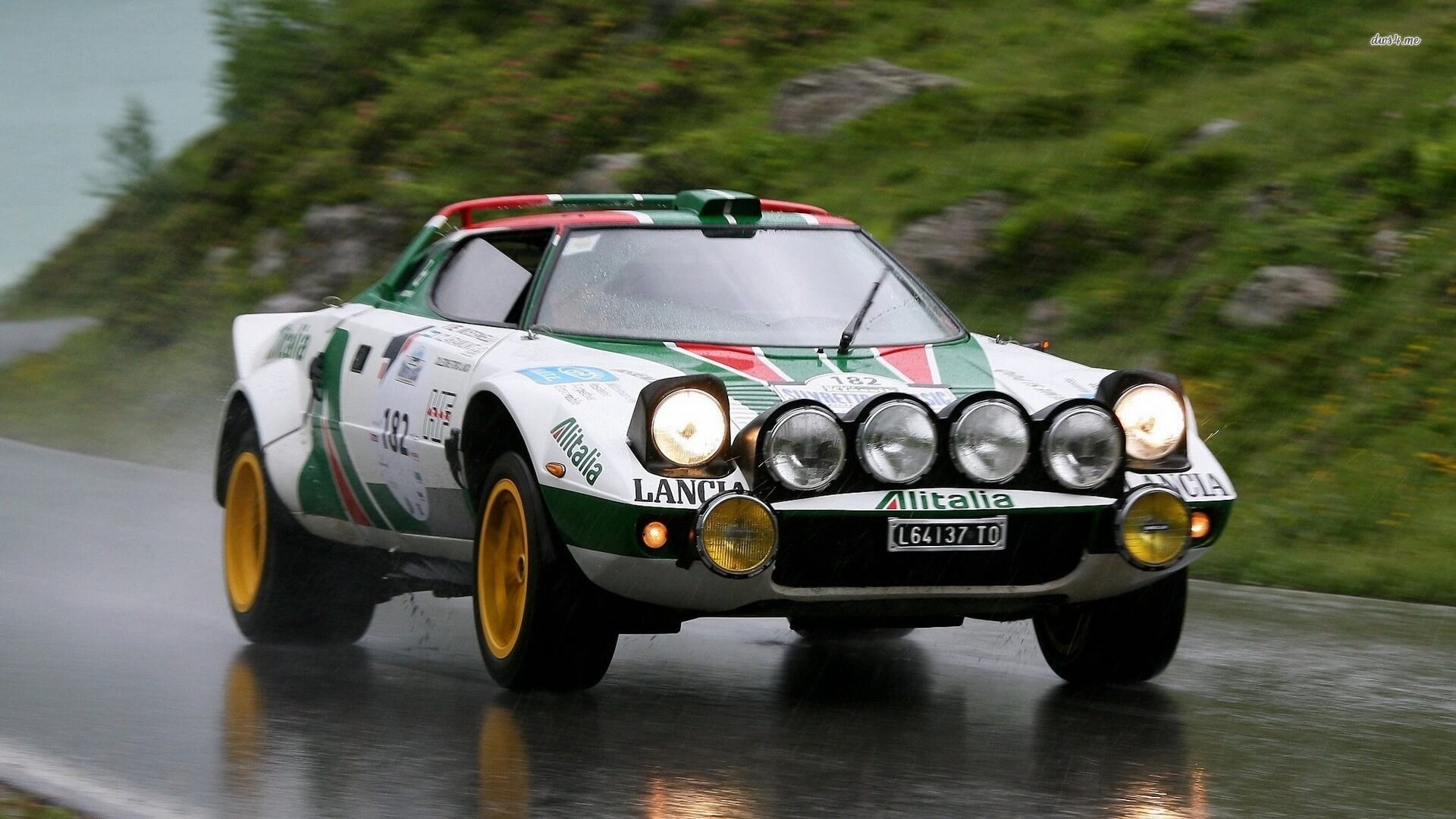
The Lancia Stratos HF is a mid-engined two-seat coupé designed from the start to win rallies. About 492 road cars were built in 1973–1975 to homologate it, each with a 2.4-litre Ferrari Dino V6 of 140 kW (190 PS) and a weight of 980 kg. It won the World Rally Championship in 1974, 1975 and 1976.
In short
- Concept: the Bertone Stratos Zero of 1970 and the Stratos HF prototype of 1971, both drawn by Marcello Gandini.
- Road car: the Stratos HF Stradale, a steel spaceframe with a glass-fibre body, five-speed gearbox and rear-wheel drive.
- Record: 18 World Rally Championship wins, four Monte Carlo Rally victories and a Targa Florio win.
- Revival: the one-off New Stratos of 2010, built on a shortened Ferrari F430 Scuderia, with a run of 25 announced in 2018.

Stratos HF Stradale technical data

| Parameter | Metric | Imperial |
|---|---|---|
| Engine | 2,418 cc 65° V6 (Ferrari Dino), three Weber 40 IDF carburettors | 147.6 cu in |
| Power | 140 kW (190 PS) at 7,000 rpm | 188 bhp |
| Torque | 226 Nm at 4,000 rpm | 166 lb-ft |
| Gearbox and drive | 5-speed manual, ZF limited-slip differential, rear-wheel drive | - |
| Kerb weight | 980 kg (rally Group 4 cars: 880 kg) | 2,161 lb |
| 0–100 km/h | 6.4–6.8 s, depending on the test | 0–60 mph about 6.5 s |
| Top speed | 232 km/h | 144 mph |
| Length / width / height | 3,710 / 1,750 / 1,110 mm | 146.1 / 68.9 / 43.7 in |
| Wheelbase | 2,180 mm | 85.8 in |
| Fuel tanks | two tanks, 80 litres in total | 21.1 US gal |
From the Stratos Zero to a rally homologation special
Lancia had won rallies with the front-wheel-drive Fulvia, but by 1970 the car was outclassed. Bertone answered with a show car: the Stratos Zero, a wedge barely a metre tall, shown at the 1970 Turin Motor Show with a 1.6-litre Fulvia V4. Marcello Gandini drew it, and its shape later sold at auction in 2011 for €761,600. You can read more about his work in the profile of Marcello Gandini.
A year later, at the 1971 Turin show, Bertone and Lancia presented the Stratos HF prototype. This time it had a Ferrari Dino V6 behind the seats. Lancia's team manager Cesare Fiorio pushed the project, the racing driver and engineer Mike Parkes helped develop it, and the works driver Sandro Munari tested it. The prototypes raced in 1972 and 1973 before the car was homologated.
Group 4 rules demanded 500 road cars. Bertone built the bodies at Grugliasco, and Lancia completed the cars at its Chivasso plant about 40 km away. The best estimate is 492 cars, plus spare bodyshells, all with left-hand drive. Homologation came on 1 October 1974, and most production took place between July 1973 and 1975. For the story of the company behind it, see the history of Lancia.
Dino V6, spaceframe and short wheelbase
The Stratos is built around a semi-monocoque steel spaceframe with an integral roll cage. The glass-fibre body has huge front and rear clamshells that lift off for service. Suspension is by double wishbones at the front and MacPherson struts with lower wishbones at the rear.

The engine sits across the car. It is the 2,418 cc Dino V6 with a cast-iron block, light-alloy heads and three twin-choke Weber carburettors. Ferrari also supplied the five-speed gearbox. Brakes are 271 mm ventilated discs on all four wheels, with no servo, and the car runs on 14-inch Campagnolo magnesium wheels.
The key number is the wheelbase: 2,180 mm. That is very short for a car of 1.75 m width, and it makes the Stratos turn in sharply and react fast to the throttle. Rally drivers loved it on tight tarmac. Ordinary drivers found the road car nervous at the limit.
By our calculation, the road car carries 7.0 kg per kW and a Group 4 rally car about 4.3 kg per kW with roughly 205 kW. Check how that compares with modern cars in the 1cars power-to-weight calculator.
World rally titles from 1974 to 1976
The Stratos is often called the first car designed purely to win rallies, and it did exactly that. In 1974 it won three World Rally Championship rounds: Sanremo and the Rideau Lakes Rally with Munari, and the Tour de Corse with Jean-Claude Andruet. Lancia took the manufacturers' title with 96 points against Fiat's 69.

| Year | Result |
|---|---|
| 1974 | First manufacturers' world title; Targa Florio win |
| 1975 | Second title; four WRC wins, including Monte Carlo |
| 1976 | Third title in a row; Monte Carlo again with Munari |
| 1977 | Third straight Monte Carlo win for Munari |
| 1979 | Private Chardonnet team wins Monte Carlo |
| 1981 | Last WRC win: Tour de Corse with Bernard Darniche |
Works rally engines were tuned to about 205 kW (275 hp) with 12 valves and about 235 kW (320 hp) with 24 valves. The 24-valve heads were banned from Group 4 from 1978. By then Fiat, which owned Lancia, had moved its works effort to the Fiat 131 Abarth, so the Stratos carried on in private hands. It also won the Tour de France Automobile five times and the 1976 European Rallycross title.
Group 5 Turbo and endurance racing
Lancia also built two turbocharged Group 5 "silhouette" cars for circuit racing, engineered by Nicola Materazzi. A Stratos finished 20th overall at the 1976 Le Mans 24 Hours, driven by Christine Dacremont and Lella Lombardi. These cars were rare side projects, but they showed how adaptable the short chassis was.

Cabin, practicality and ownership
The cockpit is tight and simple. There is a deep, curved windscreen and almost no rear visibility. The two fuel tanks hold 80 litres in total, and there is no real boot.

Original cars are expensive collector pieces today, and many were rebuilt after rally damage. A buyer should check chassis history with a marque specialist before anything else. The spaceframe can rust, the glass-fibre panels crack, and genuine Dino parts are costly. Several companies build replicas, so documented provenance matters. If you want the period atmosphere at lower cost, a well-made replica is the realistic choice.
New Stratos: the 2010 Ferrari F430 Scuderia revival
The New Stratos is the car the old 1cars article described. It was commissioned by the German businessman Michael Stoschek and his son Maximilian. Pininfarina designed and developed it, and it was shown in 2010. It was never an official Lancia production model.

The base is a Ferrari F430 Scuderia. Its chassis was shortened by 200 mm to a 2,400 mm wheelbase. The body uses carbon-fibre panels on the aluminium chassis, and a steel roll cage is built in. The car is 4,181 mm long, 1,971 mm wide and 1,240 mm tall. According to the old 1cars text, it is about 33 cm shorter and 80 kg lighter than its donor car.
| Parameter | New Stratos (2010) |
|---|---|
| Engine | 4.3-litre V8 from the F430 Scuderia, retuned |
| Power | about 400 kW (540 hp) at 8,200 rpm |
| Torque | 520 Nm at 3,750 rpm |
| Kerb weight | 1,247 kg |
| 0–100 km/h | 3.3 s |
| Top speed | about 320 km/h |
The old article quoted 0–200 km/h in 9.7 seconds, carbon-ceramic Brembo brakes and a 90-litre tank; those figures come from the builder's launch data. On 10 February 2018, Manifattura Automobili Torino announced it would build the 25 cars originally planned. By our calculation, the New Stratos carries about 3.1 kg per kW, less than half the figure of the 1974 road car.
Stratos against its 1970s rally rivals
| Model | Engine | Layout | Rally role |
|---|---|---|---|
| Lancia Stratos HF | 2.4 V6 (Ferrari Dino) | Mid-engine, RWD | Purpose-built rally car |
| Alpine-Renault A110 | 1.6–1.8 I4 | Rear-engine, RWD | 1973 world champion |
| Fiat 131 Abarth | 2.0 I4 16v | Front-engine, RWD | Took over from the Stratos at Fiat |
| Ford Escort RS1800 | 2.0 I4 16v | Front-engine, RWD | Main British rival |
| Lancia 037 | 2.0 I4 supercharged | Mid-engine, RWD | Lancia's next rally car (1982) |
The rivals were road saloons or sports cars adapted for rallying. The Stratos reversed that order. Later, Lancia went back to four-door hatchbacks and won six more titles with the Lancia Delta. For other cars from the same decade, browse 1970s classics on 1cars, or set two of them side by side with the 1cars comparison tool.

Lancia Stratos in our rankings
- No. 716 of 1022 · Most powerful cars (140 kW · top 71%)
- No. 122 of 146 · Most powerful Italian cars (140 kW · top 84%)
- No. 299 of 334 · Most powerful coupes (140 kW · top 90%)
More powerful than 29% of ranked cars in the 1CARS catalog (No. 716 of 1022).
Lancia Stratos photos 15


Lancia Stratos videos 2

Lancia Stratos video 1

Test drive
FAQ
How many Lancia Stratos were built?
The best estimate is 492 Stratos HF road cars, built mainly between 1973 and 1975 to meet the Group 4 rule of 500 cars. A small number of spare bodyshells and works rally cars add to that total.
What engine does the Lancia Stratos have?
It uses the 2,418 cc Ferrari Dino V6, mounted across the car behind the seats. In road trim it delivers 140 kW (190 PS) and 226 Nm. Works rally engines reached about 235 kW (320 hp) with 24-valve heads.
How many world titles did the Stratos win?
It won the World Rally Championship for manufacturers three times in a row, in 1974, 1975 and 1976. In total it scored 18 WRC wins, the last at the 1981 Tour de Corse.
Is the New Stratos a real Lancia?
No. The 2010 New Stratos was a private project by Michael Stoschek, designed by Pininfarina on a shortened Ferrari F430 Scuderia. Lancia never sold it, and Manifattura Automobili Torino announced a run of 25 cars in 2018.
How fast is the Lancia Stratos?
The road-going Stratos HF reaches 232 km/h and covers 0–100 km/h in about 6.4–6.8 seconds. The 2010 New Stratos needs 3.3 seconds and tops out at about 320 km/h.
Data sources
Data checked by an editor against the sources below.
- The text of this article (1cars archive)
- Wikipedia - Lancia Stratos


