
 Porsche Panamera
All generations, specs and history
Updated Published Sources (6) Report an error
By Felix Hartmann, Automotive Technology & EV Contributor Reviewed by Oleksandr Hnatiuk

- Built
- 2009–present
- Generations
- 3
- Top power
- 575 kW (782 PS)
Timeline
Panamera generations
Click a generation for its own page


- Panamera 2009–2016 · Hatchback · 184–419 kW (250–570 PS)
- Panamera II (971) 2016–2023 · Hatchback, Station wagon · 243–515 kW (330–700 PS)
- Panamera III (976) Current 2023–now · Hatchback · 260–575 kW (354–782 PS)
Newest first · 3 generations since 2009
-
2023
 976 In production 2023–now · Hatchback · 260–575 kW (354–782 PS)
-
2016

-
2009
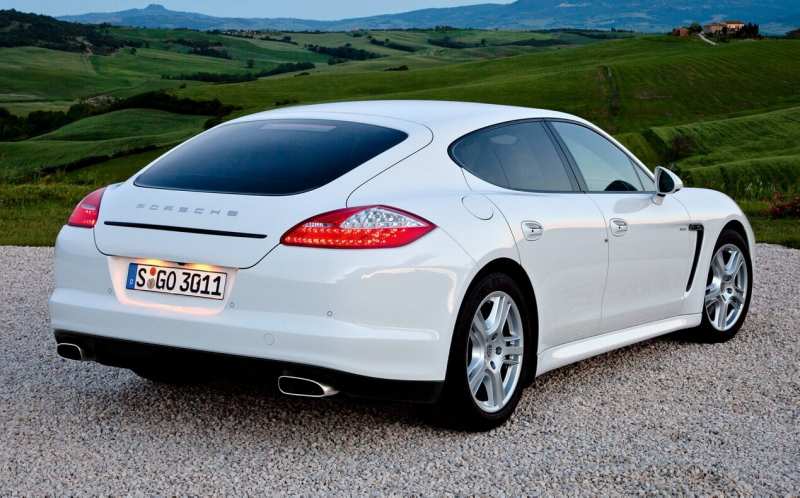
All generations by year: Panamera III (976) (2023–now) · Panamera II (971) (2016–2023) · Panamera (2009–2016)
Which one is mine?
Pick the year of first registration to see which generation it is.
Check by VINWhich Porsche Panamera to buy
Our verdict · Felix Hartmann
- Best value: a 970 4S or GTS. The naturally aspirated V8 is the classic choice, and prices have fallen far from new.
- Best for long distances: a 971 4 or 4S Sport Turismo, with the extra practicality of the estate body.
- Lowest running costs in town: an E-Hybrid that you can charge at home; the 976 versions offer up to 90 km on electricity.
- Maximum performance: a 971 Turbo S or a 976 Turbo S E-Hybrid.
Before buying any used Panamera, check the service history at a Porsche specialist, the air suspension (if fitted) and, on hybrids, the battery health. For the background of the brand, read the history of Porsche; if you want a Porsche SUV instead, see the Porsche Macan.
The Porsche Panamera is a four-door, four-seat luxury fastback built in Leipzig since April 2009. There have been three generations: the 970 (2009–2016), the 971 (2016–2023) and the 976, presented on 24 November 2023. Power has grown from 184 kW in the first diesel to 575 kW in today's Turbo S E-Hybrid, and Porsche has offered plug-in hybrids since 2013.
In short
- Revealed at the Shanghai Auto Show on 19 April 2009; the name recalls the Carrera Panamericana road race.
- Body styles: five-door fastback, long-wheelbase Executive and, for the 971 only, the Sport Turismo estate.
- Engines: V6 and V8 petrol, a V6 and later a V8 diesel, and E-Hybrid plug-in hybrids.
- The current Turbo S E-Hybrid has 575 kW (782 PS), 1,000 Nm and a top speed of 325 km/h.

Specs by version
Engines
| Version | Engine | Gearbox | Drive | Production years |
|---|---|---|---|---|
| 971 · 2016–2023 | ||||
| 971 · 2.9 L 6 cyl Automatic (AM-S8) · 2022 (EPA) | 2.9 l · 6 cyl 2,900 cc | 8-sp Dual-clutch | Rear-wheel drive | 2022 |
| 971 · 2.9 L 6 cyl Automatic (AM-S8) · 2021 (EPA) | 2.9 l · 6 cyl 2,900 cc | 8-sp Dual-clutch | Rear-wheel drive | 2021 |
| 971 · 3 L 6 cyl Automatic (AM-S8) · 2020 (EPA) | 3.0 l · 6 cyl 3,000 cc | 8-sp Dual-clutch | Rear-wheel drive | 2020 |
| 971 · 3 L 6 cyl Automatic (AM-S8) · 2019 (EPA) | 3.0 l · 6 cyl 3,000 cc | 8-sp Dual-clutch | Rear-wheel drive | 2019 |
| 976 · 2023–present | ||||
| 976 · 2.9 L 6 cyl Automatic (AM-S8) · 2026 (EPA) | 2.9 l · 6 cyl 2,900 cc | 8-sp Dual-clutch | Rear-wheel drive | 2026 |
| 976 · 2.9 L 6 cyl Automatic (AM-S8) · 2025 (EPA) | 2.9 l · 6 cyl 2,900 cc | 8-sp Dual-clutch | Rear-wheel drive | 2025 |
| 976 · 2.9 L 6 cyl Automatic (AM-S8) · 2024 (EPA) | 2.9 l · 6 cyl 2,900 cc | 8-sp Dual-clutch | Rear-wheel drive | 2024 |
| 976 · 2.9 L 6 cyl Automatic (AM-S8) · 2023 (EPA) | 2.9 l · 6 cyl 2,900 cc | 8-sp Dual-clutch | Rear-wheel drive | 2023 |
Performance
Show all 8 versions
| Version | Fuel consumption |
|---|---|
| 971 · 2016–2023 | |
| 971 · 2.9 L 6 cyl Automatic (AM-S8) · 2022 (EPA) | 11.8 l/100 km19.9 mpg US · 23.9 mpg UK |
| 971 · 2.9 L 6 cyl Automatic (AM-S8) · 2021 (EPA) | 11.8 l/100 km19.9 mpg US · 23.9 mpg UK |
| 971 · 3 L 6 cyl Automatic (AM-S8) · 2020 (EPA) | 10.7 l/100 km22.0 mpg US · 26.4 mpg UK |
| 971 · 3 L 6 cyl Automatic (AM-S8) · 2019 (EPA) | 10.7 l/100 km22.0 mpg US · 26.4 mpg UK |
| 976 · 2023–present | |
| 976 · 2.9 L 6 cyl Automatic (AM-S8) · 2026 (EPA) | 11.2 l/100 km21.0 mpg US · 25.2 mpg UK |
| 976 · 2.9 L 6 cyl Automatic (AM-S8) · 2025 (EPA) | 11.2 l/100 km21.0 mpg US · 25.2 mpg UK |
| 976 · 2.9 L 6 cyl Automatic (AM-S8) · 2024 (EPA) | 11.2 l/100 km21.0 mpg US · 25.2 mpg UK |
| 976 · 2.9 L 6 cyl Automatic (AM-S8) · 2023 (EPA) | 11.8 l/100 km19.9 mpg US · 23.9 mpg UK |
Verified Manufacturer and type-approval data from our catalog · Sources and methodology
Panamera generations at a glance
| Generation | Years | Platform / build | Power range | Body styles |
|---|---|---|---|---|
| 970 | 2009–2016 | Bodies from Hannover, assembly in Leipzig | 184–419 kW (250–570 PS) | Fastback, Executive (from 2013) |
| 971 | 2016–2023 | Volkswagen Group MSB, built in Leipzig | 243–515 kW (330–700 PS) | Fastback, Executive, Sport Turismo |
| 976 | 2023– | MSB, built in Leipzig | 260–575 kW (353–782 PS) | Fastback, Executive |
Michael Mauer led the design of the first generation, Peter Varga the second and James Burgess the third.

First generation (970): a new kind of Porsche, 2009–2016
The Panamera was shown at the Shanghai Auto Show in April 2009, and production began the same month. It was Porsche's first four-door saloon-style car. The bodies were built at the Volkswagen Group plant in Hannover, the engines in Stuttgart, and final assembly took place in Leipzig.

The 970 kept a sporty layout with four individual seats separated by a wide centre console. It weighed nearly 1,800 kg and had a 440-litre boot behind a large tailgate. The old 1cars text described a drag coefficient of 0.29, an active rear spoiler with a variable angle and double-wishbone front suspension.
| 970 version (2009–2013) | Engine | Power | Torque | Top speed |
|---|---|---|---|---|
| Panamera / 4 | 3.6 V6 | 221 kW (300 PS) | 400 Nm | 261 / 257 km/h |
| Diesel (from May 2011) | 3.0 V6 turbodiesel | 184 kW (250 PS) | 550 Nm | 244 km/h |
| S Hybrid | 3.0 supercharged V6 + electric motor | 279 kW (380 PS) | 580 Nm | 270 km/h |
| S / 4S | 4.8 V8 | 294 kW (400 PS) | 500 Nm | 285 / 282 km/h |
| GTS | 4.8 V8 | 316 kW (430 PS) | 520 Nm | 288 km/h |
| Turbo | 4.8 twin-turbo V8 | 368 kW (500 PS) | 700 Nm | 303 km/h |
| Turbo S | 4.8 twin-turbo V8 | 405 kW (550 PS) | 750 Nm | 306 km/h |
By 2011 the 4S was the most popular version, with 9,394 sales, ahead of the Turbo with 6,171. The United States was the biggest single market, with 6,188 cars sold by 2011 and 7,614 in 2012.
The 2013 facelift and the first plug-in hybrid
Porsche presented the updated 970 in Shanghai in April 2013. It brought new bumpers, a 3.0-litre twin-turbo V6 for the S, and a long-wheelbase Executive version for selected markets, 150 mm longer between the axles. The Turbo S rose to 419 kW (570 PS) and reached 100 km/h in 3.3 seconds with launch control.
The big news was the S E-Hybrid, Porsche's first plug-in hybrid in this class. It combined the supercharged V6 with a 96 PS electric motor for 310 kW (422 PS) and 590 Nm. Its 9.4 kWh battery gave more than 32 km of electric driving on the NEDC cycle and charged in about 2.5 hours. In the US it started at 99,000 dollars in 2014, about €75,000 at the time. From January to August 2014 it took about 9 % of Panamera sales worldwide.
Second generation (971): MSB platform and Sport Turismo, 2016–2023
The second Panamera was revealed in Berlin on 28 June 2016. It moved to the Volkswagen Group's MSB platform, which it shares with Bentley, and full production moved to Leipzig. It is 35 mm longer than the first generation, with a 30 mm longer wheelbase. The Sport Turismo estate followed at the Geneva Motor Show in March 2017.

| 971 version | Engine | Power | Torque | 0–100 km/h | Top speed |
|---|---|---|---|---|---|
| Panamera / 4 | 2.9 twin-turbo V6 | 243 kW (330 PS) | 450 Nm | 5.6 / 5.3 s | up to 268 km/h |
| 4 E-Hybrid | 2.9 V6 + electric | 340 kW (462 PS) | 700 Nm | 4.6 s | 278 km/h |
| 4S | 2.9 twin-turbo V6 | 324 kW (440 PS) | 549 Nm | 4.2 s | 289 km/h |
| 4S Diesel (2016–2018) | 4.0 twin-turbo V8 diesel | 310 kW (422 PS) | 850 Nm | 4.5 s | 285 km/h |
| GTS (2019–2020) | 4.0 twin-turbo V8 | 338 kW (460 PS) | 620 Nm | 4.1 s | 298 km/h |
| Turbo | 4.0 twin-turbo V8 | 405 kW (550 PS) | 770 Nm | 3.6 s | 306 km/h |
| Turbo S E-Hybrid | 4.0 V8 + electric | 500 kW (680 PS) | 850 Nm | 3.4 s | 310 km/h |
The facelift for the 2021 model year added a full-width LED light bar at the rear and more power. The Turbo S reached 463 kW (630 PS) and 820 Nm, the GTS 353 kW (480 PS), and the Turbo S E-Hybrid 515 kW (700 PS). A new 4S E-Hybrid with 412 kW (560 PS) needed only 3.5 seconds to 100 km/h. Porsche dropped the diesel in 2018.
Third generation (976): Porsche Active Ride, 2023 onwards
Porsche presented the third Panamera on 24 November 2023. The styling changes are evolutionary, the Sport Turismo was dropped, and every version now has air suspension. E-Hybrid models can have Porsche Active Ride, an electro-hydraulic active suspension that can lift the car by 55 mm to make getting in easier. Rear-wheel steering and centre-lock wheels are options.

| 976 version | Engine | Power | Torque | Top speed |
|---|---|---|---|---|
| Panamera / 4 | 2.9 turbo V6 | 260 kW (353 PS) | 500 Nm | 272 / 270 km/h |
| 4 E-Hybrid | 2.9 V6 + 190 PS motor | 346 kW (470 PS) | 650 Nm | 280 km/h |
| 4S E-Hybrid | 2.9 V6 + 190 PS motor | 400 kW (544 PS) | 750 Nm | 298 km/h |
| GTS | 4.0 twin-turbo V8 | 368 kW (500 PS) | 660 Nm | 302 km/h |
| Turbo E-Hybrid | 4.0 V8 + 190 PS motor | 500 kW (680 PS) | 930 Nm | 315 km/h |
| Turbo S E-Hybrid | 4.0 V8 + 190 PS motor | 575 kW (782 PS) | 1,000 Nm | 325 km/h |
The Turbo E-Hybrid has a 25.9 kWh battery (21.8 kWh usable), up to 90 km of electric range on the WLTP cycle and an 11 kW on-board charger. A full charge takes about 138 minutes. The long-wheelbase Executive is 5,202 mm long with a 3,100 mm wheelbase and weighs about 2,400 kg.
How the Panamera has grown
By our calculation, the most powerful Panamera has gained 170 kW in 14 years, an increase of 42 %. The 2009 Turbo S had 405 kW; the 2024 Turbo S E-Hybrid has 575 kW. The electric range of the plug-in versions has risen from about 32 km (NEDC) in 2013 to 90 km (WLTP) today, almost three times as far even on the stricter test.

The base car has also become stronger. The 2009 V6 had 221 kW; the 2023 base car has 260 kW, which is 39 kW more. You can check the power-to-weight ratio of any version with the 1cars power-to-weight calculator.
Panamera vs rivals
| Rival | Body | Character |
|---|---|---|
| Mercedes-Benz CLS | Four-door coupé | Based on the E-Class, more comfort-oriented |
| Maserati Quattroporte | Saloon | Large Italian luxury saloon |
| Tesla Model S | Electric liftback | Battery-electric alternative |
| Porsche Taycan | Electric saloon | Porsche's own electric alternative |
The Panamera's main strength is that it drives like a Porsche while carrying four adults and their luggage. To set it side by side with these rivals on power, size and weight, use the 1cars comparison tool.

Porsche Panamera evolution in numbers
Did you know?
- The Porsche Panamera has been around for 17 years: 3 generations in our catalog since 2009.
- The biggest jump in power came with the Panamera II (971): up to 515 kW (700 PS), 96 kW more than the Panamera.
Most powerful version, kW
Figures from the 1cars catalog: power is the strongest version of each generation; generations without the figure are left out.
Porsche Panamera: first vs latest generation
| Spec | Panamera | Panamera III (976) | Change |
|---|---|---|---|
| Years | 2009–2016 | 2023–present | 14 years apart |
| Most powerful version | 419 kW (570 PS) | 575 kW (782 PS) | +156 kW (+37%) |
Oldest and newest generation in the 1cars catalog. Power is the strongest version of each; other rows are shown only when both generations have the figure.
Porsche Panamera in our rankings
- No. 1 of 141 · Most powerful hatchbacks (575 kW)
- No. 3 of 151 · Most powerful German cars (575 kW)
- No. 6 of 91 · Biggest engines: hatchbacks (2,900 cc)
- No. 61 of 1011 · Most powerful cars (575 kW · top 7%)
- No. 38 of 317 · Most powerful cars of the 2020s (575 kW · top 12%)
- No. 262 of 1082 · Longest-running car nameplates (17 years · top 25%)
More powerful than 99% of ranked hatchbacks in the 1CARS catalog (No. 1 of 141).
Porsche Panamera photos 13


Porsche Panamera videos 3

Porsche Panamera video 1

Test drive

Video overview
FAQ
What does the name Panamera mean?
The name comes from the Carrera Panamericana, the Mexican road race of the early 1950s in which Porsche cars did well. Porsche had already used "Carrera" for its sports cars, so the Panamera name continued that link.
How many generations of the Porsche Panamera are there?
There are three: the 970 from 2009 to 2016, the 971 from 2016 to 2023 and the 976, presented in November 2023. All three are built in Leipzig, Germany.
Is the Porsche Panamera a hybrid?
Some versions are. Porsche sold the S Hybrid from the first generation and has offered plug-in E-Hybrid models since 2013. In the current car, the E-Hybrid versions range from 346 kW to 575 kW.
What is the fastest Porsche Panamera?
The current Turbo S E-Hybrid is the fastest. It has 575 kW (782 PS) and 1,000 Nm, reaches 325 km/h and accelerates from 0 to 60 mph in 2.8 seconds.
Is there a Porsche Panamera estate?
Yes. The second generation was also sold as the Panamera Sport Turismo, which made its debut in Geneva in spring 2017. Porsche did not continue this body style in the third generation.
Data sources
Data checked by an editor against the sources below.
- The text of this article (1cars archive)
- Wikipedia - Porsche Panamera
- US EPA fueleconomy.gov - 44570.shtml
- US EPA fueleconomy.gov - 43727.shtml
- US EPA fueleconomy.gov - 41918.shtml
- US EPA fueleconomy.gov - 41389.shtml


