
 Porsche 959
Specs, engines and history
Updated Published Sources (2) Report an error
By Felix Hartmann, Automotive Technology & EV Contributor Reviewed by Oleksandr Hnatiuk
- Built
- 1985–1988
- Top power
- 331 kW (450 PS)
- New price
- from about €214,743 (1987)
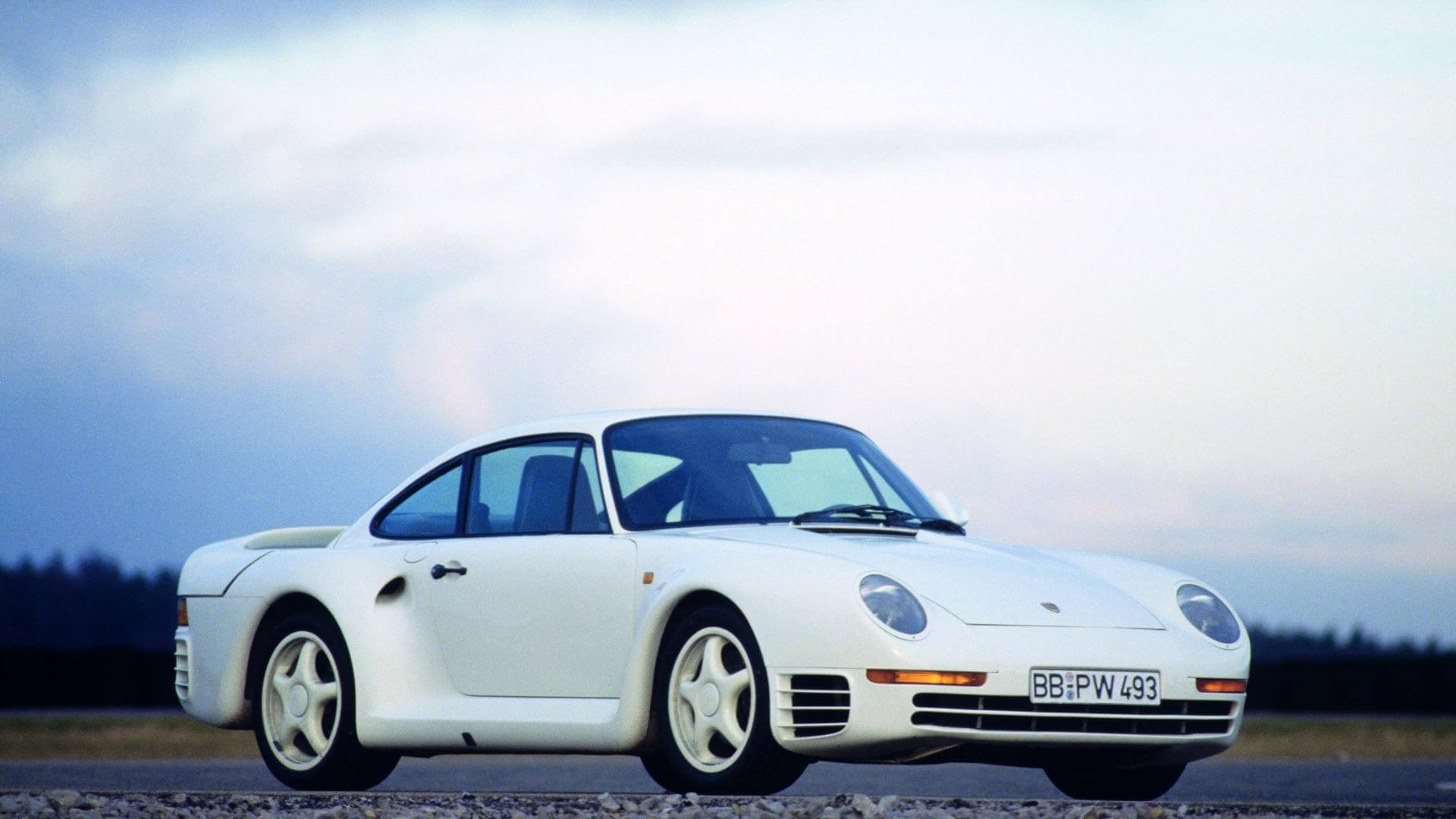
The Porsche 959 is a twin-turbocharged, all-wheel-drive sports car built in 1986–1988 as a homologation special for Group B. Its 2.85-litre flat-six produced 331 kW (450 PS), and at launch it was the fastest street-legal production car in the world. Porsche assembled 292 production cars, plus 37 prototypes and eight extra cars in 1992–1993.
In short
- Shown as the "Gruppe B" study at Frankfurt in 1983 and as the road car in 1985; first deliveries in 1987.
- 2,849 cc flat-six with sequential twin turbos, 331 kW (450 PS) and 500 Nm, six-speed manual and PSK variable all-wheel drive.
- Won the Paris–Dakar Rally in 1986 with René Metge; the 961 racing version took its class at Le Mans the same year.
- Launch price DM 431,550; it was not road legal in the USA until the "Show or Display" law of 1999.

Size at a glance
| Dimensions | Porsche 959 |
|---|---|
| Length | 4,260 mm167.7 in |
| Width | 1,840 mm72.4 in |
| Height | 1,280 mm50.4 in |
| Wheelbase | 2,272 mm89.4 in |
Specs by version
Engines
Performance
Show all 1 versions
| Version | 0–100 km/h | Top speed |
|---|---|---|
| 2.9 331 kW (450 PS) Coupe | 3.7 s 0–62 mph | 317 km/h197 mph |
Dimensions and weight
Show all 1 versions
| Version | Length | Width | Height | Wheelbase | Kerb weight |
|---|---|---|---|---|---|
| 2.9 331 kW (450 PS) Coupe | 4,260 mm167.7 in | 1,840 mm72.4 in | 1,280 mm50.4 in | 2,272 mm89.4 in | 1,450 kg3,197 lb |
Verified Manufacturer and type-approval data from our catalog · Sources and methodology
Porsche 959 at a glance
The 959 was Porsche's technology showcase of the 1980s. It looked like a smoothed-out 911 but shared little with it beneath the skin: composite body panels, a racing-derived engine, computer-controlled four-wheel drive, adjustable ride height and tyre-pressure monitoring were all new for a road Porsche. Many of these ideas later reached the 911 Turbo and the Porsche Carrera GT.
| Fact | Value |
|---|---|
| Maker | Porsche, Stuttgart-Zuffenhausen (Germany) |
| Production | 1986–1988 (deliveries from 1987), plus 8 cars in 1992–1993 |
| Production cars | 292 (337 including prototypes and pre-production cars) |
| Purpose | Group B homologation, technology demonstrator |
| Body | Two-door 2+2 coupé |
| Layout | Rear engine, variable all-wheel drive |
The wider story of the company is told in Porsche's history.
From the Gruppe B study to the road car
Development began in 1981, soon after Peter Schutz became managing director. Chief engineer Helmuth Bott proposed a car that would prove how far the 911 concept could go and qualify for Group B, the rally and racing class that required at least 200 road cars. The "Gruppe B" prototype appeared at the Frankfurt Motor Show in 1983.

The road version was shown at Frankfurt in 1985 as a 1986 model, but the complex car took more than a year longer than planned. Customer deliveries began in 1987, and the regular run ended in 1988. By then Group B had been cancelled (in 1986), so the 959 never raced in the series it was designed for.
| Year | Event |
|---|---|
| 1981 | Development starts under Helmuth Bott |
| 1983 | "Gruppe B" study at the Frankfurt Motor Show |
| 1984 | Four-wheel-drive 953 (a modified 911) wins the Paris–Dakar Rally |
| 1985 | Road car shown at Frankfurt; a 959 wins the Rallye des Pharaons |
| 1986 | 959s finish 1st and 2nd at Paris–Dakar; the 961 takes its class at Le Mans |
| 1987 | First customer deliveries |
| 1988 | Regular production ends with 292 cars; a 959 S reaches 339 km/h at Nardò |
| 1992–1993 | Eight more Komfort cars assembled from spare parts |
Engineering: body, chassis and electronics
The body and chassis combine aluminium and aramid (Kevlar) composite, with a Nomex floor. The drag coefficient is 0.31, and the shape was tuned to eliminate aerodynamic lift, which is why the 959 has smooth sills, side vents for engine cooling and a wide integrated rear wing instead of the 911's bolt-on spoilers.

The road car could change its ride height automatically, unlike the fixed suspension of the 961 racer; the old 1cars text describes three height settings. The hollow magnesium wheels form a sealed chamber with built-in tyre-pressure sensors, an early example of the system that is now standard on every new car in the EU.
Inside, the cabin follows the 911 Turbo of the period: four-spoke steering wheel, cloth or leather seats and a large central rev counter to 8,000 rpm next to a speedometer marked to 340 km/h. Extra gauges show the slip at the rear differential and how much power goes to the front axle.
Flat-six engine and PSK all-wheel drive
The 2,849 cc flat-six comes from the 956/962 racing engine. It has air-cooled cylinders, water-cooled four-valve heads, Bosch Motronic injection and two turbochargers working in sequence: the first spools at low revs, the second joins higher up. This gave a smoother delivery than the sudden boost of other Porsche turbo engines of the time.

The PSK (Porsche-Steuer Kupplung) system uses a multi-plate clutch to vary torque between the axles according to grip and load. Under hard acceleration up to 80% goes to the rear wheels. The six-speed manual gearbox has a short first gear marked "G" for terrain (Gelände), which also helped the car meet noise rules; for normal driving owners start in second.
Porsche 959 specifications
| Parameter | Metric | Imperial |
|---|---|---|
| Engine | 2,849 cc flat-six, twin turbo | 174 cu in |
| Bore × stroke | 95 × 67 mm | 3.74 × 2.64 in |
| Power | 331 kW (450 PS) at 6,500 rpm | 444 hp |
| Torque | 500 Nm at 5,000 rpm | 369 lb-ft |
| Top speed (Komfort, claimed) | 317 km/h | 197 mph |
| 0–100 km/h | about 3.6–3.7 s | 0–60 mph 3.6 s |
| Length | 4,260 mm | 167.7 in |
| Width | 1,840 mm | 72.4 in |
| Height | 1,280 mm | 50.4 in |
| Wheelbase | 2,272 mm | 89.4 in |
| Kerb weight | 1,450 kg | 3,197 lb |
| Drag coefficient | 0.31 | – |
Road & Track measured 319 km/h (198 mph) on a Komfort, matching the factory claim.

Variants and derivatives

| Variant | Years | Body / purpose | Engine | Notes |
|---|---|---|---|---|
| 959 Komfort | 1987–1988 | Road car with full equipment | 331 kW (450 PS) | Most common version; ride-height control |
| 959 Sport | 1987–1988 | Lighter road car | 331 kW (450 PS) | Less comfort equipment |
| 959 S | 1988 | Lightweight performance version | 379 kW (515 PS) | 29 built; larger turbos; no air conditioning, rear seats or levelling |
| Factory power upgrade | 1988 on | Optional for Komfort | 390 kW (530 PS) | Up to 336 km/h and 3.4 s to 100 km/h in period tests |
| 1992–1993 Komfort | 1992–1993 | Late cars from spare parts | 331 kW (450 PS) | 8 built (4 red, 4 silver), DM 747,500, speed-sensitive dampers |
| 961 | 1986–1987 | Racing car for Le Mans | about 477 kW (640 hp) | Fixed suspension; class win in 1986 |
Dakar, Le Mans and the 959's rivals
The rally programme came first. In 1984 four-wheel-drive 953 prototypes, based on the 911 Carrera, won the Paris–Dakar Rally with René Metge, and Jacky Ickx finished sixth. In 1985 Saeed Al-Hajri and John Spiller won the Rallye des Pharaons in a 959. In 1986 the 959s finished first (Metge), second (Ickx) and sixth on the Dakar, a result no supercar has matched since.

The 961, a racing 959, finished seventh overall and first in its class at Le Mans in 1986 with Metge and Claude Ballot-Léna. In 1987 Kees Nierop crashed a 961 there and it caught fire; the restored car now stands in the Porsche Museum.
On the road, the 959 faced a small group of rivals, shown below; today's quickest cars are listed in the fastest cars ranking.
| Model | Launch | Engine | Power | Drive |
|---|---|---|---|---|
| Porsche 959 | 1986 | 2.85 twin-turbo flat-six | 331 kW (450 PS) | All-wheel |
| Ferrari F40 | 1987 | 2.9 twin-turbo V8 | 352 kW (478 PS) | Rear-wheel |
| Ferrari 288 GTO | 1984 | 2.9 twin-turbo V8 | 294 kW (400 PS) | Rear-wheel |
| Lamborghini Countach 5000 QV | 1985 | 5.2 V12 | 335 kW (455 PS) | Rear-wheel |
With 331 kW for 1,450 kg, the 959 has about 228 kW per tonne, compared with about 320 kW per tonne for the F40 (352 kW, 1,100 kg). The F40 was lighter and faster at high speed; the 959 was quicker away from the line in poor conditions and far more advanced. Line up the figures yourself in the 1cars comparison tool.
Price, the US ban and collecting the 959 today
The launch price was DM 431,550, roughly half of what each car is reported to have cost Porsche to build. The car was engineered and crash-tested to European standards only, so it could not be registered in the USA after the 1988 Imported Vehicle Safety Compliance Act. Bill Gates bought a 959 in 1988 and US Customs held it for 13 years. The "Show or Display" exemption, backed by Gates, Otis Chandler and Bruce Canepa, took effect on 13 August 1999 and allowed up to 2,500 miles a year. Canepa later developed an upgrade programme with emissions-compliant turbos and electronics.

Today the 959 is a blue-chip collector car. Sports Car International named it the top sports car of the 1980s in 2004. Buyers should check the documented history, the condition of the complex hydraulic ride-height system and the PSK drivetrain, the sequential turbo control and the magnesium wheels, which age and can crack. Parts for the unique systems are scarce, so specialist inspection is essential. The late 1992–1993 cars and the 29 959 S are the most sought after. More 1980s classics are collected in the 1980s classics section.

Porsche 959 in our rankings
- No. 2 of 18 · Fastest cars of the 1980s (317 km/h)
- No. 5 of 69 · Most powerful cars of the 1980s (331 kW)
- No. 6 of 85 · Fastest German cars (317 km/h)
- No. 44 of 376 · Fastest cars (317 km/h · top 12%)
- No. 54 of 388 · Power-to-weight: cars (228 kW/t · top 14%)
- No. 54 of 343 · Quickest cars, 0–100 (3.7 s · top 16%)
More powerful than 92% of ranked cars of the 1980s in the 1CARS catalog (No. 5 of 69).
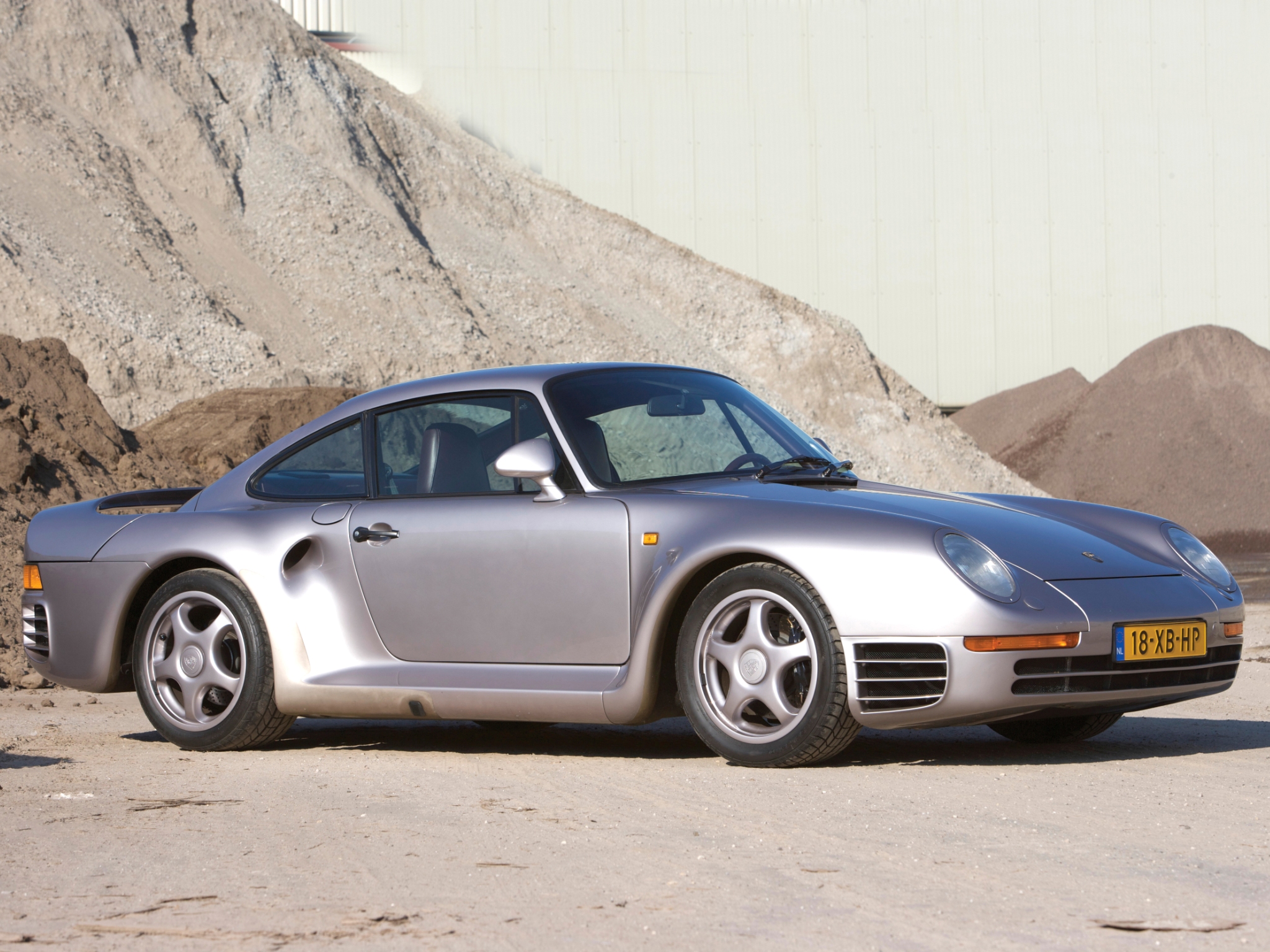
Porsche 959 photos 15




FAQ
When was the Porsche 959 produced, and where?
Porsche built the 959 in Stuttgart-Zuffenhausen. Regular production ran from 1986 to 1988, with customer deliveries starting in 1987, and eight more Komfort cars were assembled from spare parts in 1992 and 1993.
How many Porsche 959 were built?
Porsche completed 292 production cars by 1988. Including 37 prototypes and pre-production cars the total is 337, and eight further cars from 1992–1993 bring it to 345. Only 29 were the lightweight 959 S.
What engine does the Porsche 959 have?
It uses a 2,849 cc flat-six derived from the 956/962 racing engine, with water-cooled heads and sequential twin turbochargers. It produces 331 kW (450 PS) at 6,500 rpm and 500 Nm, driving all four wheels through a six-speed manual.
How fast is the Porsche 959?
Porsche claimed 317 km/h (197 mph) for the Komfort, and Road & Track measured 319 km/h. A 959 S reached 339 km/h (211 mph) at Nardò in 1988. The car reaches 100 km/h in about 3.6 seconds.
Is the Porsche 959 collectable, and what should buyers check?
Yes, it is one of the most valuable Porsches of its era. Check the service history, ride-height hydraulics, PSK all-wheel drive, sequential turbo controls and magnesium wheels, and use a specialist, because parts for these systems are rare.
Data sources
Data checked by an editor against the sources below.
- The text of this article (1cars archive)
- Wikipedia - Porsche 959


