
 Porsche 911 Carrera Cabriolet
Specs, engines and history
Updated Published Sources (3) Report an error
By Felix Hartmann, Automotive Technology & EV Contributor Reviewed by Oleksandr Hnatiuk

- Built
- 2012–2019
- Top power
- 316 kW (430 PS)
Which Porsche 911 Carrera Cabriolet to buy
Our verdict · Felix Hartmann
For a naturally aspirated sound and lower prices, choose a 991.1 Carrera S Cabriolet with PDK and Sport Chrono. The 991.1 GTS is the most desirable of the non-turbo cars. Drivers who value torque and economy should look at the 991.2 Carrera S, with 309 kW from the 3.0 twin-turbo engine. All-wheel drive suits owners in snowy regions, and the manual suits keen drivers who accept slower acceleration. Always check the roof, the service history and the condition of the tyres. Every 911 version is listed in the Porsche catalogue.
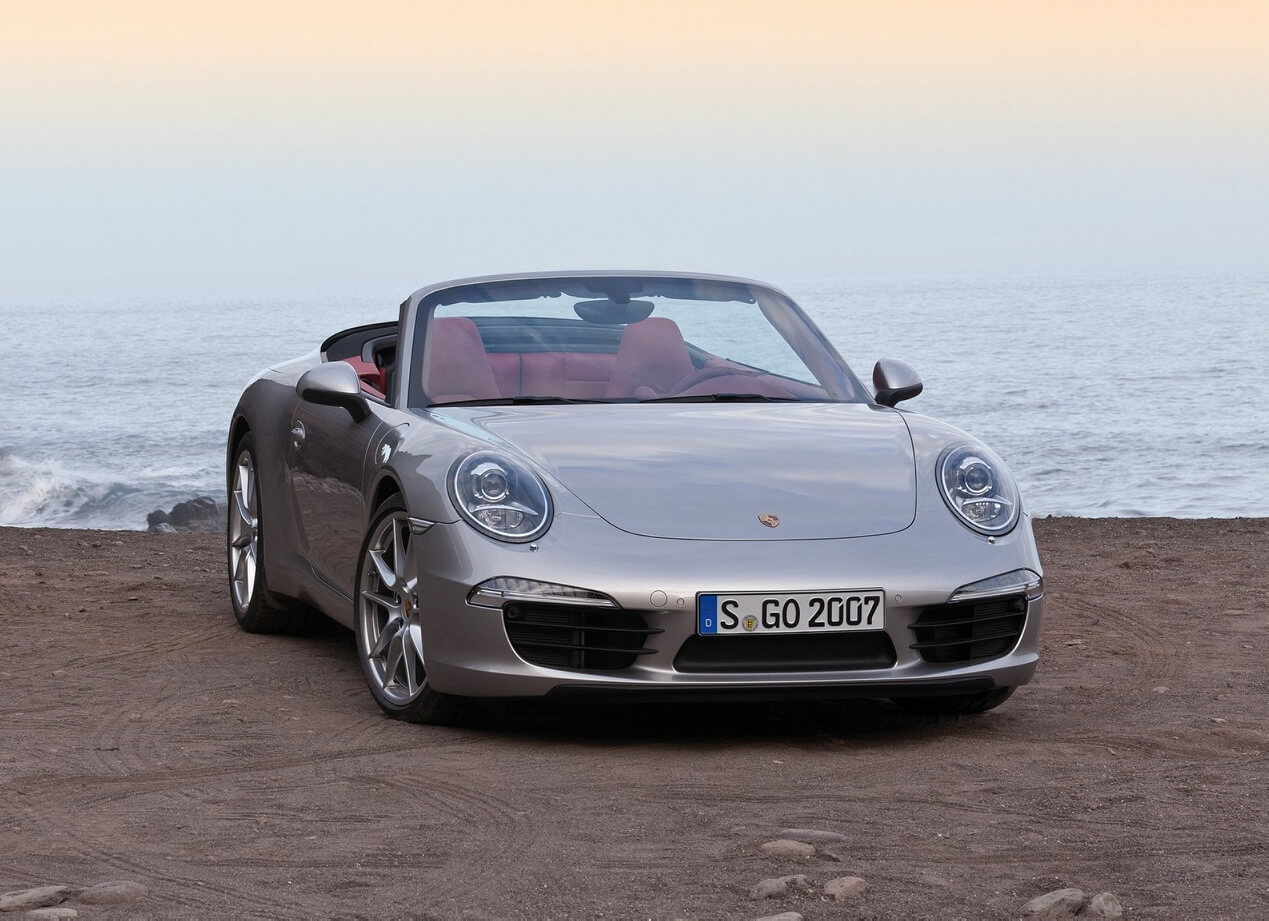
The Porsche 911 Carrera Cabriolet of the 991 generation is a 2+2 convertible sports car built from 2012 to 2019. It launched in Germany on 3 March 2012 with a 3.4-litre flat-six of 257 kW (350 PS) or a 3.8-litre of 294 kW (400 PS) in the Carrera S. Its fabric roof opens or closes in about 13 seconds at up to 50 km/h.
In short
- 991.1 (2012–2015): naturally aspirated 3.4 and 3.8 flat-sixes, later a 316 kW GTS.
- 991.2 (from model year 2016): 3.0 twin-turbo flat-six with 272 to 331 kW.
- Seven-speed manual or seven-speed PDK, rear-wheel drive or all-wheel drive (Carrera 4 and 4S).
- German launch prices: 100,532 EUR (Carrera) and 114,931 EUR (Carrera S), including VAT.

Specs by version
Engines
Dimensions and weight
Show all 2 versions
| Version | Kerb weight |
|---|---|
| 3.4 257 kW (349 PS) Convertible | 1,500 kg3,307 lb |
| 3.8 294 kW (400 PS) Convertible | 1,500 kg3,307 lb |
Verified Manufacturer and type-approval data from our catalog · Sources and methodology
The 911 Carrera Cabriolet at a glance
| Fact | 911 Carrera Cabriolet (991) |
|---|---|
| Generation | 991.1 (2012–2015), 991.2 (2016–2019) |
| Revealed | Announced November 2011; shown in Detroit on 9 January 2012 |
| Launch | Germany, 3 March 2012 |
| Body | 2+2 convertible with fabric roof on magnesium bows |
| Engines | 3.4 and 3.8 flat-six (991.1); 3.0 twin-turbo flat-six (991.2) |
| Power | 257–316 kW (991.1); 272–331 kW (991.2) |
| Drive | Rear-wheel drive; all-wheel drive in Carrera 4 and 4S |
| Successor | 992 Cabriolet, January 2019 |
The 991 replaced the 997. Porsche built 233,540 cars of the 991 family, coupés, Cabriolets and Targas together, until 20 December 2019. The broader story is told in the history of Porsche.

What changed from the 997 Cabriolet
The new Cabriolet kept the coupé's roofline when closed, with a fabric top stretched over magnesium bows and three flat roof panels. It has a heated glass rear window and a power-operated wind deflector that rises in about two seconds and works up to 120 km/h. Compared with the 997 Cabriolet, the wheelbase is 100 mm longer and the front track is 46 to 52 mm wider. The car is up to 60 kg lighter, thanks partly to magnesium in the body. A rear spoiler extends at 120 km/h and retracts at 80 km/h, and the drag coefficient is 0.30 with the top closed.

Flat-six engines, gearboxes and performance
The 991.1 Cabriolet used naturally aspirated flat-six engines. A seven-speed manual was standard, and the seven-speed PDK dual-clutch gearbox was optional.

| Version | Engine | Power | 0–100 km/h (manual / PDK / PDK + Sport Chrono) | Top speed |
|---|---|---|---|---|
| Carrera Cabriolet | 3.4 flat-six | 257 kW (350 PS) | 5.0 / 4.8 / 4.6 s | 286 km/h (178 mph) |
| Carrera S Cabriolet | 3.8 flat-six | 294 kW (400 PS) | 4.7 / 4.5 / 4.3 s | 301 km/h (187 mph) |
| Carrera GTS Cabriolet (from late 2014) | 3.8 flat-six | 316 kW (430 PS) | - | - |
Torque for the 3.4 engine was 390 Nm (287 lb-ft) at 5,600 rpm. The Carrera 4 and 4S, shown in September 2012, added all-wheel drive to both bodies.
For the 2016 model year, the 991.2 update replaced both engines with a 3.0-litre twin-turbo flat-six. The Carrera then gave 272 kW (370 PS), the Carrera S 309 kW (420 PS) and the GTS 331 kW (450 PS). With PDK, the coupé figures were 4.4 s (Carrera), 4.1 s (Carrera S) and 3.7 s (GTS) to 100 km/h.
By our calculation, the turbo engine added 15 kW to both the Carrera and the Carrera S, about 6 % and 5 % more power. The latest 992.2 Carrera of 2024 has 290 kW (394 PS), 13 % more than the 2012 Carrera Cabriolet.
Dimensions, cabin and luggage space
| Parameter | Metric | Imperial |
|---|---|---|
| Length | 4,491 mm | 176.8 in |
| Width | 1,808 mm | 71.2 in |
| Height (Carrera Cabriolet) | about 1,299 mm (4 mm lower than the coupé) | 51.1 in |
| Wheelbase | 2,450 mm | 96.5 in |
| Roof operation | about 13 s, up to 50 km/h | up to 31 mph |
| Wheels | 19 in (Carrera), 20 in (Carrera S) | - |
The 991 Cabriolet is a 2+2. The rear seats suit children or luggage, and the main boot sits under the front bonnet. When open, the roof folds into a package about 23 cm high and 55 cm long behind the rear seats. According to the old 1cars text, standard equipment included leather upholstery, xenon headlights, electric windows and mirrors, an audio system and sports seats.

Fuel consumption and running costs
| Version | Gearbox | Fuel (NEDC) | CO2 |
|---|---|---|---|
| Carrera Cabriolet | Manual | 9.2 l/100 km (25.6 mpg US) | 217 g/km |
| Carrera Cabriolet | PDK | 8.4 l/100 km (28.0 mpg US) | 198 g/km |
| Carrera S Cabriolet | Manual | 9.7 l/100 km (24.2 mpg US) | 229 g/km |
| Carrera S Cabriolet | PDK | 8.9 l/100 km (26.4 mpg US) | 210 g/km |
The PDK uses about 9 % less fuel than the manual on the official test. Real costs come mainly from tyres, brakes, servicing and insurance. Check the roof mechanism and the drainage channels on any used car, because a convertible roof is costly to repair. Use the 1cars fuel cost calculator for a yearly estimate.

Trims, options and versions
The Cabriolet followed the coupé range: Carrera, Carrera S, Carrera 4, Carrera 4S and, from late 2014, Carrera GTS and Carrera 4 GTS. Options included the Sport Chrono package, which cuts the 0–100 km/h time by 0.2 seconds with PDK. Larger wheels and a sports exhaust were also on the list. The Targa, with its fixed roll bar and glass rear, arrived in January 2014 as a separate model. The old 1cars text dated the facelifted range to 2011, but the 991 was in fact the new generation that replaced the 997.

Safety
The 911 Cabriolet was not crash-tested by Euro NCAP or the IIHS, as is common for this class. It has front and side airbags, stability control and a roll-over protection system that deploys behind the rear seats. The longer wheelbase and wider front track also help stability compared with the 997.
Rivals: the 911 Cabriolet compared with other open sports cars
| Model | Layout | Seats | Strength |
|---|---|---|---|
| Porsche 911 Carrera Cabriolet (991) | Rear engine | 2+2 | Performance, everyday usability |
| Porsche Boxster | Mid engine | 2 | Balance, lower price |
| Mercedes-Benz SL (R231) | Front engine | 2 | Comfort, V8 power |
| Audi R8 Spyder | Mid engine | 2 | V8 or V10 sound |
| Jaguar F-Type Convertible | Front engine | 2 | Style, V6 and V8 options |
The 911 is the only car here with two rear seats. Its closed sibling, the Porsche Cayman, is the hard-top version of the Boxster rather than a 911 alternative. To line up two open cars with their official data, open the 1cars comparison tool.

Porsche 911 Carrera Cabriolet in our rankings
- No. 10 of 30 · Power-to-weight: convertibles and roadsters (196 kW/t)
- No. 10 of 30 · Heaviest convertibles and roadsters (1,500 kg)
- No. 70 of 444 · Power-to-weight: cars (196 kW/t · top 16%)
- No. 311 of 1112 · Most powerful cars (316 kW · top 28%)
- No. 26 of 89 · Most powerful convertibles and roadsters (316 kW · top 30%)
- No. 249 of 730 · Biggest engines: cars (3,800 cc · top 35%)
Better power-to-weight than 84% of ranked cars in the 1CARS catalog (No. 70 of 444).
Porsche 911 Carrera Cabriolet photos 12


Porsche 911 Carrera Cabriolet videos 3

Porsche 911 Carrera Cabriolet video 1

Test drive

Video overview
FAQ
What is the fuel consumption of the Porsche 911 Carrera Cabriolet?
On the NEDC test, the 991.1 Carrera Cabriolet used 8.4 l/100 km with PDK and 9.2 l/100 km with the manual. The Carrera S Cabriolet used 8.9 and 9.7 l/100 km.
Is the Porsche 911 Carrera Cabriolet available with all-wheel drive or as a hybrid?
Yes, the Carrera 4 and 4S Cabriolets drive all four wheels. There was no hybrid 991. The current 992.2 generation offers a Carrera GTS T-Hybrid Cabriolet with 398 kW (541 PS).
What are the main rivals of the Porsche 911 Carrera Cabriolet?
Its rivals include the Mercedes-Benz SL, Audi R8 Spyder, Jaguar F-Type Convertible and Porsche's own Boxster. The 911 stands out with its 2+2 seating and rear-engined layout.
How fast does the 911 Carrera Cabriolet open its roof?
The 991 Cabriolet opens or closes its fabric roof in about 13 seconds at speeds of up to 50 km/h. An electric wind deflector rises in about two seconds and works up to 120 km/h.
How much did the 991 Carrera Cabriolet cost new?
At its German launch in March 2012, the Carrera Cabriolet cost 100,532 EUR and the Carrera S Cabriolet 114,931 EUR, both including VAT. Options often added a large share to the final price.
Data sources
Data checked by an editor against the sources below.
- The text of this article (1cars archive)
- Wikipedia - Porsche 911 (991)
- Wikipedia - Porsche 991


