
 Porsche 356 №1 Roadster
Specs, engines and history
Updated Published Sources (3) Report an error
By Felix Hartmann, Automotive Technology & EV Contributor Reviewed by Oleksandr Hnatiuk
- Built
- 1948
- Top power
- 26 kW (35 PS)
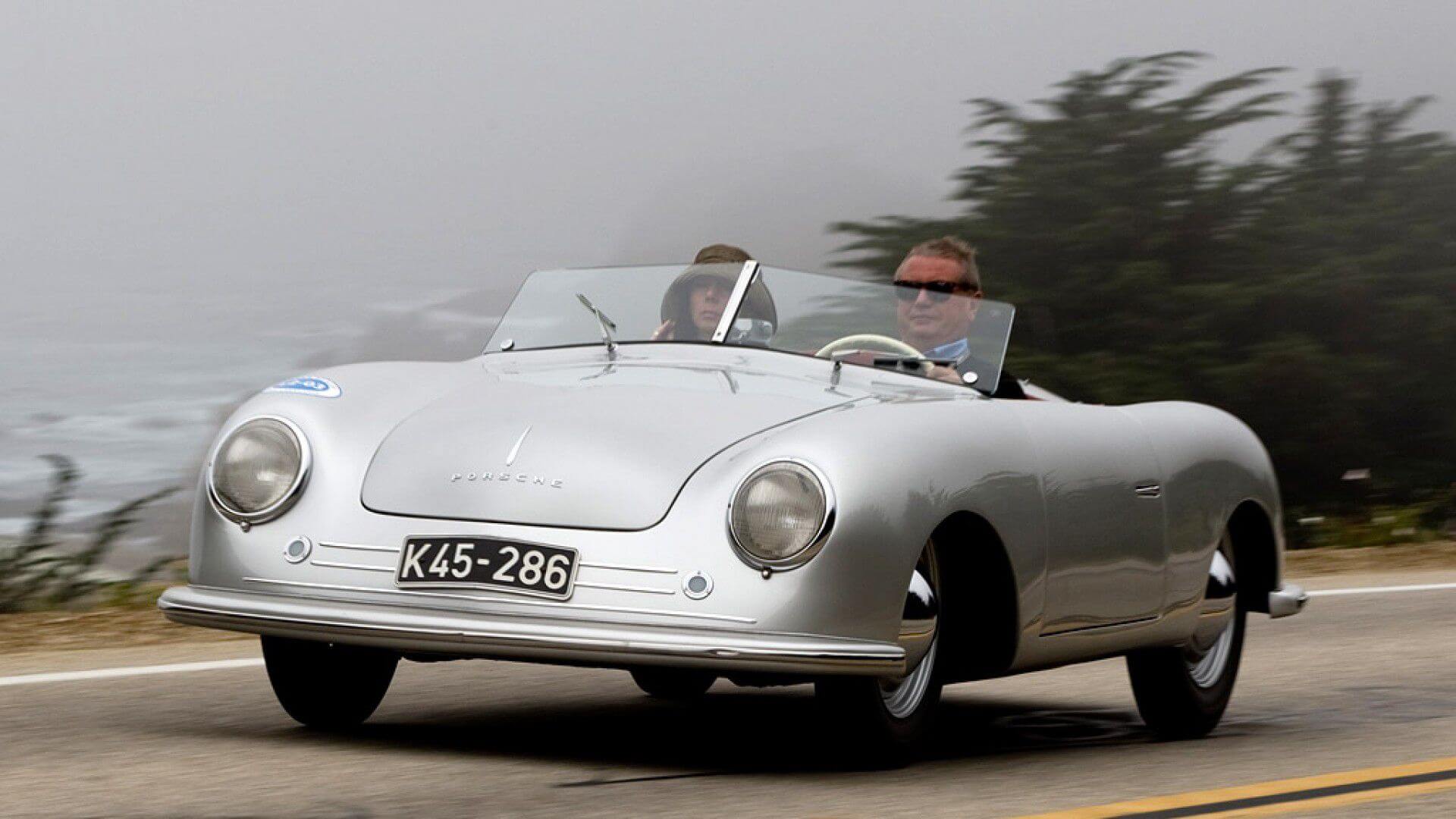
The Porsche 356 "No. 1" Roadster is the first car to carry the Porsche name. Built by hand in Gmünd, Austria, it was granted its road permit on 8 June 1948, the date Porsche treats as the birth of the brand. It is a one-off mid-engined roadster with an aluminium body, a tubular steel frame and a 1,131 cc Volkswagen flat-four tuned to 26 kW (35 PS).
In short
- Conceived in summer 1947 as the "Type 356 VW sports car"; Ferry Porsche first drove the chassis on 5 February 1948.
- Engine ahead of the rear axle, unlike the rear-engined 356 production cars that followed.
- Weighs 585 kg and reaches at least 135 km/h.
- Sold to a Swiss owner in 1948, it returned to Porsche in 1958 and is now in the Porsche Museum.

Specs by version
Performance
Show all 1 versions
| Version | Top speed |
|---|---|
| 1.1 26 kW (35 PS) Convertible | 135 km/h84 mph |
Dimensions and weight
Show all 1 versions
| Version | Kerb weight |
|---|---|
| 1.1 26 kW (35 PS) Convertible | 585 kg1,290 lb |
Verified Manufacturer and type-approval data from our catalog · Sources and methodology
Porsche 356 No. 1 specifications
| Parameter | Metric | Imperial |
|---|---|---|
| Chassis number | 356-001 | - |
| Engine | 1,131 cc VW air-cooled flat-four | 69 cu in |
| Power | 26 kW (35 PS) at 4,000 rpm | 35 hp |
| Layout | mid-engine (ahead of the rear axle), rear-wheel drive | - |
| Gearbox | Volkswagen four-speed manual | - |
| Frame | tubular steel space frame | - |
| Body | hand-formed aluminium, open two-seater | - |
| Kerb weight | 585 kg | 1,290 lb |
| Top speed | at least 135 km/h | 84 mph |
| Power-to-weight | 22.5 kg per kW (our calculation) | - |
| Built | 1948, Gmünd, Carinthia (Austria) | - |
The engine was originally rated at 18 kW (24.5 PS), as in the Volkswagen it came from. With a higher-compression cylinder head and other changes, Porsche raised it to 26 kW (35 PS): compared with the Volkswagen original, that is 8 kW or 44 % more power.

Background: the Porsche office in Gmünd
During the Second World War the Porsche design office moved from Stuttgart to Gmünd in Carinthia, Austria, where it worked in a former sawmill. After the war, Ferdinand Porsche was held in French custody from late 1945 until 1947. His son Ferry Porsche and daughter Louise Piëch kept the business going with repair work and design contracts.

One of those contracts came from the Italian industrialist Piero Dusio, who commissioned a Grand Prix car for his Cisitalia company, the Type 360. According to the old 1cars text and most Porsche histories, part of the Cisitalia fee helped pay for Ferdinand's release. The same Cisitalia contract also gave the small team money and confidence to build a sports car of its own. More on both men is in our profiles of Ferdinand Porsche and Ferry Porsche.
From idea to first drive: 1947–1948
Ferry Porsche conceived the car in summer 1947. Internally it was called the "Type 356 VW sports car", or "VW Sport", because it used so many Volkswagen parts: the engine, gearbox, suspension and steering came from the Volkswagen Beetle, which Ferdinand Porsche had designed before the war. Erwin Komenda, Porsche's body engineer, shaped the low, streamlined aluminium body.

Parts were scarce in post-war Austria. The old 1cars text recalls that staff brought components from Germany in their pockets. By 5 February 1948 the chassis was ready, and Ferry Porsche drove it for the first time in Gmünd. On 8 June 1948 the Carinthian state government issued its general operating permit, which made the car road-legal.
Engineering: why the engine sits in the middle
The most important design choice was the engine position. In No. 1, the VW flat-four sits ahead of the rear axle, with the gearbox behind it, so the car is mid-engined. The front suspension is Volkswagen's, and the rear uses VW swing arms turned round and held by torsion bars.

This layout gave good balance, but it left no room for rear seats or luggage. For the production 356/2, Porsche moved the engine behind the rear axle, as in the Beetle. That created space for a small rear seat and a usable luggage area and made the car easier to build, at the cost of more weight at the back and trickier handling at the limit, a point the old text also makes.
The frame is a lattice of steel tubes welded together, drawing on ideas Ferdinand Porsche had tried on the pre-war Auto Union racing cars, according to the old text, and the open aluminium body was shaped by hand over it. The result weighed only 585 kg, so each kilowatt had to move about 22.5 kg by our calculation, a respectable figure for a 1948 sports car with a 1.1-litre engine.
1948: first races and the first customer
Porsche presented the "Sport 356/1" to the public around the Swiss Grand Prix at the Bremgarten circuit near Bern in July 1948, and the Swiss magazine Automobil-Revue published the first driving report on 7 July 1948. Soon after, the car won its class at a city race in Innsbruck held around the Hofgarten park.

Switzerland became the first market. The car was sold to Peter Kaiser, a German architect living in Zurich, for 7,500 Swiss francs, and registered with the plate ZH 20640. Some accounts give 7,000 francs and name Rupprecht von Senger as the buyer; Porsche's own history names Kaiser. He replaced the cable brakes with hydraulic ones and even put his own "Pesco" badge on the car.
Later owners and the return to Porsche in 1958
In 1952 Hermann Schulthess found the car, had the engine enlarged to 1.5 litres and raced it in Swiss slaloms. Accident repairs and modifications changed its look: the front was lowered, and the original one-piece rear lid was replaced by a two-piece cover. Its next owner, Franz Blaser, eventually agreed to swap it for a new 356 Speedster, and in 1958 No. 1 returned to Porsche.

The engine still carries its original number, which is unusual for a car with so many owners and repairs.
How No. 1 differs from the production 356
| Feature | 356 "No. 1" Roadster (1948) | Production 356 (from 1948) |
|---|---|---|
| Engine position | ahead of the rear axle (mid-engine) | behind the rear axle |
| Frame | tubular space frame | steel platform chassis |
| Body | open aluminium roadster | aluminium coupé or cabriolet at Gmünd; steel from 1950 |
| Seats | two | two plus small rear seat |
| Numbers built | one | about 76,000 by April 1965 |
| Factory | Gmünd | Gmünd, then Zuffenhausen from 1950 |
At Gmünd, Porsche built about 50 aluminium-bodied 356/2 cars in two years. In 1950 production moved to Zuffenhausen near Stuttgart, with steel bodies supplied by Reutter. By the end of production in April 1965, about 76,000 Porsche 356s had been made, and about half are thought to survive.

The 2018 show car and the 70th anniversary
For Porsche's 70th anniversary in 2018, the Porsche Museum built a show car that recreates No. 1 as it looked in 1948, before the later changes to the nose and rear lid. The original car itself was driven through the Bernese Highlands to mark the occasion and appeared at events in Goodwood, Vancouver, California and China. In the museum it is usually shown as the starting point of the company's history, which is told in full in our Porsche history.

Legacy, and collecting an early 356
No. 1 established the formula Porsche still follows: a light, compact sports car built from proven mass-production parts, tuned for efficiency rather than size. The name "Porsche" on its nose turned a design consultancy into a car maker, and 8 June 1948 is celebrated as the company's birthday.

Collectors should note that No. 1 itself is not for sale: it belongs to the Porsche Museum. The old 1cars text quoted a price of over a million dollars, but we found no record of any sale since 1958, so that figure has been removed. Early aluminium 356 cars from Gmünd, of which about 50 were built, are the closest a private collector can get. To compare its power-to-weight ratio with a modern Porsche, use the 1cars power-to-weight calculator or the comparison tool; every later model is listed on the Porsche brand page.

Porsche 356 №1 Roadster photos 13


FAQ
What was the first Porsche car?
The 356 "No. 1" Roadster, completed in Gmünd, Austria, in 1948, was the first car sold under Porsche's own name. Its general operating permit, dated 8 June 1948, marks what the company celebrates as its birthday.
What engine does the Porsche 356 No. 1 have?
It uses a Volkswagen air-cooled flat-four of 1,131 cc. Porsche raised its output from the original 18 kW (24.5 PS) to 26 kW (35 PS), enough for a top speed of at least 135 km/h.
Is the Porsche 356 No. 1 mid-engined?
Yes. Its engine sits in front of the rear axle, which makes it a mid-engined car. The production 356 that followed moved the engine behind the rear axle to make room for a rear seat and luggage.
How many Porsche 356 No. 1 Roadsters were built?
Only one. No. 1 was a one-off with a tubular space frame and an aluminium roadster body. The production 356 used a different chassis, and about 76,000 were built until April 1965.
Where is the Porsche 356 No. 1 today?
The car is owned by Porsche and kept in the Porsche Museum in Stuttgart-Zuffenhausen. It returned to the company in 1958 after ten years with Swiss owners and still appears at anniversary events.
Data sources
Data checked by an editor against the sources below.
- The text of this article (1cars archive)
- Wikipedia
- Porsche - Porsche 356 „Nr.1“ Roadster


