
 Porsche Carrera GT
Specs, engines and history
Updated Published Sources (2) Report an error
By Felix Hartmann, Automotive Technology & EV Contributor Reviewed by Oleksandr Hnatiuk

- Built
- 2003–2006
- Top power
- 450 kW (612 PS)
- New price
- from about €452,400 (2003)
Who the Carrera GT suits: verdict
Our verdict · Felix Hartmann
The Carrera GT suits a collector or experienced driver who wants one of the last great analogue supercars: a naturally aspirated V10, a manual gearbox and no turbochargers or hybrid systems. Its strengths are the engine's sound and response, a carbon chassis and its rarity. The drawbacks are a demanding clutch, limited luggage space, high running costs and a car that needs respect at the limit. Ask for the service history of the clutch and the condition of the carbon-ceramic brakes, and check for chassis damage, since carbon repairs are costly. More of the brand's cars are in the Porsche catalogue and in our best sports cars selection, and other strong open cars are in the most powerful convertibles ranking.
The Porsche Carrera GT is a mid-engined two-seat roadster built by Porsche in Leipzig, Germany, from 2003 to 2006. It uses a 5.7-litre V10 with 450 kW (612 PS) that grew out of a Formula One and Le Mans engine project. Around it sit a carbon-fibre monocoque, ceramic brakes and a six-speed manual gearbox with a ceramic clutch. Porsche built 1,270 cars.
In short
- Concept shown at the 2000 Paris Motor Show; series production 2003–2006 in Leipzig, 1,270 cars (internal type code 980).
- Engine: M80/01 5,733 cc V10, 450 kW (612 PS) at 8,000 rpm and 590 Nm at 5,750 rpm.
- Gearbox: six-speed manual with a twin-plate ceramic dry clutch (PCCC); top speed 330 km/h, 0–100 km/h in 3.9 seconds (factory figure).
- Carbon-fibre monocoque and subframe, 380 mm carbon-ceramic brakes, kerb weight 1,380 kg, two removable roof panels.

Size at a glance
| Dimensions | Porsche Carrera GT 980 |
|---|---|
| Length | 4,613 mm181.6 in |
| Width | 1,921 mm75.6 in |
| Height | 1,166 mm45.9 in |
| Wheelbase | 2,730 mm107.5 in |
Specs by version
Engines
Performance
Show all 1 versions
| Version | Top speed |
|---|---|
| Carrera GT | 330 km/h205 mph |
Dimensions and weight
Show all 1 versions
| Version | Length | Width | Height | Wheelbase | Kerb weight |
|---|---|---|---|---|---|
| Carrera GT | 4,613 mm181.6 in | 1,921 mm75.6 in | 1,166 mm45.9 in | 2,730 mm107.5 in | 1,380 kg3,042 lb |
Verified Manufacturer and type-approval data from our catalog · Sources and methodology
Porsche Carrera GT at a glance
The Carrera GT is the most race-derived road car Porsche had built until then. It was planned as a show car to demonstrate the company's engineering, but the reaction to the 2000 concept was strong enough for Porsche to put it into production. Designed by Jason Hill (concept) and Harm Lagaay (production design), it was built at Porsche's Leipzig plant. Its successor is the 918 Spyder, and the wider story of the brand is in the history of Porsche.

| Fact | Value |
|---|---|
| Maker | Porsche AG, Leipzig plant, Germany |
| Production | 2003–2006 |
| Units built | 1,270 |
| Body | Two-seat roadster with removable roof panels |
| Layout | Mid-engine, rear-wheel drive |
| Engine | 5.7 l V10, naturally aspirated |
| Power | 450 kW (612 PS) |
| Gearbox | 6-speed manual, ceramic clutch |
| Successor | Porsche 918 Spyder |
A V10 born for racing
The engine has an unusual history. Porsche first built a V10 in secret in 1992 for the Footwork Formula One team, and the design was later developed for a Le Mans prototype that never raced. When the Le Mans programme stopped, the engine found its place in the Carrera GT. For the road car its displacement grew from 5.5 litres in the concept to 5.7 litres in production.

| Parameter | Metric | Imperial |
|---|---|---|
| Engine | Porsche M80/01, V10, naturally aspirated | – |
| Displacement | 5,733 cc | 350 cu in |
| Power | 450 kW (612 PS) at 8,000 rpm | 603 hp |
| Torque | 590 Nm at 5,750 rpm | 435 lb ft |
| Gearbox | 6-speed manual, twin-plate ceramic clutch | – |
| 0–100 km/h | 3.9 s (factory); 3.57 s in a magazine test | 0–62 mph |
| Top speed | 330 km/h | 205 mph |
The Porsche Ceramic Composite Clutch (PCCC) is small and light, which lets the engine sit very low in the car. It is also the reason the Carrera GT has a reputation for being difficult to pull away smoothly: the clutch has little slip and needs a precise foot.
Carbon chassis, brakes and aerodynamics
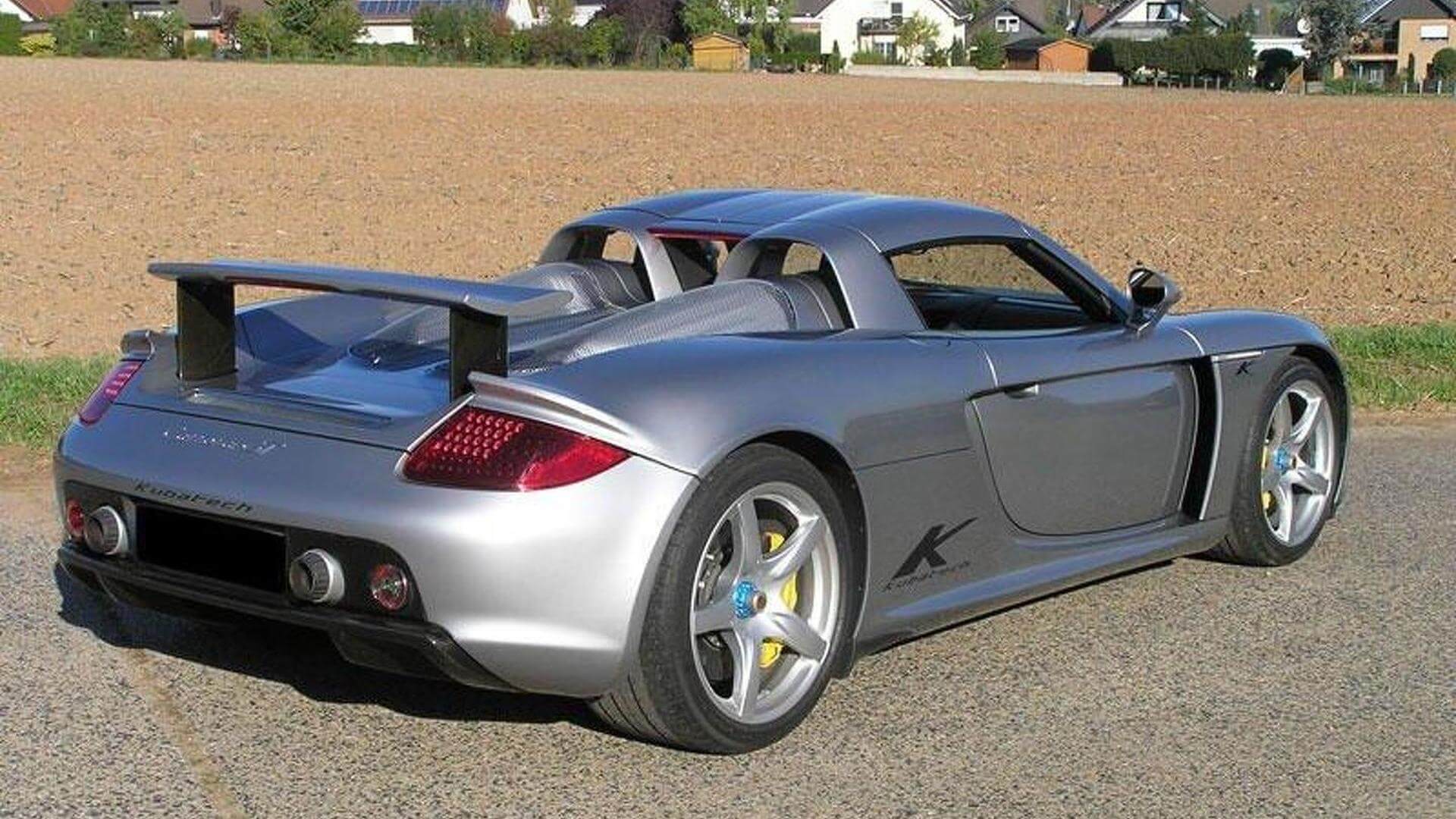
The Carrera GT has a monocoque and subframe made entirely of carbon fibre, produced by the Italian specialist ATR Composites. The brakes use carbon-fibre-reinforced silicon carbide discs of 380 mm at the front and rear. The underbody is shaped like a racing car's for downforce, and a rear wing rises automatically at speed; the old 1cars text puts the threshold at about 110 km/h.
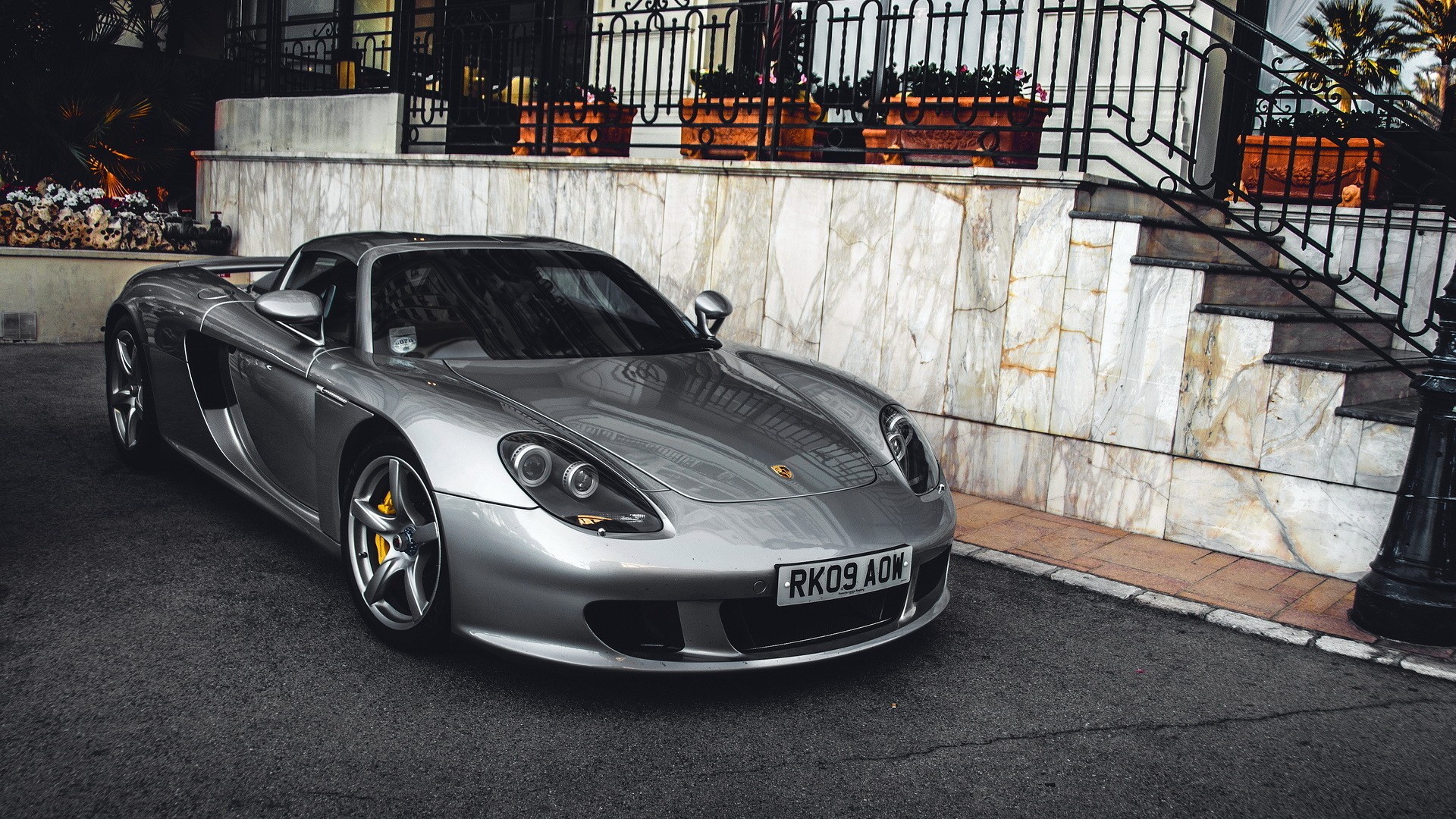
| Parameter | Metric | Imperial |
|---|---|---|
| Length | 4,613 mm | 181.6 in |
| Width | 1,921 mm | 75.6 in |
| Height | 1,166 mm | 45.9 in |
| Wheelbase | 2,730 mm | 107.5 in |
| Kerb weight | 1,380 kg | 3,042 lb |
Cabin and roof
The cabin is simple and focused, with a high centre console placing the gear lever close to the steering wheel. Two lightweight carbon roof panels can be removed by hand and stored in the front luggage compartment, where they take up most of the space. According to the old 1cars text, the seats are made of aramid and carbon composite and weigh about half as much as conventional seats. Leather trim, navigation and a Bose audio system were part of the equipment. The same source lists five standard colours: GT Silver, Seal Grey, Basalt Black, Fayence Yellow and Guards Red.
Production, price and the end of the run
Porsche had planned to build about 1,500 cars, according to the old 1cars text, but stopped at 1,270 in 2006, citing new US airbag regulations that the car would not have met. Launched in 2003, the Carrera GT cost roughly €400,000 new. Since then values have risen well above that: in 2020, cars in good condition were advertised at €600,000 to €880,000.

Carrera GT on the track
The Carrera GT lapped the Nürburgring Nordschleife in 7 minutes 28 seconds in its original test, a strong time for a road car of its era. In a 2024 run it recorded 7:12. The car is known for its precise steering and high-revving engine, and also for being demanding at the limit.
Porsche Carrera GT compared with its rivals
| Model | Years | Engine | Power | Top speed | Weight | Built |
|---|---|---|---|---|---|---|
| Porsche Carrera GT | 2003–2006 | 5.7 l V10 | 450 kW (612 PS) | 330 km/h | 1,380 kg | 1,270 |
| McLaren F1 | 1992–1998 | 6.1 l V12 | 461 kW (627 PS) | 386.4 km/h | 1,260 kg | 106 |
| Bugatti Veyron 16.4 | 2005–2011 | 8.0 l W16 quad-turbo | 736 kW (1,001 PS) | 408.47 km/h | about 1,888 kg | 252 |
The Carrera GT has almost the same power as the McLaren F1 and weighs only about 120 kg more, at about 3.1 kg per kW against 2.7 for the McLaren, but it was built in more than ten times the number. Against the Veyron it is about 500 kg lighter, with less than two-thirds of the power. Within Porsche, it follows the 959 and the 911 GT1 as a technology flagship, and it was followed by the hybrid 918 Spyder.

Popular comparisons
Porsche Carrera GT in our rankings
- No. 2 of 25 · Power-to-weight: convertibles and roadsters (326 kW/t)
- No. 2 of 22 · Fastest convertibles and roadsters (330 km/h)
- No. 4 of 85 · Fastest German cars (330 km/h)
- No. 5 of 56 · Fastest cars of the 2000s (330 km/h)
- No. 6 of 29 · Widest convertibles and roadsters (1,921 mm)
- No. 7 of 32 · Longest convertibles and roadsters (4,613 mm)
Faster than 95% of ranked German cars in the 1CARS catalog (No. 4 of 85).
Porsche Carrera GT photos 17


FAQ
How many Porsche Carrera GTs were made?
Porsche built 1,270 Carrera GTs at its Leipzig plant between 2003 and 2006. Production ended earlier than planned, with Porsche citing new airbag regulations in the United States.
What engine does the Porsche Carrera GT have?
It has a 5,733 cc naturally aspirated V10 (M80/01) with 450 kW (612 PS) at 8,000 rpm and 590 Nm. The engine design began as a Formula One unit in 1992 and was later developed for a Le Mans prototype.
How fast is the Porsche Carrera GT?
The official top speed is 330 km/h. Porsche quotes 0–100 km/h in 3.9 seconds, and magazine tests recorded about 3.6 seconds. On the Nürburgring Nordschleife, the original test lap was 7 minutes 28 seconds.
Does the Porsche Carrera GT have a manual gearbox?
Yes. Every Carrera GT has a six-speed manual gearbox with a twin-plate ceramic dry clutch, the Porsche Ceramic Composite Clutch, which is light and compact but needs a precise foot when pulling away.
What replaced the Porsche Carrera GT?
The Porsche 918 Spyder, a plug-in hybrid hypercar introduced in the 2010s, is its successor as Porsche's technology flagship. Unlike the Carrera GT, it combines a V8 with electric motors and all-wheel drive.
Data sources
Data checked by an editor against the sources below.
- The text of this article (1cars archive)
- Wikipedia - Porsche Carrera GT


