
 Porsche 911 GT1
Specs, engines and history
Updated Published Sources (2) Report an error
By Felix Hartmann, Automotive Technology & EV Contributor Reviewed by Oleksandr Hnatiuk

- Built
- 1996–1999
- Top power
- 401 kW (545 PS)
Which 911 GT1 to buy, and who it suits
Our verdict · Felix Hartmann
There is no "budget" GT1. The most collectable cars are the 1996 prototypes and the single 1998 road car, which are almost never offered. For most collectors, a 1997 Strassenversion with 996-style lights is the realistic choice. Buy one with a known chassis number, unbroken service records and the original tools and manuals.
The car suits a collector who values Le Mans history more than daily usability. In 1997 a GT1 cost 1.55 million Deutsche Mark, about 792,500 EUR at the fixed euro conversion rate. In 2017 one sold at auction for a sum Porsche later put at about 6.4 million EUR in current money. More Porsche models are in the Porsche catalogue.
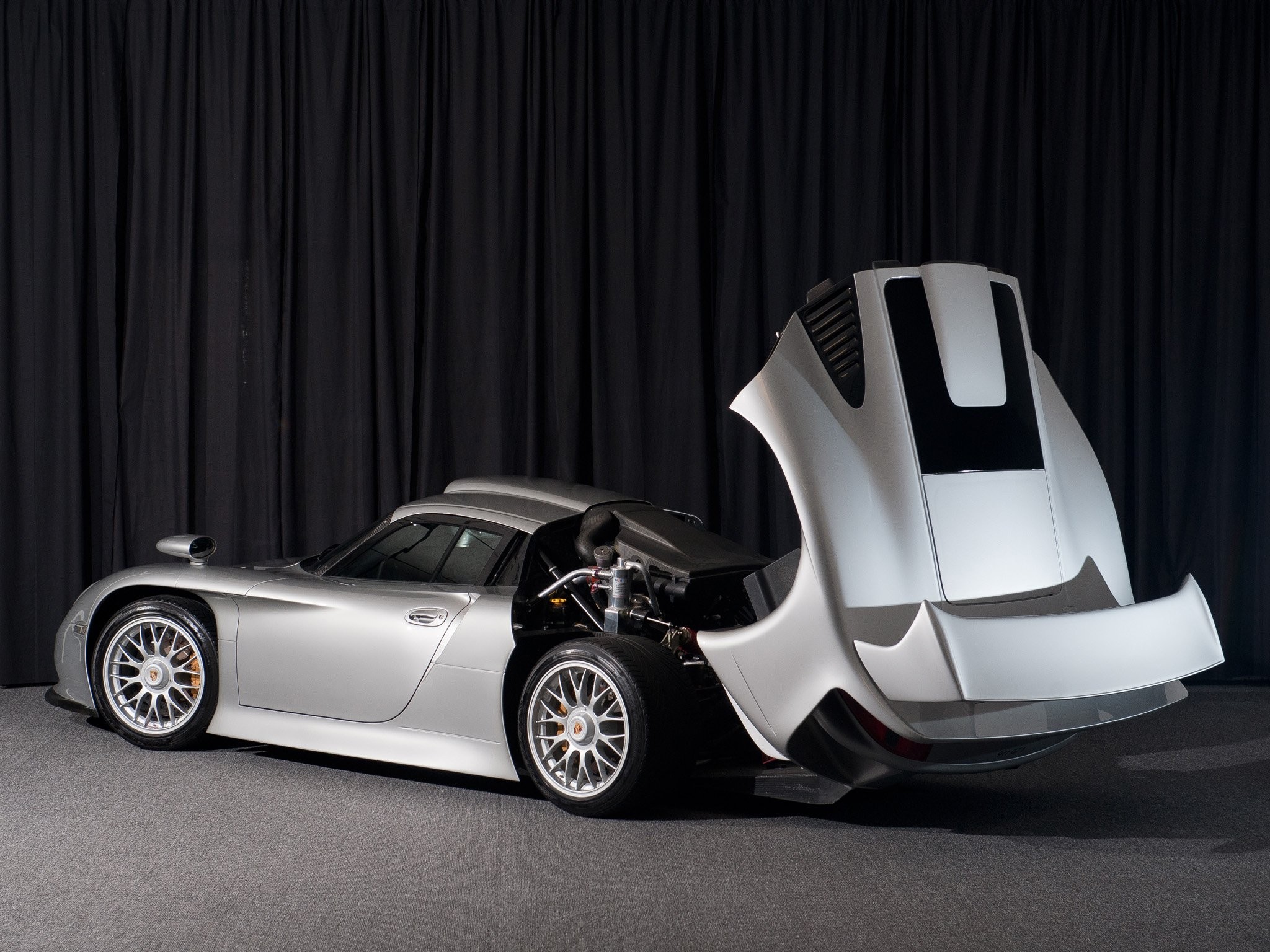
The Porsche 911 GT1 is a mid-engined racing car built for the GT1 class from 1996 to 1998, together with a small run of road-legal versions. The road car, called the Strassenversion, has a 3.2-litre twin-turbo flat-six with 400 kW (544 PS) and reaches 308 km/h. A works GT1-98 gave Porsche its 16th overall Le Mans win in 1998.
In short
- Built to meet GT1 homologation rules, which demanded road-legal cars; roughly 20 to 25 were made.
- Only the headlights are shared with the production 911; the engine sits ahead of the rear axle, not behind it.
- Road car: 0–100 km/h in 3.9 seconds, kerb weight about 1,150 kg, price in 1997 of 1.55 million Deutsche Mark.
- Le Mans results: second and third overall in 1996, first and second in 1998.

Size at a glance
| Dimensions | Porsche 911 GT1 |
|---|---|
| Length | 4,700 mm185.0 in |
| Width | 1,980 mm78.0 in |
| Height | 1,170 mm46.1 in |
Specs by version
Performance
Show all 1 versions
| Version | 0–100 km/h | Top speed |
|---|---|---|
| 3.2 401 kW (545 PS) Coupe | 3.5 s 0–62 mph | 320 km/h199 mph |
Dimensions and weight
Show all 1 versions
| Version | Length | Width | Height | Kerb weight |
|---|---|---|---|---|
| 3.2 401 kW (545 PS) Coupe | 4,700 mm185.0 in | 1,980 mm78.0 in | 1,170 mm46.1 in | 1,100 kg2,425 lb |
Verified Manufacturer and type-approval data from our catalog · Sources and methodology
The 911 GT1 at a glance

| Fact | Value |
|---|---|
| Type | GT1 racing car and homologation road car |
| Years | 1996–1998 (road cars 1996–1998) |
| Designers | Norbert Singer (engineering), Tony Hatter (styling) |
| Structure | Steel tube frame; 993 front section, rear subframe from the 962C |
| Engine | 3.2-litre water-cooled twin-turbo flat-six, mid-mounted |
| Road car power | 400 kW (544 PS) at 7,000 rpm |
| Gearbox | Six-speed manual (road car); six-speed sequential (race car) |
Why Porsche built a 911 for Le Mans
In the mid-1990s, the BPR series and Le Mans opened a GT1 class for sports cars derived from road models. Porsche first tried a modified 993 GT2, which was not competitive. So Norbert Singer's team built a new car that only looked like a 911. Under the 911-style front, the 993 structure was joined to a tube frame and a rear end taken from the Group C 962C racer. The brand's long Le Mans record is covered in the history of Porsche.

The rules required a minimum of 25 road-legal examples. That is why Porsche, after a few prototypes, offered a road version to selected customers. The old 1cars text called it both a road car and a "real racing monster", which sums up the idea well.
Race car, Evo, GT1-98 and Strassenversion
| Version | Year | What changed |
|---|---|---|
| 911 GT1 (race) | 1996 | First version with 993-style headlights; won on debut at Brands Hatch |
| 911 GT1 Evo (race) | 1997 | Revised nose with 996-style headlights; same engine |
| 911 GT1-98 (race) | 1998 | All-new car with a new sequential gearbox and TAG engine electronics |
| Strassenversion prototypes | 1996 | Two road cars with 993-style lights |
| Strassenversion | 1997 | About 20 customer cars with 996-style lights |
| GT1-98 Strassenversion | 1998 | A single road-registered car |
The race car first ran at the BPR Brands Hatch 4 Hours in 1996, where Hans-Joachim Stuck and Thierry Boutsen won as an invited entry without points. It went on to win at Spa and Zhuhai. The Evo of 1997 led at Le Mans but the works cars did not finish. For 1998 Porsche built the GT1-98 to face Mercedes and Toyota.

Twin-turbo flat-six: engine, gearbox and performance
| Figure | Strassenversion (road) | Race car |
|---|---|---|
| Engine | 3,164 cc flat-six, two turbochargers, four valves per cylinder | same base engine |
| Power | 400 kW (544 PS) at 7,000 rpm | about 441 kW (600 PS) |
| Torque | 600 Nm at 4,250 rpm | - |
| 0–100 km/h | 3.9 s | - |
| Top speed | 308–309 km/h | 330 km/h at Le Mans practice (1996) |
| Braking 100–0 km/h | 36 m | - |
Unlike the air-cooled 993 of the same years, the GT1 engine is water-cooled. Bosch Motronic 5.2 controls the injection. The road version was slightly detuned to meet European emission rules. It also reached 400 m from rest in 11.6 seconds and stopped from 200 km/h in 130.8 m. The old 1cars text quoted 545 hp, 3.5 seconds and 320 km/h; the figures above come from Porsche and German road tests.

With about 1,150 kg and 400 kW, the road car carries 2.9 kg per kW by our calculation. Compared with the Porsche 959 at 4.4 kg per kW (1,450 kg, 331 kW), it has a third less mass for every kilowatt. You can test other pairs in the power-to-weight calculator.
Size, cabin and luggage space of the road car
| Dimension | Metric | Imperial |
|---|---|---|
| Length | 4,710 mm | 185.4 in |
| Width | 1,950 mm | 76.8 in |
| Height | 1,170 mm | 46.1 in |
| Wheelbase | 2,500 mm | 98.4 in |
| Kerb weight (1997 test car) | 1,150 kg | 2,535 lb |
The GT1 is long and very low, but its cabin is closer to a road 911 than the shape suggests. The road car has a trimmed dashboard and switches from the 993, carpets, upholstered sports seats and a three-spoke wheel. A roof vent limits headroom for tall drivers. There is a small luggage compartment in the rear bodywork. The 1998 road car was more spartan, with a racing steering wheel.

Running a 911 GT1: fuel, service and storage
Porsche never published an official fuel figure for the road car, and owners use these cars too rarely for a meaningful average. Running costs are those of a race car: specialist servicing and careful storage matter more than fuel. The old 1cars text noted that the road cars used steel brake discs while race cars ran carbon discs.

Equipment and the 993 and 996 front ends
There were no trim levels in the usual sense. The two 1996 prototypes and early chassis numbers 001 to 003 have round 993-style headlights. Chassis 004 to 022 use the newer 996-style lights. Most cars were painted Arctic Silver or Fern White, with three special colours. Buyers received the original manuals and tool kit, according to auction listings.
Safety and crash-test status
The GT1 was never crash-tested by Euro NCAP or any similar body, because it was a low-volume homologation car. Its protection comes from the racing-derived structure. Racing showed the risks of the late-1990s GT1 cars: at the 1998 Petit Le Mans, Yannick Dalmas's GT1-98 lifted, flipped and hit the barriers.
The 911 GT1 compared with its GT1 rivals
| Model | Engine | Power | Road cars |
|---|---|---|---|
| Porsche 911 GT1 Strassenversion | 3.2 twin-turbo flat-six | 400 kW (544 PS) | about 20–25 |
| McLaren F1 | 6.1 BMW V12 | 461 kW (627 PS) | 106 F1s in total, all versions |
| Mercedes-Benz CLK GTR | 6.9 V12 | - | a small homologation run |
| Porsche Carrera GT (later) | 5.7 V10 | 450 kW (612 PS) | 1,270 |
The McLaren F1 was faster on the road, while the Mercedes CLK GTR beat the GT1-98 in every 1998 FIA GT race. Porsche had the last word at Le Mans: the faster Toyota GT-One and Mercedes cars broke down, and the two GT1-98s finished first and second. Allan McNish, Laurent Aïello and Stéphane Ortelli drove the winning car. After 1998 the GT1 class was cancelled and Porsche withdrew. The 1cars comparison tool sets the GT1 against these rivals figure by figure.

Porsche 911 GT1 in our rankings
- No. 2 of 28 · Fastest cars of the 1990s (320 km/h)
- No. 2 of 22 · Quickest cars of the 1990s, 0–100 (3.5 s)
- No. 3 of 112 · Most powerful cars of the 1990s (401 kW)
- No. 5 of 85 · Fastest German cars (320 km/h)
- No. 7 of 87 · Lightest coupes (1,100 kg)
- No. 16 of 391 · Power-to-weight: cars (365 kW/t · top 5%)
More powerful than 97% of ranked cars of the 1990s in the 1CARS catalog (No. 3 of 112).
Porsche 911 GT1 photos 12


Porsche 911 GT1 videos 3

Porsche 911 GT1 video 1

Test drive

Video overview
FAQ
How many Porsche 911 GT1 road cars were made?
Sources give between 21 and 25. Porsche says two prototypes were built in 1996, about 20 customer cars in 1997 and one GT1-98 road car in 1998. GT1 rules required at least 25 road-legal examples.
How fast is the Porsche 911 GT1 Strassenversion?
The road car reaches 308–309 km/h and accelerates from 0 to 100 km/h in 3.9 seconds. Its 3.2-litre twin-turbo flat-six produces 400 kW (544 PS) and 600 Nm.
Did the Porsche 911 GT1 win Le Mans?
Yes. In 1998 a works GT1-98 won overall, with the sister car second; McNish, Aïello and Ortelli shared the winning car. It was Porsche's 16th overall win, a record. In 1996 the first GT1 finished second and third.
Is the 911 GT1 a real 911?
Only in name and look. It shares just the headlights with the production 911. Its water-cooled engine sits ahead of the rear axle, and the rear structure comes from the 962C racing car.
How much did a Porsche 911 GT1 cost new?
A 1997 road car cost 1.55 million Deutsche Mark, which is about 792,500 EUR at the fixed conversion rate. Today the cars change hands for several million euros when one comes up for sale.
Data sources
Data checked by an editor against the sources below.
- The text of this article (1cars archive)
- Wikipedia - Porsche 911 GT1


