 Ford Boss 351 Mustang
Specs, engines and history
Published Sources (1) Report an error
By Sarah Whitmore, Senior Automotive Writer
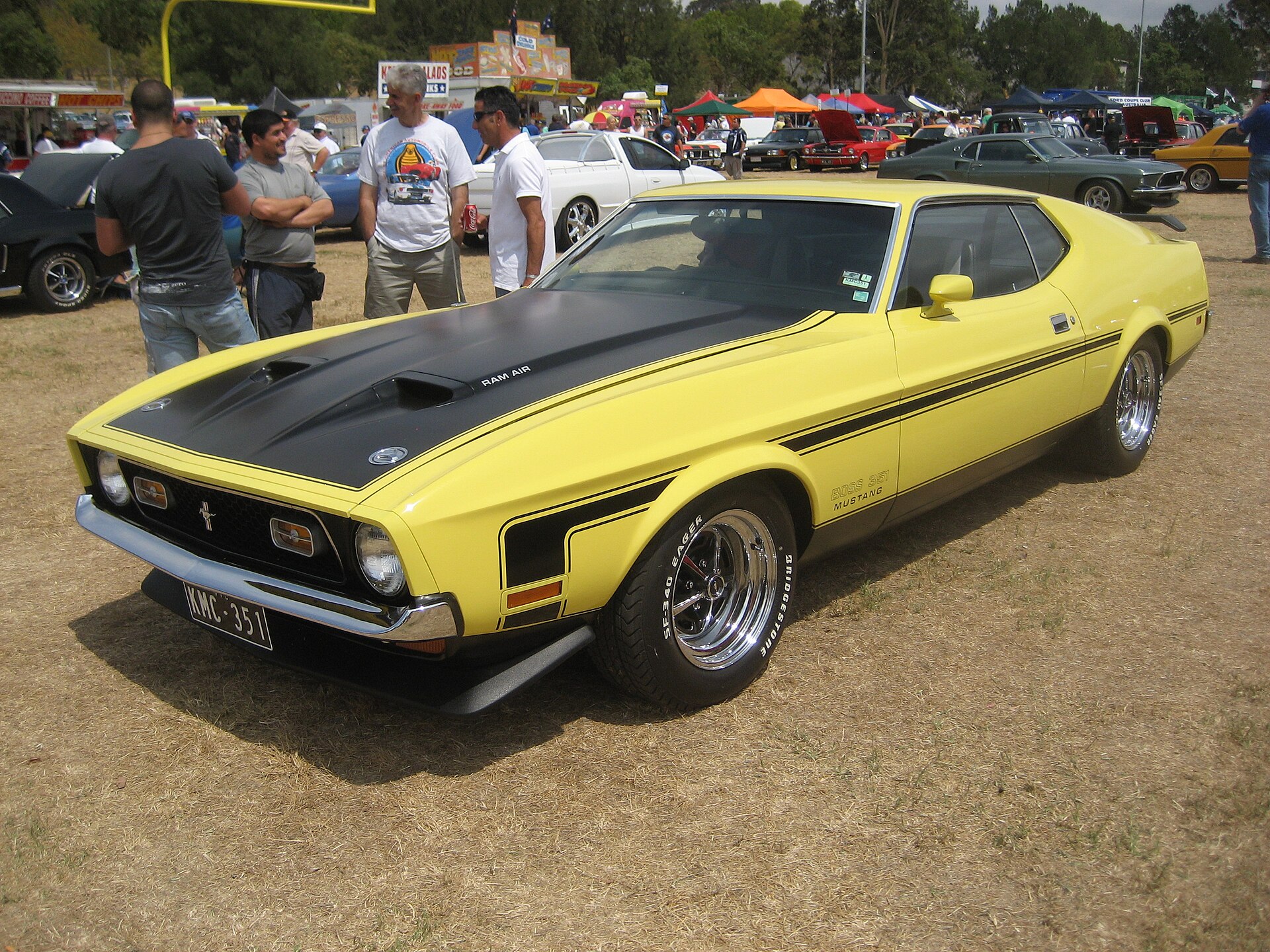
- Built
- 1971
- Top power
- 246 kW (334 PS)
Which Boss Mustang to choose
Our verdict · Sarah Whitmore
- For racing history: the Boss 302, the Trans-Am homologation car.
- For the biggest engine and rarity: the Boss 429, built for NASCAR homologation.
- For the best road car of the three: the Boss 351, Hagerty's pick as the best blend of the other two.
The Boss 351 is listed with the other golden-age Fords in the muscle car guide, and the most powerful muscle cars ranking places its 246 kW among the SAE gross figures.
The Boss 351 was the last of the original "Boss" Mustangs, built for the 1971 model year only. It replaced both the Boss 302 and the Boss 429 with a single SportsRoof fastback powered by a high-compression 351 Cleveland V8, rated at 246 kW (330 hp, SAE gross). Hagerty counts 1,806 cars, all with a four-speed manual, and calls the Boss 351 the best blend of its two predecessors.
In short
- One model year, 1971; 1,806 built according to Hagerty, all four-speed SportsRoof fastbacks.
- 351 cu in (5.8 l) Cleveland V8 with the R-code: 246 kW (330 hp) and 502 Nm (370 lb-ft), SAE gross.
- Contemporary magazine tests, as summarised by Hagerty: 0–60 mph in 5.8 s, quarter mile in as little as 13.8 s.
- Stricter emission rules ended it after a single season, Wikipedia says.
Specs by version
Verified Manufacturer and type-approval data from our catalog · Sources and methodology
Boss 351 at a glance
| Specification | Ford Mustang Boss 351 |
|---|---|
| Model year | 1971 |
| Built | 1,806 (Hagerty) |
| Body | SportsRoof fastback coupé |
| Engine | 351 cu in (5.8 l) Cleveland V8, R-code, four-barrel carburettor |
| Compression | 11.7:1 (Hagerty) |
| Power | 246 kW (330 hp), SAE gross |
| Torque | 502 Nm (370 lb-ft) |
| Gearbox | four-speed manual with Hurst shifter |
| Rear axle | 3.91:1 Traction-Lok, as fitted to the cars described by supercars.net and ClassicCars.com |
| Predecessors | Boss 302 and Boss 429 (1969–1970) |
The Boss 351 belongs to the first-generation Ford Mustang, in the larger body introduced for 1971.
One Boss instead of two
For 1969 and 1970 Ford had two Boss Mustangs with very different jobs. The Boss 302, styled by Larry Shinoda, homologated a small-block V8 for the SCCA Trans-Am series; it was rated at 216 kW (290 hp), and 7,013 were sold in 1970. The Boss 429 existed because NASCAR required at least 500 road cars with Ford's new semi-hemi 429 V8; Ford built 859 in 1969 and 499 in 1970.
For 1971 Ford replaced both cars with one model. The new Mustang, approved by company president Semon "Bunkie" Knudsen and introduced in September 1970, was 3 inches (76 mm) wider so that the 429 big block fitted without a major suspension redesign. Its engine was the 351 Cleveland. The link to the Boss 302 was direct: according to Wikipedia, the Boss 302's cylinder heads had been designed for the planned 351 Cleveland, which arrived a year later.

Engine: the R-code 351 Cleveland
The Boss engine topped the 351 range of 1971. Wikipedia lists the alternatives (SAE gross):
| 1971 Mustang V8 | Code | Power |
|---|---|---|
| 351 Cleveland two-barrel | H | 179 kW (240 hp) at 5,400 rpm |
| 351 Cleveland four-barrel | M | 213 kW (285 hp) at 5,400 rpm |
| 351 Cobra Jet four-barrel (late 1971) | Q | 213 kW (285 hp) at 5,400 rpm |
| 351 Cleveland Boss | R | 246 kW (330 hp) |
| 429 Cobra Jet | C | 276 kW (370 hp) at 5,200 rpm |
| 429 Super Cobra Jet | J | 280 kW (375 hp) at 5,200 rpm |
Hagerty describes the Boss 351 engine as a special build of the Cleveland:
| Part | Boss 351 specification |
|---|---|
| Block | special block |
| Cylinder heads | canted-valve Cleveland heads |
| Compression | 11.7:1 |
| Camshaft | big-lift cam; ClassicCars.com describes a solid-lifter cam |
| Induction | aluminium intake, 750 cfm four-barrel (Wikipedia: Autolite 4300D) |
| Connecting rods | shot-peened and magnafluxed, according to ClassicCars.com |
| Rev limiter | 6,150 rpm |
The two main sources give the same peak figures but different engine speeds: Wikipedia lists 246 kW (330 hp) at 5,400 rpm and 502 Nm at 4,000 rpm, Hagerty 5,800 rpm and 3,400 rpm. Both are SAE gross ratings, the last year before American makers switched to net figures. Supercars.net describes the R-code engine with Ram Air induction.
Design, size and chassis
Like every 1971 Mustang, the Boss 351 used the body that had grown 76 mm in width over the 1970 car. Wikipedia describes it as styled like the 1971 Mach 1, with a larger blacked-out bonnet than the Mach 1, front and rear spoilers, dual exhausts and chrome bumpers with the sport-lamp grille.
The cars documented by supercars.net and ClassicCars.com share the same running gear:
- a Hurst-shifted Top Loader four-speed manual;
- a 9-inch Traction-Lok rear axle with 3.91:1 gears;
- the Competition Suspension;
- power front disc brakes;
- 15-inch Magnum 500 wheels on the ClassicCars.com example.

Performance and acceleration
| Model (SAE gross) | Years | Power | Built |
|---|---|---|---|
| Boss 302 | 1969–1970 | 216 kW (290 hp) | 7,013 in 1970 |
| Boss 429 | 1969–1970 | 280 kW (375 hp) at 5,200 rpm | 859 + 499 |
| Boss 351 | 1971 | 246 kW (330 hp) | 1,806 |
| Mach 1 with 429 Super Cobra Jet | 1971 | 280 kW (375 hp) | - |
The road tests Hagerty cites recorded 5.8 seconds to 60 mph and quarter-mile runs down to 13.8 seconds. Hagerty adds that the 429 Super Cobra Jet Mustang of the same year was quicker, while the Boss 351 was lighter and better balanced.

Boss 351 in numbers
1CARS calculated the specific output of the three Boss engines from their rated power and displacement:
| Engine | Displacement | Rated power | kW per litre | Nm per litre |
|---|---|---|---|---|
| Boss 302 | 4.9 l | 216 kW | 44 | - |
| Boss 351 | 5.8 l | 246 kW | 43 | 87 |
| Boss 429 | 7.0 l | 280 kW | 40 | 87 |
On these figures the Boss 351 sits in the middle: almost the specific output of the high-revving 302 with close to the torque per litre of the 429. Its 246 kW also made it the most powerful small-block Mustang of 1971 in the catalog; only the 429 big-block versions were rated higher. The comparison tool sets it against the Boss 302 and Mach 1 side by side.
The end of the Boss
Wikipedia states that tightening emission regulations ended both the Boss 351 and the optional 429 big-block engine after 1971. The 1972 Mustang Mach 1 could be ordered with a 351 HO rated at 205 kW (275 hp) in the new SAE net system. The Boss name returned in 2012 on the Boss 302, rated at 331 kW (450 PS).
Boss 351 buying guide
- Documents: check the R-code in the VIN and a Marti Report; the cars described by supercars.net and ClassicCars.com come with build sheets or a Marti Report.
- Survival: supercars.net notes that fewer than 600 cars are listed in the Boss 351 Registry.
- Drivetrain: every car should have the four-speed manual; an automatic Boss 351 is not original.
- Market references: a car sold at Mecum's Monterey auction in 2011 for US$45,000, and another failed to sell at US$47,000 at Kissimmee in 2014, according to supercars.net.
Ford Boss 351 Mustang in our rankings
- No. 102 of 557 · Biggest engines: cars (5,752 cc · top 19%)
- No. 31 of 88 · Most powerful cars of the 1970s (246 kW · top 36%)
- No. 64 of 173 · Biggest engines: coupes (5,752 cc · top 38%)
- No. 376 of 859 · Most powerful cars (246 kW · top 44%)
- No. 164 of 368 · Most torque: cars (502 Nm · top 45%)
- No. 89 of 154 · Most powerful American cars (246 kW · top 58%)
Bigger engine than 81% of ranked cars in the 1CARS catalog (No. 102 of 557).
FAQ
How many Boss 351 Mustangs were made?
1,806, all for the 1971 model year and all with a four-speed manual gearbox, according to Hagerty.
How much horsepower did the Boss 351 have?
Its R-code Cleveland V8 was rated at 246 kW (330 hp) SAE gross, with 502 Nm of torque and an 11.7:1 compression ratio.
How fast was the Boss 351?
About 5.8 s to 60 mph and quarter-mile times around 13.8 s were recorded in period magazine tests, according to Hagerty.
Why was the Boss 351 only made in 1971?
Wikipedia links its end, and that of the 429 option, to tightening emission regulations. The 1972 range offered a 351 HO with 205 kW (275 hp net) instead.
What replaced the Boss 302 and Boss 429?
The Boss 351 replaced both for 1971, as a single model on the larger 1971 Mustang body.
Data sources
Data checked by an editor against the sources below.