Ford: How Henry Ford's Company Put the World on Wheels
Ford Motor Company is an American carmaker based in Dearborn, Michigan, founded by Henry Ford and eleven other investors on 16 June 1903. Its Model T of 1908 and the moving assembly line of 1913 made the car affordable for millions. Today the company builds about 4.4 million vehicles a year under its own name and the Lincoln brand.

Key takeaways
- Henry Ford's third company, after the Detroit Automobile Company (1899) and the Henry Ford Company (1901); about 15 million Model Ts were built from 1908 to 1927.
- Key firsts: the moving assembly line at Highland Park (1913), the five-dollar day (1914) and the first low-priced V8 car (1932).
- Landmarks after the war: the F-Series pickups, the Mustang (1964), the GT40's Le Mans win (1966), Ford of Europe (1967) and its Escort, Fiesta and Sierra.
- Since 2022 the business has been split into three units: Blue (combustion engines), Model e (electric) and Pro (commercial vehicles).

Ford at a glance
| Fact | Value |
|---|---|
| Founded | 16 June 1903, Detroit, Michigan |
| Founder | Henry Ford, with eleven other investors including John and Horace Dodge |
| Headquarters | Dearborn, Michigan; new world headquarters opened in November 2025 |
| Leadership | Jim Farley (president and CEO since 2020), Bill Ford (executive chair) |
| Ownership | listed company since 1956; the Ford family holds about 2% of shares but 40% of votes through Class B stock |
| Brands | Ford, Lincoln (Mercury ended 2010–2011) |
| Divisions | Blue, Model e, Pro (since March 2022) |
| Output | about 4.4 million vehicles in 2025; 169,000 employees |
Ford was the sixth-largest carmaker in the world by production in 2022. Unlike General Motors and Chrysler, it came through the 2008–2010 crisis without a government rescue.

Henry Ford and the first companies (1896–1903)
Henry Ford, an engineer at the Edison Illuminating Company in Detroit, built his first vehicle, the Quadricycle, in 1896. His first business, the Detroit Automobile Company of 1899, failed, and the Henry Ford Company of 1901 broke with him in March 1902; it later became Cadillac. On 16 June 1903 he and eleven investors incorporated Ford Motor Company with 1,000 shares. Its first president was the banker John S. Gray, and Henry took over the presidency after Gray's death in 1906.

The first product, the Model A of 1903, sold 1,708 cars. A Canadian company followed in 1904. At first the company built a few cars a day in a rented plant on Mack Avenue in Detroit. Small teams assembled each car from parts bought from suppliers, among them the Dodge brothers' engines and chassis.
The Model T and the moving assembly line (1908–1927)
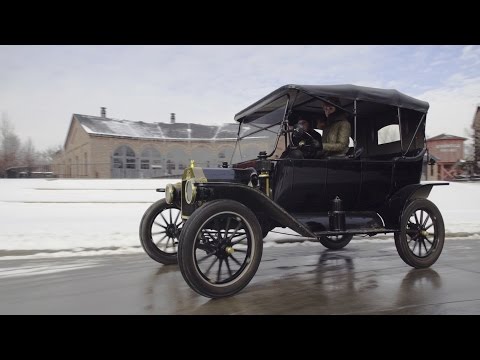
The Model T, introduced in 1908, was simple, tough and easy to repair, with a four-cylinder engine with a detachable cylinder head and a two-speed planetary gearbox. Just over 10,000 were built in 1909. Production moved to the new Highland Park plant in 1910, and in 1913 the company introduced the moving assembly line there, cutting assembly time sharply. Output rose to 202,667 cars in 1913 and 501,462 in 1915: by our count, about 20 times the 1909 figure in just four years.

In January 1914 Henry Ford doubled pay to five dollars a day for an eight-hour day, a step that cut staff turnover and turned his workers into customers. Annual output passed one million cars around 1920–1921, and construction of the giant River Rouge complex began in 1918. When the Model T ended in 1927, about 15 million had been built.
| Year | Event |
|---|---|
| 1903 | Ford Motor Company founded; first Model A |
| 1908 | Model T introduced |
| 1913 | Moving assembly line at Highland Park |
| 1914 | Five-dollar day and eight-hour shift |
| 1922 | Lincoln Motor Company bought (4 February) |
| 1927 | Model T ends after about 15 million cars |
| 1932 | First low-priced car with a V8 |
| 1938 | Mercury brand created |
| 1956 | The company goes public |
| 1964 | Mustang launched |
| 1966 | First Le Mans win with the GT40 Mk II |
| 1967 | Ford of Europe founded |
| 2006 | "The Way Forward" restructuring; Alan Mulally becomes CEO |
| 2022 | Split into Blue, Model e and Pro units |
Lincoln, the V8 and Mercury (1922–1945)
Ford bought the Lincoln Motor Company on 4 February 1922 and made it its luxury brand. The second Model A followed the Model T in December 1927 and carried the script badge that is still used. In 1932 the company put a one-piece cast V8 into a low-priced car, the Model 18, and made eight-cylinder power affordable. The Mercury brand, for buyers between Ford and Lincoln, was created in 1938.

During the Second World War civilian production stopped in 1942. The Willow Run plant built more than 8,000 B-24 bombers. Henry's son Edsel died in 1943, and in 1945 his grandson Henry Ford II took over a company in poor shape; Henry Ford himself died in 1947.
The post-war era: F-Series, Thunderbird, Mustang and GT40
Under Henry Ford II, the company modernised. The F-Series pickups of 1948 began a line that has been North America's best-selling truck for decades. The Thunderbird of 1955 opened the personal luxury segment, while the Edsel brand of 1957–1960 was an expensive failure. The company went public in 1956.
On 17 April 1964 the Mustang was unveiled and created the pony car class; the original Mustang Fastback is second in the 1cars list of the best classic cars of the 1960s. Carroll Shelby's tuned versions, such as the 1967 Shelby GT500, followed. On the track, the GT40 Mk II took the brand's first Le Mans 24 Hours win in 1966, beating Ferrari; GT40s won again in 1967, 1968 and 1969.
Ford of Europe and the world car
Ford had built cars in Britain and Germany since before the war, but in 1967 it joined its European businesses into Ford of Europe. That organisation produced some of the best-selling cars on the continent:
- the Escort (from 1968) and Cortina in Britain, and the Taunus and Granada in Germany;
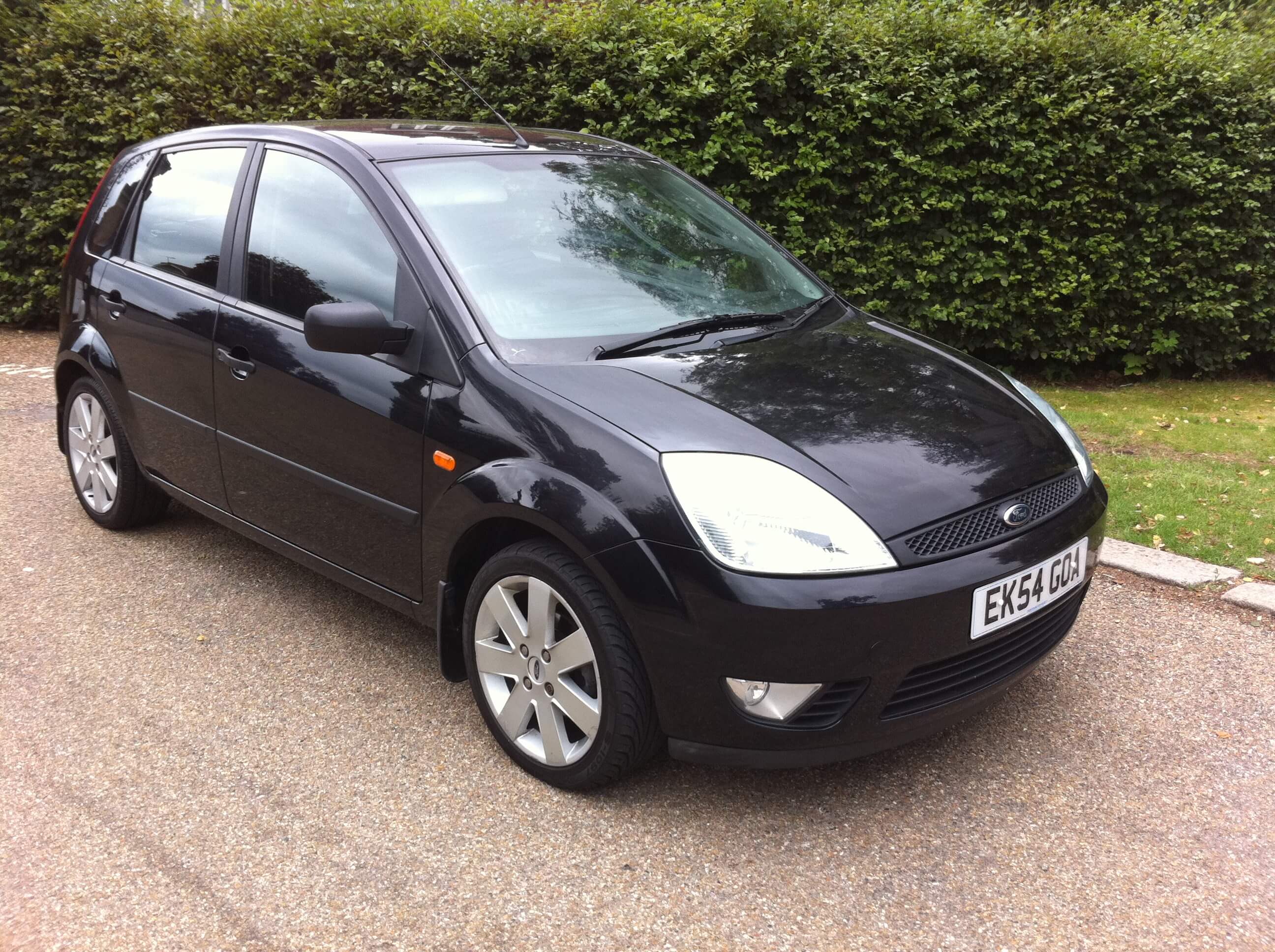
- the Fiesta (1976), the brand's first front-wheel-drive small car;
- the aerodynamic Sierra (1982), which replaced the Cortina and was itself replaced by the front-wheel-drive Mondeo in 1993;
- the Focus of 1998, successor to the Escort;
- the Transit van, built since 1965 and sixth among the longest-produced models in the 1cars data.

In 1979 the company took 25% of Mazda, raised to 33.4% in 1996, and the two shared platforms for years. In North America, the Taurus of 1985 brought aerodynamic styling into the mid-size class.
The Premier Automotive Group and the 2006 crisis
In the late 1980s and 1990s it bought European premium brands: Aston Martin (1987), Jaguar (1989), Volvo's car division (1999) and Land Rover (2000), gathered in the Premier Automotive Group. The plan never paid off. In December 2006 the company mortgaged almost all its assets, including its blue oval logo, to raise a very large loan for the "Way Forward" restructuring, and hired Alan Mulally as CEO.

The loan let it avoid the government rescue that GM and Chrysler needed in 2009. It sold Aston Martin in 2007, Jaguar and Land Rover to Tata Motors in 2008 and Volvo to Geely in 2010. It also reduced its Mazda stake and ended the Mercury brand, whose last car, a Grand Marquis, was built in early 2011. By 2009 it was profitable again, for the first full year in four years.
Ford today: trucks, electric cars and Europe
In April 2018 the company decided to stop selling most passenger cars in North America and to focus on pickups, SUVs and the Mustang. The Mustang Mach-E electric SUV arrived in 2020, the Bronco returned in 2021 after about 25 years, and the electric F-150 Lightning followed in 2022. In March 2022 it split into three units: Blue for combustion cars, Model e for electric vehicles and Pro for commercial customers.

The electric business has been costly. Model e lost money in every year from 2021. In December 2025 the company announced large write-downs on its electric business and scrapped several planned electric models after US subsidies were cut, which led to a net loss for 2025. Sales still rose by about 6% in 2025, helped by hybrids.
In Europe, the company cut its range to SUVs, vans and a few electric models. The Fiesta ended in 2023 and the Focus in 2025, while the Cologne plant switched to electric SUVs such as the Explorer. It announced 3,800 job cuts in Europe in 2023 and a further 2,900 in Germany and 800 in the UK in November 2024. In Turkey, the Ford Otosan joint venture (Ford owns 41%) builds Transit vans and took over the Romanian plant in Craiova in 2022.
Ford in numbers
| Milestone | Figure |
|---|---|
| First Model A (1903) | 1,708 built |
| Model T (1908–1927) | about 15 million |
| B-24 bombers at Willow Run | more than 8,000 |
| Vehicles produced in 2023 | 4.4 million |
| Vehicles sold in 2024 | about 4.5 million |
| Employees in 2025 | about 169,000 |
| Family voting power | about 40% |
You can compare any of its models with rivals in the 1cars comparison tool, and every Ford model in the catalogue is on the Ford brand page.

FAQ
Who owns Ford today?
Ford Motor Company is a listed company. The Ford family owns only about 2% of the shares but controls about 40% of the voting power through special Class B stock. Bill Ford, Henry Ford's great-grandson, is executive chair, and Jim Farley is CEO.
When was Ford founded and by whom?
Henry Ford and eleven investors, including the Dodge brothers, incorporated Ford Motor Company in Detroit on 16 June 1903. It was Henry Ford's third car company, after the Detroit Automobile Company of 1899 and the Henry Ford Company of 1901.
Where are Ford cars made?
Ford builds vehicles in the United States, Canada, Mexico, China, Germany, Spain, Romania (through Ford Otosan), Turkey, Thailand and other countries. The F-Series pickups come mainly from US plants in Michigan, Missouri and Kentucky.
What does the Ford logo mean?
The flowing script spells the family name and has been used since the company's early years. The blue oval around it appeared on cars from the late 1920s, starting with the Model A, and was pledged as collateral with other assets when Ford mortgaged its business in 2006.
What is the best-selling or most famous Ford?
The Model T made the company famous, with about 15 million built. The F-Series pickup has been North America's best-selling truck for decades, and the Mustang, launched in 1964, is its best-known sports car.
Photos (6)




Videos 2
Video 1

Video 2