The Brand-New Chevrolet Niva: What Happened to the Second Generation
The brand-new, second-generation Chevrolet Niva was a compact four-wheel-drive SUV that the GM-AvtoVAZ joint venture showed as a concept in August 2014 and planned to build from 2016. It did not reach production. Work slowed after General Motors cut back its business in 2015, the project was suspended in 2018, and the existing Niva carried on, renamed the Lada Niva Travel in December 2020.

Key takeaways
- Concept: shown in August 2014 with a longitudinal engine, permanent four-wheel drive, a two-speed transfer case and a rigid rear axle.
- Planned engine: a 1.8-litre PSA EC8 petrol unit with about 99 kW (135 hp), later dropped for cost reasons.
- Outcome: no production; GM sold its 50% share of the joint venture, and from 2020 the car was sold as a Lada.
- The first-generation Niva, built since 2002, is still in production in 2026 as the Niva Travel.

The first Chevrolet Niva and GM-AvtoVAZ
The original Chevrolet Niva began as the VAZ-2123, a successor to the boxy Lada Niva of 1977 developed by AvtoVAZ in the 1990s. In 2002 General Motors and AvtoVAZ formed the joint venture GM-AvtoVAZ, each with half of the shares, which received the licence for the car and the right to the Niva name. From 2002 it was sold as the Chevrolet Niva. It was a five-door SUV with a 2,450 mm wheelbase, independent front suspension and a coil-sprung rigid rear axle, and its permanent four-wheel drive had a low range.
Size at a glance
Renault Duster
The Chevrolet Niva is 267 mm shorter, 52 mm narrower and 27 mm taller than the Renault Duster.
| Dimensions | Chevrolet Niva | Renault Duster | Difference |
|---|---|---|---|
| Length | 4,048 mm159.4 in | 4,315 mm169.9 in | −267 mm−10.5 in |
| Width | 1,770 mm69.7 in | 1,822 mm71.7 in | −52 mm−2.0 in |
| Height | 1,652 mm65.0 in | 1,625 mm64.0 in | +27 mm+1.1 in |
| Wheelbase | 2,450 mm96.5 in | 2,673 mm105.2 in | −223 mm−8.8 in |
| Boot | 320 L11.3 cu ft | - | - |
Daihatsu Terios J200
The Chevrolet Niva is 47 mm shorter, 75 mm wider and 53 mm lower than the Daihatsu Terios J200.
| Dimensions | Chevrolet Niva | Daihatsu Terios J200 | Difference |
|---|---|---|---|
| Length | 4,048 mm159.4 in | 4,095 mm161.2 in | −47 mm−1.9 in |
| Width | 1,770 mm69.7 in | 1,695 mm66.7 in | +75 mm+3.0 in |
| Height | 1,652 mm65.0 in | 1,705 mm67.1 in | −53 mm−2.1 in |
| Wheelbase | 2,450 mm96.5 in | 2,580 mm101.6 in | −130 mm−5.1 in |
| Boot | 320 L11.3 cu ft | 205 L7.2 cu ft | +115 L+4.1 cu ft |

Its weak point was the engine: the 1.7-litre petrol four from the old Niva with about 59 kW (80 PS), paired with a five-speed manual. Bertone gave the car a light facelift in 2009, which added an ABS-equipped version with two front airbags. A full model page for the car is here: Chevrolet Niva.
Development and the 2014 concept
By the early 2010s the joint venture wanted a modern replacement that would be larger and more comfortable but keep real off-road ability. The concept shown in August 2014 rode on 235/70 R16 all-terrain tyres and carried a skid plate, a snorkel, a roof-mounted light bar and a full-size spare wheel on the tailgate. It had the size of a Renault Duster, but a different layout. The engine sat lengthways and the four-wheel drive was permanent. A two-speed transfer case gave a low range, and the rear axle was rigid for wheel articulation.
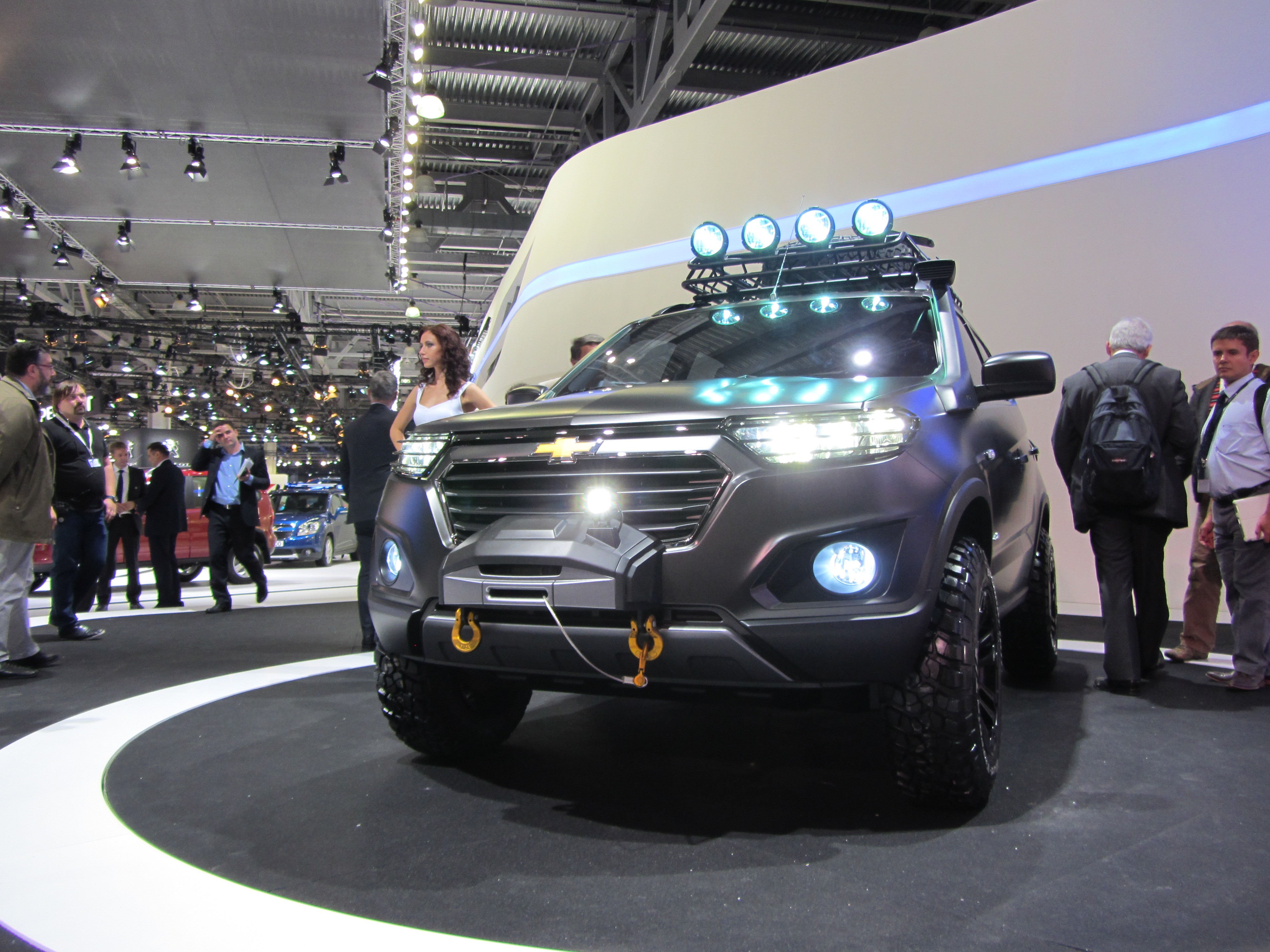
| Feature | First-generation Niva (2002) | Second-generation concept (2014) |
|---|---|---|
| Engine | 1.7 petrol, about 59 kW (80 PS) | 1.8 PSA EC8 petrol, about 99 kW (135 hp) planned |
| Gearbox | 5-speed manual | 5-speed manual planned |
| Drive | permanent 4WD, low range | permanent 4WD, two-speed transfer case |
| Front suspension | independent, double wishbones | independent, MacPherson struts reported |
| Rear axle | rigid, coil springs | rigid |
| Size | compact, 2,450 mm wheelbase | about Renault Duster size |
The engine plan needed a new plant and outside investors, and costs rose quickly. The engineers looked at a 1.8-litre AvtoVAZ engine with about 90 kW (122 PS) instead. Its torque was too much for the existing gearbox, which was reported to cope with about 165 Nm, so a bought-in gearbox, possibly from Isuzu, was discussed. Compared with the first Niva's 59 kW, the PSA engine promised about 68% more power.
Why the brand-new Chevrolet Niva was stopped
Several things worked against the car. The costs of a new engine and gearbox rose. AvtoVAZ, which owned half of the joint venture, was developing its own successor to the Lada 4x4 and had little reason to supply parts to a rival. In March 2015 GM withdrew most Chevrolet models and the Opel brand from the country where the Niva was built, which left the project without its main sponsor.

The project, started in 2013, was suspended early in 2015 and then revived in the summer of the same year. The joint venture's general director, Jeffrey Glover, said that testing of the new model had begun in Europe. The plan now called for 120,000 cars a year and a sales launch in mid-2016. The PSA-licensed engine was to come from a new plant run with India's AVTEC. Prototypes were photographed during cold- and hot-weather trials, yet the launch date slipped again, to 2017 and then 2018, and later statements described the programme as suspended. In September 2018 GM was reported to have stopped work on the replacement altogether.
| Year | Event |
|---|---|
| 2002 | GM-AvtoVAZ formed; Chevrolet Niva production begins |
| 2009 | Facelift styled by Bertone |
| Aug 2014 | Second-generation concept shown |
| 2015 | Project suspended; GM scales back its business |
| Aug 2018 | Lada 4x4 Vision concept shown by AvtoVAZ |
| Sep 2018 | GM reportedly stops work on the replacement |
| 2019–2020 | GM sells its 50% share; AvtoVAZ takes over the joint venture |
| Aug 2020 | Car renamed Lada Niva |
| Dec 2020 | Updated car renamed Lada Niva Travel |
The interim plan: a city version of the old Niva
While the new car waited, the joint venture looked at ways to keep the old one selling. According to the old 1cars text, one plan was a more urban version. It would have had a reworked 1.7 engine with lighter connecting rods and pistons and an improved cylinder head. Lower suspension, better sound insulation, disc brakes all round and 17-inch wheels were also planned. A similar idea, the Lada 4x4 Urban, had earlier been limited to new bumpers and seats. The fuller city version did not go on sale under the Chevrolet name.

What happened next: Lada Niva Travel
When GM left, AvtoVAZ took over the car and the plant. In August 2020 it became the Lada Niva, and with a facelift in December 2020 it was renamed the Lada Niva Travel. At the same time the original three-door Niva became the Lada Niva Legend. The Niva Travel kept the old mechanical layout.

AvtoVAZ's own replacement went through several stages. The Lada 4x4 Vision concept of August 2018 was reported to use the Renault Duster platform, and a later project was planned on Renault's CMF platform. After Renault sold its stake in AvtoVAZ in 2022, that plan was dropped, and from 2023 AvtoVAZ worked on a new Niva using its own Vesta chassis. For 2026 the company announced a facelift of the Niva Travel with a 1.8-litre engine option, more than a decade after the first 1.8 plan. More on the earlier concept is on the Lada 4x4 Vision page.
A traditional 4x4 layout in a modern body
The 2014 concept is worth remembering for what it tried to combine. Most compact SUVs of its size, such as the Renault Duster, use a transverse engine and an on-demand four-wheel-drive system without a low range. The Niva concept kept the layout of a traditional off-roader, with a longitudinal engine, a transfer case with a low range and a rigid rear axle, but in a modern body. The Suzuki Jimny follows a similar recipe, though with part-time drive; in this size class the combination is rare.

Because it did not reach production, there are no confirmed figures for weight, ground clearance, boot space or fuel use. The only engine data are the planned 1.8 PSA with about 99 kW and the alternative 1.8 AvtoVAZ unit with about 90 kW.
What remains of the project
The second-generation Chevrolet Niva exists only as a concept and as test prototypes, so it has no market value. Its legacy is indirect: the first-generation car lived on for more than two decades, and the ideas of the 2014 concept fed later Lada projects. A buyer looking at a used Chevrolet Niva or Niva Travel today gets a simple, repairable 4x4 with a low range, but also old engineering, modest power and limited crash protection. The broader story of these cars is told in the history of Soviet all-wheel-drive cars, and other off-roaders are listed in the 4x4 section.
Verdict: who the Niva story matters to
For owners of the first-generation car, the cancelled project explains why their Niva did not receive a new engine or gearbox under Chevrolet. For buyers who want a small, mechanically simple off-roader with a low range, the Niva Travel and the Suzuki Jimny remain the main choices in this layout. Those who mostly drive on tarmac are better served by a Duster-type SUV. You can compare the sizes of these cars in the 1cars comparison tool or with the size comparison tool, and look up every catalogued Niva version in the specifications section.


FAQ
When was the second-generation Chevrolet Niva shown?
The concept was shown in August 2014. It had a longitudinal 1.8-litre engine, permanent four-wheel drive, a two-speed transfer case and a rigid rear axle. Production was planned for 2016 but did not begin.
Why was the new Chevrolet Niva cancelled?
The planned PSA engine and new gearbox became too expensive, AvtoVAZ was working on its own rival, and GM cut back its business in 2015. The project was suspended in 2015 and GM reportedly stopped work in September 2018.
What engine did the new Chevrolet Niva have?
The concept was planned with a 1.8-litre PSA EC8 petrol engine of about 99 kW (135 hp) and a five-speed manual. A 1.8 AvtoVAZ engine of about 90 kW (122 PS) was later considered as a cheaper option.
Is the Chevrolet Niva still made?
Yes, under another name. After GM sold its share, AvtoVAZ renamed the car Lada Niva in August 2020 and Lada Niva Travel in December 2020. A facelift with a 1.8-litre engine option was announced for 2026.
What is the difference between the Niva Travel and the Niva Legend?
The Niva Travel is the former Chevrolet Niva, a five-door SUV designed in the 1990s. The Niva Legend is the original Lada Niva of 1977, sold in three- and five-door forms with a shorter or longer wheelbase.
Photos (1)