
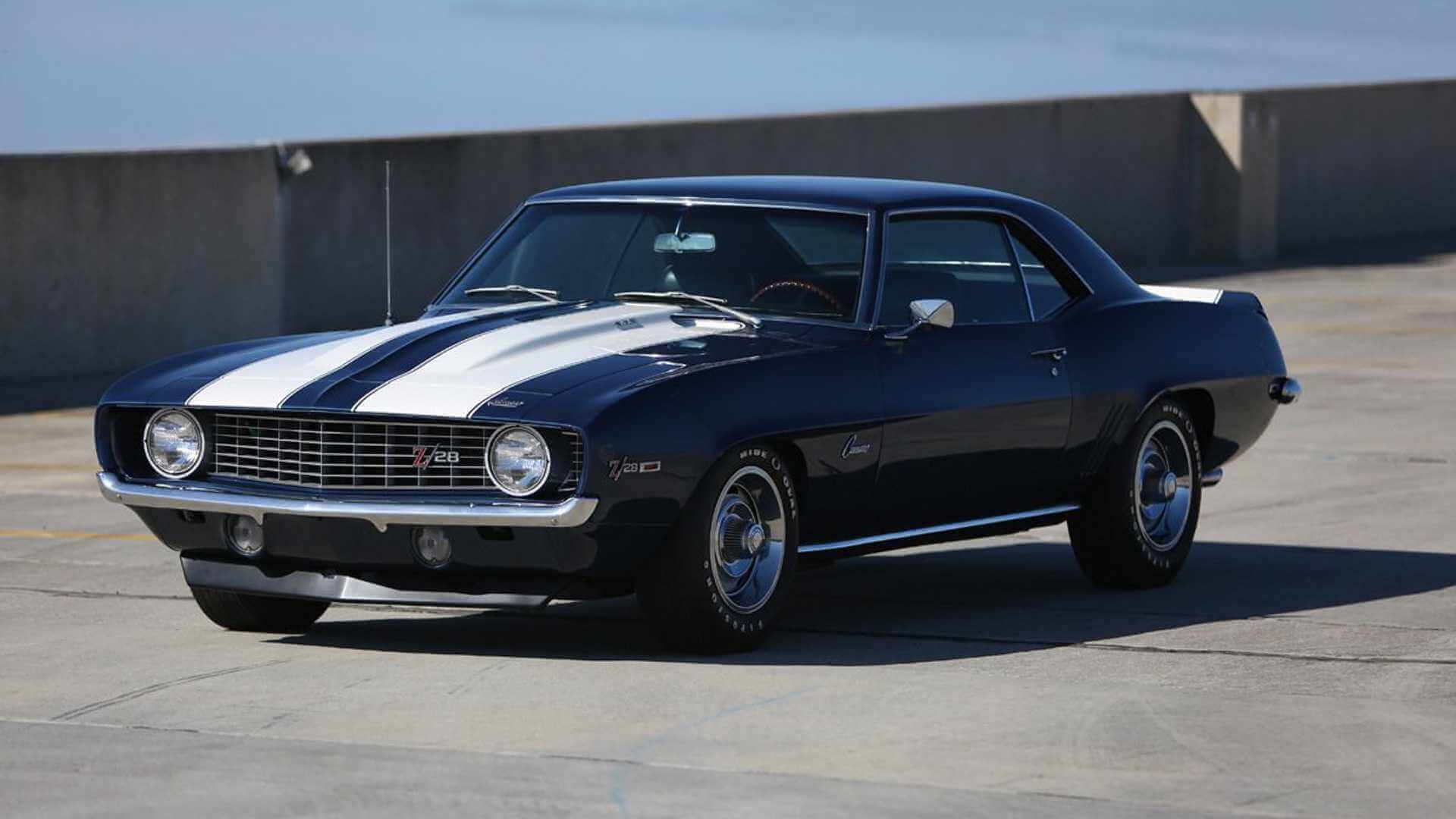
 Chevrolet Camaro Z28
Specs, engines and history
Updated Published Sources (3) Report an error
By Sarah Whitmore, Senior Automotive Writer Reviewed by Oleksandr Hnatiuk
- Built
- 1966–2015
- Top power
- 216 kW (294 PS)
Which Z28 to choose
Our verdict · Sarah Whitmore
- For the original story: a 1967–1969 car with the 302; the 1967 cars are the rarest, and 1969 cars with the JL8 brakes or cross-ram intake are the most sought after.
- For a usable classic V8: a 1970–1973 LT-1 car, before emissions rules cut power further.
- For modern performance: a 2014–2015 Z/28, the most track-capable Camaro of its generation.
For any classic Z/28, ask for documents that prove the car left the factory with the Z28 option, because many standard Camaros were later converted. All Chevrolet models are listed in our Chevrolet catalogue.
The Chevrolet Camaro Z/28 is the track-oriented Camaro created for the 1967 model year to homologate the car for the SCCA Trans-Am series. Its special 302 cu in (4.9-litre) V8 was rated at 290 hp gross (216 kW), and only 602 were sold in the first year. The name ran until 2002 and returned for 2014–2015 with a 376 kW LS7.
In short
- Origin: regular production option RPO Z28, introduced in December 1966 and conceived by Chevrolet's Vince Piggins.
- Engine: 302 V8 from a 327 block and a 283 crankshaft, just under the Trans-Am limit of 305 cu in.
- Classic years: 602 cars in 1967, nearly 7,200 in 1968 and more than 20,000 in 1969.
- Last Z/28: 2014–2015, 505 hp LS7, six-speed manual, carbon-ceramic brakes and a 7:37 Nürburgring lap.

Size at a glance
| Dimensions | Chevrolet Camaro Z28 |
|---|---|
| Length | 4,691 mm184.7 in |
| Width | 1,842 mm72.5 in |
| Height | 1,306 mm51.4 in |
| Wheelbase | 2,743 mm108.0 in |
Specs by version
Engines
Dimensions and weight
Verified Manufacturer and type-approval data from our catalog · Sources and methodology
Z/28 generations at a glance

| Years | Camaro generation | Engine | Power | Highlights |
|---|---|---|---|---|
| 1967–1969 | first | 302 cu in V8 | 216 kW (290 hp gross) | Trans-Am homologation, 602 / ~7,200 / 20,000+ cars |
| 1970–1974 | second | 350 LT-1 V8 | 268 kW (360 hp gross) in 1970 | more than 13,000 sold in 1974, then dropped |
| 1977–1981 | second | 350 V8 | 138 kW (185 hp net) in 1977 | returned in spring 1977, outsold the Mustang |
| 1982–1992 | third | 5.0 V8 | 108–142 kW (145–190 hp) | 1982 Indy 500 pace car year; IROC-Z 1985–1990 |
| 1993–2002 | fourth | 5.7 LT1, then LS1 V8 | up to 231 kW (310 hp) | LS1 from 1998; 35th Anniversary in 2002 |
| 2014–2015 | fifth | 7.0 LS7 V8 | 376 kW (505 hp) | track special, no air conditioning as standard |
Why Chevrolet created the Z/28
When the Camaro arrived for 1967, the Ford Mustang already dominated the pony-car market and the new Trans-Am series. The SCCA capped displacement at 305 cubic inches, and no Camaro engine fitted that class. Chevrolet's Vince Piggins proposed a "virtually race-ready" Camaro that any customer could order from a dealer, which would allow the car to be homologated.

The result was option code Z28, the Special Performance Package. Chevrolet introduced it in December 1966 but did not mention it in the sales brochures, so most buyers never knew it existed. Only 602 were sold for 1967. The Z/28 appeared in the brochures for 1968, and sales grew to nearly 7,200. In 1969, the most famous year of the first-generation Camaro, more than 20,000 were sold. The wider story of the first car is on our first-generation Camaro page.
The 302 V8
Chevrolet built the 302 by combining the 4.00-inch bore of the 327 block with the 3.00-inch stroke of the 283 crankshaft, giving 302.4 cu in (4,942 cc). The short stroke let the engine rev freely. It had an 11:1 compression ratio, forged pistons, solid lifters and, in 1967, a 780 cfm Holley four-barrel carburettor.

Chevrolet rated the 302 at 290 hp gross, quoted for 1969 at 5,800 rpm with 290 lb-ft at 4,200 rpm. That rating was deliberately low and kept the engine under one horsepower per cubic inch. Jalopnik's history of the model puts the real output at about 268 kW (360 hp) with the single four-barrel and about 298 kW (400 hp) with two four-barrel carburettors on a cross-ram intake, which dealers offered in 1969. By our calculation the official figure equals about 44 kW per litre, while the estimated real output would be closer to 54 kW per litre.
| 302 V8 (1967–1969) | Figure |
|---|---|
| Bore × stroke | 4.00 × 3.00 in (101.6 × 76.2 mm) |
| Displacement | 302.4 cu in (4,942 cc) |
| Compression | 11:1 |
| Official power | 290 hp gross (216 kW), 1969: at 5,800 rpm |
| Official torque | 290 lb-ft (393 Nm) at 4,200 rpm (1969) |
| Carburation | Holley four-barrel, 780 cfm (1967); cross-ram with two four-barrels as dealer option (1969) |
Running gear and options
The Z/28 package always came with a close-ratio Muncie four-speed manual gearbox, heavy-duty suspension, power front disc brakes and 15-inch Rally wheels. The 12-bolt rear axle had a 3.73 ratio as standard in 1969, when a Hurst shifter became standard and a cowl-induction bonnet that draws air from the base of the windscreen was optional. The rare JL8 option added disc brakes on all four wheels for 500.30 US dollars in 1969; only 206 cars had it. The wide stripes on the bonnet and boot lid became the Z/28's trademark, although buyers could delete them at no cost.

Inside, the Z/28 used the normal Camaro cabin. The old version of this page described vinyl trim in four colours, lap belts for all seats with shoulder belts as an option, and an optional console with extra gauges and a clock. These details match the standard Camaro equipment of the period.
On the track the package did its job. Roger Penske's team with Mark Donohue won the Trans-Am championship for Chevrolet in 1968 and 1969, and the all-round disc brakes of 1969 are regarded as one of the keys to the second title. Our published comparison of the first-generation Camaro and the Mustang fastback shows how the two pony cars measured up.
Z28 after 1969: from LT-1 to LS1
The second-generation Camaro of 1970 kept the Z/28 name but switched to the 350 cu in LT-1 V8, rated at 268 kW (360 hp gross) and 515 Nm (380 lb-ft). The Turbo Hydramatic 400 automatic was offered for the first time, and in 1972 the slash disappeared from the badge. Emissions rules cut power from 1971; after selling more than 13,000 in 1974, Chevrolet dropped the Z28. It returned in spring 1977 with a 350 V8 of 138 kW (185 hp) to compete with Pontiac's Trans Am and helped the Camaro outsell the Mustang for the first time. Our second-generation Camaro page covers that era in detail.

The third-generation Z28 of 1982 used a 5.0-litre V8 with 108 kW (145 hp), or 123 kW (165 hp) with Cross-Fire Injection, and the Camaro was Motor Trend's Car of the Year. The 1983 L69 High Output V8 reached 142 kW (190 hp), and the IROC-Z ran from 1985 to 1990. The fourth generation of 1993 used the LT1 V8 from the Corvette and was chosen as the pace car of that year's Indianapolis 500; 633 replicas were sold for 995 US dollars extra. The LS1 of 1998 raised power to 227 kW (305 hp) and later 231 kW (310 hp), and the Z28 ended with the Camaro in 2002.
The 2014–2015 Z/28: a track car with an LS7
The name returned for the 2014 model year on the fifth-generation Camaro, as a lighter and more focused alternative to the supercharged ZL1. Its 7.0-litre (7,008 cc) LS7 V8 with dry-sump lubrication produced 505 hp (376 kW) at 6,100 rpm and 481 lb-ft (652 Nm) at 4,800 rpm. The only gearbox was a Tremec TR6060 six-speed manual with a helical Torsen limited-slip differential.

| 2014 Camaro Z/28 | Figure |
|---|---|
| Kerb weight (without air conditioning) | 1,732 kg (3,820 lb), 136 kg less than the ZL1 |
| Brakes | Brembo carbon-ceramic, 394 × 36 mm front with six pistons, 390 × 32 mm rear with four pistons |
| Tyres | Pirelli P Zero Trofeo R, 305/30 ZR19 on all four wheels |
| Dampers | spool-valve dampers, among the first in a production car |
| Nürburgring | 7:37, about four seconds faster than the ZL1 |
| Price (2014) | 75,000 US dollars including 995 US dollars destination, about €56,000 |
Chevrolet saved weight wherever it could: air conditioning was optional, the forged wheels were 19 kg lighter than the ZL1's set and the carbon-ceramic brakes saved another 12.5 kg. Jalopnik summed it up as a pony car "with a 500 horsepower V8 and no radio". With 1,732 kg and 376 kW, the Z/28 carried 4.6 kg per kW by our calculation; our power-to-weight calculator compares that with any other car. The sixth-generation Camaro, built from 2016 until December 2023, had no Z/28; its track model was the Camaro ZL1.

Popular comparisons
Chevrolet Camaro Z28 in our rankings
- No. 160 of 627 · Biggest engines: cars (4,942 cc · top 26%)
- No. 36 of 99 · Longest coupes (4,691 mm · top 37%)
- No. 202 of 531 · Longest cars (4,691 mm · top 39%)
- No. 88 of 181 · Biggest engines: coupes (4,942 cc · top 49%)
- No. 504 of 1011 · Most powerful cars (216 kW · top 51%)
- No. 260 of 509 · Widest cars (1,842 mm · top 52%)
Bigger engine than 74% of ranked cars in the 1CARS catalog (No. 160 of 627).
Chevrolet Camaro Z28 photos 13



FAQ
What does Z28 mean on a Camaro?
Z28 was Chevrolet's regular production option code for the Special Performance Package, introduced in December 1966 for the 1967 model year. The option code became the model name, written Z/28 or Z28 depending on the year.
How many 1967 Camaro Z/28 were made?
Only 602 Z/28s were sold for the 1967 model year, because the option was not advertised. Sales rose to nearly 7,200 in 1968 and to more than 20,000 in 1969.
How much horsepower does the 302 Z/28 have?
Chevrolet rated the 302 V8 at 290 hp gross, about 216 kW, with 290 lb-ft of torque. Period sources estimate the real output at about 360 hp, or around 400 hp with the cross-ram intake.
Why did the Z/28 have a 302 engine?
The SCCA Trans-Am series limited engines to 305 cu in (5.0 litres). Chevrolet combined a 327 block with a 283 crankshaft to create a 302.4 cu in V8 that fitted the rule.
What engine is in the 2014 Camaro Z/28?
The 2014–2015 Z/28 uses the 7.0-litre LS7 V8 with dry-sump lubrication, rated at 505 hp (376 kW) and 481 lb-ft (652 Nm), with a six-speed manual gearbox only.
Data sources
Data checked by an editor against the sources below.
- The text of this article (1cars archive)
- Wikipedia - Chevrolet Camaro
- Wikipedia - Chevrolet Camaro (first generation)


