Chevrolet Camaro History: GM's Answer to the Mustang, 1966–2023
The Chevrolet Camaro is the pony car General Motors launched on 29 September 1966 to compete with the Ford Mustang. It was built in six generations, with a break from 2002 to 2009, until production ended on 14 December 2023. Its best sales year was 1979, with 282,571 cars sold in the US.

Key takeaways
- The name was revealed on 28 June 1966 in Detroit; the first cars went on sale as 1967 models.
- Six generations: 1967–1969, 1970–1981, 1982–1992, 1993–2002, 2010–2015 and 2016–2024 model years.
- The Z/28 was born for Trans-Am racing in 1966; only 69 COPO ZL1 cars with an aluminium 427 V8 were built in 1969.
- Camaros paced the Indianapolis 500 nine times between 1967 and 2016.

A late start: why Chevrolet needed the Camaro
Ford's Mustang created the pony car class in 1964 and sold in huge numbers from the start. Chevrolet had nothing comparable: the rear-engined Corvair and the compact Chevy II were the closest products. According to some historians, the Super Nova concept shown in New York in spring 1964 was Chevrolet's first response, but it did not go into production.
Size at a glance
Chevrolet Camaro V
The Chevrolet Camaro VI is 53 mm shorter, 21 mm narrower and 28 mm lower than the Chevrolet Camaro V.
| Dimensions | Chevrolet Camaro VI | Chevrolet Camaro V | Difference |
|---|---|---|---|
| Length | 4,783 mm188.3 in | 4,836 mm190.4 in | −53 mm−2.1 in |
| Width | 1,897 mm74.7 in | 1,918 mm75.5 in | −21 mm−0.8 in |
| Height | 1,349 mm53.1 in | 1,377 mm54.2 in | −28 mm−1.1 in |
| Wheelbase | 2,812 mm110.7 in | 2,852 mm112.3 in | −40 mm−1.6 in |
| Boot | 258 L9.1 cu ft | - | - |
GM approved a proper rival, and from April 1965 the motoring press reported a car codenamed "Panther". Internally it was project XP-836. It shared a new F-body platform with the Pontiac Firebird, which arrived a few months later.
Naming the car and the 1966 launch
On 28 June 1966, GM held a press conference at the Statler-Hilton Hotel in Detroit and announced the name Camaro. Chevrolet said it came from an old French-English dictionary, where "camaro" was slang for a friend or comrade. Product managers were more direct when journalists asked what a Camaro was: "a small, vicious animal that eats Mustangs".

The public introduction followed on 26 September 1966, and the car went on sale on 29 September 1966 as a 1967 model. Buyers could choose a hardtop coupé or a convertible, a six-cylinder engine or a range of V8s, and the RS appearance package or the SS performance package. Almost all first-generation cars were built at Norwood, Ohio, and Van Nuys, California.
Camaro timeline, 1965–2023

| Year | Event |
|---|---|
| 1965 | Press reports of a Chevrolet pony car codenamed "Panther" |
| 1966 | Name announced on 28 June; on sale from 29 September as a 1967 model |
| 1966 | Z/28 with a 302 cu in V8 goes on sale in December for Trans-Am homologation |
| 1967 | First Indianapolis 500 pace car; 220,906 cars sold in the first model year |
| 1969 | 69 COPO ZL1 cars built with an all-aluminium 427 V8 |
| 1970 | Second generation introduced on 26 February |
| 1979 | Record year: 282,571 sold |
| 1982 | Third generation, the first Camaro with fuel injection |
| 1985 | IROC-Z introduced (to 1990) |
| 1993 | Fourth generation, built in Quebec |
| 2002 | F-body production ends on 27 August |
| 2006 | Camaro Concept shown; production approved on 10 August |
| 2009 | Fifth generation starts production in Oshawa on 16 March |
| 2015 | Sixth generation revealed on 16 May |
| 2023 | Production ends at Lansing Grand River on 14 December |
The first generation and the birth of the Z/28
The first Camaro offered engines from a 3.8-litre six with 104 kW (140 hp) to big-block V8s; all outputs of the period are SAE gross figures. In December 1966 Chevrolet added the Z/28, built around a 302 cu in (4.9-litre) V8 that met the Trans-Am series' 5.0-litre limit. Only 602 were sold in 1967, nearly 7,200 in 1968 and more than 20,000 in 1969, and the Z/28 won the Trans-Am championship in 1968 and 1969.

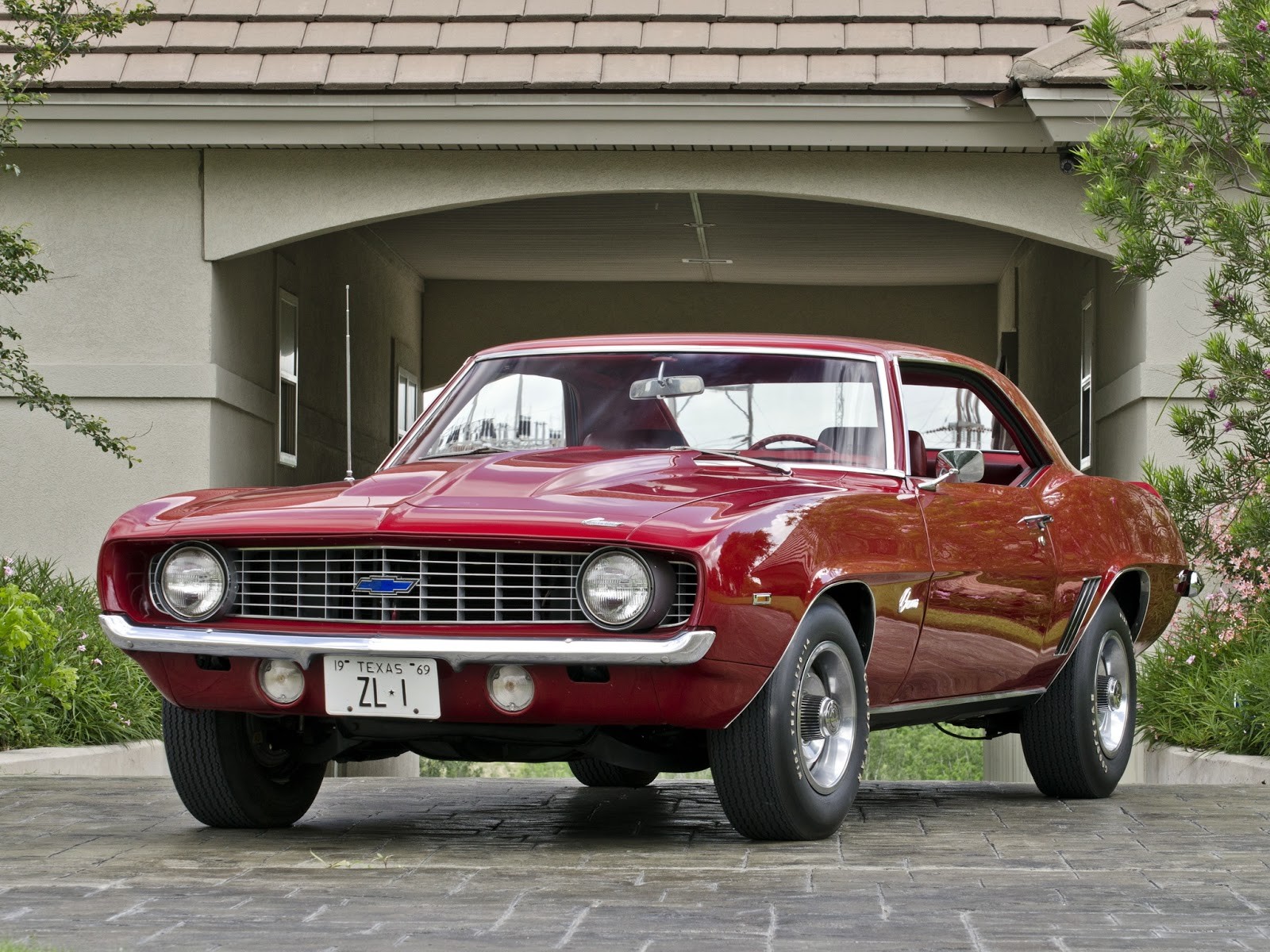
The rarest early Camaro is the 1969 COPO ZL1. Ordered through GM's Central Office Production Order system, it had an all-aluminium 427 cu in V8 rated at 321 kW (430 hp). Only 69 were built. The old 1cars text called the ZL1 one of the rarest and most expensive Camaros, and that is still true.
Sales were strong: 220,906 in the 1967 model year, 235,147 in 1968 and 243,085 in 1969, almost 700,000 in three years by our count. That was a success, but the Mustang still sold more. The full story of these years is on our first-generation Camaro page.
The long-lived second generation (1970–1981)
The second Camaro was introduced on 26 February 1970 as a "1970½" model. It was longer, lower and wider, with a fastback coupé body only; no factory convertible was offered. Production ran at Van Nuys and Norwood, with a plant in Caracas, Venezuela, adding cars until 1973.
This generation lived through stricter emissions rules, 5 mph bumpers and the switch from gross to net power ratings. Output fell from 280 kW (375 hp gross) in the 1970 SS 396 to 89 kW (120 hp net) in the 1980 base V8. The Z28 left the range after 1974 and returned in spring 1977. Yet sales grew late in life: in 1979 the Camaro reached its all-time record of 282,571, helped by the new Berlinetta and the T-top roof added for 1978. More details are in the second-generation Camaro article.
Lighter and fuel-injected: 1982 to 1992
The third generation, built from 12 October 1981 to 27 August 1992, was a hatchback coupé roughly 227 kg (500 lb) lighter than the car it replaced. It was the first Camaro with factory fuel injection. Engines ran from a 66 kW (88 hp) four-cylinder to the 5.7-litre L98 V8 with 183 kW (245 hp).

Highlights of the era were the IROC-Z (1985–1990), named after the International Race of Champions, the return of the convertible in 1987 and the 1LE track package. A Camaro paced the Indianapolis 500 again in 1982. In total, 1,567,657 third-generation cars were built at Van Nuys and, until 1987, Norwood. See the third-generation Camaro for engines and buying advice.
Corvette power and the 2002 pause
The fourth generation was introduced in January 1993 and built at a single plant in Sainte-Thérèse, Quebec. It brought composite body panels, standard anti-lock brakes and V8 engines from the Corvette: the LT1 with 205 kW (275 hp) and, from 1998, the aluminium LS1 with about 227–231 kW (305–310 hp). A convertible joined the coupé for 1994.

Sales, however, were far below the 1970s and 1980s: 39,103 in 1993 and 41,776 in 2002. Facing a weak market for sports coupés and spare plant capacity, GM ended F-body production on 27 August 2002, together with the Pontiac Firebird. Our fourth-generation Camaro page covers this period.
The comeback: concept car, film star and fifth generation
The revival began with the 2006 Camaro Concept, styled after the 1969 car. GM approved production on 10 August 2006, and a convertible concept followed in 2007. That year the car reached a wider public as Bumblebee in the first Transformers film, where the character changes from a 1976 Camaro into the new design.
Production of the fifth generation started at Oshawa, Ontario, on 16 March 2009, for the 2010 model year. It used GM's Zeta platform. The ZL1 of 2012 had a supercharged 6.2-litre V8 with 433 kW (580 hp), and the Z/28 returned in 2014 with the 7.0-litre LS7 and 377 kW (505 hp). The Camaro was also sold officially in Europe from November 2011. Read the fifth-generation Camaro article for details.
The sixth generation and the end of production
The sixth-generation Camaro was revealed on 16 May 2015 and built at Lansing Grand River Assembly in Michigan on the Alpha platform shared with the Cadillac ATS. It was more than 91 kg lighter than its predecessor, and its range stretched from a 2.0-litre turbo four to the ZL1 with 485 kW (650 hp).
Sales kept falling as buyers turned to SUVs: from 72,705 in 2016 to 29,775 in 2020. Production ended on 14 December 2023, with the final cars sold as 2024 models. GM said at the time that this was not the end of the Camaro story.
Camaro sales by era
| Model or calendar year | US sales | Context |
|---|---|---|
| 1969 | 243,085 | best first-generation year |
| 1979 | 282,571 | all-time record |
| 1984 | 261,591 | third generation at its peak |
| 1993 | 39,103 | fourth generation launch year |
| 2010 | 81,299 | fifth generation return |
| 2014 | 86,297 | best year after the comeback |
| 2023 | 31,028 | final production year |
By our calculation, 2023 sales were about 11 % of the 1979 peak, and 89 % less than in that record year. Compared with 1969, the last first-generation year, 2023 sales were 212,057 cars lower. Model years apply up to 2002; calendar years from 2010.
Engineering highlights across six generations
| Generation | Model years | Main plant | Power range (approx.) |
|---|---|---|---|
| First | 1967–1969 | Norwood / Van Nuys | 104–321 kW (gross) |
| Second | 1970–1981 | Van Nuys / Norwood | 89–280 kW (gross, then net) |
| Third | 1982–1992 | Van Nuys / Norwood | 66–183 kW |
| Fourth | 1993–2002 | Sainte-Thérèse | 119–231 kW |
| Fifth | 2010–2015 | Oshawa | V6 to 433 kW |
| Sixth | 2016–2024 | Lansing | 2.0 turbo to 485 kW |
Collecting a Camaro: which classic to buy
Collectors value the first-generation cars most, especially the 1967 Indianapolis pace car replicas (100 were sold to the public), the Z/28 and the COPO ZL1. Third-generation IROC-Z cars and fourth-generation LS1 cars are cheaper ways into the classic V8 Camaro. Among modern cars, the 2014–2015 Z/28 and the sixth-generation ZL1 are the most sought after.
The Camaro's rivalry with the Mustang defined American performance cars for decades; the Ford side of the story is told in our history of the Ford Mustang. To set a Camaro against a Mustang or Firebird of the same year, use the 1cars comparison tool.

FAQ
When was the Chevrolet Camaro made?
The Camaro was sold from September 1966 (1967 model year) to the 2024 model year, with production ending on 14 December 2023. There was a break between August 2002 and March 2009, when no Camaro was built.
How many generations of the Camaro are there?
There are six: four built between 1966 and 2002, and two after the 2009 revival. The second generation lasted longest, twelve model years, while the third was built in 1,567,657 examples.
What does the name Camaro mean?
Chevrolet said the name came from an old French dictionary, where "camaro" was slang for friend or comrade. Its product managers gave a less polite answer, aimed squarely at Ford's pony car.
What is the rarest Chevrolet Camaro?
Among production cars, the 1969 COPO ZL1 is the rarest well-known Camaro, with only 69 built. Its 7.0-litre aluminium big-block produced 321 kW (430 hp gross), and dealers ordered it through a special GM fleet process.
Why was the Camaro discontinued in 2002 and 2023?
In 2002 GM stopped building the F-body because sales of sports coupés were weak and its plants had spare capacity. In 2023 the sixth generation ended as American buyers had moved to SUVs and annual sales had fallen to around 30,000.