BYD: History of the Chinese Car Maker from Batteries to Electric Cars
BYD Auto is the car-making division of BYD Company, a Chinese manufacturer founded in 1995 by Wang Chuanfu as a producer of rechargeable batteries. It entered the car business in 2003, stopped building purely petrol-engined cars in March 2022 and in 2025 became the world's largest maker of electric cars.
Key takeaways
- 1995: BYD founded as a battery maker; about thirty employees at the start.
- 2003: entry into cars with the purchase of 77% of Xi'an Qinchuan Automobile; 2005: the F3 saloon.
- 2008: F3DM plug-in hybrid shown in Geneva; 2009: e6, BYD's first battery-electric car.
- 2024: 4,272,145 vehicles sold, about ten times the 2020 figure.

Background: a battery company becomes a car maker
BYD began in 1995 in Shenzhen as a small company making rechargeable batteries, with about thirty employees, and grew into one of the world's leading battery suppliers. In 2003 Wang Chuanfu decided to use this expertise in cars and founded BYD Auto by buying a 77% stake in Xi'an Qinchuan Automobile, a struggling small car maker. From Qinchuan BYD inherited the Flyer small car, but its aim from the start was to develop its own models and its own technology, from batteries and electric motors to complete vehicles. Today the company's car plants in China include sites in Shenzhen, Xi'an, Shanghai and Beijing. BYD models on 1cars, such as the BYD e6, are listed in the BYD catalogue.

| Fact | Value |
|---|---|
| Parent | BYD Company Ltd (founded 1995) |
| Founder | Wang Chuanfu |
| Car business since | 2003 (Xi'an Qinchuan) |
| Home | Shenzhen, China |
| First own car | F3 (2005) |
| First plug-in hybrid | F3DM (2008) |
| Petrol-only cars ended | March 2022 |
| Sales 2024 / 2025 | 4,272,145 / 4,602,436 vehicles |
Development and launch: from F3 to F3DM
BYD's first own development, the F3 compact saloon, entered production in 2005. It was a commercial success, although critics said it closely copied the Toyota Corolla; according to the old 1cars text, it soon sold up to 10,000 cars a month. BYD exported cars from 2005, and from 2009 it expanded exports to the Middle East, South America and Africa.

In 2008 BYD presented the F3DM at the Geneva Motor Show, describing it as the world's first production plug-in hybrid car. It used the company's own battery technology. In 2009 the e6 became BYD's first battery-electric car. In 2010 BYD and Daimler formed a joint venture that launched the Denza brand of electric cars.
Production years and numbers
Between 2010 and 2013 BYD faced dealer withdrawals and quality problems and refocused on quality and brand building. According to the old 1cars text, BYD sold 506,189 passenger cars in China in 2013. In 2013 it also formed a joint venture in Bulgaria to build electric buses, gaining approval to sell them in many EU countries. Government subsidies for new-energy vehicles supported BYD's growth in the 2010s, and when they declined, profits fell in 2019.

The breakthrough came in the early 2020s. Sales rose about tenfold between 2020 and 2024, to 4,272,145 vehicles, and reached 4,602,436 in 2025.
| Year | Milestone |
|---|---|
| 1995 | BYD founded as a battery company |
| 2003 | BYD Auto created through the Qinchuan takeover |
| 2005 | F3 enters production |
| 2008 | F3DM plug-in hybrid |
| 2009 | e6 battery-electric car |
| 2010 | Denza joint venture with Daimler |
| 2020 | Han with the Blade battery; European entry announced |
| 2021 | e-Platform 3.0 and DM-i hybrid system |
| March 2022 | End of petrol-only car production |
| 2023 | Yangwang and Fangchengbao brands; BYD becomes China's best-selling car brand |
| 2024 | 4,272,145 vehicles sold |
| 2025 | World's largest maker of electric cars; 4,602,436 vehicles |
Technical highlights
BYD's strength is vertical integration: it designs and builds its own batteries, motors, electronics and chips. The Blade battery, introduced with the Han saloon in 2020, uses long, thin lithium iron phosphate cells arranged directly in the pack to save space and improve safety. The e-Platform 3.0 of 2021 is a dedicated platform for battery-electric cars, while the DM-i system, also from 2021, is a plug-in hybrid design focused on very low fuel consumption. In March 2022 BYD stopped building cars powered only by combustion engines and now sells only battery-electric and plug-in hybrid models. In 2021 BYD took full control of Denza, and in 2023 it launched the luxury brand Yangwang and the off-road and performance brand Fangchengbao. A small, low-priced electric hatchback launched in 2023 quickly became one of its best-selling models.

Global expansion
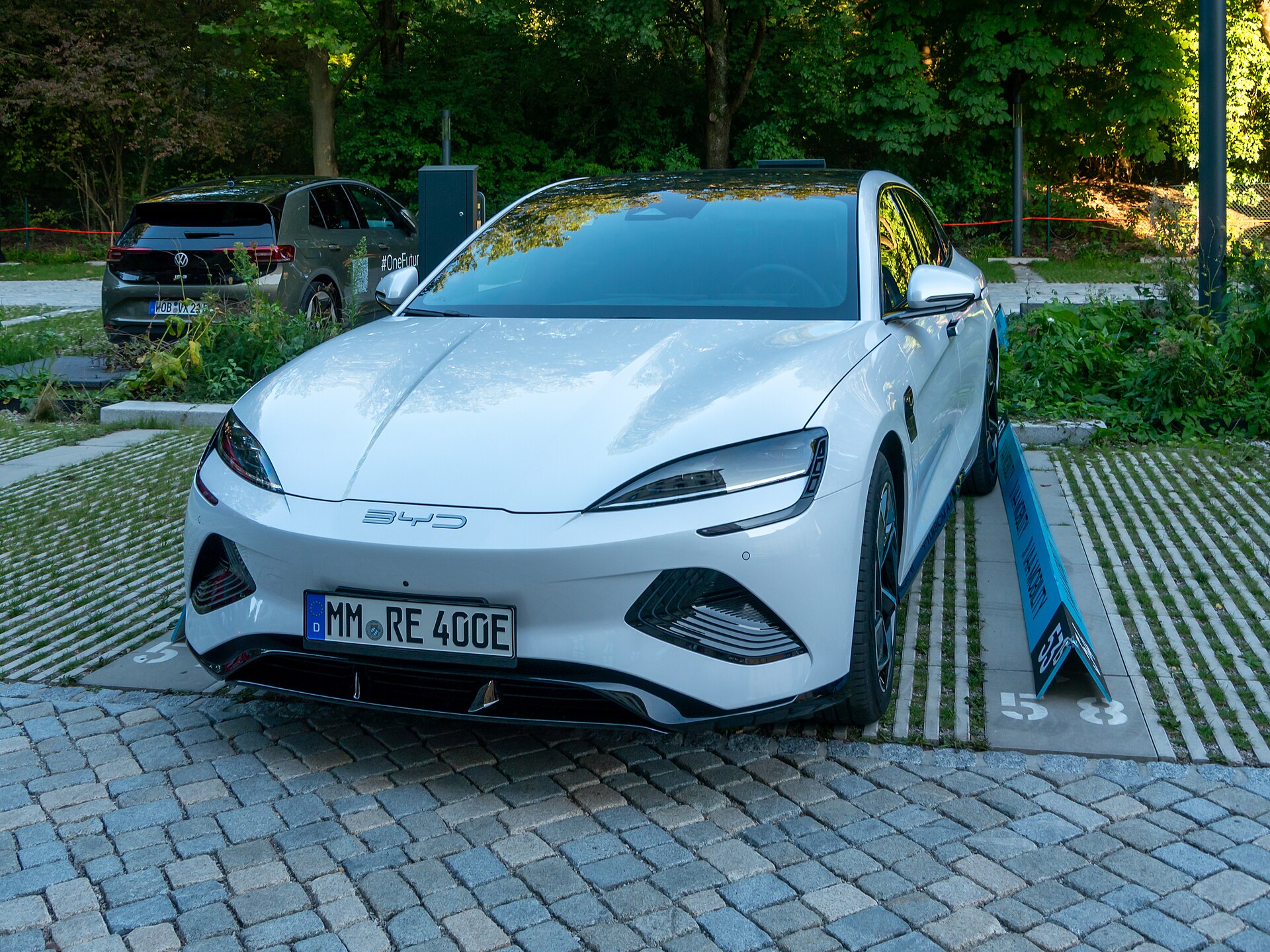
BYD announced its entry into the European passenger-car market in 2020, starting in Norway, and expanded more widely from 2022. Its first wholly owned plant outside China opened in Thailand. A plant in Szeged, Hungary, is planned for 2026, a joint venture builds cars in Jizzakh, Uzbekistan, a factory in Turkey is planned, and construction of a plant in Camaçari, Brazil, was halted in late 2024. In 2025 BYD overtook Ford in total annual sales. In Europe its models compete with established electric cars such as the Tesla Model 3, and its range has grown from the compact Dolphin hatchback to the Atto 3 crossover and the Seal saloon, and in 2024 BYD's Hungarian and Thai plants were being prepared to build cars closer to export markets.

BYD among Chinese car makers
BYD's path differs from that of most other Chinese manufacturers. State-owned groups such as FAW grew through joint ventures with foreign brands, and private companies such as Chery built conventional petrol cars and exported them early. BYD, by contrast, came from the battery industry, invested heavily in plug-in hybrid and electric technology from 2008 and committed fully to electrified vehicles in 2022, at a time when most rivals still relied on combustion engines.

Legacy and position today
In just over two decades BYD went from a battery supplier with a few dozen employees to the world's largest maker of electric cars. In 2023 it overtook Volkswagen to become China's best-selling car brand, and in 2025 it became the largest electric-car maker worldwide. Its history shows how expertise in batteries, combined with government support for new-energy vehicles and an early bet on plug-in hybrids, transformed a newcomer into one of the leading car companies. Other manufacturers from China are collected in the Chinese cars section.

FAQ
When was BYD founded?
BYD Company was founded in 1995 by Wang Chuanfu as a battery manufacturer. It entered the car industry in 2003 by buying 77% of Xi'an Qinchuan Automobile and creating BYD Auto.
What was BYD's first car?
BYD first inherited the Flyer from Qinchuan, but its first own development was the F3 compact saloon of 2005, which became a commercial success in China.
Does BYD still make petrol cars?
No. In March 2022 BYD stopped building cars powered only by combustion engines. It now sells battery-electric cars and plug-in hybrids that combine an engine with its own batteries and motors.
What is the BYD Blade battery?
The Blade battery, introduced in 2020 with the Han saloon, uses long, thin lithium iron phosphate cells packed directly into the battery pack to save space and improve safety.
How many cars does BYD sell?
BYD sold 4,272,145 vehicles in 2024 and 4,602,436 in 2025, when it became the world's largest maker of electric cars and overtook Ford in annual sales.
Photos (8)