 BYD E6
All generations, specs and history
Updated Published Sources (3) Report an error
By Felix Hartmann, Automotive Technology & EV Contributor Reviewed by Oleksandr Hnatiuk

- Built
- 2009–present
- Generations
- 2
- Top power
- 200 kW (272 PS)
Timeline
E6 generations
Click a generation for its own page


Newest first · 2 generations since 2009
-
2021

-
2009
All generations by year: e6 II (2021–now) · E6 (2009–2021)
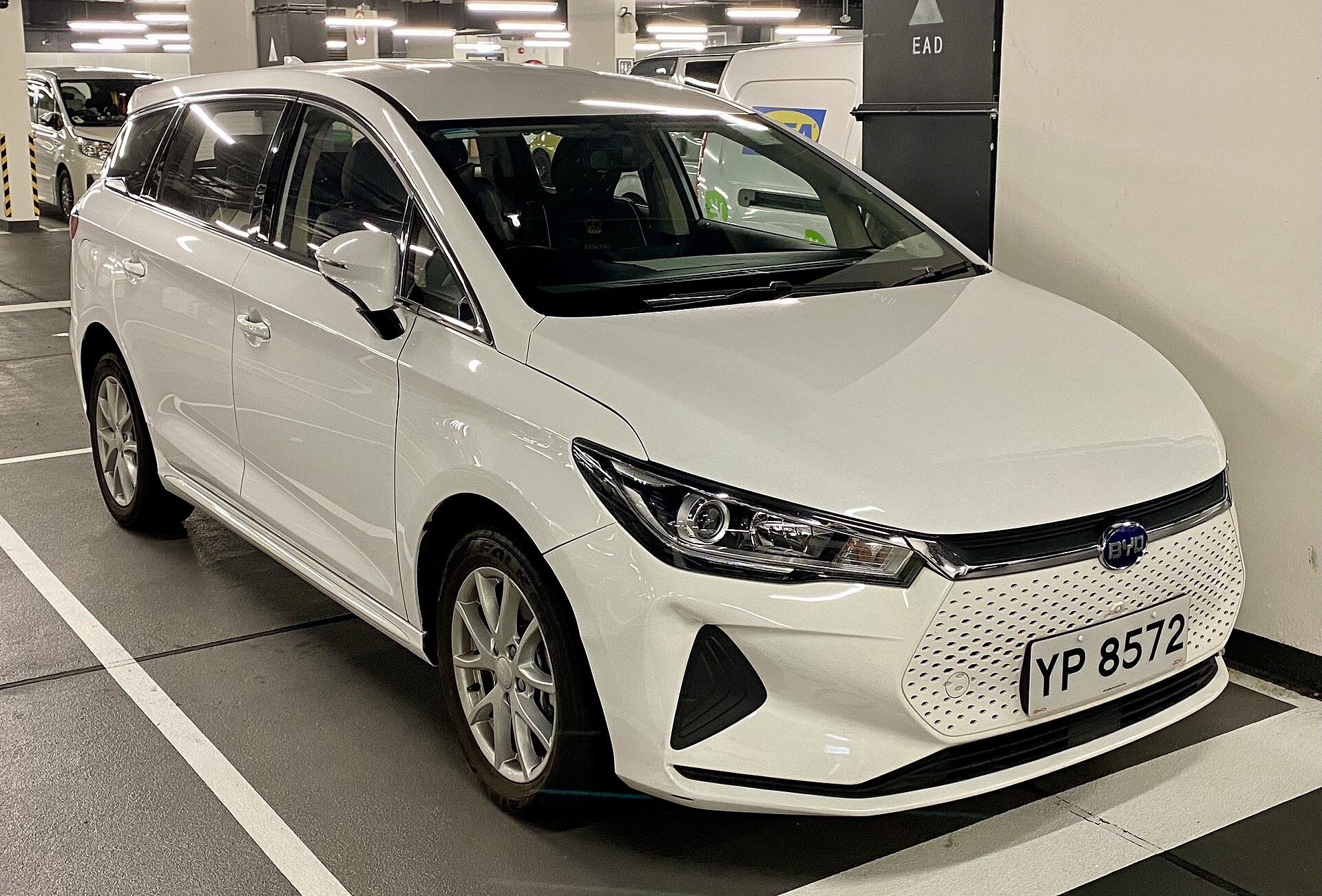
The BYD e6 is a five-seat electric crossover, close to a tall estate in shape, that BYD built from 2010 and sold mainly to taxi and fleet operators. The first generation used a lithium iron phosphate battery of 60 to 82 kWh and a claimed 300 to 400 km range; a second generation based on the Song Max MPV followed in 2021.
In short
- First shown in 2009 and tested from May 2010 with 40 taxis in Shenzhen; private sales in Shenzhen started in October 2011.
- Motors from 75 kW (front-wheel drive) to 160 kW, plus all-wheel-drive versions with a second 40 kW motor; top speed 140 km/h.
- In 2016 the e6 was China's best-selling pure electric car (20,605 units); taxis ran in Shenzhen, Brussels, London, Bogotá, Singapore and many other cities.
- In Germany and Austria it was offered from early 2016 at about 50,000 EUR plus VAT.

BYD e6 at a glance
The e6 was the first electric car from BYD, then known mainly as a battery maker. It is a five-door, five-seat vehicle with a tall body, front-wheel drive in most versions and a large battery under the floor. BYD presented it in 2009 with ambitious claims; the car that reached customers was heavier and slower, but proved durable in taxi service.

| Generation | Years | Body | Battery | Power | Range (claimed) |
|---|---|---|---|---|---|
| First (e6) | from 2010 | five-seat crossover / tall estate | LFP, 60–82 kWh | 75–200 kW | 300–400 km |
| Second (e6, Song Max-based) | 2021–2024 | five-seat MPV | LFP Blade, about 71.7 kWh | 70 kW (95 PS) | up to 520 km (WLTP city) |
The old 1cars text compared the look with a Nissan Note; most sources compare the first e6 with the third-generation Honda Odyssey, which it resembles in profile.
First generation: from Shenzhen taxis to retail sales
BYD showed the e6 in 2009 and brought it to the Detroit motor show in January 2010 with a claimed range of 330 km. Field testing began in May 2010, when 40 e6 taxis entered service in Shenzhen, BYD's home city. Private customers had to wait until October 2011, more than two years after BYD's first target date, when retail sales opened in Shenzhen.

The taxi trial gave BYD a public test bench. By April 2011 the Shenzhen fleet had covered about 2.78 million km, and the taxis used about 21.5 kWh per 100 km, the same figure the old 1cars article quoted. Shenzhen later ran around 300 e6 taxis and ordered 500 e6 police cars in 2013.
Battery, motors and charging
The e6 is built around BYD's own lithium iron phosphate (LFP) cells, a chemistry that is heavier than nickel-based cells but tolerant of heat and fast charging, with a long cycle life. BYD quoted 4,000 cycles and a 10-year battery warranty. The pack measures 175 by 95 by 30 cm and sits under the floor, which is why the old text mentioned a heavy battery and a noticeable central tunnel.

| Item | First-generation e6 |
|---|---|
| Battery | 60 kWh (early taxis, US version), 80–82 kWh (later cars) |
| Motor versions | 75 kW; 75 + 40 kW (AWD); 160 kW; 160 + 40 kW (AWD); 90 kW / 450 Nm in German data |
| Top speed | 140 km/h |
| Claimed range | 300 km (2009), 400 km with 82 kWh |
| Real range reported | 230–240 km in hard use, 290–320 km in town |
| Fast charging | about 80% in 15 minutes, 100% in about 40 minutes (BYD claim) |
| Normal charging | household 220 V socket, about 6 hours (old 1cars data) |
BYD's original 2009 claims of 0–60 mph in under 8 seconds and 160 km/h were not met by the production car; testers estimated under 14 seconds in 2010. In practice the e6 is a calm, heavy car tuned for range and comfort, with independent suspension and soft springs. Range in winter falls, and the old article estimated a loss of about 25% in cold weather, which matches the general behaviour of LFP batteries.
Cabin, space and equipment
Inside, the e6 is roomy for its length of about 4.5 metres. The front seats are electrically adjusted and the rear bench seats three, although the middle passenger has less legroom. The boot holds 385 litres, rising to about 1,000 litres with the rear seats folded (old 1cars data).
Typical equipment of the first-generation car:
- touchscreen multimedia with navigation and Bluetooth;
- two-zone climate control;
- an Infinity audio system with 10 speakers;
- a rear-view camera and an SOS emergency button;
- four airbags, ABS, brake-force distribution, ISOFIX mounts and keyless entry.
There are no Euro NCAP, IIHS or C-NCAP results for the first e6 in the published records.
Fleets around the world
The e6 spread as a fleet car rather than as a private car:
- Brussels: 35 taxis in 2014;
- London: 20 delivered to the operator Thriev in February 2014;
- Rotterdam: the first two e6 taxis in December 2013;
- Bogotá: 45 taxis by September 2013;
- Montevideo: at least 25 taxis by January 2018;
- Singapore: ComfortDelGro added 100 cars in 2022;
- Quebec: an initial 25 cars in 2019;
- Indonesia: the operator Bluebird ran 25 cars from 2019 and phased them out in 2024.

Not every trial went well. In Hong Kong a planned fleet of 45 was halted after poor results. In the United States, BYD switched to fleet-only sales in May 2013, and fewer than 100 cars had been imported by February 2016.
In China, sales grew slowly from 33 cars in 2010 to 7,029 in 2015, then jumped to 20,605 in 2016, enough to make the e6 that year's best-selling pure electric car in China. Cumulative Chinese sales reached 34,862 by the end of 2016.
Safety and the 2012 Shenzhen crash
On 26 May 2012 in Shenzhen, a drunk driver in a Nissan GT-R hit an e6 taxi at about 180 km/h. The e6 struck a tree and caught fire, and all three people inside died. The official investigation found that the fire started from electric arcs in short-circuited high-voltage cables. The battery pack did not explode, about 75% of the cells did not ignite, and the collision itself caused the deaths. It found no design flaw in the e6's safety systems.
Second generation (2021–2024)
The second e6 is a different vehicle: a five-seat MPV derived from the BYD Song Max, with BYD's "Dragon Face" front, more length and height, and the Blade version of the LFP battery. It has a 70 kW (95 PS) front motor and a claimed range of up to 520 km in the WLTP city cycle. It was sold in right-hand-drive markets, starting with Singapore in March 2021 and India in November 2021, and also in Hong Kong, Thailand, Nepal and Australia. In India the updated model was renamed eMAX 7 in 2024.

Rivals: how the e6 compares
| Model | Battery | Claimed range | Notes |
|---|---|---|---|
| BYD e6 (first generation) | 60–82 kWh LFP | 300–400 km | large battery, built for taxi use |
| Nissan Leaf (first generation) | 24–30 kWh | about 175–250 km (NEDC) | smaller and lighter, mass-market private car |
| Tesla Model S (early) | 60–85 kWh | up to about 500 km | far faster and more expensive |
| Kia e-Niro (2018) | 64 kWh | 455 km (WLTP) | the next wave of long-range crossovers |
In 2011 the e6 offered a battery more than twice as large as the Leaf's, which made it suitable for taxi shifts. By 2018 cars like the e-Niro gave a similar range with a much smaller, lighter battery. You can compare electric models side by side with the 1cars comparison tool or browse the electric cars section.
Is a used BYD e6 worth buying?
For a private buyer in Europe, the first-generation e6 makes sense only in special cases. It was sold in small numbers, mostly as fleet cars with very high mileage, and dealer support outside fleet contracts is limited. Its strengths are the tough LFP battery, a roomy cabin and a simple, proven drivetrain. Its weak points are slow charging by today's standards on older units, modest performance and dated equipment.

Before buying, check:
- the battery health report from a BYD workshop and the remaining warranty;
- the taxi history and mileage, since many cars covered several hundred thousand kilometres;
- the charging socket type, which differs between markets and years;
- parts availability in your country.
The e6 matters most as history: it was the car that turned BYD into a carmaker of electric vehicles, a path told in the history of BYD. Today's BYD models in the catalogue are on the BYD brand page.

Image credits · Photos from Wikimedia Commons under free licences
- BYD E6 · Photo: User3204 / Wikimedia Commons, CC BY-SA 4.0
BYD E6 in our rankings
- No. 108 of 197 · Most powerful SUVs and crossovers (200 kW · top 56%)
- No. 481 of 859 · Most powerful cars (200 kW · top 57%)
- No. 63 of 97 · Most powerful electric cars (200 kW · top 65%)
- No. 342 of 345 · Cars with the most generations (2 generations)
More powerful than 44% of ranked SUVs and crossovers in the 1CARS catalog (No. 108 of 197).
BYD E6 photos 16


FAQ
What is the range of the BYD e6?
BYD claimed 300 km for the first e6 and up to 400 km with the later 82 kWh battery. Real-world reports were 230–320 km depending on use. The 2021 second-generation e6 claims up to 520 km in the WLTP city cycle.
What battery does the BYD e6 use?
It uses BYD's own lithium iron phosphate cells, about 60 kWh in early cars and 80–82 kWh in later ones, with a 10-year warranty and 4,000 claimed cycles. The second generation uses the LFP Blade battery of about 71.7 kWh.
Is the BYD e6 available with all-wheel drive?
Some first-generation versions added a 40 kW front motor to the 75 kW or 160 kW main motor, giving all-wheel drive. Most e6 taxis and the second-generation MPV are front-wheel drive.
How fast does the BYD e6 charge?
BYD claimed about 80% in 15 minutes and a full charge in about 40 minutes on its fast chargers; taxi drivers reported 20–30-minute quick charges. On a household socket, a full charge takes about six hours or more.
What replaced the first BYD e6?
From 2021, BYD sold a second-generation e6 based on the Song Max MPV, with the Blade battery and up to 520 km of range. In India this model was renamed eMAX 7 in 2024.
Data sources
Data checked by an editor against the sources below.
- The text of this article (1cars archive)
- Wikipedia — BYD e6
- Wikipedia — BYD Song Max