
 Ford Fiesta Sedan
Specs, engines and history
Updated Published Sources (2) Report an error
By Sarah Whitmore, Senior Automotive Writer Reviewed by Oleksandr Hnatiuk

- Built
- 2008–2019
- Top power
- 92 kW (125 PS)
Which Fiesta sedan to buy
Our verdict · Sarah Whitmore
Choose a manual gearbox if you can: the five-speed manual avoids the PowerShift problems entirely. If you need an automatic, look for a 2017–2019 car with documented gearbox repairs or software updates, and check that the clutch pack has been renewed under the extended warranty. The 1.6 Ti-VCT is the simplest engine to live with, and the 1.0 EcoBoost suits drivers who want lower fuel use. Other Ford models are in the Ford catalogue.
The Ford Fiesta sedan is the four-door saloon version of the sixth-generation Fiesta, revealed at the Guangzhou Auto Show in November 2008. Built in China, Mexico, Thailand and India, it was sold in Asia, the Americas and Australia but not in Western Europe. Engines ranged from 63 to 92 kW, and North American production ended in August 2019.
In short
- Same 2,489 mm wheelbase as the hatchback but about 50 cm longer, with a boot of about 465 litres.
- Engines: 1.4, 1.5 and 1.6 Duratec petrol from 71 to 88 kW in most markets, plus the 92 kW 1.0 EcoBoost in North America from 2013.
- Five-speed manual, four-speed automatic or the six-speed PowerShift dual-clutch, whose faults led to US class actions.
- Facelift for the 2014 model year with the trapezoid grille; the 2017–2019 cars are considered the most reliable.

Specs by version
Performance
Show all 1 versions
| Version | 0–100 km/h |
|---|---|
| 63 kW (86 PS) Sedan | 12.8 s 0–62 mph |
Dimensions and weight
Show all 1 versions
| Version | Width |
|---|---|
| 63 kW (86 PS) Sedan | 1,720 mm67.7 in |
Verified Manufacturer and type-approval data from our catalog · Sources and methodology
Ford Fiesta sedan at a glance
Ford designed the sixth-generation Fiesta under its "kinetic design" language and offered it worldwide as a hatchback. The saloon was added for markets where four-door small cars sell best. Chinese sales began in 2009, and from 2010 the car reached the rest of Asia and North America; Brazil imported it from Mexico. The model sits below the Ford Focus, and the larger Ford Mondeo tops the saloon range.

| Parameter | Metric | Imperial |
|---|---|---|
| Length | 4,291–4,409 mm, depending on market | 169–174 in |
| Width | 1,709–1,722 mm | 67.3–67.8 in |
| Height | 1,453–1,473 mm | 57.2–58.0 in |
| Wheelbase | 2,489 mm | 98.0 in |
| Kerb weight | 1,100–1,192 kg | 2,425–2,628 lb |
| Boot | about 465 l | about 16.4 cu ft |
| Layout | Front engine, front-wheel drive, five seats | – |
The saloon was built in Nanjing (Changan Ford Mazda) and in Cuautitlán Izcalli in Mexico for all of North America. Rayong in Thailand built it from 2010 to 2018, and Chennai in India from July 2011 until September 2015, when low demand ended production there.
Duratec, Ti-VCT and EcoBoost engines
| Engine | Power | Years | Notes |
|---|---|---|---|
| 1.4 Duratec | 71 kW (96 PS) | 2008–2013 | Only engine with the 4-speed automatic |
| 1.5 Duratec | 79 kW (107 PS) | 2013–2017 | Later replacement for the 1.4 |
| 1.5 Ti-VCT | 82 kW (112 PS) | – | Thai version 80 kW (109 PS) |
| 1.6 Ti-VCT | 88 kW (120 PS) | 2008–2017 | Main engine in North America |
| 1.6 Duratec (some markets) | 63 kW (85 PS) or 77 kW (105 PS) | – | Detuned versions |
| 1.0 EcoBoost | 92 kW (125 PS) | 2013–2019 | Three-cylinder turbo, North America |
With the 88 kW 1.6, the sedan reaches 100 km/h in about 10.7 seconds and 188 km/h. The 63 kW version needs about 12.8 seconds and tops out at 173 km/h, according to the old 1cars data. The 1.0 EcoBoost has 4 kW more than the 1.6, and its torque arrives much lower in the rev range.
Gearboxes were a five-speed manual, a four-speed automatic with the 1.4, and the six-speed PowerShift DPS6 dual-clutch, optional in North America. Front suspension uses MacPherson struts with a twist beam at the rear, and the brakes are discs at the front and drums at the rear, with rear discs on top versions.
Cabin, space and equipment
The cabin and dashboard are shared with the hatchback: soft-touch plastics on top, a height- and reach-adjustable steering wheel and a 3.5-inch screen in the centre console. Higher trims offered the Ford SYNC voice-control system, developed with Microsoft, Bluetooth, a Sony audio system, a sunroof, leather seats, multi-colour ambient lighting, cruise control and rain and light sensors. Ford's MyKey function let owners set limits on top speed and audio volume for younger drivers.

Front seats have good side support. The rear bench fits two adults comfortably, three for short trips only, and the 1.72 m width of the cabin is the limiting factor. The boot of about 465 litres is large for the class, though the high sill makes loading heavier items harder, and the rear seat folds for longer loads.
Fuel use and servicing costs
The 1.6 petrol uses about 6 l/100 km on the open road and about 8–9.5 l/100 km in town, according to the old 1cars data, with only small differences between the power outputs. US reviews quote "30+ mpg" in mixed use. The 1.0 EcoBoost was offered as the most economical choice in North America. Servicing costs are low, and parts are widely available in the markets where the sedan was sold.

Reliability and the PowerShift problem
The weak point of the Fiesta sedan is the PowerShift DPS6 dual-clutch automatic. Owners of 2011–2016 cars reported shuddering, slipping and delayed shifts, and some gearboxes failed completely. US class actions covered about 1.5 million Fiestas and Focuses; Ford revised clutch packs and control software at least six times and extended the warranty in 2014 and 2019. A settlement approved in March 2020 opened compensation claims from April 2020.

Other problems reported on US cars include door latch faults on 2011–2014 models, which led to a large recall, coolant leaks on early 1.0 engines and faster-than-expected wear of suspension and brake parts. Complaint numbers fell sharply from the 2017 model year.
Euro NCAP, ANCAP and ASEAN NCAP results
The sixth-generation Fiesta earned five stars from Euro NCAP in 2012 in its European hatchback form. In Australia, ANCAP tested the seven-airbag sedan in 2010. It recorded 14.90 of 16 points in the frontal offset test, 15.55 of 16 in the side test and 2 of 2 in the pole test, with stability control as standard. The ASEAN NCAP result of 2012, by contrast, was only one star for adult occupants, reflecting the basic version tested there.

Equipment depends on market and trim. Base cars have two front airbags, ABS with EBD and electronic stability control, while top versions have seven airbags.
Rivals: how the Fiesta sedan compares
| Model | Engines | Power |
|---|---|---|
| Ford Fiesta sedan | 1.4–1.6 petrol, 1.0 EcoBoost | 63–92 kW |
| Volkswagen Polo sedan | 1.4–1.6 petrol | – |
| Kia Rio sedan | 1.4–1.6 petrol | – |
| Toyota Yaris / Vios, Honda City, Hyundai Accent, Chevrolet Sonic | 1.3–1.8 petrol | – |
The Fiesta was widely regarded as the best-handling car in this group, with sharp steering and a well-tuned chassis. Rivals such as the Honda City and Toyota Yaris offered more rear space or a better reliability record. Compare them in the 1cars comparison tool or check versions in the specifications section.

Rivals
Compare with…
Compare Ford Fiesta Sedan with
- Volkswagen Polo quick spec comparison
-
In production
- Years
- 1975–present
- Body
- Sedan, Hatchback
- Fuel
- Petrol, Diesel, LPG / CNG
- Power
- 29–110 kW (39–150 PS)
6 generations
- 86
- 86C
- 6N
- 9N
- 6R
- VI

Ford Fiesta Sedan in our rankings
- No. 432 of 1181 · Longest-running car nameplates (11 years · top 39%)
- No. 152 of 214 · Most powerful sedans (92 kW · top 72%)
- No. 86 of 117 · Widest sedans (1,720 mm · top 75%)
- No. 51 of 64 · Quickest sedans, 0–100 (12.8 s · top 82%)
- No. 479 of 568 · Widest cars (1,720 mm · top 85%)
- No. 90 of 106 · Most torque: sedans (141 Nm · top 86%)
In production longer than 61% of ranked nameplates in the 1CARS catalog (No. 432 of 1181).
Ford Fiesta Sedan photos 17


Ford Fiesta Sedan videos 3
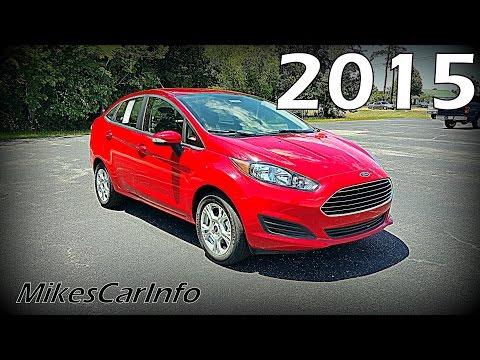
Ford Fiesta Sedan video 1

Test drive

Video overview
FAQ
What is the fuel consumption of the Ford Fiesta sedan?
The 1.6 petrol needs about 6 l/100 km on the open road and 8–9.5 l/100 km in town. The 1.0 EcoBoost offered in North America from 2013 was the most economical engine in the range.
Is the Ford Fiesta sedan available with all-wheel drive or as a hybrid?
No. Every Fiesta sedan is front-wheel drive with a petrol engine. Gearbox choices were a manual, an automatic for the 1.4 and the PowerShift dual-clutch unit.
Which Ford Fiesta sedan years should you avoid?
Automatic cars from 2011 to 2016 have the most complaints, mainly about the PowerShift dual-clutch gearbox. The 2017–2019 models show far fewer problems, and manual cars of any year avoid the main weakness.
Was the Ford Fiesta sedan sold in Europe?
Not in Western Europe, where the Fiesta was a hatchback. The sedan was built in China, Mexico, Thailand and India mainly for Asia, the Americas and Australia, and it was never offered in the European Union.
What are the main rivals of the Ford Fiesta sedan?
It competed with small saloons such as the Volkswagen Polo sedan, Kia Rio, Toyota Yaris or Vios, Honda City, Hyundai Accent and Chevrolet Sonic. It was the sportiest to drive, while some rivals offered more rear space.
Data sources
Data checked by an editor against the sources below.
- The text of this article (1cars archive)
- Wikipedia - Ford Fiesta (sixth generation)


