Lee Iacocca: The Victories and Defeats of a Car Industry Manager
Lee Iacocca (1924–2019) was an American car executive who rose from engineering trainee to president of Ford Motor Company, championed the Ford Mustang of 1964 and was fired by Henry Ford II in 1978. He then took over a near-bankrupt Chrysler, won a government loan guarantee in 1980 and brought it back with the K-cars and the first Chrysler minivans.

Key takeaways
- Born Lido Anthony Iacocca in Allentown, Pennsylvania, on 15 October 1924; joined Ford in August 1946.
- As head of the Ford Division he backed the Mustang, launched on 17 April 1964 with about 22,000 orders on the first day.
- President of Ford from 10 December 1970 until Henry Ford II dismissed him on 13 July 1978.
- At Chrysler from November 1978: the 1980 loan guarantee, K-cars in 1981, minivans in late 1983 and the purchase of AMC and Jeep in 1987.

Lee Iacocca at a glance
| Fact | Detail |
|---|---|
| Full name | Lido Anthony Iacocca |
| Born | 15 October 1924, Allentown, Pennsylvania |
| Died | 2 July 2019, Bel Air, Los Angeles, aged 94 |
| Education | Lehigh University (industrial engineering, 1945); Princeton University (master's, 1946) |
| Ford | 1946–1978; president 1970–1978 |
| Chrysler | president from 2 November 1978; chairman and CEO 1979–1992 |
| Best-known cars | Ford Mustang, Continental Mark III, Chrysler K-cars and minivans |
| Books | Iacocca: An Autobiography (1984), Talking Straight (1988), Where Have All the Leaders Gone? (2007) |
Our short Lee Iacocca profile lists the key dates; this page tells the longer story of his wins and setbacks.

An Allentown engineer who wanted to sell cars
Iacocca's parents, Nicola Iacocca and Antonietta Perrotta, were Italian immigrants from San Marco dei Cavoti, a small town in the province of Benevento. A family story said he was named Lido after the Venice district where his parents had honeymooned; he later dismissed it as romantic but untrue.

He finished Allentown High School with honours in 1942 and graduated from Lehigh University in 1945 with a degree in industrial engineering. Ford offered him a job, but he also won a Wallace Memorial Fellowship to Princeton, so he persuaded the company to wait a year. In August 1946, with a master's degree in mechanical engineering, he joined Ford as an engineering trainee in Dearborn.
The engineering work did not suit him. Within months he asked to move into sales, and the company sent him to a district office in Pennsylvania.
"56 for '56": the campaign that made his name
As assistant sales manager of Ford's Philadelphia district, Iacocca launched a financing plan for the 1956 models: 20 % down and 56 dollars a month for three years. By our calculation the 36 monthly payments added up to 2,016 dollars on top of the deposit. The slogan "56 for '56" was simple, the payments looked affordable, and the district's sales rose so sharply that Ford adopted the plan nationally. According to the old version of this page, Ford credited the plan with about 75,000 extra sales; we could not confirm that figure from a second source.
The campaign brought him to head office. On 10 November 1960, aged 36, he became vice-president and general manager of the Ford Division, the largest part of the company.
The Mustang: his biggest win
Iacocca believed that the baby-boom generation wanted a small, sporty and cheap car. He championed the project inside Ford, and his chief engineer Donald Frey supervised development in about 18 months. To keep costs low, the car used the Falcon's platform, suspension and drivetrain. The styling came from a team under Joe Oros, with L. David Ash often credited for the final shape.
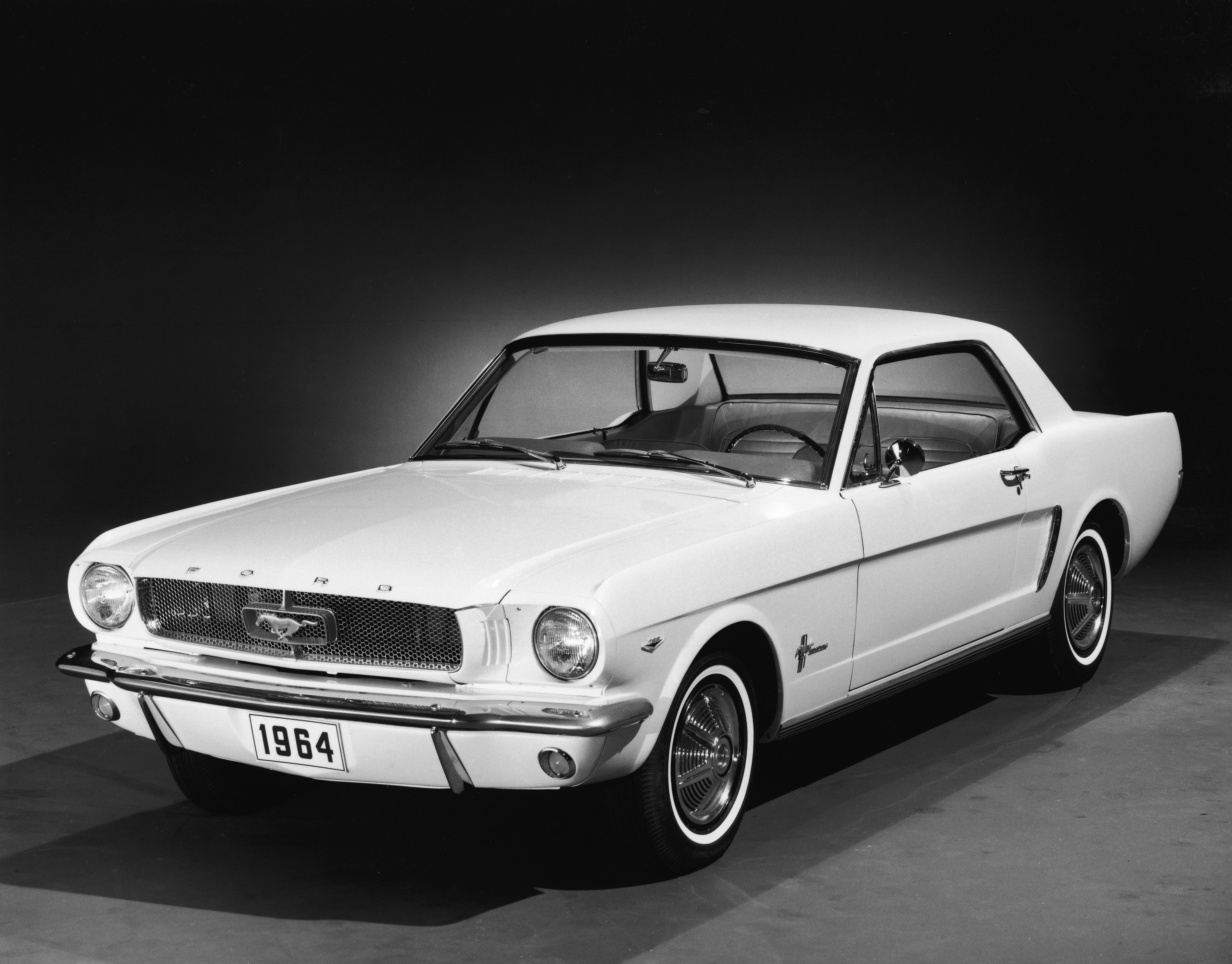
The Ford Mustang was presented on 17 April 1964 at the New York World's Fair. Ford took about 22,000 orders on the first day, and the cheapest hardtop cost 2,368 dollars. In its first twelve months the car sold 418,812 units, a record for a new model. The one-millionth Mustang was sold within two years. By our calculation that first-year total equals about 1,150 cars a day. Its rivalry with the first Chevrolet Camaro is set out in our Camaro vs Mustang comparison. Our history of the Ford Mustang follows the car from there.
The success brought fast promotion: vice-president of the car and truck group in January 1965, executive vice-president in 1967 and president of Ford Motor Company on 10 December 1970. During those years he also backed the Continental Mark III, the Mercury Cougar and the revival of the Mercury Marquis. As Ford Division chief he supported the company's "Total Performance" racing years. They followed the failed attempt to buy Ferrari in 1963, and the story of that rivalry is told on our page about Henry Ford II and Enzo Ferrari.
President of Ford, the Pinto and the 1978 dismissal
In 1968 Iacocca proposed a small economy car to answer imports: it was to weigh under 2,000 lb (907 kg) and cost under 2,000 dollars. It became the Ford Pinto, built from the 1971 model year and sold in large numbers.

From 1977 the Pinto was at the centre of a public debate about its fuel tank. The tank sat between the rear axle and the bumper and could be punctured in rear-end collisions. After a federal investigation, Ford recalled the 1971–1976 Pintos in June 1978 to add shielding and reinforcement to the fuel system. The wider story of the company in those years is told in our history of Ford. Older versions of this article claimed that the scandal caused Iacocca's dismissal and that he personally blocked changes to the tank. We found no reliable source for either claim, so both are removed here.
On 13 July 1978 Henry Ford II fired Iacocca, although the company earned about 2 billion dollars that year. The relationship between the two men had broken down, and Henry Ford II gave no detailed public reason. Our profile of Henry Ford II shows the other side of this story.
Chrysler's rescue and the 1980 loan guarantee
Chrysler hired Iacocca within months. He became president on 2 November 1978 and chairman and chief executive on 20 September 1979, after John Riccardo resigned. The company was losing heavily and had just sold its European business to Peugeot.

Iacocca asked the US government for help. The Chrysler Corporation Loan Guarantee Act, effective from 7 January 1980, guaranteed up to 1.5 billion dollars of loans (roughly €1.1 billion at the time). In return Chrysler had to cut costs, sell assets, win concessions from workers and suppliers and report to an oversight board; projects such as the gas-turbine car were dropped. Chrysler repaid the guaranteed loans about seven years ahead of schedule.
| Year | Event at Chrysler under Iacocca |
|---|---|
| 1979 | becomes chairman and CEO; asks for federal help |
| 1980 | loan guarantee of up to 1.5 billion dollars |
| 1981 | K-cars: Dodge Aries and Plymouth Reliant |
| 1982 | a production convertible returns (Chrysler LeBaron) |
| 1983 | guaranteed loans repaid early; minivan launched late in the year |
| 1987 | buys American Motors, and with it Jeep; also buys Lamborghini |
| 1992 | retires on 31 December |
The front-wheel-drive K-cars were simple and cheap to build, and Motor Trend named them Car of the Year for 1981. The Dodge Caravan and Plymouth Voyager minivans, launched late in 1983, created a new class and led it in sales for about 25 years. The 1987 purchase of AMC brought Jeep into Chrysler; our Chrysler history covers the company's later years.
Television, books and the Statue of Liberty
Iacocca became the public face of Chrysler and appeared in its television advertising himself. In 1982 President Ronald Reagan asked him to lead the private fundraising for the restoration of the Statue of Liberty and Ellis Island. He stayed on the foundation's board until his death.

His autobiography, written with William Novak and published in 1984, was the best-selling non-fiction hardback in the United States in 1984 and 1985. He gave the proceeds to diabetes research: his wife Mary, whom he married in 1956, died of complications of type 1 diabetes on 15 May 1983.
After Chrysler: late projects and legacy
Iacocca retired as chairman and CEO on 31 December 1992. In 1995 he helped the investor Kirk Kerkorian in a takeover attempt for Chrysler, which failed. He later ran small companies making electric bicycles and, from 1999, EV Global Motors, and in 2007 published Where Have All the Leaders Gone? He died at home in Bel Air on 2 July 2019, aged 94, of complications of Parkinson's disease.

By our count he spent 32 years at Ford and 14 at Chrysler. In that time he led the launch of two of the most important American vehicle types of the century: the pony car and the minivan.
Iacocca compared with other car industry leaders
| Leader | Company | Main achievement | Period in charge |
|---|---|---|---|
| Lee Iacocca | Ford, Chrysler | Mustang; Chrysler rescue and minivan | 1970–1978 (Ford), 1979–1992 (Chrysler) |
| Henry Ford II | Ford | rebuilt Ford after 1945 | 1945–1979 |
| Walter Chrysler | Chrysler | founded Chrysler in 1925 | 1925–1935 |
| Sergio Marchionne | Fiat, Chrysler | merged Fiat and Chrysler | 2004–2018 |
Iacocca and Sergio Marchionne both rescued Chrysler, three decades apart. The difference is that Iacocca relied on a government loan guarantee and on fresh models, while Marchionne used a merger with Fiat.

Our verdict on Iacocca's career
Iacocca's victories were real: the Mustang showed that market research and a cheap platform could create a new kind of car, and the minivan did the same 20 years later. His defeats were real too. The Pinto debate damaged Ford's name while he was president, and his dismissal showed how fragile a manager's position is when the founding family still controls the company. For anyone interested in how the American car industry worked from the 1950s to the 1990s, his career is the best single case study.
FAQ
What is Lee Iacocca famous for?
He championed the Ford Mustang of 1964, served as president of Ford from 1970 to 1978 and then led Chrysler through its 1980 rescue. Under him Chrysler launched the K-cars and the minivan and bought Jeep.
Why was Lee Iacocca fired from Ford?
Henry Ford II dismissed him on 13 July 1978 without a detailed public reason. That year Ford made about 2 billion dollars in profit. The two men had a long and difficult personal relationship.
Did Iacocca design the Mustang?
No. He championed and managed the project as head of the Ford Division. Engineering was supervised by Donald Frey, and the styling came from Joe Oros's team, with David Ash credited for much of the shape.
How did Iacocca save Chrysler?
He obtained a federal loan guarantee of up to 1.5 billion dollars in 1980, cut costs and launched simple, profitable cars. The K-cars arrived in 1981 and the minivans in late 1983, and the loans were repaid years early.
When did Lee Iacocca die?
He died on 2 July 2019 at his home in Bel Air, Los Angeles, aged 94, from complications of Parkinson's disease. He is buried in Troy, Michigan.