
 Ford Thunderbird Special Supercharged 312
Specs, engines and history
Updated Published Sources (2) Report an error
By Sarah Whitmore, Senior Automotive Writer Reviewed by Oleksandr Hnatiuk

- Built
- 1957
- Top power
- 224 kW (305 PS)
Verdict: who the F-code Thunderbird suits
Our verdict · Sarah Whitmore
The F-code is for a collector who wants the rarest and most documented version of the first Thunderbird, and who can pay for authentication. A buyer who simply wants to drive a 1957 two-seater will be better served by a D-code car with 183 kW, or an E-code car with 201 kW. Those cars look almost the same and cost a fraction of the price. Avoid any car sold as an F-code without a matching VIN: a later supercharger conversion can be a pleasant driver, but it is not worth an F-code premium.
The Ford Thunderbird Special Supercharged 312 is the rarest factory version of the two-seat Thunderbird. Offered only for the 1957 model year, it combined the 312 cu in (5.1-litre) Y-block V8 with a McCulloch/Paxton centrifugal supercharger and was rated at 224 kW (300 hp). Of 21,380 Thunderbirds built for 1957, only about 208–211 were F-code cars.
In short
- Engine: 5,113 cc Y-block V8 with a McCulloch/Paxton VR57 supercharger and a Holley four-barrel carburettor, 224 kW (300 hp gross) at 4,800 rpm.
- Rarity: roughly 210 F-code Thunderbirds out of 21,380 cars of the 1957 model year, about one in a hundred.
- Origin: a homologation engine meant for stock-car racing, launched in the season Ford backed the Daytona Speed Weeks with its own team.
- Today: the most valuable two-seat Thunderbird; auction results run well into six figures in US dollars.

Specs by version
Engines
| Version | Engine | Power | Torque | Drive | Production years |
|---|---|---|---|---|---|
| 312 V8 Paxton supercharged (F-code) | 5.1 l · 8 cyl · Petrol 5,113 cc | 224 kW 305 PS300 hp | 595 Nm439 lb-ft | Rear-wheel drive | 1957 |
Dimensions and weight
Verified Manufacturer and type-approval data from our catalog · Sources and methodology
The F-code at a glance

| Item | 1957 Thunderbird F-code |
|---|---|
| Model year | 1957 only |
| Body | two-seat convertible with fabric top and/or removable hardtop |
| Engine | 312 cu in (5,113 cc) Y-block V8, 96.5 × 87.4 mm |
| Induction | McCulloch/Paxton VR57 centrifugal supercharger, sealed Holley four-barrel |
| Power | 224 kW (300 hp gross) at 4,800 rpm |
| Torque | 595 Nm (439 lb-ft) at 2,600 rpm |
| NASCAR rating | 254 kW (340 hp) at 5,300 rpm |
| Transmissions | three-speed manual, manual with overdrive, or Ford-O-Matic automatic |
| Wheelbase | 2,591 mm (102 in) |
| Length | 4,608 mm (181.4 in) for 1957 |
| Number built | about 208–211 (auction-house estimates) |
| Base price 1957 | 3,408 US dollars, plus more than 10 % for the F-code package |
What the "F" in F-code means
Ford began stamping an engine letter into the vehicle identification number in 1950. On a 1957 Thunderbird the first character of the VIN names the engine, so the code tells a buyer what the car left the factory with:
- C – the 292 cu in V8 with a two-barrel carburettor, rated at 158 kW (212 hp);
- D – the 312 cu in Thunderbird Special V8 with a four-barrel, 183 kW (245 hp);
- E – the 312 with two four-barrel carburettors, 201 kW (270 hp), or 213 kW (285 hp) with the racing kit;
- F – the 312 with the Paxton supercharger, 224 kW (300 hp).

That letter is why collectors call these cars "F-Birds". A genuine example carries a VIN that starts with F7FH, such as chassis F7FH347627 sold by RM Sotheby's. The supercharger itself can be bolted onto any Y-block, so the VIN, not the hardware under the bonnet, separates an original car from a later conversion.
Engine and supercharger
The 312 cu in Y-block had a bore of 3.80 in and a stroke of 3.44 in (96.5 × 87.4 mm). Ford introduced it for 1956 as the "Thunderbird Special V8", and for 1957 it built a run of higher-performance versions. The F-code engine got reinforced cylinder heads, a dual-point distributor, modified combustion chambers, a hotter camshaft and a high-pressure fuel pump.

The McCulloch (later Paxton) VR57 unit was a belt-driven centrifugal blower. Unlike a Roots supercharger, it fed air into a sealed housing around a Holley four-barrel carburettor, so the carburettor itself was pressurised. Ford quoted 224 kW (300 hp) at 4,800 rpm and 595 Nm at 2,600 rpm. Contemporary tests and Paxton itself suggested that the real figure was closer to 300 kW (400 hp). German Wikipedia also lists a NASCAR-prepared version with 254 kW (340 hp) at 5,300 rpm.
By our calculation the factory rating equals about 44 kW per litre, roughly 22 % more than the D-code four-barrel engine from the same block. Our power converter translates the gross horsepower into kW and PS for other cars of the decade.
Why Ford built a supercharged Thunderbird
The supercharged engine was a racing tool first and a road option second. In 1956 Pete DePaolo's workshop in California modified several Thunderbirds with superchargers under factory sponsorship. Early in 1957 about 14 cars were built with the VR57 blower for NASCAR homologation, and the option was opened to customers so that it would count as a production engine.
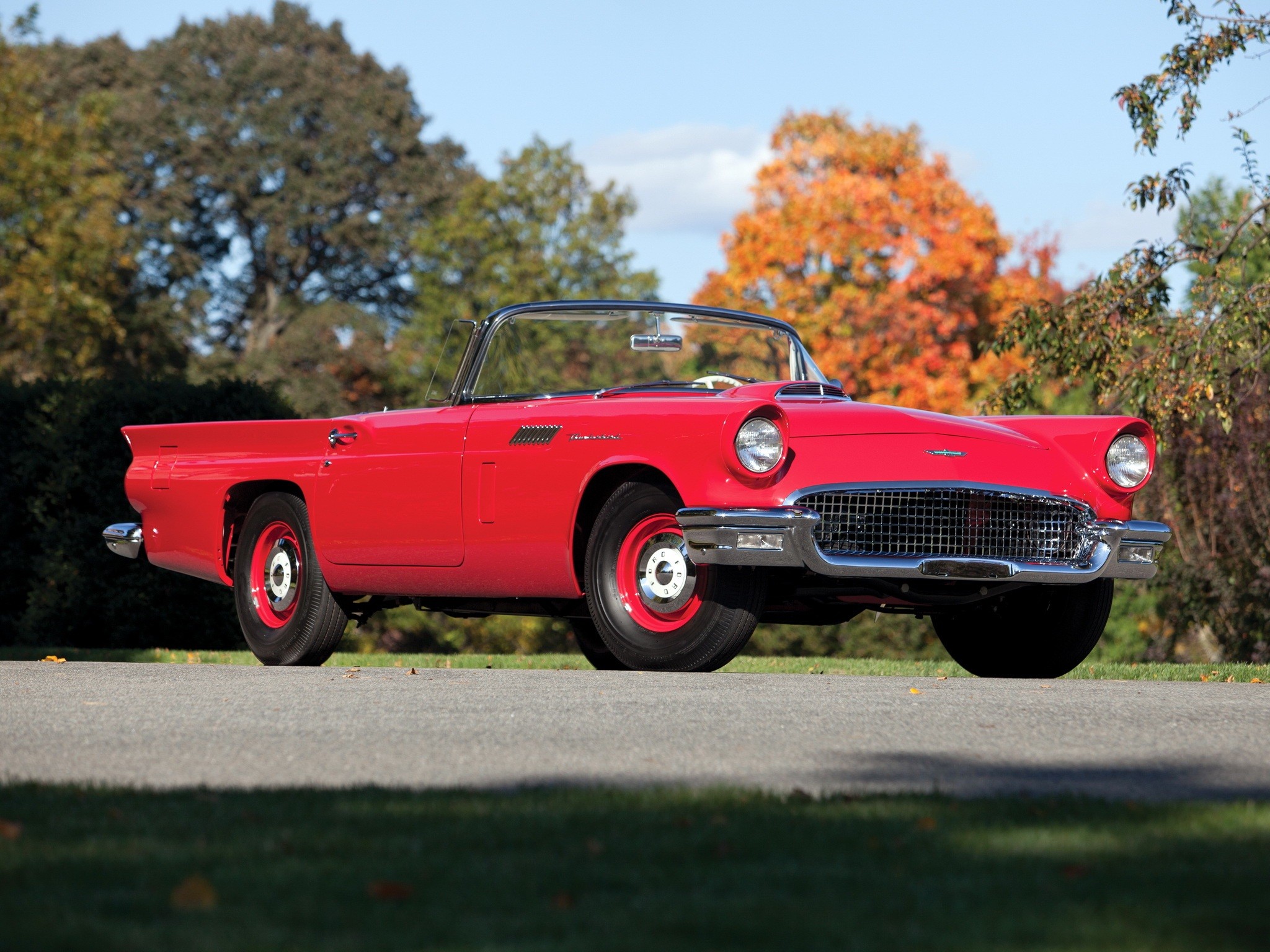
Chevrolet had just announced mechanical fuel injection for its 283 V8, and Ford needed an answer on paper and on the track. The F-code was offered in every 1957 Ford passenger-car series, but today the Thunderbirds are the most sought-after F-code cars.
Battlebirds: the Daytona Speed Weeks of February 1957
Ford's racing programme for the two-seater peaked at the Daytona Speed Weeks in February 1957. DePaolo Engineering of Long Beach prepared four Thunderbirds with full factory backing, all of them built from cars with the base C-code engine and painted Colonial White.

| Car | Engine | Purpose |
|---|---|---|
| VIN ending 265 | 312 stroked to 348 cu in, supercharged | stock sports-car class, stock appearance |
| VIN ending 266 (No. 98) | heavily modified 312 (Hagerty: stroked to 348 cu in), Jaguar four-speed, quick-change axle | modified class, aluminium bodywork |
| VIN ending 333 | highly modified 430 cu in Lincoln V8 | modified class |
| fourth car | 312 with a supercharger | stock class |
The two heavily modified cars became known as the "Battlebirds". Drivers included Chuck Daigh, Troy Ruttman, Danny Eames, Marvin Panch and Curtis Turner. Daigh ran the flying mile in the No. 98 car at more than 200 mph, about 330 km/h, but engine trouble stopped the return run that a record needs. The Lincoln-engined car took the official flying-mile title with a two-way average of 160.356 mph (258 km/h). On the beach-road course at New Smyrna, Panch finished second behind Carroll Shelby's Ferrari.
Ford had planned to take the cars to the 12 Hours of Sebring in March, but in 1957 the Automobile Manufacturers Association agreed to stop factory-backed racing, and the programme ended. The No. 98 Battlebird survives, restored in the early 1990s, and has been displayed at the AACA Museum in Hershey, Pennsylvania. The Lincoln-engined car was destroyed.
The 1957 Thunderbird it was based on
The F-code shares its body with the last year of the two-seater. For 1957 the car got a reshaped front bumper, a larger grille, taller tail fins and bigger tail lights; the spare wheel went back inside a redesigned boot, and the Thunderbird script moved to the front wings. Production ran three months longer than usual because the four-seat 1958 model was late, which is why 1957 is also the best-selling two-seat year.

| Model year | Thunderbirds built | Supercharged option |
|---|---|---|
| 1955 | 16,155 | no |
| 1956 | 15,631 | no |
| 1957 | 21,380 | yes, about 208–211 cars |
The broader story of all eleven Thunderbird generations, from the 1955 roadster to the 2002–2005 retro convertible, is told in our Ford Thunderbird generations guide in the Ford catalogue. This page stays with the one supercharged year.
Corvette rivals and a sports car that was never meant to be one
Ford sold the Thunderbird as a personal car of comfort rather than a sports car, and the old version of this page made the same point. Power windows, a telescopic steering column and the optional "Dial-o-Matic" four-way power seat, which slid back when the ignition was turned off, were part of that image. The F-code turned this boulevard car into the fastest Thunderbird of the 1950s, without changing its character on the road.

Chevrolet's Corvette shared the 102 in wheelbase, and in 1957 it offered the 283 V8 with Ramjet fuel injection. Comparing the two answers is easy in our car comparison tool; the wider field of the decade is in our 1950s classics section, alongside the Chevrolet Corvette C1.
Values and what to check before buying
Auction prices for verified F-code cars sit far above ordinary 1957 Thunderbirds:
| Sale | Car | Result |
|---|---|---|
| RM Sotheby's, Hershey 2014 | 1957 F-code, original invoice 3,538.53 US dollars | 137,500 US dollars (about €109,000 at the 2014 rate) |
| RM Sotheby's, Sam Pack Collection | 1957 F-code F7FH347627, three-speed with overdrive | 247,500 US dollars |

The old version of this page quoted a price of 373,308 US dollars without a source or date; we have removed it.
Before buying, check four things:
- VIN prefix. It must start with F7FH; anything else is a conversion, however good.
- Supporting paperwork. Original invoices, dealer records or a Ford build confirmation add real value.
- Supercharger parts. The VR57 unit, the sealed carburettor housing and the dash-mounted boost gauge pod are expensive to replace.
- Gearbox. Manual cars, especially with overdrive, are rarer than Ford-O-Matic automatics.
Our power-to-weight calculator shows how the F-Bird compares with other classics once a verified kerb weight is known.

Ford Thunderbird Special Supercharged 312 in our rankings
- No. 8 of 32 · Longest convertibles and roadsters (4,608 mm)
- No. 9 of 20 · Most torque: convertibles and roadsters (595 Nm)
- No. 136 of 627 · Biggest engines: cars (5,113 cc · top 22%)
- No. 14 of 49 · Biggest engines: convertibles and roadsters (5,113 cc · top 29%)
- No. 148 of 485 · Most torque: cars (595 Nm · top 31%)
- No. 36 of 81 · Most powerful convertibles and roadsters (224 kW · top 46%)
Bigger engine than 78% of ranked cars in the 1CARS catalog (No. 136 of 627).
Ford Thunderbird Special Supercharged 312 photos 13


FAQ
What does F-code mean on a 1957 Thunderbird?
It is the engine letter at the start of the VIN. "F" marks the 312 cu in V8 with a McCulloch/Paxton supercharger, the most powerful engine Ford offered in 1957. Cars with this code are nicknamed F-Birds.
How many supercharged 1957 Thunderbirds were built?
Auction-house research puts the total at about 208–211 cars, out of 21,380 Thunderbirds built for the 1957 model year. No official Ford production figure for the option has been published, so the number is an estimate.
How much power did the supercharged 312 make?
Ford rated it at 224 kW (300 hp gross) at 4,800 rpm with 595 Nm of torque. A NASCAR version was rated at 254 kW (340 hp), and Paxton claimed that the real output was close to 300 kW (400 hp).
Did the F-code Thunderbird race?
Yes. The engine was homologated for NASCAR, and Ford ran a four-car Thunderbird team at the Daytona Speed Weeks in February 1957. The factory programme ended later that year when carmakers agreed to stop backing racing.
How can you tell a real F-code Thunderbird?
Check that the VIN starts with F7FH and look for factory paperwork. A supercharger can be fitted to any Y-block V8, so the engine alone proves nothing. Specialist inspection is worth the cost on a six-figure car.
Data sources
Data checked by an editor against the sources below.
- Wikipedia - Ford Thunderbird
- Wikipedia - Ford Thunderbird (first generation)


