
 Ford Gran Torino
Specs, engines and history
Updated Published Sources (2) Report an error
By Sarah Whitmore, Senior Automotive Writer Reviewed by Oleksandr Hnatiuk

- Built
- 1972–1976
- Top power
- 182 kW (247 PS)
Which Ford Gran Torino to buy: our verdict
Our verdict · Sarah Whitmore
- Buy a 1972 Gran Torino Sport with the 351 CJ if you want the most driver-focused version: it is the lightest, quickest and has the cleanest styling before the big bumpers. It is also the car from the film Gran Torino.
- Choose a 1975–1976 car if you want the Starsky & Hutch look or a comfortable cruiser; expect more weight and less power.
- Pick a 302 or 351 V8 over the six for the best balance of parts, performance and value.
- Check carefully for rust in the frame rails, floors, rear wheel arches and boot floor, and confirm that a "Sport" or "Starsky & Hutch" car is genuine through its documentation and codes.
The Ford Gran Torino is the upper trim line of Ford's mid-size Torino range, sold in the United States for the 1972 to 1976 model years. It came as a two-door hardtop, four-door saloon, fastback and estate, with engines from a 4.1-litre six to a 7.5-litre V8. In 1972 the Torino range sold 496,645 cars, more than any other intermediate that year.
In short
- Model years 1972–1976; body-on-frame chassis with a 114 in (2,896 mm) wheelbase for two-doors and 118 in (2,997 mm) for four-doors and estates.
- Engines: 250 cu in (4.1 L) six and V8s of 302, 351, 400, 429 and 460 cu in; the 351 Cobra Jet gave 182 kW (248 hp SAE net).
- Gran Torino Sport (1972–1975) was the sporty version; 0–60 mph took 6.8 seconds with the 351 CJ in a 1972 test.
- Famous from the TV series Starsky & Hutch, which led to 1,000 replica cars in 1976, and from Clint Eastwood's 2008 film Gran Torino.

Specs by version
Engines
| Version | Power |
|---|---|
| 182 kW (247 PS) Coupe | 182 kW 247 PS244 hp |
Performance
Show all 1 versions
| Version | 0–100 km/h |
|---|---|
| 182 kW (247 PS) Coupe | 6.8 s 0–62 mph |
Dimensions and weight
Show all 1 versions
| Version | Width | Wheelbase | Kerb weight |
|---|---|---|---|
| 182 kW (247 PS) Coupe | 2,014 mm79.3 in | 2,896 mm114.0 in | 1,528 kg3,369 lb |
Verified Manufacturer and type-approval data from our catalog · Sources and methodology
Ford Gran Torino at a glance
Ford's Torino line ran from 1968 to 1976. For 1972 it was completely redesigned: the old unit-construction body gave way to a separate perimeter frame for a quieter ride, and the trim names changed. The former Torino 500 became the Gran Torino and the former GT became the Gran Torino Sport. The design, with its long bonnet, curved flanks and large oval grille, reminded many people of a Coca-Cola bottle, according to the old 1cars text.

| Model year | Gran Torino range | Key change | Torino range production |
|---|---|---|---|
| 1972 | Gran Torino, Gran Torino Sport | New body-on-frame design, front disc brakes standard | 496,645 |
| 1973 | Adds Gran Torino Brougham | 5 mph front bumper, compression cut to 8.0:1 | 496,581 |
| 1974 | Adds Gran Torino Elite | 5 mph rear bumper, last 351 CJ and four-speed | 426,086 |
| 1975 | Elite becomes a separate model | Catalytic converters, automatic standard | 195,110 (+123,372 Elite) |
| 1976 | Sport dropped | Starsky & Hutch replicas; last Torino year | 193,096 |
Every other Ford in our database is listed in the Ford catalogue.
From the 250 six to the 460 V8: engines and gearboxes
| Engine | Displacement | Carburettor | Years | Notes |
|---|---|---|---|---|
| Six | 250 cu in (4.1 L) | – | 1972–1974 | Base engine, except Sport and Squire estate |
| Windsor V8 | 302 cu in (4.9 L) | 2-barrel | 1972–1974 | Base on Sport |
| Windsor / Cleveland V8 | 351 cu in (5.8 L) | 2-barrel | 1972–1976 | Base engine from 1975; 351M from 1975 |
| 351 Cobra Jet V8 | 351 cu in (5.8 L) | 4-barrel, 750 CFM | 1972–1974 | 182 kW (248 hp SAE net), dual exhaust |
| 400 V8 | 400 cu in (6.6 L) | 2-barrel | 1972–1976 | Automatic only |
| 429 V8 | 429 cu in (7.0 L) | 4-barrel | 1972–1973 | Power brakes required |
| 460 V8 | 460 cu in (7.5 L) | 4-barrel | 1973 (police), 1974–1976 | Replaced the 429 |
From 1972 Ford quoted SAE net power, so the figures are lower than the gross ratings of 1971 and cannot be compared directly. Every engine ran on regular fuel with a compression ratio of 8.5:1 or less, and 1973 cut it to 8.0:1. Catalytic converters in 1975 took power down again.

A three-speed manual was standard until 1974; the three-speed Cruise-O-Matic automatic was optional and required with the larger V8s. The 351 CJ could also have a four-speed manual, the last one offered in a Torino, in 1974. From 1975 the automatic was standard and no manual gearbox was available.
The quickest Gran Torinos were the early Sports. In a 1972 Car and Driver test, a Gran Torino Sport with the 351 CJ and four-speed reached 60 mph in 6.8 seconds; the old 1cars text quotes a quarter-mile time of 14.5 seconds for the 429. Weight then rose quickly: a 1973 Sport weighed 4,308 lb (1,954 kg) in testing against 3,966 lb (1,799 kg) for the 1972 car, which slowed it down.
Dimensions, chassis and interior
| Parameter | Metric | Imperial |
|---|---|---|
| Wheelbase, two-door | 2,896 mm | 114.0 in |
| Wheelbase, four-door and estate | 2,997 mm | 118.0 in |
| Length, 1972 two-door (old 1cars text) | 5,264 mm | 207.2 in |
| Length, 1972 four-door | 5,276 mm | 207.7 in |
| Length, 1975–1976 four-door | 5,527 mm | 217.6 in |
| Width (four-door, estate) | 2,007 mm | 79.0 in |
| Test weight, 1972 Sport | 1,799 kg | 3,966 lb |
| Fuel tank (old 1cars text) | about 87 l | 23.0 US gal |
The front suspension uses unequal-length control arms with coil springs; the rear has a solid axle on four links and coils. Front disc brakes were standard from 1972, with drums at the back, and 14-inch wheels were standard. Bumpers made the car longer every year: the four-door grew by 251 mm between 1972 and 1975 (207.7 in against 217.6 in), mostly because of 5 mph impact bumpers.

The old 1cars text describes the 1972 dashboard as a new plastic panel with a speedometer, fuel and temperature gauges and warning lamps, and a tachometer on V8 cars. Bench seats with integrated head restraints were standard; cloth-and-vinyl upholstery and later a split bench were options.
Running costs and practicality
The Gran Torino is a large, heavy car with big carburetted engines, so fuel use is high by any modern measure; no official figures comparable with today's tests exist. Its simple engineering is its strength. Ford V8 parts, especially for the 302 and 351, are plentiful in the United States, and the body-on-frame layout makes repairs straightforward.
Trims and the Gran Torino Sport
- Gran Torino: the mainstream trim, as two-door hardtop, four-door pillared hardtop and estate.
- Gran Torino Squire: the estate with woodgrain side panels.
- Gran Torino Brougham (1973–1976): a luxury trim for the hardtop and saloon.
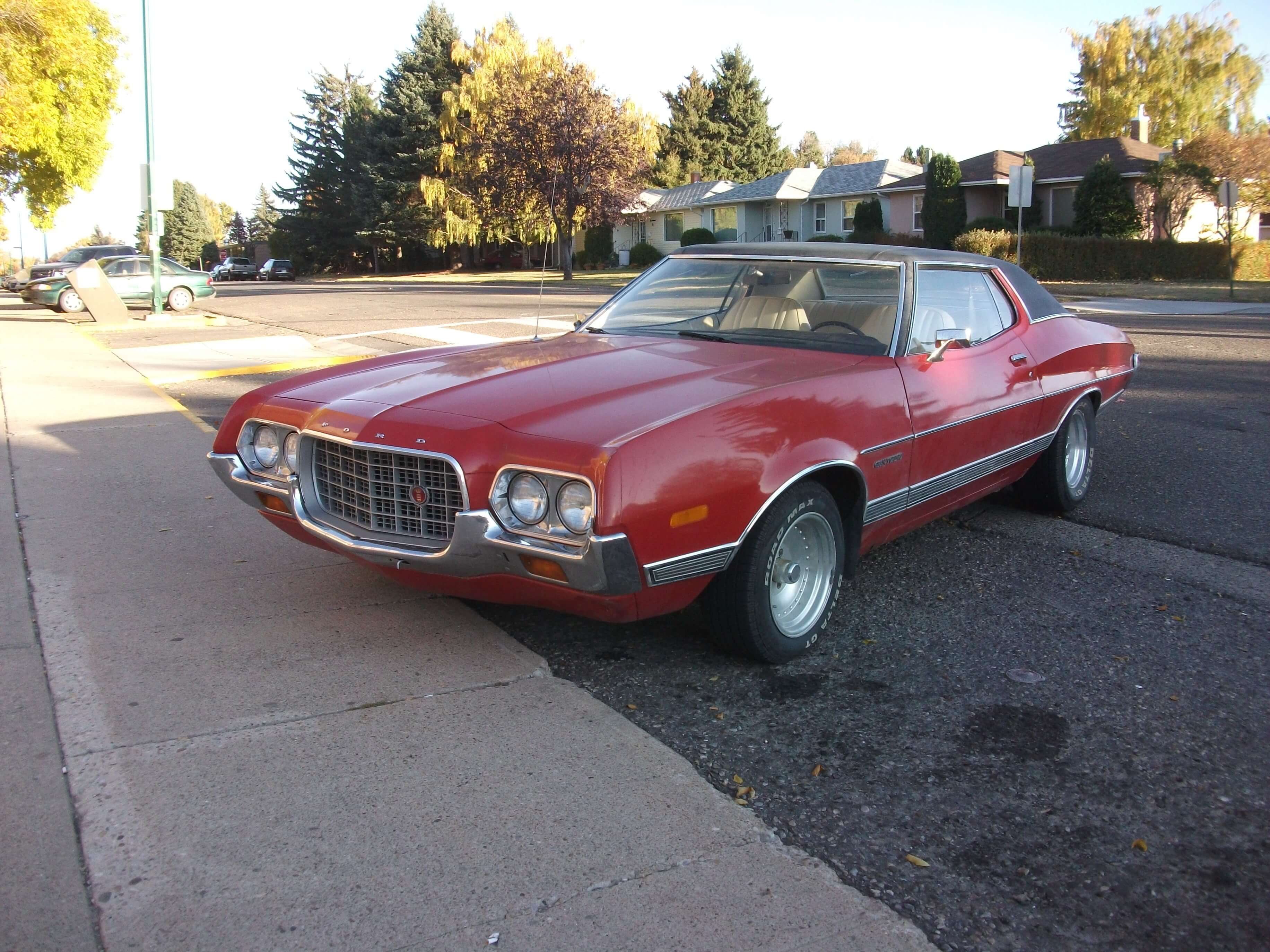
- Gran Torino Sport (1972–1975): two-door hardtop and, until 1973, a SportsRoof fastback, with an integrated bonnet scoop in 1972, racing mirrors and an optional Rallye Equipment Group. Only 5,126 were built in 1975.
- Gran Torino Elite (1974): a personal-luxury coupé with opera windows and Thunderbird-style front end, a separate Ford Elite from 1975.
In spring 1976 Ford built 1,000 Starsky & Hutch replicas at its Chicago plant, in bright red with a white side stripe. They had wheel covers rather than the slotted alloy wheels of the TV car.
Safety: bumpers instead of crash tests
There were no Euro NCAP or IIHS ratings in this era. The main safety changes came from new US rules: energy-absorbing 5 mph front bumpers for 1973 and 5 mph rear bumpers for 1974. The 1974 cars also had the short-lived seat-belt interlock, which stopped the engine starting until front occupants were buckled.

Rivals: how the Gran Torino compared
The Gran Torino's main rival was the Chevrolet Chevelle. In 1972 Ford outsold the Chevelle for the first time since the Chevelle's launch in 1964, and in 1973 the Torino range beat it by more than 168,000 cars. Other mid-size rivals of the time included the Plymouth Road Runner and the Pontiac GTO. For a sportier Ford of the same period, the Mustang was the alternative.

The Torino line was also the basis of Ford's NASCAR entries, best known for the aerodynamic Torino Talladega of 1969–1970.
Rivals
Compare with…
Compare Ford Gran Torino with
- Chevrolet Chevelle SS quick spec comparison
- Dodge Charger Daytona quick spec comparison
- Plymouth Road Runner quick spec comparison
-
Classic
- Years
- 1964–1973
- Body
- Coupe, Convertible
- Fuel
- Petrol
- Power
- 164–336 kW (223–457 PS)
3 generations
- I
- II
- III
-
Classic
- Years
- 1969
- Body
- Coupe
- Power
- 177–276 kW (241–375 PS)
-
Classic
- Years
- 1968–1980
- Body
- Coupe
- Fuel
- Petrol
- Power
- 108–317 kW (147–431 PS)
4 generations
- I
- II
- III
- IV
-
Ended 2006
- Years
- 1964–2006
- Body
- Coupe, Convertible
- Fuel
- Petrol
- Power
- 149–298 kW (203–405 PS)
5 generations
- I
- II
- III
- IV
- V


Ford Gran Torino in our rankings
- No. 32 of 509 · Widest cars (2,014 mm · top 7%)
- No. 14 of 98 · Widest coupes (2,014 mm · top 15%)
- No. 150 of 388 · Power-to-weight: cars (119 kW/t · top 39%)
- No. 12 of 25 · Quickest American cars, 0–100 (6.8 s · top 48%)
- No. 44 of 85 · Heaviest coupes (1,528 kg · top 52%)
- No. 172 of 343 · Quickest cars, 0–100 (6.8 s · top 52%)
Wider than 93% of ranked cars in the 1CARS catalog (No. 32 of 509).
Ford Gran Torino photos 13



Ford Gran Torino videos 2
Ford Gran Torino video 1

Video overview
FAQ
What years was the Ford Gran Torino made?
The Gran Torino was sold for the 1972 to 1976 model years as the upper trim of Ford's Torino range, which itself ran from 1968. The Torino name ended after 1976, and its chassis lived on in the LTD II and Thunderbird from 1977.
What engine is in the Gran Torino from the movie?
Clint Eastwood's 2008 film Gran Torino features a 1972 Gran Torino Sport SportsRoof fastback. The 1972 Sport came with a 302 V8 as standard, and buyers could order the 351, 400 or 429 V8 options.
How much horsepower does a 1972 Gran Torino have?
It depends on the engine. The 351 Cobra Jet, the top performance option, delivered 182 kW (248 hp SAE net). The base six and the two-barrel V8s gave much less, and power fell further from 1973 with lower compression and from 1975 with catalytic converters.
What car was used in Starsky & Hutch?
The TV series used 1975 and 1976 Ford Gran Torino two-door hardtops in red with a white stripe. In 1976 Ford built 1,000 replicas at its Chicago plant, with wheel covers instead of the TV car's slotted alloy wheels.
Is the Gran Torino a muscle car?
The early Gran Torino Sport with the 351 CJ or 429 counts as a muscle car: a 1972 test car reached 60 mph in 6.8 seconds. Later models, heavier and detuned for emissions, are better described as large personal-luxury or family cars.
Data sources
Data checked by an editor against the sources below.
- The text of this article (1cars archive)
- Wikipedia - Ford Gran Torino


