Swallow Sidecars and SS Cars: How Jaguar Began, 1922–1945
Jaguar began as the Swallow Sidecar Company, founded in Blackpool in September 1922 by William Lyons and William Walmsley. It moved from sidecars to special car bodies, then to its own SS cars in 1932. The name Jaguar first appeared on SS models in 1935, and on 23 March 1945 SS Cars became Jaguar Cars Limited.
Key takeaways
- 1922: Lyons and Walmsley start making motorcycle sidecars with a 1,000-pound bank overdraft.
- 1927: the Austin Seven Swallow; the dealer Henlys orders 500 cars.
- 1932–1940: SS1, SS2, SS 90 and SS Jaguar 100, with Standard engines and chassis.
- 1945: the company drops the SS initials and becomes Jaguar Cars Limited.

This page covers the years before the Jaguar name. The later story, from the XK120 to the electric Type 01, is in our history of Jaguar, and the founder's life is on the William Lyons page.
Two Williams in Blackpool
William Walmsley, then about 30, was already fitting sidecars to reconditioned motorcycles. William Lyons, about 20, was a motorcycle enthusiast with an eye for design and selling. The two founded the Swallow Sidecar Company on 2 September 1922. The partnership became official two days later, on Lyons's 21st birthday.

Their fathers helped them arrange a bank overdraft of 1,000 pounds. The first workshop was on Bloomfield Road in Blackpool. Walmsley's father later bought a larger building on Cocker Street, so the firm could add car repairs, painting and trimming.
The old 1cars text notes why sidecars made sense in the early 1920s. A motorcycle with a sidecar cost far less than a car, and many families could not afford anything bigger.
From Swallow Sidecar to car bodies
The name changed as the business grew. From 1926 it was the Swallow Sidecar and Coachbuilding Company, and from 1927 simply the Swallow Coachbuilding Company. The word "Sidecar" was dropped once car bodies became the main trade.

The breakthrough came in May 1927 with the Austin Seven Swallow. Lyons sketched a rounded two-seater body for the cheap Austin Seven chassis, and coachbuilder Cyril Holland built it. It sold for 175 pounds sterling. The dealer Henlys, run by Bert Henly and Frank Hough, ordered 500 cars, open two-seaters and saloons. A saloon version followed soon after.
More Swallow bodies came in 1929, on Standard, Swift and Fiat chassis. In January 1931 Swallow began bodying the six-cylinder Wolseley Hornet. Its slogan was "The Swallow touch that means so much".
| Year | Swallow milestone |
|---|---|
| 1922 | Swallow Sidecar Company founded in Blackpool |
| 1926 | car repairs and coachbuilding added |
| 1927 | Austin Seven Swallow; "Sidecar" dropped from the name |
| 1928 | move to Holbrook Lane, Coventry |
| 1929 | Swallow bodies on Standard, Swift and Fiat chassis |
| 1931 | Wolseley Hornet Swallow, the first six-cylinder Swallow |
The move to Coventry
Orders soon outgrew Blackpool. In 1928 the firm moved to a partly disused First World War munitions factory in Holbrook Lane, Coventry. The city was then the centre of the British motor industry, close to the suppliers of chassis, engines and parts. The Hornet-Swallow shows the scale of the work: the encyclopedia counts 21 two-seaters and 185 four-seaters on the Special Hornet, and over 100 two-seaters and 224 four-seaters on the standard Hornet.

SS1 and SS2: the first complete cars
Lyons wanted cars of his own, not bodies on other firms' cars. The Standard Motor Company agreed to supply engines and special chassis, and Swallow designed and built the bodies. The result went on sale in 1932.

| Model | Years | Engine | Built |
|---|---|---|---|
| SS 1 | 1932–1936 | Standard side-valve six, 2,054 or 2,552 cc | not published |
| SS 2 | 1932–1936 | Standard four, 1,006 cc, later 1,343 or 1,608 cc | not published |
| SS 90 | 1935–1937 | six, 2,663 cc | 23 |
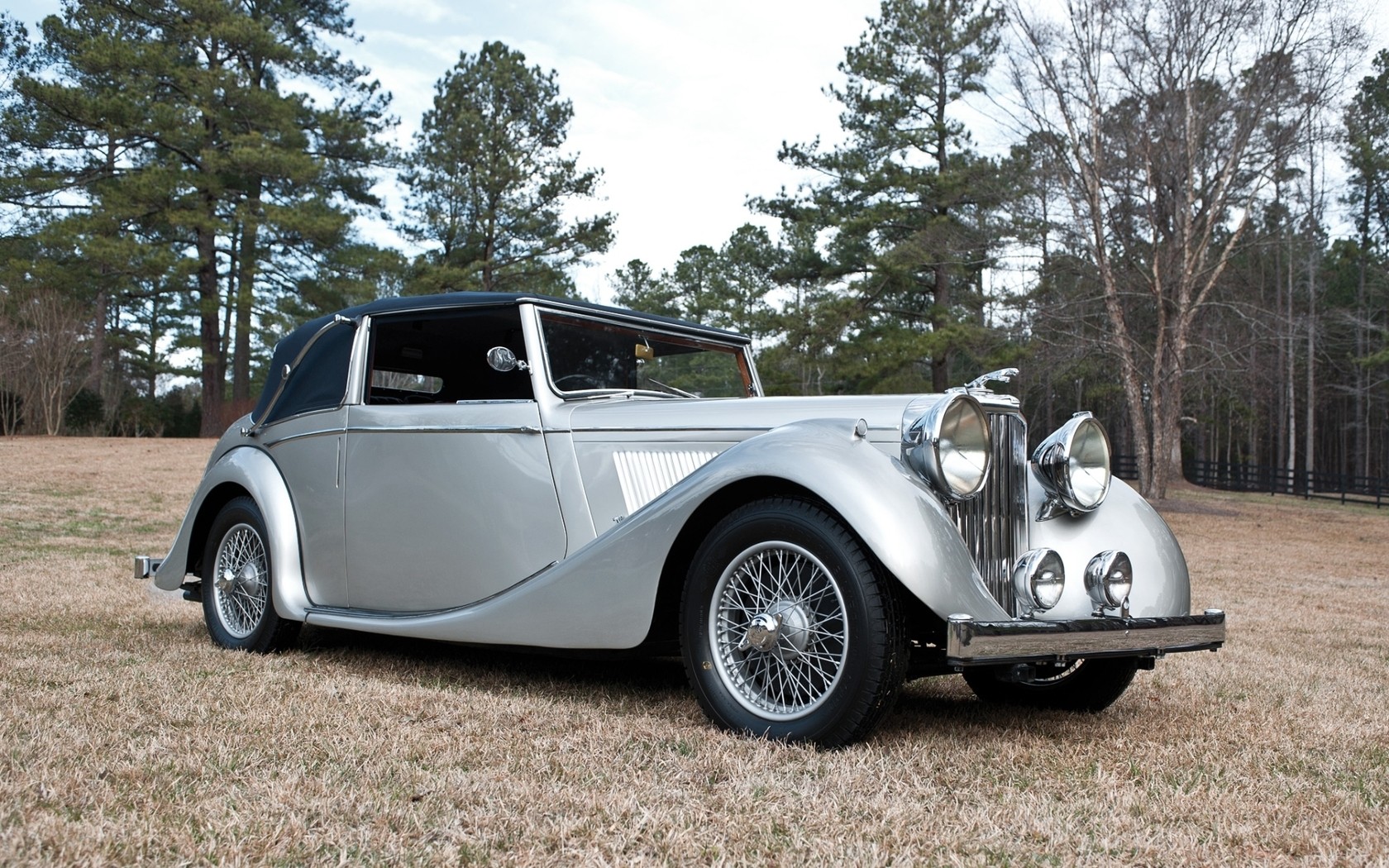
| SS Jaguar 100 | 1936–1940 | six, 2,663 or 3,485 cc | 198 + 116 |
The SS1 had a long bonnet and a low roof, which made it look more expensive than its price. A saloon on a 50 mm wider chassis followed in 1934.
SS Cars Limited and Walmsley's exit
By 1933 Walmsley wanted to leave the business. S.S. Cars Limited was incorporated on 26 October 1933 with a nominal capital of 10,000 pounds and began trading on 1 February 1934. Walmsley's capital was replaced by new outside shareholders. The old Swallow company was wound up, and S.S. Cars sold shares to the public in January 1935. The old 1cars text dates Walmsley's departure to 1935; company records show his exit through the 1933–1934 restructuring.

1935: the first cars called Jaguar
In 1935 the new saloon and sports models carried the name Jaguar for the first time: SS Jaguar. To make the engines worthy of the name, Lyons hired the tuning specialist Harry Weslake. His brief was to raise the 2½-litre Standard engine from 70 to 90 bhp (52 to 67 kW). Weslake's overhead-valve head gave 102 bhp (76 kW), well over the target. By our calculation, that is about 46 % more than the side-valve engine. You can compare such gains with our power-to-weight calculator.

William Heynes joined as chief engineer from Hillman. From 1938 the saloons and drophead coupés had all-steel bodies, and a 3½-litre saloon joined the 1½- and 2½-litre models.
The SS Jaguar 100 was the sports car of the range. The 2½-litre version was built in 198 examples and the 3½-litre in 116. By our calculation, that makes 314 cars, of which about 37 % had the larger engine.
War and the new name in 1945
Car production stopped in 1940. After the war, the initials SS had become unusable because of their association with Nazi Germany. On 23 March 1945 the shareholders agreed to rename the company Jaguar Cars Limited. Lyons explained that, unlike S.S., the name Jaguar was distinctive and could not be confused with any similar foreign name. A company called Jaguar Cars Limited had already been registered in 1937, probably to protect the name.
The sidecar business went its own way. It had passed to a separate company in Birmingham, which Jaguar sold to the Helliwell Group in January 1946. The old 1cars text notes that the first post-war saloons, later known as the Mark IV, were close to the pre-war SS Jaguar 2½-litre. The real new start came in 1948 with the Jaguar XK120 and its XK engine.
Which early SS or Jaguar suits a collector: our view
- For the start of the story: an Austin Seven Swallow. It is small and simple, and it shows Lyons's styling at its origin.
- For 1930s grand touring: an SS1 or an SS Jaguar 2½-litre saloon, with a long bonnet and a relaxed six-cylinder engine.
- For performance and prestige: an SS Jaguar 100. Only 314 were made, so check the chassis number and history with a marque register.
Period power figures are given in bhp, and our power converter turns them into kW. More cars from the period are in our classic cars section, and today's models are in the Jaguar catalogue.


FAQ
What was Jaguar's original name?
Jaguar began in 1922 as the Swallow Sidecar Company in Blackpool. It became the Swallow Coachbuilding Company in 1927, S.S. Cars Limited in 1934 and Jaguar Cars Limited on 23 March 1945.
Who founded Jaguar?
William Lyons and William Walmsley founded the Swallow Sidecar Company in September 1922. Walmsley left during the 1933–1934 restructuring into S.S. Cars Limited, and Lyons led the company for decades afterwards.
When was the name Jaguar first used?
The name first appeared in 1935 on the SS Jaguar saloons and sports cars. The company itself kept the SS Cars name until 23 March 1945, when the shareholders renamed it Jaguar Cars Limited.
Why did SS Cars change its name to Jaguar?
After the Second World War, the initials SS had become unacceptable because of the Nazi SS. Lyons also argued that Jaguar was distinctive and could not be confused with a foreign name. The change was agreed on 23 March 1945.
How many SS Jaguar 100s were built?
Between 1936 and 1940, 198 SS Jaguar 100s were built with the 2½-litre engine and 116 with the 3½-litre engine, a total of 314. The earlier SS 90 was even rarer, with only 23 made.
Photos (3)