Pre-War Bugatti: The Molsheim Cars from Type 13 to Type 57
Pre-war Bugatti means the cars Ettore Bugatti and his son Jean built in Molsheim, Alsace, between 1910 and 1939. About 7,950 cars left the original firm in all. The best known are the Type 13 Brescia, the Type 35 racer, the giant Royale and the Type 57 with its Atlantic coupé.

Key takeaways
- Molsheim production began in 1910 with five Type 13s; the Brescia version alone reached about 2,000 cars by 1926.
- The eight-cylinder era began in 1922: Types 30, 38, 40, 43, 44, 46 and 49 were the road cars that paid the bills.
- The Type 35 (about 330 built) and the Type 57 (710 built) are the two families collectors know best.
- Only six Royales and four Atlantics were made; three Atlantics survive.

This page is a model guide to the early cars. The whole company story, from Molsheim to Volkswagen and Rimac, is told in our history of Bugatti, and the founder's biography is on the Ettore Bugatti page.
Molsheim before 1940: key facts

| Fact | Value |
|---|---|
| Founder | Ettore Bugatti (1881–1947), born in Milan |
| Factory | Molsheim, west of Strasbourg; German territory until 1918, French after |
| First cars | five Type 13s in 1910 |
| Chief designer in the 1930s | Jean Bugatti (1909–1939) |
| Main engine layouts | four-cylinder (to 1926), straight-eight (from 1922) |
| Production of the original firm | about 7,950 cars, 1909–1956 |
| Pre-war Le Mans wins | 1937 and 1939, both with Type 57 "Tank" cars |
Ettore's first designs and the 1910 workshop
Ettore Bugatti came from an artistic family. His father, Carlo, was a furniture maker and designer, and his brother Rembrandt became a sculptor. The old 1cars text notes that Carlo hoped both sons would follow his trade; Ettore chose engines instead.

Before he had a factory of his own, Ettore designed cars for other firms. The old text names the De Dietrich company in Alsace and a car called the Hermes, built with Émile Mathis, as early stops. Neither project brought him lasting success. His own breakthrough came with the Type 10 of 1908, nicknamed "Petit Pur Sang" (little thoroughbred). It weighed 365 kg and its four-cylinder engine gave 7.4 kW (10 PS).
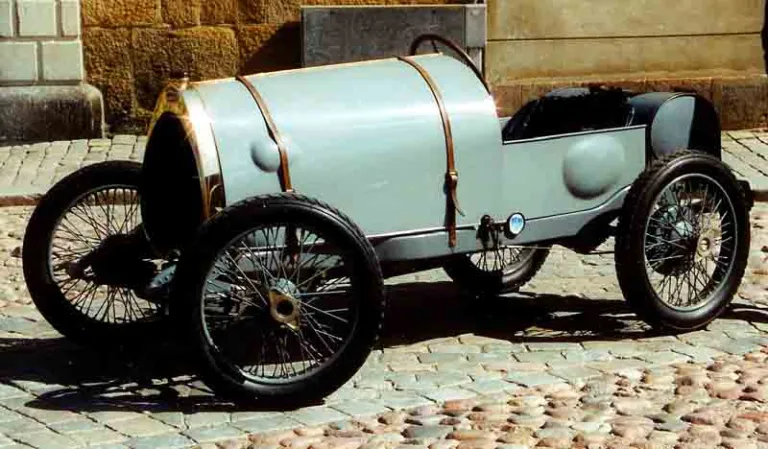
The Type 10 became the pattern for the first Molsheim car. In 1910 Ettore built five Type 13s in the buildings of a former dye works. The Type 13 gave about 22 kW (30 hp) at 4,500 rpm and weighed roughly 300 kg. At the 1911 French Grand Prix at Le Mans, a Type 13 finished second after seven hours of racing against far larger cars.
Type 13, 22 and 23: the four-cylinder Brescia era
The early four-cylinder cars came in three wheelbases. The Type 13 used about 2.0 m, the Type 15 2,400 mm and the Type 17 2,550 mm. The longer Types 22 and 23 carried touring bodies. Engines grew from 1,327 cc to 1,368 cc in 1912 and later to 1,453 and 1,496 cc.

From 1910 to 1920 the factory built 435 cars of these types. After the First World War, Molsheim became French and the cars got a 16-valve head. The new engine won the 1920 voiturette race at Le Mans. At the 1921 Voiturette Grand Prix in Brescia, Bugattis took the first four places, and the name Brescia stuck to the model.
The Brescia tourer stayed in production until 1926, and about 2,000 were built. By our calculation, that is roughly a quarter of all the cars the original company ever made. It is also why many pre-war Bugatti owners start with a Brescia: it is the most common early Molsheim car.
Eight cylinders for the road: Type 30 to Type 49
From 1922, Ettore moved his road cars to straight-eight engines. These touring models sold in larger numbers than the racers, and they funded the competition programme. The table uses figures from the encyclopedia entries for each type.

| Type | Years | Engine | Built | Notes |
|---|---|---|---|---|
| Type 30 | 1922–1926 | 1,991 cc straight-eight | about 600 | first eight-cylinder road Bugatti |
| Type 38 | 1926–1927 | 1,991 cc, 38A supercharged | 385 | 39 of them 38A |
| Type 40 | 1926–1930 | 1,496 cc four-cylinder | about 830 | the "affordable" Bugatti |
| Type 43 | 1927–1931 | 2,262 cc supercharged eight | 160 | about 89 kW (120 hp), near 180 km/h |
| Type 44 | 1927–1930 | 2,991 cc straight-eight | 1,095 known | larger touring car |
| Type 46 | 1929–1936 | 5,359 cc straight-eight | about 400 | 104 kW (140 hp); 46S supercharged, 18 built |
| Type 49 | 1930–1934 | 3,257 cc straight-eight | about 470 | twin ignition, 3 valves per cylinder |
The Type 40 is the odd one out. It kept a 1.5-litre four-cylinder engine with three valves per cylinder. The old 1cars text counted about 800 built over four years, close to the encyclopedia figure of about 830. A 1.6-litre Type 40A roadster followed in 1930, and only 40 were made.
The Type 43 Grand Sport was the fast tourer of the range. Contemporary reports called it the first production car able to reach 100 mph (160 km/h). The Type 44 was the best-selling eight-cylinder model, with 1,095 cars known today.
The Type 35 and the racing cars
Bugatti first raced the Type 35 at the 1924 French Grand Prix in Lyon. Its straight-eight had 1,991 cc, three valves per cylinder and one overhead camshaft. The first version gave up to 67 kW (90 hp). Cast alloy wheels and a hollow front axle kept the unsprung weight down, and the car weighed 650–750 kg.

| Version | Engine | Power | Built |
|---|---|---|---|
| Type 35 | 1,991 cc | up to 67 kW (90 hp) | 96 |
| Type 35A | 1,991 cc, simpler build | not published | 139 |
| Type 35T | 2,262 cc | not published | 13 |
| Type 35C | 1,991 cc, supercharged | about 95 kW (128 bhp) | about 45 |
| Type 35B | 2,262 cc, supercharged | 103 kW (138 bhp) | about 37 |
By our calculation, the five versions add up to about 330 cars. The Type 35 won the Targa Florio five times in a row, from 1925 to 1929. It won the 1926 Grand Prix World Championship, and William Grover-Williams won the first Monaco Grand Prix in 1929 in a Type 35B. The encyclopedia counts over 1,000 race wins; Bugatti itself quotes over 2,000 wins and podiums. Both figures are claims for a decade of privateer racing, so we give them as a range.
Other racers were built in small numbers. The Type 32 "Tank" of 1923 had a short, enclosed body and finished third at the French Grand Prix in Tours. The Type 59 of 1933–1935 had a 3.3-litre eight and piano-wire wheels. According to Bugatti, 12 chassis but only eight engines were made, and German rivals soon outclassed it.
The Royale and the Type 50: Ettore's big cars
The Type 41 Royale was Ettore's idea of a car for kings. Its straight-eight displaced 12.7–12.8 litres, depending on the source, and gave about 205–224 kW. The wheelbase was about 4.3 m. Ettore planned 25 cars, but only six were built and three were sold to customers. The rearing elephant on the radiator cap came from a sculpture by his brother Rembrandt. The unused engines later powered railcars for the French railways.

The Type 50 of 1930–1934 was the first Bugatti road car with two overhead camshafts. Its 4,972 cc eight gave about 167 kW (225 hp). Only 65 Type 50 and 50T cars were made. Its raked windscreen and "Superprofilée" coupé body were early work by Jean Bugatti.
Jean Bugatti's Type 57 family
The Type 57 was presented at the Paris Motor Show in 1934 and became the main Bugatti of the 1930s. All versions used a 3,257 cc straight-eight with twin overhead camshafts. Jean Bugatti designed the car and most of its factory bodies, which were named after Alpine passes: Galibier (four-door saloon), Ventoux (coupé) and Stelvio (cabriolet).

| Version | Power | Top speed | Built |
|---|---|---|---|
| Type 57 | 100 kW (135 hp) | 153 km/h | 630 |
| Type 57C (supercharged) | 119 kW (160 hp) | not published | about 96 |
| Type 57S (lowered chassis) | 125 kW (170 hp) | 201 km/h | 43 |
| Type 57S supercharged (SC) | 147 kW (200 hp) | 217 km/h | 2 built as SC |
| Type 57G "Tank" | racing | – | 3 |
The 57S chassis carried the two famous coupés. The Atalante was built in 17 examples. The Type 57SC Atlantic grew from Jean's Aérolithe concept: four were made and three survive. Its riveted spine was a design feature born of necessity, because the magnesium alloy of the prototype was hard to weld. Bugatti's modern one-off, the La Voiture Noire, was styled as a tribute to the lost fourth Atlantic.
The Type 57G "Tank" won the 1937 Le Mans 24 Hours with Jean-Pierre Wimille and Robert Benoist. A rebodied tank based on the 57C won again in 1939 with Wimille and Pierre Veyron. On 11 August 1939 Jean Bugatti died near Molsheim while testing a Type 57 racer. Within weeks, war began, and the Molsheim era of regular production ended.
How many pre-war Bugattis were made?
The original company built about 7,950 cars between 1909 and 1956, and most of them before 1940. By our calculation from the figures above:
- the Brescia family (about 2,000) is roughly 25 % of the total;
- the Type 44 (1,095) is about 14 %;
- the Type 57 (710) is about 9 %;
- the Royale (6) is less than 0.1 %.
The post-war Type 101 of 1951–1956 was a reworked Type 57, built in single figures. Ettore himself died on 21 August 1947, so the 101 is better seen as a postscript than a new chapter.
The power-to-weight figures show why the light cars won races. A Type 13 had about 73 kW per tonne (22 kW, 300 kg). A Type 35 had about 96 kW per tonne (67 kW, roughly 700 kg). You can check other cars the same way with our power-to-weight calculator, and the power converter turns period horsepower figures into kW.
Which pre-war Bugatti to buy: our view for collectors
- First Bugatti to own and drive: a Brescia or a Type 40. They are the most numerous models, simple four-cylinder cars that suit rallies and tours.
- Touring with eight cylinders: a Type 44 or Type 49. More cars survive than of the sporting types, and they are easier to use on long runs.
- Racing history: a Type 35 or 35B. Check the chassis history carefully, because many cars were rebuilt, rebodied or assembled from parts during their racing lives.
- The 1930s grand tourer: a Type 57 Galibier, Ventoux or Stelvio. The 57S and 57SC cars sit in the top tier of the classic-car market.
For any pre-war Bugatti, the factory chassis number and the documented history matter more than the paint or trim. Specialist registers and club records are the usual first check. More cars from the period are listed in our classic cars section, and the modern range is in the Bugatti catalogue.

FAQ
What was the first Bugatti car?
The first car built in the Molsheim works was the Type 13 of 1910, and five were made that year. It followed Ettore's earlier Type 10 "Petit Pur Sang" of 1908, a light four-cylinder car that weighed 365 kg and gave about 7.4 kW.
How many Bugatti Type 35s were built?
About 330 in five versions: 96 Type 35, 139 Type 35A, 13 Type 35T, about 45 Type 35C and about 37 Type 35B. The car raced from 1924 into the early 1930s and won the Targa Florio five times in a row.
How many Bugatti Royales were made?
Six Royales were built, and only three were sold to customers when new. Ettore had planned 25. Each had a straight-eight engine of 12.7–12.8 litres. The spare engines later powered railcars for the French railways.
How many Bugatti Atlantics exist?
Four Type 57SC Atlantic coupés were made between 1936 and 1938, and three survive. The fourth, Jean Bugatti's own car, disappeared around the start of the Second World War and has never been found.
When did pre-war Bugatti production end?
Regular production stopped in 1939, after Jean Bugatti's death on 11 August and the start of the Second World War. A few post-war cars followed, but the original firm built its last road cars in the 1950s.
Photos (1)

Videos 2

Video 1

Video 2