 Bugatti EB110
Specs, engines and history
Updated Published Sources (2) Report an error
By Felix Hartmann, Automotive Technology & EV Contributor Reviewed by Oleksandr Hnatiuk

- Built
- 1991–1996
- Top power
- 450 kW (612 PS)
- New price
- from about €276,537 (1992)
Which Bugatti EB110 to buy
Our verdict · Felix Hartmann
The choice is between the GT and the Super Sport. The GT is more comfortable, slightly more common and the better road car. The Super Sport is lighter, faster and rarer, and it is usually valued higher. The Dauer cars and late completions are a niche of their own. Parts and specialist knowledge are limited, so a car with a full history and recent service by a recognised EB110 specialist is essential.
The Bugatti EB110 is a mid-engined, all-wheel-drive supercar built by Romano Artioli's Bugatti Automobili in Campogalliano, Italy, from 1991 to 1995. Named for Ettore Bugatti's 110th birthday, it has a 3.5-litre V12 with four turbochargers and a carbon-fibre chassis. The GT produced 412 kW (560 PS), the Super Sport 450 kW (612 PS).
In short
- Revealed near Paris on 14–15 September 1991; about 96 GTs and 32 Super Sports left the factory before it closed in 1995.
- 3.5-litre V12 with 60 valves and four turbochargers, six-speed manual gearbox and permanent all-wheel drive.
- The Super Sport reached about 351 km/h at Nardò in 1993, a record for a production car at the time.
- The company's collapse ended the Italian chapter; Volkswagen revived the brand in France, and the 2019 Centodieci paid tribute to the EB110.

Specs by version
Engines
| Version | Engine | Power | Torque | Gearbox | Drive |
|---|---|---|---|---|---|
| 3.5 412 kW (560 PS) Coupe | 3.5 l · 12 cyl 3,500 cc | 412 kW 560 PS553 hp | 611 Nm451 lb-ft | 6-sp Manual | All-wheel drive |
| 3.5 450 kW (612 PS) Coupe | 3.5 l · 12 cyl 3,500 cc | 450 kW 612 PS603 hp | 650 Nm479 lb-ft | 6-sp Manual | All-wheel drive |
Performance
Show all 2 versions
| Version | 0–100 km/h | Top speed |
|---|---|---|
| 3.5 412 kW (560 PS) Coupe | 3.5 s 0–62 mph | 342 km/h213 mph |
| 3.5 450 kW (612 PS) Coupe | 3.3 s 0–62 mph | 355 km/h221 mph |
Dimensions and weight
Show all 2 versions
| Version | Kerb weight | Fuel tank |
|---|---|---|
| 3.5 412 kW (560 PS) Coupe | 1,620 kg3,571 lb | 120 l31.7 gal US |
| 3.5 450 kW (612 PS) Coupe | 1,418 kg3,126 lb | 120 l31.7 gal US |
Verified Manufacturer and type-approval data from our catalog · Sources and methodology
Bugatti EB110 at a glance
| Fact | EB110 GT | EB110 Super Sport |
|---|---|---|
| Years | 1991–1995 | 1992–1995 |
| Built (factory) | about 96 | about 32 |
| Engine | 3.5 l (3,500 cc) V12, 60 valves, 4 turbochargers | same, tuned |
| Power | 412 kW (560 PS) at 8,000 rpm | 450 kW (612 PS) at 8,250 rpm |
| Torque | 611 Nm at 3,750 rpm | 650 Nm at 4,200 rpm |
| 0–100 km/h | 3.46 s (official) | 3.26 s (official) |
| Top speed | 342 km/h | 351–355 km/h |
| Kerb weight | 1,620 kg | about 1,420–1,470 kg |
| Drive | permanent all-wheel drive, 27:73 split | same |
Sources disagree on the exact count. Bugatti itself gives about 96 GTs and about 32 Super Sports up to 1995, while reference works list 139 cars including those completed after the factory closed. The history of Bugatti explains how the brand passed from Ettore Bugatti's Molsheim works to Artioli and later to Volkswagen.

Romano Artioli and the blue factory in Campogalliano
The Italian entrepreneur Romano Artioli, through his company Autoexpo, acquired the rights to the Bugatti name. Bugatti Automobili SpA was founded on 14 October 1987. Instead of Molsheim in Alsace, Artioli chose Campogalliano near Modena, in the heart of Italy's supercar region. The factory, designed by architect Giampaolo Benedini for about 200 employees, was inaugurated on 15 September 1990 after three years of construction.

The engineering team included some of the best-known names of the Italian industry. Paolo Stanzani, formerly of Lamborghini, led engine and chassis development until conflicts with Artioli made him leave. Marcello Gandini drew the original shape, which Benedini later revised at Artioli's request. Nicola Materazzi, the engineer behind the Ferrari F40, served as technical director until December 1992 and changed the torque split between the axles from 40:60 to 27:73. Mauro Forghieri, Ferrari's former racing designer, followed him until mid-1994.
Launch in Paris and Versailles
The EB110 was named for Ettore Bugatti's 110th birthday on 15 September 1991, and its letters stand for his initials. Bugatti presented the GT on 14 September in front of the Grande Arche at La Défense near Paris, followed by a gala at Versailles. The next day the cars drove along the Champs-Élysées, and a launch event took place at Molsheim.
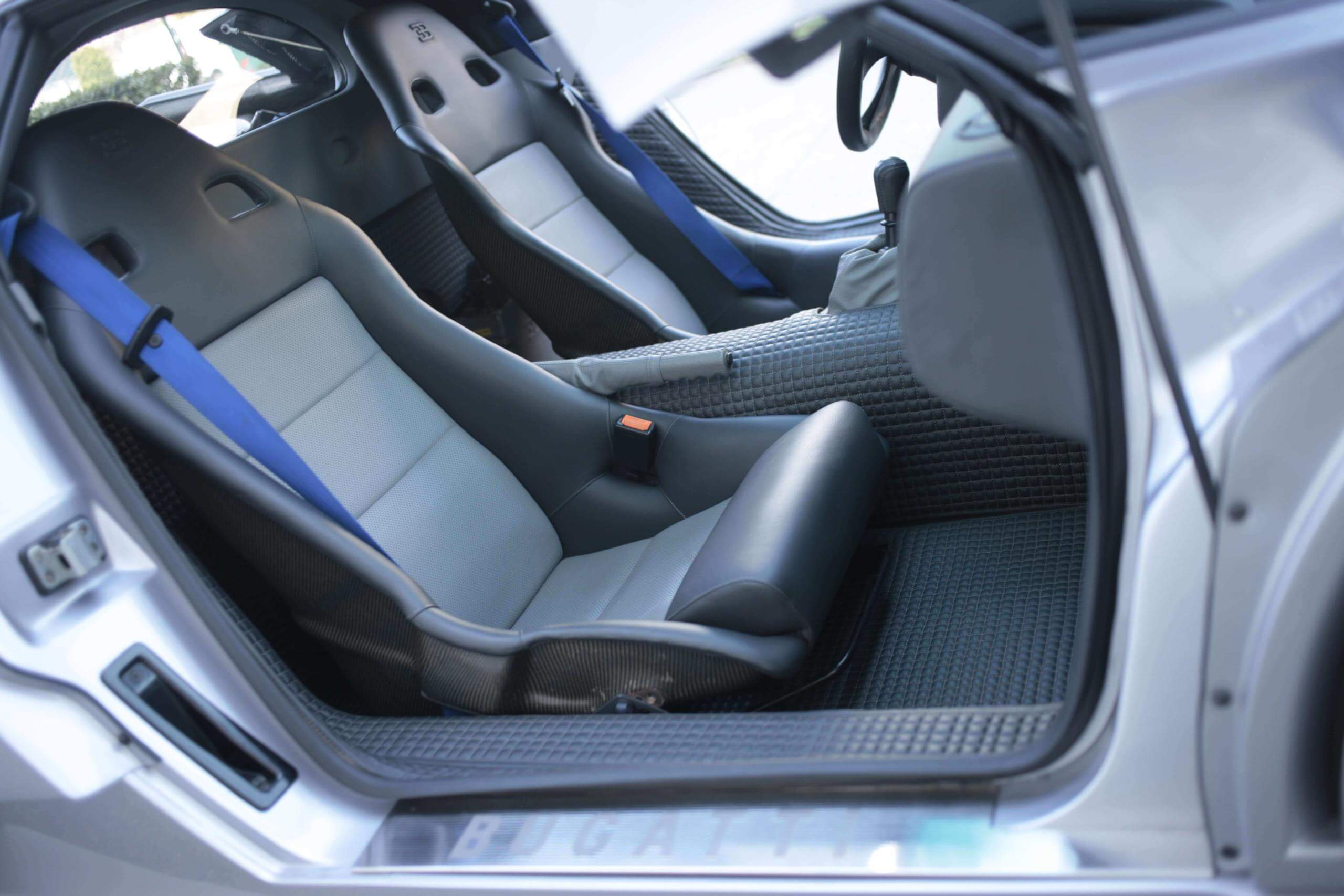
The styling was a sharp wedge with a small horseshoe-shaped grille, scissor-type doors and a glass cover over the engine. The old 1cars review noted that its modern look divided opinion, because it had little in common with the classic Bugattis of the 1930s.
Engine, gearbox and carbon-fibre chassis
The engine is a 3.5-litre V12 with five valves per cylinder, 60 in total, and four small turbochargers that cut lag. The GT version produces 412 kW (560 PS) at 8,000 rpm and 611 Nm at 3,750 rpm. A six-speed manual gearbox drives all four wheels permanently, with most of the torque sent to the rear axle.

The chassis was a major advance. Instead of the aluminium designs of its rivals, the EB110 used carbon-fibre panels bonded to an aluminium honeycomb, a technique taken from aerospace. Stanzani had asked the French aerospace firm Aérospatiale for quotes, and Artioli favoured carbon for its crash strength. The bodywork was made of aluminium panels.
| Parameter | Metric | Imperial |
|---|---|---|
| Displacement | 3,500 cc | 214 cu in |
| Power (GT) | 412 kW (560 PS) | 553 hp |
| Power (SS) | 450 kW (612 PS) | 603 hp |
| Torque (GT / SS) | 611 / 650 Nm | 451 / 479 lb-ft |
| Top speed (GT) | 342 km/h | 212 mph |
| Fuel tank | 120 l | 31.7 US gal |
The old 1cars article described the testing programme: engines ran for 300 hours on the dynamometer at 90 per cent of maximum revs. It also quoted fuel use between 11 and 22 l/100 km depending on driving, which matches the car's size and power.
EB110 Super Sport and the speed records
The Super Sport arrived in 1992 as a lighter, more powerful version. Its engine produced 450 kW (612 PS) at 8,250 rpm and 650 Nm. Reference works put the weight saving at about 150 kg, and the official 0–100 km/h time fell to 3.26 seconds.

On 30 May 1993 Jean-Philippe Vittecoq drove a Super Sport at about 351 km/h on the Nardò test track in southern Italy, the fastest speed recorded by a production car at that time. The McLaren F1 later beat it. On 3 July 1994 test driver Loris Bicocchi reached 344.7 km/h at Nardò in a car running on methane. Bugatti counts four records in total, including one for the fastest production car on ice.
With 1,620 kg and 412 kW, the GT carries about 3.9 kg per kW. A Super Sport at about 1,420–1,470 kg needs only about 3.2 kg per kW. That 1cars figure is close to the ratio of the Bugatti Veyron a decade later.
Michael Schumacher, Le Mans and racing
The most famous owner was Michael Schumacher, who bought a yellow Super Sport in early 1994. He later crashed it into a lorry, blaming the brakes, but kept the car until 2003.

Bugatti also raced the EB110. The EB 110 LM entered the 1994 Le Mans 24 Hours, qualified 17th overall and fifth in the GT1 class, but did not finish. Derek Hill's team ran an EB110 at the 24 Hours of Daytona in 1996, after the factory had closed.
Collapse, Dauer and the Edonis
The company overreached. In 1993 Artioli bought Lotus Cars, and the EB112 four-door saloon shown in 1993 consumed more money. When the factory could no longer pay its suppliers, production stopped in July 1995, and Bugatti Automobili went bankrupt. The history of Lotus covers what happened to the British firm next.

The German racing company Dauer bought the unfinished cars and parts from the receiver and completed them. Between 2001 and 2002 it built five EB110 Super Sport Lightweights with 481 kW (654 PS) and 230 kg less weight. B Engineering, set up by former Bugatti people, turned the design into the Edonis of 2000, with a 3.76-litre engine, 507 kW and rear-wheel drive only. Volkswagen bought the Bugatti brand in 1998 and moved it back to Molsheim. The blue factory in Campogalliano has stood empty since 1995, though guided visits take place from time to time.
The Centodieci and the EB110 legacy
In 2019 Bugatti presented the Centodieci, a limited series of ten cars based on the Chiron that reinterprets the EB110's shape with modern technology. Its name is Italian for "one hundred and ten". The tribute shows how the brand now sees the Italian period: as the bridge between the original Bugatti and the Veyron era.

Rivals: how the EB110 compares
| Model | Years | Engine | Power | Drive |
|---|---|---|---|---|
| Bugatti EB110 GT | 1991–1995 | 3.5 l quad-turbo V12 | 412 kW (560 PS) | AWD |
| Ferrari F40 | 1987–1992 | 2.9 l twin-turbo V8 | 352 kW (478 PS) | RWD |
| Jaguar XJ220 | 1992–1994 | 3.5 l twin-turbo V6 | 404 kW (549 PS) | RWD |
| Lamborghini Diablo | 1990–2001 | 5.7 l V12 | 362 kW (492 PS) at launch | RWD, later AWD |
| McLaren F1 | 1992–1998 | 6.1 l V12 | 461 kW (627 PS) | RWD |
The EB110 was the most technically complex car of the group, with four turbos, all-wheel drive and a carbon chassis. The McLaren F1 was lighter and faster, while the Diablo and F40 were simpler and cheaper to run. Today the fastest-cars ranking shows how far top speeds have moved since, and the comparison tool sets any two supercars side by side.


Bugatti EB110 in our rankings
- No. 1 of 23 · Fastest cars of the 1990s (355 km/h)
- No. 1 of 17 · Quickest cars of the 1990s, 0–100 (3.3 s)
- No. 2 of 91 · Most powerful cars of the 1990s (450 kW)
- No. 5 of 23 · Fastest French cars (355 km/h)
- No. 5 of 23 · Quickest French cars, 0–100 (3.3 s)
- No. 8 of 78 · Fastest coupes (355 km/h)
More powerful than 97% of ranked cars of the 1990s in the 1CARS catalog (No. 2 of 91).
Bugatti EB110 photos 15


FAQ
How many Bugatti EB110s were made?
Bugatti states that about 96 GTs and about 32 Super Sports were built before the Campogalliano factory closed in 1995. Including later completions by Dauer, reference works count 139 cars in total.
What engine does the Bugatti EB110 have?
It has a 3.5-litre V12 with 60 valves and four turbochargers. The GT produces 412 kW (560 PS) and 611 Nm, the Super Sport 450 kW (612 PS) and 650 Nm, both with a six-speed manual gearbox.
How fast is the Bugatti EB110?
The GT has a top speed of 342 km/h. A Super Sport reached about 351 km/h at Nardò in May 1993, a production-car record at the time, and the official 0–100 km/h time is 3.26 seconds.
Why is it called EB110?
EB stands for Ettore Bugatti, the founder of the original company, and 110 marks his 110th birthday on 15 September 1991, the date chosen for the car's launch near Paris.
Did Michael Schumacher own a Bugatti EB110?
Yes. Michael Schumacher bought a yellow EB110 Super Sport in early 1994. He later crashed it into a lorry, but kept the repaired car until 2003.
Data sources
Data checked by an editor against the sources below.
- The text of this article (1cars archive)
- Wikipedia - Bugatti EB110