 McLaren F1
Specs, engines and history
Updated Published Sources (2) Report an error
By Felix Hartmann, Automotive Technology & EV Contributor Reviewed by Oleksandr Hnatiuk

- Built
- 1992–1998
- Top power
- 491 kW (668 PS)
- New price
- from about €766,000 (1993)
Owning a McLaren F1 today: verdict
Our verdict · Felix Hartmann
The F1 is a collector's car above all. Almost all road cars are in private collections, and they change hands rarely, usually at auction for eight-figure sums, which places them among the most valuable cars built since 1990. McLaren's Special Operations division services and restores the cars, and many have received factory upgrades.
For a driver, the F1 asks for skill: there is no power steering, no ABS and no traction control, the steering is heavy at parking speeds, and the central seat takes getting used to. For anyone who wants to understand how modern supercars came to be, it is the car to study first. Other models of the brand are in the McLaren catalogue.
The McLaren F1 is a mid-engined, three-seat supercar built by McLaren in Woking, England, from 1992 to 1998. Designed by Gordon Murray around a carbon-fibre monocoque and a 6.1-litre BMW V12 with 461 kW (627 PS), it reached 386.4 km/h in 1998, a production-car record for years. Just 106 were built, including racing GTRs that won Le Mans in 1995.
In short
- 106 cars in total: road cars, the F1 LM and F1 GT specials, 28 F1 GTR racers and prototypes.
- BMW S70/2 V12: 6,064 cc, 461 kW (627 PS) at 7,400 rpm and 650 Nm, with a six-speed manual gearbox.
- Central driving seat with a passenger seat on each side, butterfly doors and no power steering, ABS or traction control.
- 386.4 km/h two-way average at Ehra-Lessien on 31 March 1998; F1 GTR first, third, fourth and fifth at Le Mans 1995.

Size at a glance
| Dimensions | McLaren F1 |
|---|---|
| Length | 4,288 mm168.8 in |
| Width | 1,820 mm71.7 in |
| Height | 1,140 mm44.9 in |
| Wheelbase | 2,718 mm107.0 in |
| Boot | 245 L8.7 cu ft |
Specs by version
Engines
Performance
Show all 1 versions
| Version | Fuel consumption |
|---|---|
| 6.1 461 kW (627 PS) Coupe | 15.0 l/100 km15.7 mpg US · 18.8 mpg UK |
Dimensions and weight
Show all 1 versions
| Version | Length | Width | Height | Wheelbase | Kerb weight | Boot |
|---|---|---|---|---|---|---|
| 6.1 461 kW (627 PS) Coupe | 4,288 mm168.8 in | 1,820 mm71.7 in | 1,140 mm44.9 in | 2,718 mm107.0 in | 1,260 kg2,778 lb | 245 l8.7 cu ft |
Verified Manufacturer and type-approval data from our catalog · Sources and methodology
McLaren F1 at a glance
The F1 was McLaren's first road car and the product of a simple brief from its technical director, Gordon Murray: build the best driver's car possible, with as little weight as possible. Peter Stevens styled the body, and BMW Motorsport, under engine designer Paul Rosche, supplied the V12. McLaren's later road cars, from the MP4-12C to the P1, all trace their line back to it, as told in the history of McLaren.

| Fact | Value |
|---|---|
| Maker | McLaren Cars, Woking, England |
| Production | 1992–1998 |
| Units built | 106 (all versions) |
| Designers | Gordon Murray (engineering), Peter Stevens (styling) |
| Layout | Mid-engine, rear-wheel drive |
| Seats | Three, driver in the centre |
| Engine | BMW S70/2 6.1 l V12 |
| Power | 461 kW (627 PS) |
| Top speed | 386.4 km/h (record run, 1998) |
The BMW S70/2 V12
The engine is a naturally aspirated 60-degree V12 of 6,064 cc, developed specially for the car by BMW M. It has four overhead camshafts, 48 valves and variable valve timing, and drives the rear wheels through a transverse six-speed manual gearbox. With a bore of 86 mm and a stroke of 87 mm, it revs to a limiter set at 7,500 rpm. The engine bay is lined with about 16 grams of gold foil, chosen because gold reflects heat well.

| Parameter | Metric | Imperial |
|---|---|---|
| Engine | BMW S70/2, 60° V12, 48 valves | – |
| Displacement | 6,064 cc | 370 cu in |
| Power | 461 kW (627 PS) at 7,400 rpm | 618 hp |
| Torque | 650 Nm at 5,600 rpm | 479 lb ft |
| Rev limiter | 7,500 rpm | – |
| Gearbox | 6-speed manual, rear-wheel drive | – |
| 0–100 km/h | about 3.2 s | 0–60 mph about 3.2 s |
| 0–200 km/h | about 9.4 s | 0–124 mph |
| Top speed | 386.4 km/h (two-way average) | 240.1 mph |
According to the old 1cars text, the V12 weighs 266 kg. The F1 LM's version of the engine, without the intake restrictors of the racing GTR, produced about 500 kW (680 PS).
Carbon chassis, packaging and dimensions
The F1 was the first production road car with a carbon-fibre monocoque. Murray's team fought for every gram: carbon fibre was used wherever possible, and titanium where carbon was not suitable. The result is a dry weight of 1,140 kg and a kerb weight of about 1,260 kg, light for a car with a 6.1-litre V12. The underbody is shaped for ground effect, so the car generates downforce without a large fixed rear wing on the road version.

| Parameter | Metric | Imperial |
|---|---|---|
| Length | 4,287 mm | 168.8 in |
| Width | 1,820 mm | 71.7 in |
| Height | 1,140 mm | 44.9 in |
| Wheelbase | 2,718 mm | 107.0 in |
| Dry weight | 1,140 kg | 2,513 lb |
| Kerb weight | 1,260 kg | 2,778 lb |
| Fuel tank | 90 l (old 1cars text) | 19.8 UK gal |
The cabin is the car's most famous feature. The driver sits in the middle, slightly ahead of two passenger seats, which gives an unobstructed view and a balanced driving position. Butterfly doors, inspired by the Toyota Sera, swing up and forward. Luggage goes into two lockers in the flanks ahead of the rear wheels. For a car with no power steering, ABS or traction control, the F1 is surprisingly well equipped, with air conditioning, a high-quality audio system and leather seats.
Variants: road cars, LM, GT and GTR
Different sources split the 106 cars slightly differently, because some prototypes were later rebuilt. The commonly cited breakdown is below.

| Version | Number | What it is |
|---|---|---|
| F1 (road car) | 64 | Standard road car |
| F1 LM | 5 | Road car built to honour the Le Mans GTRs, painted Papaya Orange, about 500 kW |
| F1 GT | 3 | Long-tail road version made to homologate the 1997 GTR |
| F1 GTR | 28 | Racing car (1995, 1996 and 1997 specifications) |
| Prototypes | 6 | XP1–XP5 and the XP LM |
Two road cars were later upgraded with the high-downforce kit, a version known as the F1 HDK. The ten 1997 "long-tail" GTRs were stretched versions built for the international GT championship.
Records and racing
On 31 March 1998, Andy Wallace drove the XP5 prototype at Volkswagen's Ehra-Lessien test track to a two-way average of 386.4 km/h (240.1 mph), with the rev limiter raised to 8,300 rpm. The peak in one direction was 391 km/h. No production car went faster until the Bugatti Veyron in 2005, and the F1 is still often described as the fastest naturally aspirated production car.

The F1 GTR raced at the 24 Hours of Le Mans in 1995, its first attempt, and finished first, third, fourth, fifth and 13th overall. The GTR went on to race in the BPR and FIA GT championships until 1998.
McLaren F1 compared with later supercars
| Model | Years | Engine | Power | Top speed | Built |
|---|---|---|---|---|---|
| McLaren F1 | 1992–1998 | 6.1 l V12, naturally aspirated | 461 kW (627 PS) | 386.4 km/h | 106 |
| Porsche Carrera GT | 2003–2006 | 5.7 l V10, naturally aspirated | 450 kW (612 PS) | 330 km/h | 1,270 |
| Bugatti Veyron 16.4 | 2005–2011 | 8.0 l W16, four turbochargers | 736 kW (1,001 PS) | 408.47 km/h | 252 coupés |
| Gumpert Apollo | 2005–2012 | 4.2 l V8, twin-turbo | 478 kW (650 PS) | 360 km/h | 44 |
The F1 weighs around 600 kg less than a Veyron and about 120 kg less than a Carrera GT, and it needed no turbochargers to reach its speed. That combination of low mass and a big atmospheric engine is why it is still the benchmark for driver-focused supercars. More fast cars are listed in our fastest cars ranking and in the most powerful supercars selection.

McLaren F1 in our rankings
- No. 1 of 91 · Most powerful cars of the 1990s (491 kW)
- No. 14 of 301 · Power-to-weight: cars (366 kW/t · top 5%)
- No. 101 of 859 · Most powerful cars (491 kW · top 12%)
- No. 86 of 557 · Biggest engines: cars (6,064 cc · top 16%)
- No. 13 of 79 · Power-to-weight: coupes (366 kW/t · top 17%)
- No. 13 of 79 · Lightest coupes (1,260 kg · top 17%)
More powerful than 98% of ranked cars of the 1990s in the 1CARS catalog (No. 1 of 91).
McLaren F1 photos 15


McLaren F1 videos 2
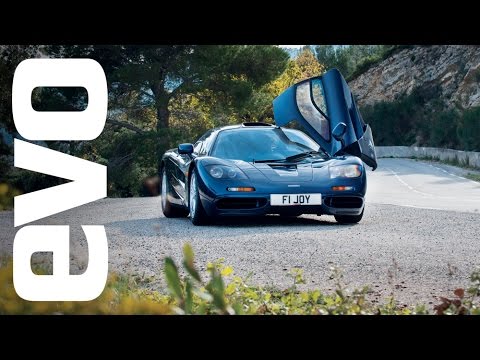
McLaren F1 video 1

Test drive
FAQ
How fast is the McLaren F1?
On 31 March 1998 a prototype reached a two-way average of 386.4 km/h (240.1 mph) at Ehra-Lessien, with the rev limiter raised. With the standard 7,500 rpm limiter the top speed is lower, at about 370 km/h.
How many McLaren F1s were built?
McLaren built 106 cars between 1992 and 1998. The usual breakdown is 64 standard road cars, 5 F1 LM, 3 F1 GT, 28 F1 GTR racing cars and 6 prototypes, although sources differ slightly.
What engine does the McLaren F1 have?
It has the BMW S70/2, a 6,064 cc naturally aspirated V12 designed by Paul Rosche's team at BMW M. It produces 461 kW (627 PS) at 7,400 rpm and 650 Nm at 5,600 rpm.
Why does the McLaren F1 have three seats?
Gordon Murray put the driver in the centre for the best view and balance, with a passenger seat on each side slightly further back. The layout also lets the car carry two passengers in a narrow body.
Did the McLaren F1 win Le Mans?
Yes. In 1995, on its first attempt, the F1 GTR won the 24 Hours of Le Mans outright, and other GTRs finished third, fourth, fifth and 13th. The F1 LM road car was later built to celebrate that result.
Data sources
Data checked by an editor against the sources below.
- The text of this article (1cars archive)
- Wikipedia - McLaren F1