
 McLaren P1
Specs, engines and history
Updated Published Sources (2) Report an error
By Felix Hartmann, Automotive Technology & EV Contributor Reviewed by Oleksandr Hnatiuk

- Built
- 2013–2015
- Top power
- 674 kW (916 PS)
- New price
- from about €1,070,000 (2013)
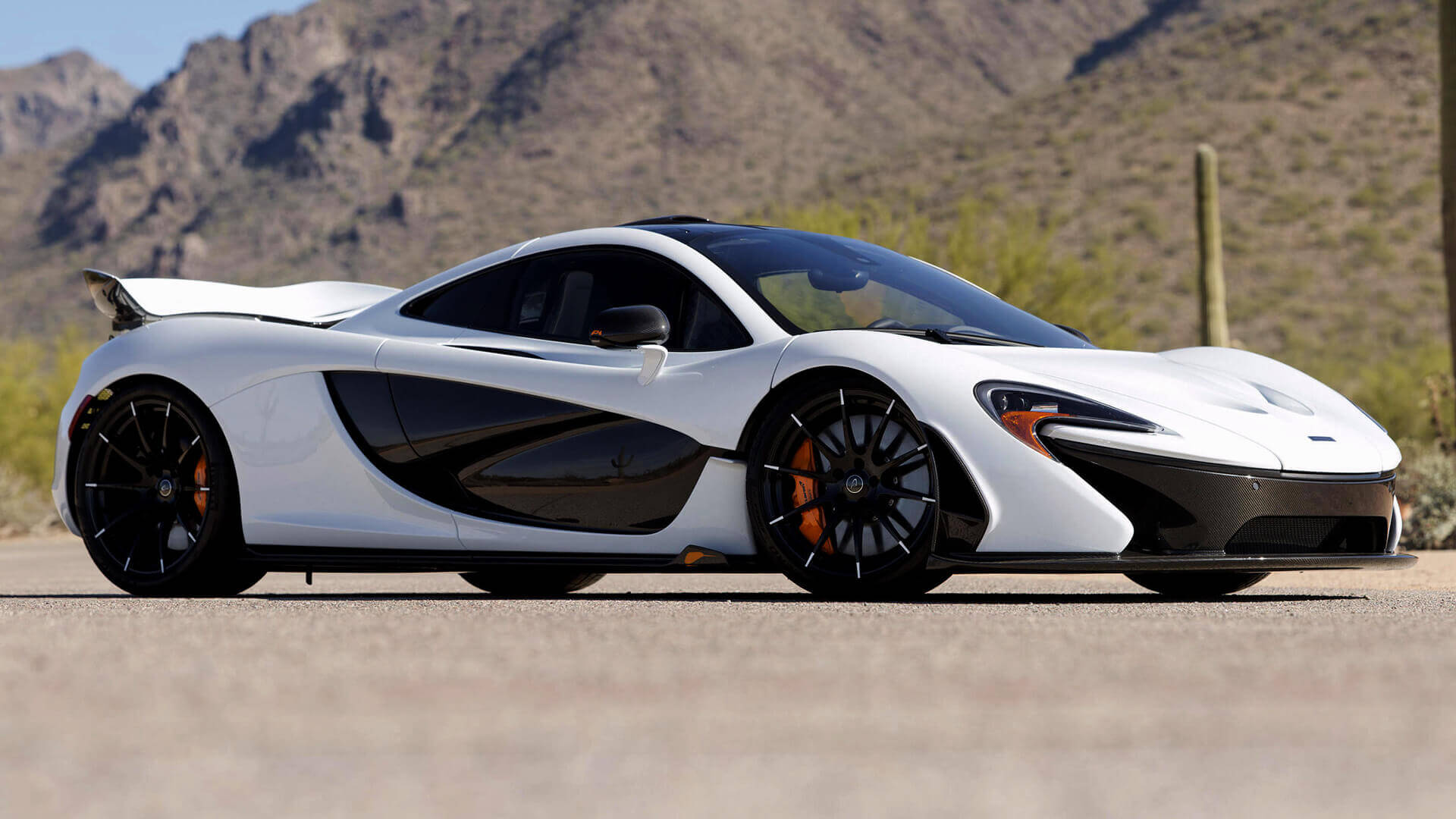
The McLaren P1 is a mid-engined plug-in hybrid hypercar built in Woking, England, from October 2013 to December 2015. A 3.8-litre twin-turbo V8 and an electric motor together produce 674 kW (916 PS) and 900 Nm. McLaren built 375 road cars, all sold before production began, plus 58 track-only P1 GTRs.
In short
- Concept at the Paris Motor Show in September 2012; production version at Geneva in March 2013.
- M838TQ V8 with 542 kW (737 PS) plus a 132 kW (179 PS) electric motor; seven-speed Graziano dual-clutch gearbox, rear-wheel drive.
- McLaren claims 0–100 km/h in 2.8 s, 0–300 km/h in 16.5 s and a limited 350 km/h (217 mph); about 10 km of electric range.
- With the Porsche 918 Spyder and LaFerrari it formed the first generation of hybrid hypercars; the McLaren W1 is its successor.

Size at a glance
Koenigsegg Agera R
The McLaren P1 is 295 mm longer, 50 mm narrower and 68 mm taller than the Koenigsegg Agera R.
| Dimensions | McLaren P1 | Koenigsegg Agera R | Difference |
|---|---|---|---|
| Length | 4,588 mm180.6 in | 4,293 mm169.0 in | +295 mm+11.6 in |
| Width | 1,946 mm76.6 in | 1,996 mm78.6 in | −50 mm−2.0 in |
| Height | 1,188 mm46.8 in | 1,120 mm44.1 in | +68 mm+2.7 in |
| Wheelbase | 2,670 mm105.1 in | 2,662 mm104.8 in | +8 mm+0.3 in |
Lamborghini Veneno
The McLaren P1 is 432 mm shorter, 129 mm narrower and 23 mm taller than the Lamborghini Veneno.
| Dimensions | McLaren P1 | Lamborghini Veneno | Difference |
|---|---|---|---|
| Length | 4,588 mm180.6 in | 5,020 mm197.6 in | −432 mm−17.0 in |
| Width | 1,946 mm76.6 in | 2,075 mm81.7 in | −129 mm−5.1 in |
| Height | 1,188 mm46.8 in | 1,165 mm45.9 in | +23 mm+0.9 in |
| Wheelbase | 2,670 mm105.1 in | 2,700 mm106.3 in | −30 mm−1.2 in |
Specs by version
Engines
Performance
Show all 1 versions
| Version | 0–100 km/h | Top speed |
|---|---|---|
| P1 | 2.8 s 0–62 mph | 350 km/h217 mph |
Dimensions and weight
Verified Manufacturer and type-approval data from our catalog · Sources and methodology
McLaren P1 at a glance
McLaren presented the P1 as the spiritual successor to the McLaren F1, and the concept appeared in Paris in 2012, 20 years after the F1's launch. Frank Stephenson styled it around a carbon-fibre monocoque and an aerodynamic brief: 600 kg of downforce well below top speed with a drag coefficient of 0.34. Before the Geneva debut McLaren showed the car privately to customers in Beverly Hills in January 2013. The company background is in McLaren's history.

| Fact | Value |
|---|---|
| Maker | McLaren Automotive, Woking (England) |
| Production | October 2013 – December 2015 |
| Road cars built | 375 |
| Body | Two-door coupé, butterfly doors, two seats |
| Layout | Mid-engine, rear-wheel drive, plug-in hybrid |
| Price (Spain, 2013) | slightly over 1 million EUR |
All 375 cars were spoken for quickly: the Americas, Asia-Pacific and the Middle East had sold out by August 2013 and Europe by mid-November 2013. About 34% went to the USA and 26% to Europe.
Hybrid powertrain: V8, electric motor and battery
The petrol engine is McLaren's M838TQ 3,799 cc twin-turbo V8, developed from the unit in the McLaren MP4-12C. In the P1 it produces 542 kW (737 PS) at 7,500 rpm and 720 Nm. An electric motor adds 132 kW (179 PS) and 260 Nm, giving a combined 674 kW (916 PS) and 900 Nm. The motor also fills the gaps while the turbos build boost. With 674 kW and a dry weight of 1,395 kg, the P1 has about 483 kW per tonne, compared with about 405 kW per tonne for the F1 of 1992 (461 kW, 1,138 kg).

| Component | Output | Details |
|---|---|---|
| 3.8 twin-turbo V8 (M838TQ) | 542 kW (737 PS), 720 Nm | Peak at 7,500 rpm |
| Electric motor | 132 kW (179 PS), 260 Nm | Fills the gap while the turbos spool |
| Combined | 674 kW (916 PS), 900 Nm | Rear-wheel drive |
| Battery | 4.7 kWh, 324 cells, 535 V | About 96 kg; full charge in about 2 hours |
| Gearbox | 7-speed dual-clutch (Graziano) | Paddle shift |
The battery charges from a plug or from the engine and regenerative braking. In E-mode the P1 can cover about 10–11 km on the European NEDC cycle; the US EPA rated it at 19 miles (31 km). EPA petrol consumption is 17 mpg (US) combined, about 14 l/100 km.
IPAS, DRS and the chassis
Two buttons on the steering wheel define the P1. IPAS (Instant Power Assist System) releases the full electric boost on demand, and DRS (Drag Reduction System), borrowed from Formula 1, flattens the rear wing to cut drag on straights. The active rear wing extends and changes its angle with speed, and in Race mode the hydraulic RaceActive Chassis Control lowers the car and stiffens the suspension.

The car rides on double wishbones with hydro-pneumatic suspension, stops with carbon-ceramic brakes developed by Akebono and uses Pirelli P Zero Corsa tyres. From 300 km/h it stops in 6.2 seconds over 246 metres, according to McLaren.
| Parameter | Metric | Imperial |
|---|---|---|
| Length | 4,588 mm | 180.6 in |
| Width | 1,946 mm | 76.6 in |
| Height | 1,188 mm | 46.8 in |
| Wheelbase | 2,670 mm | 105.1 in |
| Dry weight | 1,395 kg | 3,075 lb |
| Kerb weight | about 1,490–1,547 kg (sources differ) | about 3,285–3,410 lb |
| Boot | about 120 l | 4.2 cu ft |
| Downforce | 600 kg at 257 km/h | 1,323 lb at 160 mph |
Performance figures
| Measure | McLaren claim | Independent test |
|---|---|---|
| 0–100 km/h | 2.8 s | Autocar: 0–60 mph in 2.8 s |
| 0–200 km/h | 6.8 s | – |
| 0–300 km/h | 16.5 s | – |
| Quarter mile | 9.8 s at 245 km/h | Autocar: 10.2 s at 237 km/h |
| Top speed | 350 km/h (217 mph), limited | – |
McLaren said a P1 had lapped the Nürburgring Nordschleife in under seven minutes but did not publish the exact time. A modified P1 LM later set 6:43.22 there in April 2017 with Kenny Bräck at the wheel.

Cabin and everyday use
The cabin is stripped for weight: exposed carbon fibre, two lightweight bucket seats, little sound insulation and a digital instrument display with a central touchscreen for climate and navigation. The old 1cars text notes that the seating position was set for each owner at the factory. Climate control and a Meridian audio system came as standard. Luggage space is small, about 120 litres, so the P1 is a car for driving rather than touring.
P1 GTR, P1 LM and special versions

| Version | Years | Built | Power | Notes |
|---|---|---|---|---|
| P1 | 2013–2015 | 375 | 674 kW (916 PS) | Road car |
| P1 GTR | 2015 | 58 | 735 kW (1,000 PS) | Track-only, shown at Geneva 2015; 27 later converted for road use by Lanzante |
| P1 LM | 2016–2017 | 5 + 1 prototype | 735 kW (1,000 PS), 1,050 Nm | Lanzante road conversion of the GTR, 3,994 cc engine |
| P1 GT | 2018 | 2 | – | Lanzante build |
Rivals: the hybrid hypercar trio
| Model | Years | Powertrain | Power | Built |
|---|---|---|---|---|
| McLaren P1 | 2013–2015 | 3.8 V8 twin-turbo + 1 motor, RWD | 674 kW (916 PS) | 375 |
| Porsche 918 Spyder | 2013–2015 | 4.6 V8 + 2 motors, AWD | 652 kW (887 PS) | 918 |
| Ferrari LaFerrari | 2013–2016 | 6.3 V12 + 1 motor, RWD | 708 kW (963 PS) | 499 coupés |
The Porsche was the most usable and quickest off the line, the Ferrari the most powerful, and the P1 the most extreme on track with its aero and suspension. See how they rank today in the quickest cars ranking or compare two of them in the 1cars comparison tool.

Values and buying a P1 today
The P1 was priced at slightly more than 1 million EUR in Spain in 2013. Today it trades on the collector market, where prices depend on mileage, colour, specification and history. Typical checks include the battery's state of health, full McLaren service records, the hydraulic suspension, the carbon-ceramic brakes and tyre age. A recall covered 122 cars of the 2014–2015 model years for a faulty secondary bonnet latch, so confirm that it was done. The P1's spirit continued in the track-focused McLaren Senna and in the W1, McLaren's next hybrid flagship.

Rivals
Compare with…
Compare McLaren P1 with
- Koenigsegg Agera R quick spec comparison
- Lamborghini Veneno quick spec comparison
-
Ended 2014
- Years
- 2011–2014
- Body
- Coupe
- Fuel
- Petrol
- Power
- 706–838 kW (960–1,139 PS)


McLaren P1 in our rankings
- No. 1 of 33 · Fastest British cars (350 km/h)
- No. 1 of 24 · Quickest British cars, 0–100 (2.8 s)
- No. 6 of 126 · Most powerful British cars (674 kW)
- No. 7 of 197 · Most powerful V8 cars (674 kW)
- No. 7 of 97 · Power-to-weight: coupes (452 kW/t)
- No. 7 of 421 · Power-to-weight: cars (452 kW/t)
Better power-to-weight than 98% of ranked cars in the 1CARS catalog (No. 7 of 421).
McLaren P1 photos 13


McLaren P1 videos 2

McLaren P1 video 1

McLaren P1 video 2
FAQ
How many McLaren P1 were made?
McLaren built 375 road-going P1s between October 2013 and December 2015, all sold before deliveries started. It also built 58 track-only P1 GTRs in 2015, and Lanzante later produced five road-legal P1 LMs plus a prototype.
How much horsepower does the McLaren P1 have?
The combined output is 674 kW, equal to 916 PS or 903 hp. The 3.8-litre twin-turbo V8 provides 542 kW (737 PS) and the electric motor 132 kW (179 PS), with 900 Nm of combined torque.
How fast is the McLaren P1?
McLaren claims 0–100 km/h in 2.8 seconds, 0–200 km/h in 6.8 seconds and 0–300 km/h in 16.5 seconds. Top speed is electronically limited to 350 km/h (217 mph).
Is the McLaren P1 a plug-in hybrid?
Yes. Its 4.7 kWh battery can be charged from a plug in about two hours or by the engine. In electric mode the P1 can drive about 10 km on the European cycle without starting the V8.
What replaced the McLaren P1?
The McLaren W1 is the P1's direct successor as the brand's hybrid flagship. Between the two, the track-focused McLaren Senna of 2018 used a non-hybrid version of the same twin-turbo V8 family.
Data sources
Data checked by an editor against the sources below.
- The text of this article (1cars archive)
- Wikipedia - McLaren P1


