
 McLaren 720S
Specs, engines and history
Updated Published Sources (3) Report an error
By Felix Hartmann, Automotive Technology & EV Contributor Reviewed by Oleksandr Hnatiuk
- Built
- 2017–2023
- Top power
- 530 kW (721 PS)
- New price
- from about €237,946 (2017)
- Used price today
- about €185,000–325,000 (AutoScout24, Nov 2026)
720S versus its rivals: our verdict
Our verdict · Felix Hartmann
The 720S was built to beat the Ferrari 488 GTB, and our Ferrari 488 vs McLaren 720S comparison sets the two side by side. On paper the McLaren is the stronger car: it matches the output of the track-focused 488 Pista while being lighter, and its carbon tub was a generation ahead. The Ferrari answers with a broader range of versions and a more responsive torque delivery at low revs. The Lamborghini Huracán and Porsche 911 Turbo S were the other main rivals.
The 720S suits drivers who want close to hypercar performance in a car usable on the road. In our view its glazed roof sections and slim pillars give unusually good visibility for a mid-engined car. For a used car, the coupé is lighter and sharper, while the Spider costs only a little performance. Buyers should check service records, the condition of the hydraulic suspension and any updates carried out by McLaren dealers. All McLaren models are in our McLaren catalogue.
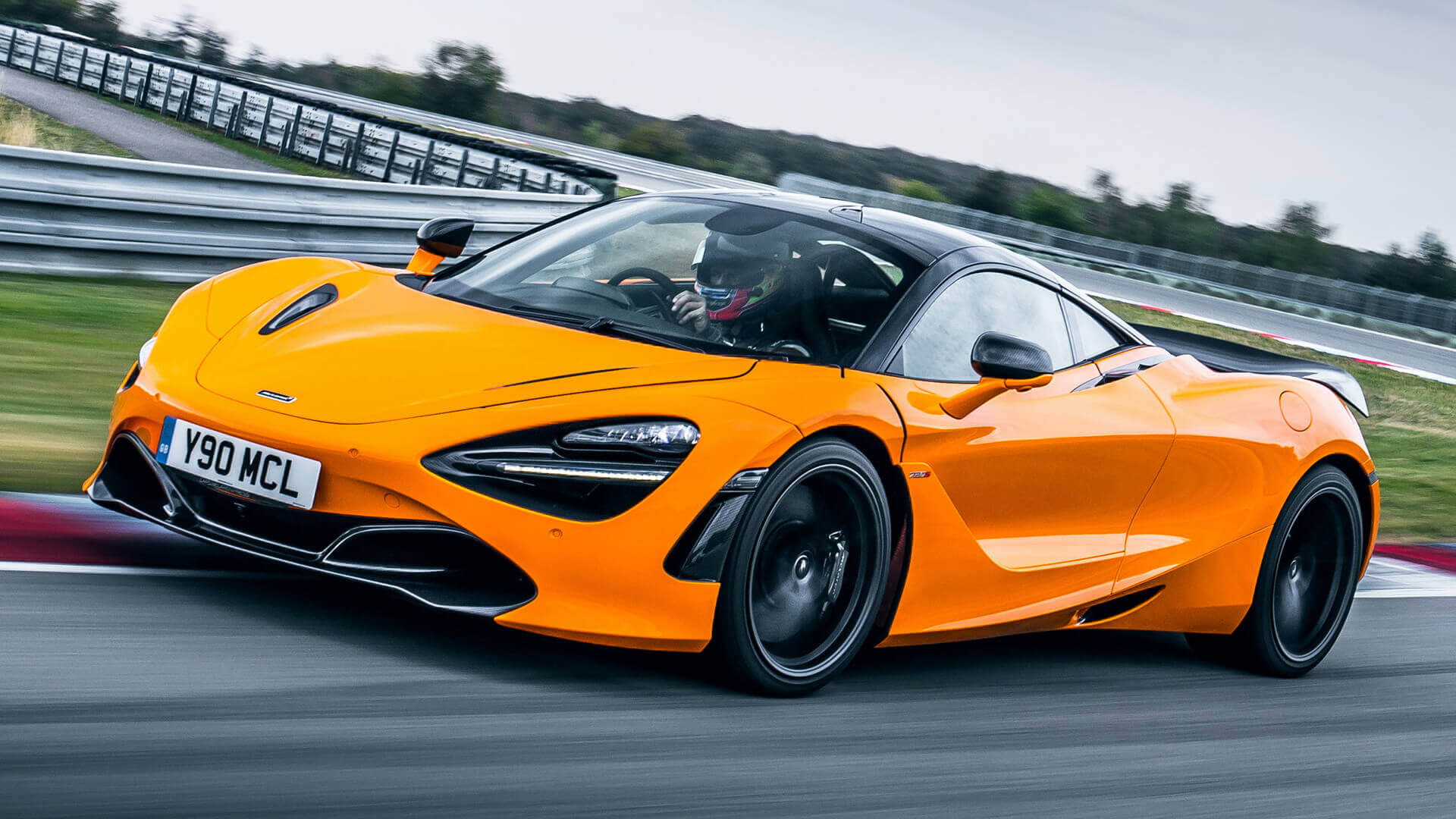
The McLaren 720S is a mid-engined two-seat supercar that McLaren revealed at the Geneva Motor Show on 7 March 2017 and built until the 750S replaced it in 2023. Its 4.0-litre twin-turbo V8 delivers 530 kW (720 PS), and with a carbon fibre tub the car weighs 1,283 kg dry. McLaren claimed 341 km/h and reaching 200 km/h from rest in under eight seconds; a Spider followed in December 2018.
In short
- Replaced the 650S in 2017; McLaren said 91 % of the car was new; UK price at launch 208,600 pounds.
- Engine: M840T 3,994 cc twin-turbo V8, 530 kW at 7,500 rpm, 770 Nm at 5,500 rpm, seven-speed dual-clutch gearbox.
- Structure: MonoCage II carbon tub, dihedral doors, 50 % more downforce than the 650S.
- Family: 720S Spider (2018), 720S GT3 (2018), 765LT (2020) and the 750S successor (2023).

Size at a glance
| Dimensions | McLaren 720S |
|---|---|
| Length | 4,544 mm178.9 in |
| Height | 1,196 mm47.1 in |
| Wheelbase | 2,670 mm105.1 in |
| Boot | 150 L5.3 cu ft |
Running cost
Fuel · 720S 720S
about 3,200 EUR fuel a year at 15,000 km
12.2 l/100 km · petrol at 1.75 EUR/l · change mileage, fuel price or version
Specs by version
Engines
Performance
Show all 1 versions
| Version | 0–100 km/h | Top speed | Fuel consumption | CO₂ |
|---|---|---|---|---|
| 720S | 2.9 s 0–62 mph | 341 km/h212 mph | 12.2 l/100 km19.3 mpg US · 23.2 mpg UK | 276 g/km |
Dimensions and weight
Verified Manufacturer and type-approval data from our catalog · Sources and methodology
McLaren 720S technical data

| Item | 720S coupé |
|---|---|
| Built | 2017–2023 |
| Engine | M840T 3,994 cc V8, twin-turbo, mid-mounted |
| Power | 530 kW (720 PS) at 7,500 rpm |
| Torque | 770 Nm at 5,500 rpm |
| Gearbox | 7-speed dual-clutch, rear-wheel drive |
| Weight | 1,283 kg dry; 1,419 kg kerb |
| 0–100 km/h | 2.8–2.9 s (McLaren) |
| 0–200 km/h | 7.8 s (McLaren) |
| Top speed | 341 km/h |
| Length / width / height | 4,544 / 2,161 / 1,196 mm |
| Wheelbase | 2,670 mm |
| Combined fuel use | 10.7 l/100 km, 249 g/km CO₂ |
| Luggage | about 150 l at the front, 210 l behind the seats |
The step up from the 650S
The 720S was the second all-new car of McLaren's Super Series, the range between the cheaper Sports Series and the limited Ultimate Series. Its predecessor, the 650S, had grown out of the McLaren MP4-12C of 2011. McLaren described the 720S as 91 % new, and the old version of this page gave its internal code as P14. Orders opened on the day of the Geneva reveal, all 400 Launch Edition cars were sold quickly, and customer deliveries began in May 2017.

The shape was new too. The headlights sit in deep "eye sockets" that also channel air to the radiators, so the car needs no conventional side intakes. Aerodynamics produce half as much downforce again as the 650S, and an active rear wing changes angle with speed and works as an air brake. The company's background is in our history of McLaren.
Engine and gearbox
The M840T is a 3,994 cc twin-turbo V8 developed from the 3.8-litre M838T of the 650S. The old version of this page said 41 % of its parts were new. Peak power arrives at 7,500 rpm and peak torque at 5,500 rpm. A seven-speed dual-clutch gearbox, which McLaren calls SSG, drives the rear wheels. By our calculation, that is about 133 kW per litre, a very high figure for a road engine meant to run for many years.

Fuel use is moderate for the performance: the official combined figure is 10.7 litres per 100 km, with 249 g/km of CO₂. Real-world use on fast roads is of course much higher.
Carbon tub, chassis and weight
At the heart of the car is the MonoCage II, a carbon fibre tub with an integrated roof structure. It is 18 kg lighter than the tub of the 650S. The Proactive Chassis Control II suspension, which links the dampers hydraulically instead of using anti-roll bars, is another 16 kg lighter. McLaren quotes a dry weight of 1,283 kg, while the kerb weight with fluids is 1,419 kg.

| Weight measure | Figure | Per kW (our calculation) |
|---|---|---|
| Dry weight | 1,283 kg | 2.4 kg |
| Kerb weight, coupé | 1,419 kg | 2.7 kg |
| Kerb weight, Spider | 1,468 kg | 2.8 kg |
The dihedral doors use a double-skin construction and lift up and forward. Inside, a Folding Driver Display lies flat in track mode and shows only the essential information on a thin screen. Variable Drift Control lets the driver adjust how much the stability control allows the rear to slide. Our power-to-weight calculator compares these ratios with other cars.
Performance: claims and test results
McLaren's figures were conservative. Independent tests of standard cars beat several of them:
| Measure | McLaren claim | Independent test |
|---|---|---|
| 0–97 km/h (60 mph) | 2.9 s | 2.5 s |
| 0–200 km/h | 7.8 s | 7.1 s |
| Quarter mile | 10.3 s | 9.9 s |
| Top speed | 341 km/h | – |

These results put the 720S among the fastest-accelerating rear-wheel-drive cars of its time, in some tests close to hypercars that cost several times more. Carbon-ceramic brake discs are standard, and the old version of this page quoted 4.6 seconds to stop from 200 km/h.
The 720S Spider
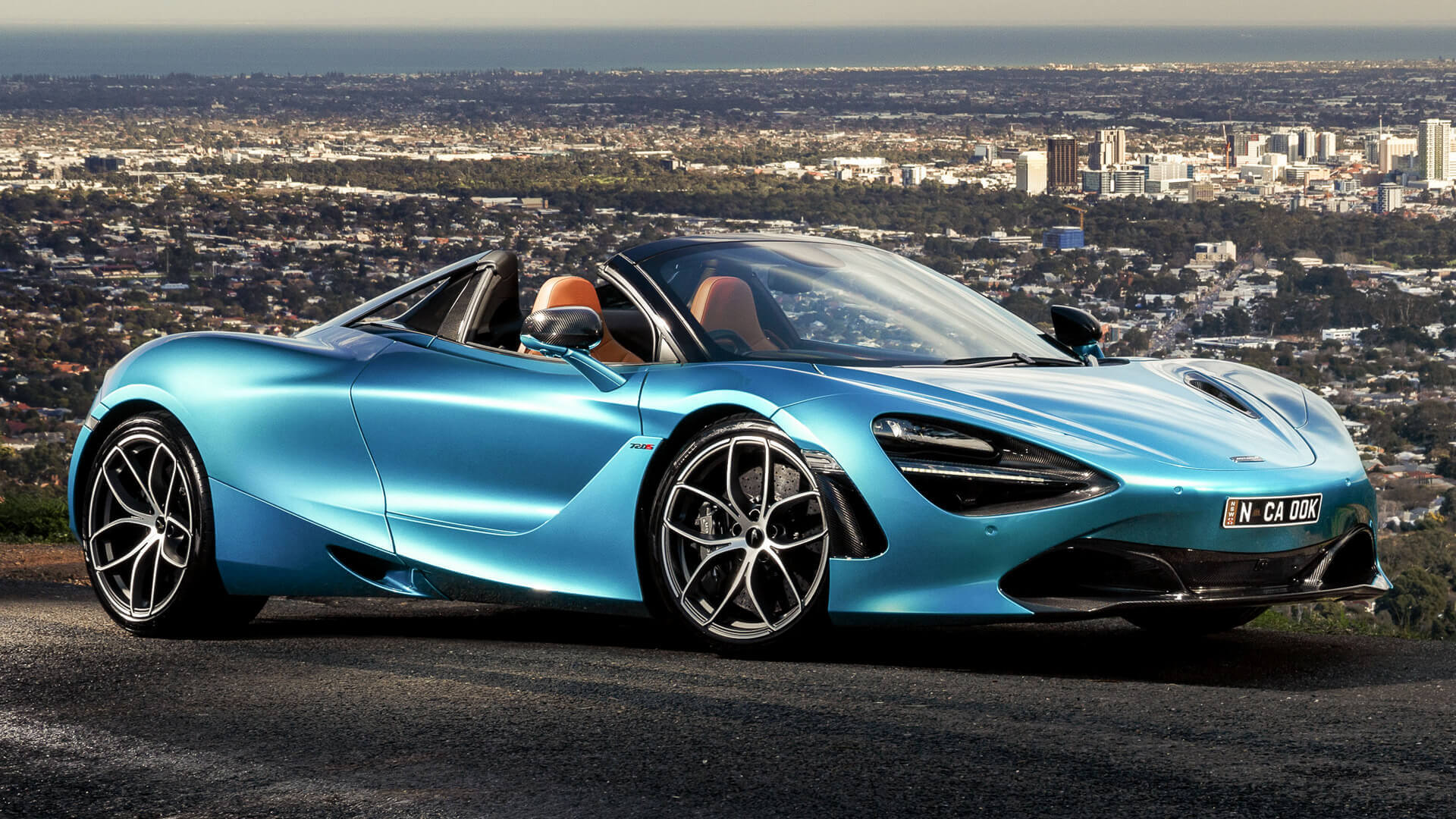
McLaren revealed the 720S Spider in December 2018. Its retractable hard top opens or closes in 11 seconds at speeds up to 50 km/h. The Spider weighs about 45 kg more than the coupé, but McLaren still quoted 0–97 km/h in 2.9 seconds and 0–193 km/h in 7.9 seconds. Top speed is 341 km/h with the roof closed and about 16 km/h lower with it open.

Special editions, racing cars and the 765LT
Several special versions were built on the 720S:
- 720S GT3 (revealed August 2018): a customer racing car for GT3 series, priced at 564,000 US dollars (about €480,000 at the time) and updated in 2023.
- 720S GT3X (March 2021): a track-only version freed from GT3 rules; it won the 2021 Goodwood Festival of Speed hill climb in 45.01 seconds.
- Apex Collection (2019): 15 cars in five designs at 288,813 pounds each in the UK.
- 720S Le Mans (2020): on sale from 17 June 2020, celebrating McLaren's 1995 Le Mans victory.
- 765LT (2020): the lighter Longtail version with 563 kW, described on our McLaren 765LT page.

Price, production and the 750S
At launch in April 2017, the 720S coupé cost 208,600 pounds in the UK, about €238,000 at the average exchange rate of that year. By our calculation, that is roughly 394 pounds per kW. Regular production exceeded 5,000 cars by one Australian estimate, which makes the 720S a relatively common supercar on the used market.
In 2023 the McLaren 750S replaced it. The 750S keeps the same basic structure but has 552 kW and less weight. The 720S therefore remains the purest version of the design as first conceived.
Living with a 720S
For a car this fast, the 720S is practical. There is a luggage space of about 150 litres under the nose and a shelf of about 210 litres behind the seats, enough for two soft bags. The dihedral doors need less side room than conventional doors, but the wide carbon sills make getting in an acquired skill. The infotainment screen is small and simple, and the 720S lacks the larger touchscreen and phone mirroring that arrived with the 750S. Servicing must be done by McLaren dealers or specialists, and tyres wear quickly on a car with 770 Nm driving the rear axle.

Popular comparisons
McLaren 720S in our rankings
- No. 2 of 33 · Fastest British cars (341 km/h)
- No. 5 of 24 · Quickest British cars, 0–100 (2.9 s)
- No. 14 of 420 · Power-to-weight: cars (374 kW/t · top 4%)
- No. 16 of 418 · Fastest cars (341 km/h · top 4%)
- No. 23 of 366 · Quickest cars, 0–100 (2.9 s · top 7%)
- No. 28 of 362 · Most powerful cars of the 2010s (530 kW · top 8%)
Better power-to-weight than 96% of ranked cars in the 1CARS catalog (No. 14 of 420).
McLaren 720S photos 17





McLaren 720S videos 3
McLaren 720S video 1

McLaren 720S video 2

Test drive
FAQ
How fast is the McLaren 720S?
The official figures are about 2.9 seconds to 100 km/h and a top speed of 341 km/h. Independent tests of standard cars were quicker than McLaren's own claims, with 2.5 seconds to 60 mph and 7.1 seconds to 200 km/h.
What engine does the McLaren 720S have?
It uses the M840T, a 3,994 cc twin-turbo V8 mounted behind the seats and developed from the 650S engine. Its output of 720 PS gave the car its name, and all of it goes to the rear wheels.
What replaced the McLaren 720S?
The McLaren 750S replaced the 720S in 2023. It is an evolution of the same car with more power, 552 kW, and less weight, available as a coupé and a Spider.
How much did a McLaren 720S cost new?
The UK list price at launch in 2017 was 208,600 pounds, roughly €238,000 at that year's exchange rate. Options and special editions such as the Apex Collection cost considerably more.
Is the McLaren 720S a hypercar?
Not officially. McLaren placed it in the Super Series, below Ultimate Series cars such as the P1 and Senna. Its acceleration, however, came close to many hypercars of its time.
Data sources
Data checked by an editor against the sources below.
- The text of this article (1cars archive)
- Wikipedia - McLaren 720S
- EEA CO₂ monitoring (European Environment Agency, CC BY 4.0)


