
 McLaren MP4-12C
Specs, engines and history
Updated Published Sources (2) Report an error
By Felix Hartmann, Automotive Technology & EV Contributor Reviewed by Oleksandr Hnatiuk

- Built
- 2011–2014
- Top power
- 460 kW (625 PS)
- New price
- from about €200,000 (2011)
- Used price today
- about €95,000–148,000 (AutoScout24, Nov 2026)
Which McLaren 12C to buy
Our verdict · Felix Hartmann
A 2013–2014 car with the 460 kW update and the later software is the best buy, because it fixes most early complaints about gearbox calibration and infotainment. On older cars, ask for proof that all factory upgrades from January 2013, July 2013 and January 2014 were fitted. Cars sold through McLaren dealers usually have them; trade cars sometimes do not. The Spider suits buyers who want an open car with almost no loss in stiffness. Successors such as the McLaren 720S are faster, but the 12C remains the most affordable way into a carbon-tub McLaren.
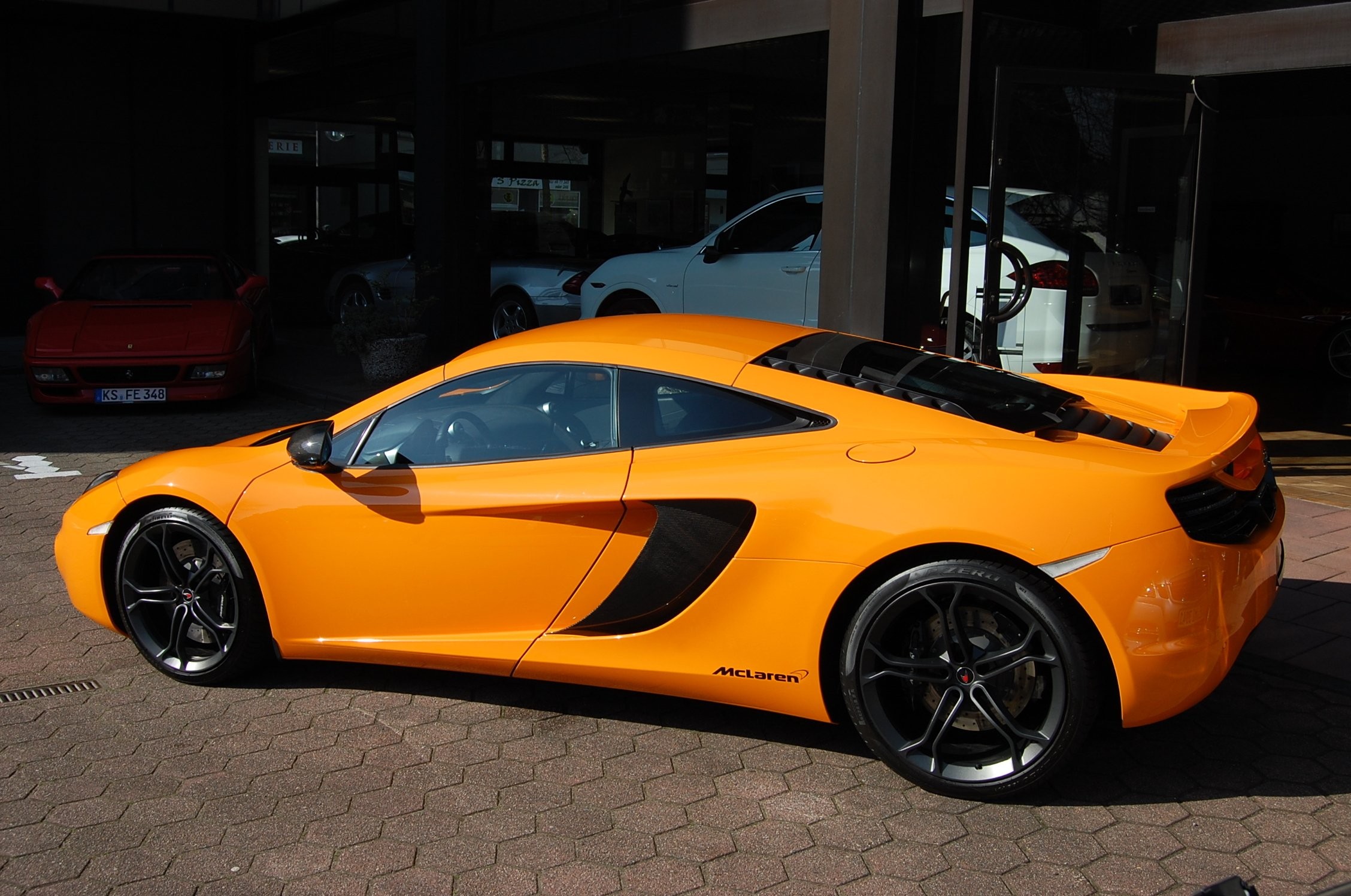
The McLaren MP4-12C is a mid-engined two-seat supercar built in Woking from February 2011 to spring 2014. It has a carbon-fibre MonoCell tub weighing 80 kg and a 3.8-litre twin-turbo V8 with 441 kW (600 PS), raised to 460 kW (625 PS) in 2013. More than 3,400 coupés and Spiders were built before the 650S replaced it.
In short
- The first series-production car of McLaren Automotive, launched in 2011 and renamed simply "12C" in 2012.
- M838T 3.8 V8 twin-turbo, seven-speed dual-clutch gearbox, rear-wheel drive, 0–100 km/h in 3.3 s.
- Kerb weight 1,434 kg and hydraulically linked ProActive Chassis Control suspension.
- Body styles: coupé with dihedral doors and, from 2012, the 12C Spider with a folding hard top.

Size at a glance
| Dimensions | McLaren MP4-12C |
|---|---|
| Length | 4,509 mm177.5 in |
| Width | 1,908 mm75.1 in |
| Height | 1,204 mm47.4 in |
| Wheelbase | 2,670 mm105.1 in |
Specs by version
Engines
| Version | Engine | Power | Gearbox | Drive |
|---|---|---|---|---|
| 12C (2013 update) | 3.8 l · 8 cyl · Petrol 3,799 cc | 460 kW 625 PS617 hp | 7-sp Dual-clutch | Rear-wheel drive |
Performance
Show all 1 versions
| Version | Top speed |
|---|---|
| 12C (2013 update) | 333 km/h207 mph |
Dimensions and weight
Show all 1 versions
| Version | Length | Width | Height | Wheelbase | Kerb weight |
|---|---|---|---|---|---|
| 12C (2013 update) | 4,509 mm177.5 in | 1,908 mm75.1 in | 1,204 mm47.4 in | 2,670 mm105.1 in | 1,434 kg3,161 lb |
Verified Manufacturer and type-approval data from our catalog · Sources and methodology
McLaren MP4-12C key specifications

| Parameter | Metric | Imperial |
|---|---|---|
| Engine | 3,799 cc M838T V8, twin-turbo, dry sump | 232 cu in |
| Power (2011) | 441 kW (600 PS) at 7,000 rpm | 592 bhp |
| Power (2013 update) | 460 kW (625 PS) | 616 bhp |
| Torque | 600 Nm from 3,000 rpm | 443 lb-ft |
| Gearbox | 7-speed dual-clutch (SSG) | - |
| 0–100 km/h (0–62 mph) | 3.3 s (3.1 s on Corsa tyres) | 3.3 s |
| Top speed | 330 km/h | 205 mph |
| Kerb weight (DIN) | 1,434 kg | 3,161 lb |
| Length / width / height | 4,507 / 1,909 / 1,199 mm | 177.4 / 75.2 / 47.2 in |
| Wheelbase | 2,670 mm | 105.1 in |
| Front boot | 144 litres | 5.1 cu ft |
| EU combined fuel / CO₂ | 11.7 l/100 km, 279 g/km | 20.1 mpg (US) |
How McLaren built its first series car
McLaren began the project in 2005 and decided in 2007 to build the car itself, without a partner. That followed the Mercedes-Benz SLR McLaren, which the two companies had built together; the old 1cars text linked the clean break to disagreements between them. More than fifty prototypes were tested in places as different as Bahrain, Arizona, the Arctic and high-altitude South Africa.

The car was shown online in September 2009 and in public at the Goodwood Festival of Speed in July 2010. Series production started on 2 February 2011 at the McLaren Technology Centre in Woking. A dedicated McLaren Production Centre, built for about 4,000 cars a year, was opened on 18 November 2011. Frank Stephenson led the design team from 2008 and reworked the headlights, front bumper and cabin.
The name follows McLaren's Formula 1 cars, which have used the MP4 prefix since 1981. "12" is the company's internal vehicle performance index and "C" stands for carbon. McLaren dropped "MP4" in 2012, so later cars are badged 12C. For the wider story of the company, read the history of McLaren and the profile of its founder Bruce McLaren.
MonoCell carbon tub and ProActive chassis
The tub is the story. The MonoCell is a one-piece carbon-fibre structure that weighs 80 kg and is made by Carbo Tech in Salzburg. A carbon tub took about 3,000 hours to make for McLaren's F1 cars and 500 hours for the SLR; the 12C process cut that to four hours. Aluminium frames carry the front suspension and the engine.

The double-wishbone suspension is linked by a hydraulic system called ProActive Chassis Control. It controls body roll hydraulically, so the car can ride softly on a bumpy road and still stay flat in corners. Brake Steer brakes the inside rear wheel when the car starts to run wide, a trick McLaren had used in Formula 1. Tyres are Pirelli P Zero, 235/35 R19 at the front and 305/30 R20 at the rear, on forged wheels.
M838T engine, gearbox and performance
The M838T is a 3.8-litre 90-degree V8 with two turbochargers and a dry sump, developed with Ricardo. It revs to 8,500 rpm. Turbo lag is small. At launch McLaren quoted 441 kW (600 PS) at 7,000 rpm and 600 Nm from 3,000 rpm. A free upgrade in January 2013 added 25 PS, giving 460 kW (625 PS), and owners of earlier cars received it too.

Power reaches the rear wheels through a seven-speed Graziano dual-clutch gearbox that McLaren calls SSG. The engine sits behind the cabin, and the weight split is 42.5 % front and 57.5 % rear. McLaren quoted 0–200 km/h in 9.1 seconds and a stop from 100 km/h in 30.5 metres.
| Version | Years | Power | 0–100 km/h | Top speed |
|---|---|---|---|---|
| MP4-12C coupé | 2011–2012 | 441 kW (600 PS) | 3.3 s | 330 km/h |
| 12C coupé (2013 update) | 2013–2014 | 460 kW (625 PS) | 3.1 s (Corsa tyres) | 330–333 km/h |
| 12C Spider | 2012–2014 | 460 kW (625 PS) | 3.1 s | 328 km/h (315 km/h roof down) |
| 12C GT3 (racing) | 2012– | 368 kW (500 PS) | - | - |
By our calculation, the launch car carries 3.25 kg per kW, and the 2013 update brings that down to 3.12 kg per kW. Use the 1cars power-to-weight calculator to set those numbers against any other car.
Dimensions, cabin and front boot
It is a low car. The 12C is 4,507 mm long, 1,909 mm wide and only 1,199 mm tall, on a 2,670 mm wheelbase. The dihedral doors swing up and forward, and the narrow carbon sills make getting in easier than in many mid-engined cars. The cabin is snug but simple, with a slim centre console and a portrait seven-inch touchscreen.
That screen ran the IRIS infotainment system, which drew criticism when the car was new. The optional upgrade added voice-controlled navigation, a larger hard drive and a seven-speaker Meridian sound system. Luggage goes in a 144-litre boot under the front lid.
Spider, HS and racing versions
The 12C Spider arrived in 2012 with a two-piece folding hard top that works at up to 30 km/h. Because the MonoCell needed no extra bracing, the Spider weighs only about 40 kg more than the coupé. Its top speed is 328 km/h with the roof up and 315 km/h with it down.

McLaren Special Operations built ten 12C HS cars with a revised nose, diffuser and wing, plus 75 hp more. It also built the one-off X-1 coupé, shown at Pebble Beach in 2012. On the track, the 12C GT3 was announced in December 2010 and raced from 2012, when 25 cars were readied for the FIA GT1 World Championship. The first wins came at Navarra with Hexis Racing.
Running costs and ownership
The EU combined figure is 11.7 l/100 km and CO₂ emissions are 279 g/km. That was low for a 441 kW car in 2011, when rivals with similar power used far bigger engines without turbochargers. Tyres and brakes cost more than fuel. Servicing was due every 16,000 km (10,000 miles) under a three-year, unlimited-mileage warranty. In November 2010, McLaren's launch price list put the car at about €200,000 in Germany. McLaren later offered an extended warranty for cars up to 12 years old, which helps used buyers today.

Safety equipment and testing
There is no crash-test score. Neither Euro NCAP nor IIHS tested the 12C, which is normal for a supercar built in small numbers for a few years in a single British plant. The carbon MonoCell itself is the main safety structure, and it does not rust like a steel body. Stability control and cast-iron brake discs are standard. Early cars had no reversing camera; one became available as an upgrade in July 2013.

McLaren 12C against its 2011 rivals
| Model | Engine | Layout | Body |
|---|---|---|---|
| McLaren MP4-12C | 3.8 V8 twin-turbo | Mid-engine, RWD | Coupé, Spider |
| Ferrari 458 Italia | 4.5 V8 | Mid-engine, RWD | Coupé, Spider |
| Lamborghini Gallardo | 5.2 V10 | Mid-engine, AWD | Coupé, Spyder |
| Porsche 911 Turbo S | 3.8 flat-six twin-turbo | Rear-engine, AWD | Coupé, Cabriolet |
| Audi R8 V10 | 5.2 V10 | Mid-engine, AWD | Coupé, Spyder |
The Ferrari 458 was the benchmark, and testers often found the 12C quicker but less emotional. The McLaren was widely praised for its supple ride, a result of its hydraulic suspension. The Gallardo and the Audi offered four-wheel drive and a V10 sound. In a Top Gear test-track lap on 10 July 2011, the 12C recorded 1:16.2, second-fastest at the time. Other mid-engined cars are listed in the 1cars supercars section, and the 1cars comparison tool sets any two of them side by side.

Popular comparisons
McLaren MP4-12C in our rankings
- No. 4 of 31 · Fastest British cars (333 km/h)
- No. 25 of 418 · Power-to-weight: cars (321 kW/t · top 6%)
- No. 23 of 415 · Fastest cars (333 km/h · top 6%)
- No. 17 of 145 · Fastest cars of the 2010s (333 km/h · top 12%)
- No. 47 of 362 · Most powerful cars of the 2010s (460 kW · top 13%)
- No. 136 of 1081 · Most powerful cars (460 kW · top 13%)
Better power-to-weight than 94% of ranked cars in the 1CARS catalog (No. 25 of 418).
McLaren MP4-12C photos 13


McLaren MP4-12C videos 3

McLaren MP4-12C video 1

Video overview

Test drive
FAQ
How much power does the McLaren MP4-12C have?
At launch in 2011 the 3.8-litre twin-turbo V8 produced 441 kW (600 PS) and 600 Nm. From January 2013 McLaren raised it to 460 kW (625 PS), and owners of earlier cars could have the upgrade free of charge.
How fast is the McLaren 12C from 0 to 100 km/h?
McLaren quoted 3.3 seconds for the launch coupé and 3.1 seconds with the optional Corsa tyres or the Spider. The car reaches 200 km/h in about 9.1 seconds, and its top speed is 330 to 333 km/h.
How many McLaren MP4-12C cars were built?
Production ran from February 2011 to spring 2014, and more than 3,400 coupés and Spiders were built in Woking. The 650S, which shares most of its parts, took over in 2014.
What does the "12C" in the name mean?
"MP4" is the prefix McLaren's Formula 1 cars have carried since 1981. "12" refers to the company's internal vehicle performance index, and "C" stands for carbon, after the carbon-fibre MonoCell tub. McLaren dropped "MP4" in 2012.
Is the McLaren 12C reliable?
The engine and carbon tub are robust, but early cars suffered software, gearbox and infotainment faults. McLaren fixed most of them with free updates, so check that every factory upgrade is recorded before buying a used car.
Data sources
Data checked by an editor against the sources below.
- Wikipedia - McLaren MP4 12C
- Wikipedia - McLaren 12C


