
 Dodge Viper GTS-R
Specs, engines and history
Updated Published Sources (3) Report an error
By Sarah Whitmore, Senior Automotive Writer Reviewed by Oleksandr Hnatiuk

- Built
- 1996–2005
- Top power
- 570 kW (775 PS)
Verdict: why the GTS-R matters
Our verdict · Sarah Whitmore
The Viper GTS-R is the car that turned the Viper from a crude road car into a winner of the world's biggest GT races. For collectors, a car with a works Oreca history and Le Mans results is the prize; for road drivers, the GT2 Champion Edition offers the look and the story. Its spirit lives on in the later Viper ACR and in Dodge's modern V8 cars such as the Challenger SRT Demon.
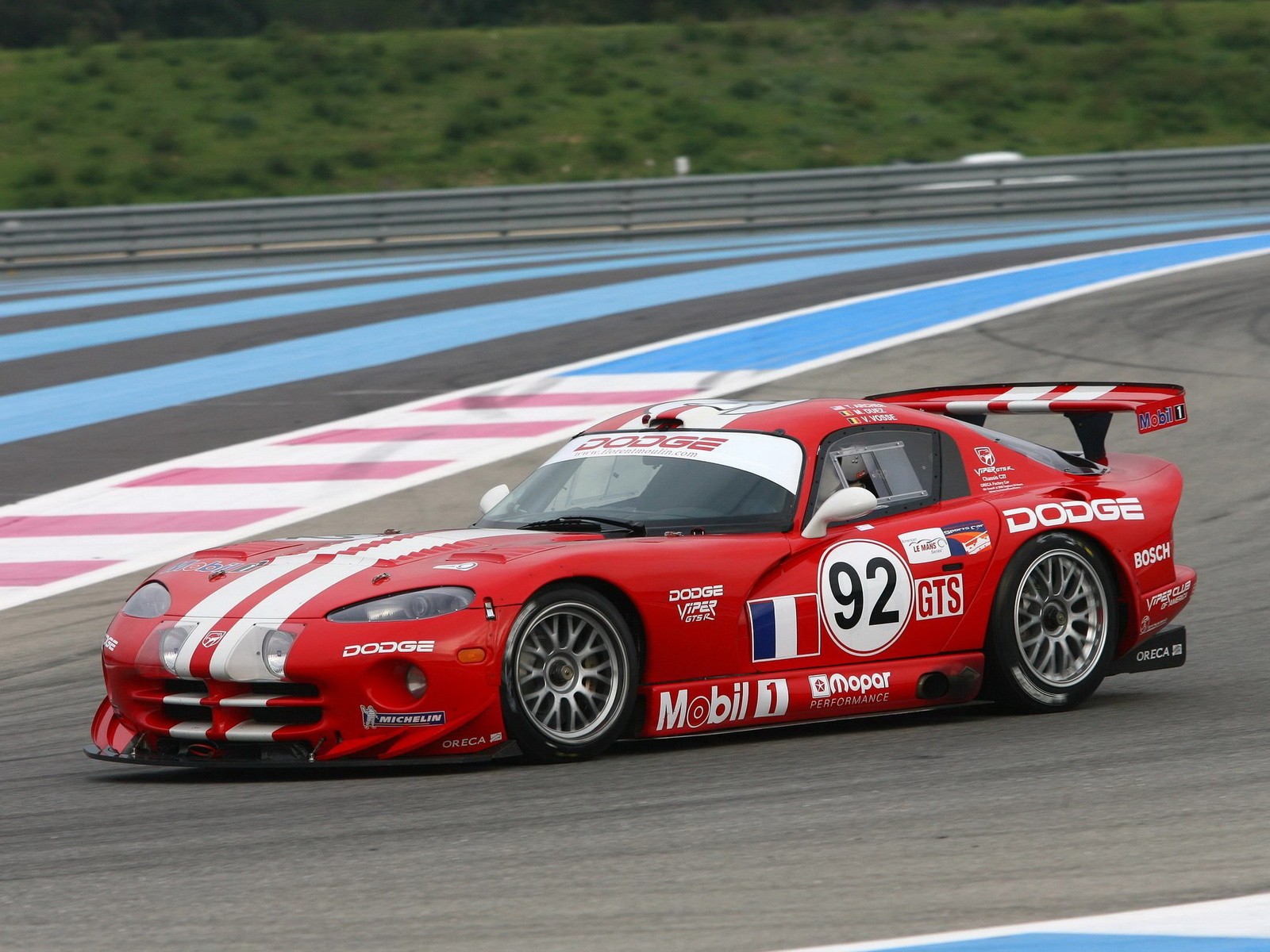
The Viper GTS-R is the racing version of the Dodge Viper GTS coupé, raced as the Chrysler Viper GTS-R in Europe. Chrysler unveiled it in 1995; Oreca built and ran the cars on a Reynard-made chassis, and 57 were made until 2005. Its 8.0-litre V10 gave 450–570 kW (600–770 hp), and it won its class at Le Mans in 1998, 1999 and 2000.
In short
- Built from 1995 to 2005: five prototypes and 52 further cars, with Oreca in France and Reynard Motorsport in England.
- Engine: naturally aspirated 7,998 cc V10 with 450–570 kW (600–770 hp) and 725–988 Nm, six-speed manual gearbox.
- Results: GTS class wins at Le Mans 1998–2000, FIA GT titles in 1997–1999 and 2001–2002, and outright victory at the 2000 Daytona 24 Hours.
- The name returned in 2012 on the SRT Viper GTS-R, which won the GTLM class of the US sports car championship in 2014.

The Dodge Viper GTS-R at a glance
Chrysler approved a works racing programme in 1995, while Dodge was preparing the Viper GTS coupé. The race car was shown at the Pebble Beach Concours that year. Oreca, a racing team based in France, built and ran the cars, Reynard Motorsport made the basic chassis and many parts, and the Canadian team Canaska/Southwind ran the first North American effort. In Europe the cars raced as Chryslers, because Dodge was not sold there. The brand's road cars are listed in the Dodge catalogue, and its story is told in the history of Dodge.
| Fact | Value |
|---|---|
| Makers | Chrysler, with Oreca (France) and Reynard Motorsport (UK) |
| Shown | Pebble Beach Concours, 1995 |
| Racing debut | Daytona 24 Hours, 1996 |
| Production | 1995–2005, 57 cars (5 prototypes + 52) |
| Class | GT2, later GTS (FIA GT, Le Mans, ALMS) |
| Engine | 7,998 cc V10, naturally aspirated |
| Power | 450–570 kW (600–770 hp) |
| Weight | 1,150 kg |
Engine and gearbox: an 8.0-litre V10 just under the limit
The engine is the Viper's overhead-valve V10, enlarged to 7,998 cc so that it stayed just under the 8,000 cc limit of the rules. Changes from the road engine were modest: new intakes and reinforcements for endurance racing. Depending on the year, the series and the air restrictors, it produced 450–570 kW (600–770 hp) and 725–988 Nm. Power went to the rear wheels through a six-speed manual gearbox, a BorgWarner T56 or a Tremec. The side exhausts run under the doors, as on the road car.
One team took a different route: from 1998 to 2002 the Zakspeed squad from Germany raced a car with a 6.2-litre V8 developed from the Viper's engine family.
Chassis, body and dimensions
The GTS-R uses a steel spaceframe chassis and keeps much of the Viper GTS body. The race car adds a large rear wing, a rear diffuser, a front splitter, vents in the bonnet and intakes in the roof and rear wings. The old 1cars text credits Reynard engineer Paul Brown with the chassis design.

| Parameter | Metric | Imperial |
|---|---|---|
| Length | 4,548 mm | 179.1 in |
| Width | 1,924 mm | 75.7 in |
| Height | 1,146 mm | 45.1 in |
| Wheelbase | 2,243 mm | 88.3 in |
| Weight | 1,150 kg | 2,540 lb |
| Engine | 7,998 cc V10 | 488 cu in |
| Power | 450–570 kW | 600–770 hp |
| Torque | 725–988 Nm | 535–729 lb-ft |
| Gearbox | 6-speed manual | 6-speed manual |
By our calculation, at its peak rating the car carried only about 2 kg per kW, a ratio that few road cars of the time could match. To see how modern road cars compare, browse our ranking of the most powerful coupés.
Racing record: Le Mans, Daytona and FIA GT
The first season was a learning year. At the 1996 Daytona 24 Hours the Canaska/Southwind car finished 29th, and at Le Mans that June three of the four Vipers finished, the best in tenth place. From 1997 the car began to win. Oreca took the FIA GT Championship GT2 team and driver titles in October 1997, and the Viper won the series again in 1998, 1999, 2001 and 2002.
| Year | Result |
|---|---|
| 1995 | Programme approved; car shown at Pebble Beach |
| 1996 | Debut at Daytona (29th) and Le Mans (best 10th) |
| 1997 | FIA GT Championship GT2 titles for Oreca |
| 1998 | GTS class win at Le Mans (11th overall); FIA GT title; British GT drivers' title |
| 1999 | GTS class win at Le Mans; FIA GT title for Olivier Beretta and Karl Wendlinger; ALMS title |
| 2000 | Outright win at the Daytona 24 Hours; GTS class win at Le Mans; ALMS title |
| 2001 | Chrysler factory support ends; privateers continue |
| 2003 | Last Le Mans appearance |
| 2006 | Last win, at Magny-Cours in the French GT series |
The 2000 Daytona win stands out: a GT car beat the prototypes, finishing narrowly ahead of the factory Corvettes. Over its career the GTS-R started 445 races and won 162, with 213 podiums, 117 pole positions and dozens of championships for constructors and drivers. Even Alain Prost raced one, in the French GT championship of 2005.
The 2000 GTS-R concept and the GT2 Champion Edition
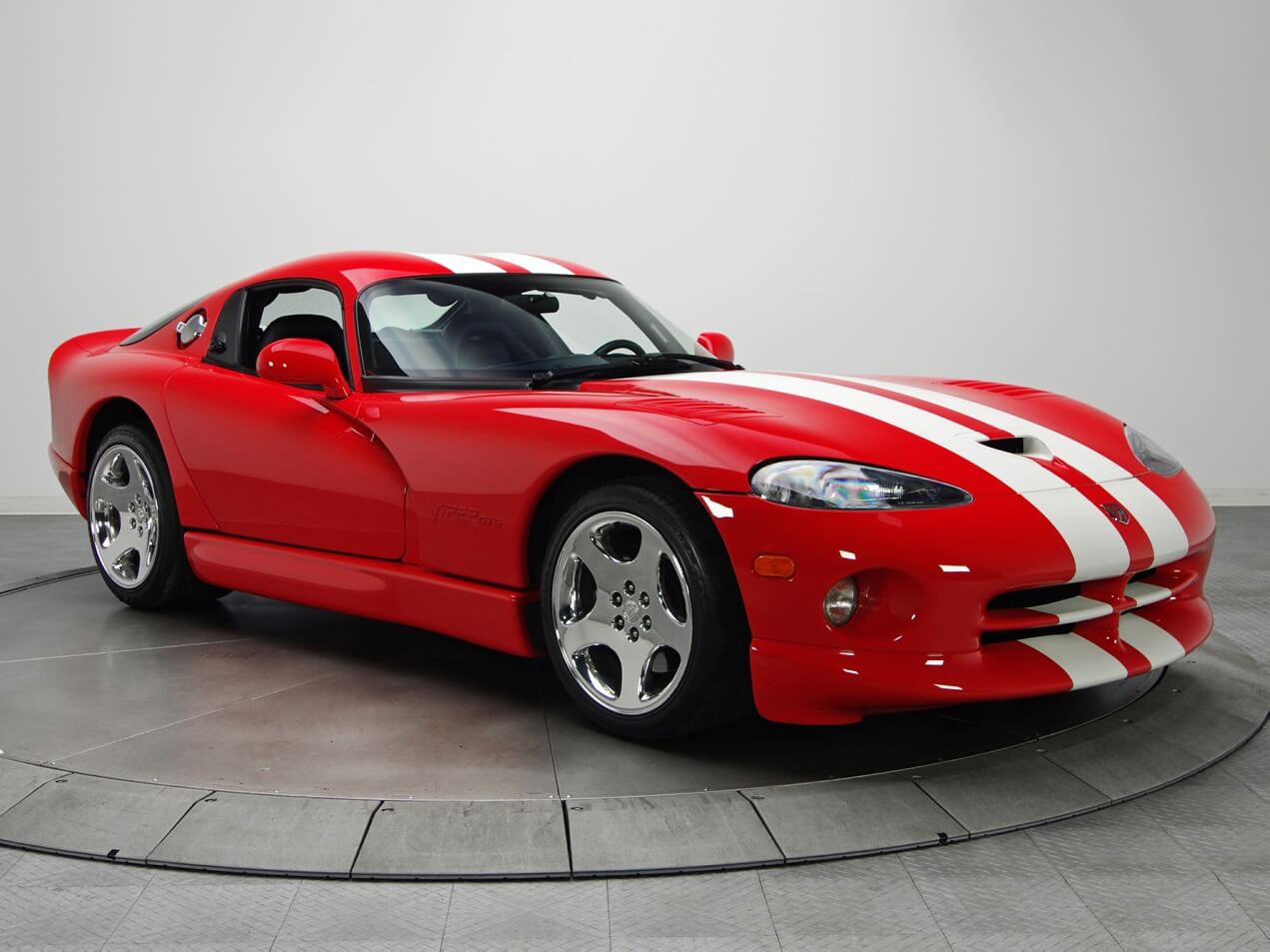
After the 1997 titles Dodge offered a road-going GT2 Champion Edition through its main Viper dealers. It was planned as a run of 100 cars with a large rear wing, front dive planes, a splitter and side sills. Inside and out it added BBS wheels, GTS-R badges, Oreca five-point racing belts and a numbered plaque on the dashboard.

In 2000 Dodge also showed a Viper GTS-R concept car. According to the old 1cars text, it was designed by Osamu Shikado, with a large rear wing, a roof intake and a big diffuser. Its cabin had air conditioning, adjustable pedals and a premium audio system. Its styling pointed the way to the second-generation road Viper.
The SRT Viper GTS-R of 2012–2014
The name returned in 2012, when SRT Motorsports brought the new SRT Viper GTS-R to the American Le Mans Series, at the same time as the new road car. Its road-going sister, the SRT Viper GTS, used an 8.4-litre V10 with 477 kW (640 hp); our ranking of the fastest coupés shows where such road cars stand today. In 2014 the race car won the GTLM class of the United SportsCar Championship, after which factory support ended. The GT3-R version was homologated for customer racing in FIA GT3 from 2013. The track-focused road car of the same era is covered on our Viper ACR page.

Rivals: how the GTS-R compared
| Model | Engines | Power (hp) | Boot (l) | Price from (EUR) |
|---|---|---|---|---|
| Chrysler Viper GTS-R | 8.0 l V10 | 600–770 | – | race car, not sold new |
| Porsche 911 GT2 (993) | 3.6 l twin-turbo flat-six | varied with restrictors | – | race car |
| Chevrolet Corvette C5-R | 7.0 l V8 | varied with restrictors | – | race car |
Compared with the turbocharged Porsche 911 GT2, the Viper relied on sheer displacement and torque, which made it simple and durable over 24 hours. Its later rival in the GTS class was the Corvette C5-R, which it beat at Daytona in 2000 and which took over as the class benchmark after Chrysler withdrew.

Rivals
Compare with…
Compare Dodge Viper GTS-R with
- BMW M3 GTR quick spec comparison

Dodge Viper GTS-R photos 13


Dodge Viper GTS-R videos 2

Dodge Viper GTS-R video 1

Video overview
FAQ
How many Viper GTS-R race cars were built?
A total of 57 cars were made between 1995 and 2005: five prototypes and 52 further cars. Oreca built 18 of the chassis, and the rest went to customer teams in Europe and North America.
What engine does the Viper GTS-R have?
It uses a naturally aspirated 7,998 cc V10, just under the 8.0-litre class limit. Depending on the series and restrictors, it produced 450–570 kW (600–770 hp) and 725–988 Nm through a six-speed manual gearbox.
Did the Viper GTS-R win Le Mans?
It won the GTS class at the 24 Hours of Le Mans three times, in 1998, 1999 and 2000; in 1998 it finished 11th overall. It also won the 2000 Daytona 24 Hours outright, ahead of the prototypes.
Was the Viper GTS-R sold as a road car?
Not as a race car, but Dodge offered the road-going GT2 Champion Edition after the 1997 titles, planned as 100 cars with the racer's wing, splitter, BBS wheels and numbered plaque.
Why is it called a Chrysler in Europe?
Dodge was not sold in Europe in the 1990s, so Chrysler entered the cars in European races under its own name. In North America the same car raced as the Dodge Viper GTS-R.
Data sources
Data checked by an editor against the sources below.
- Wikipedia - Dodge Viper
- Wikipedia - Chrysler Viper GTS R
- Wikipedia - Dodge Viper GTS R


