
 Gumpert Apollo
Specs, engines and history
Updated Published Sources (2) Report an error
By Felix Hartmann, Automotive Technology & EV Contributor Reviewed by Oleksandr Hnatiuk

- Built
- 2005–2013
- Top power
- 478 kW (650 PS)
Who the Apollo suits: verdict
Our verdict · Felix Hartmann
The Apollo suits a collector or track-day driver who values a raw, race-derived car over comfort and badge. It is rare, mechanically robust thanks to its Audi-based engine, and genuinely fast on a circuit. The trade-offs are a cramped cabin, poor rear visibility, a firm ride and the uncertain support that comes with a small, insolvent maker. When considering a car, check its history, the condition of the spaceframe and the gearbox, and the availability of body panels. Other cars from the brand are in the Gumpert catalogue.
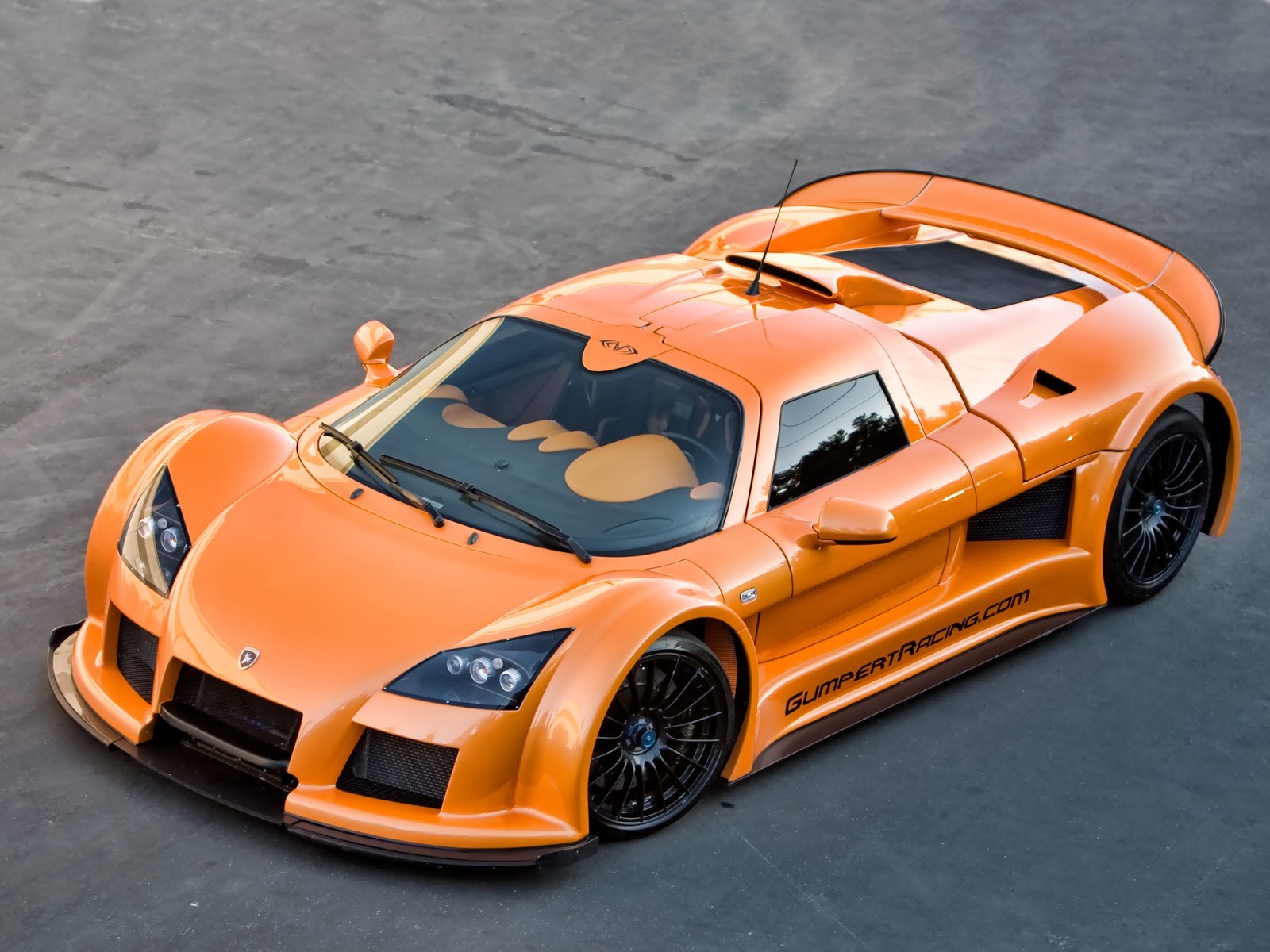
The Gumpert Apollo is a mid-engined supercar built in Altenburg, Germany, from late 2005 until the maker's insolvency in 2013. Created by former Audi motorsport chief Roland Gumpert, it combines a chrome-molybdenum spaceframe with an Audi-based 4.2-litre twin-turbo V8 of 478 kW (650 PS) or more. It reaches 360 km/h and set a Top Gear lap record in 2008.
In short
- Production from 21 December 2005 to 2013; only around 40 to 60 cars were built and sold.
- Engine: 4.2-litre (4,163 cc) twin-turbo V8 based on an Audi block, 478 kW (650 PS) and 850 Nm as standard, with 515 kW (700 PS) and 588 kW (800 PS) options.
- 0–100 km/h in 3.1 s, 0–200 km/h in 9.1 s and a top speed of 360 km/h for the 650 PS car.
- Price at production start €198,000 before tax, later €301,600 before VAT.

Size at a glance
Pagani Zonda R
The Gumpert Apollo is 426 mm shorter, 16 mm narrower and 33 mm lower than the Pagani Zonda R.
| Dimensions | Gumpert Apollo | Pagani Zonda R | Difference |
|---|---|---|---|
| Length | 4,460 mm175.6 in | 4,886 mm192.4 in | −426 mm−16.8 in |
| Width | 1,998 mm78.7 in | 2,014 mm79.3 in | −16 mm−0.6 in |
| Height | 1,114 mm43.9 in | 1,147 mm45.2 in | −33 mm−1.3 in |
| Wheelbase | 2,700 mm106.3 in | - | - |
Specs by version
Engines
Performance
Show all 1 versions
| Version | 0–100 km/h |
|---|---|
| 4.2 478 kW (650 PS) Coupe | 3.1 s 0–62 mph |
Dimensions and weight
Verified Manufacturer and type-approval data from our catalog · Sources and methodology
Gumpert Apollo at a glance
Roland Gumpert led Audi Sport during its rally years and began work on his own car in 2002, under the project name R1. His aim was a car that could be driven to a race track, set competitive lap times and be driven home again. The result has the proportions of a sports prototype: very low, nearly two metres wide, with large air intakes, a big rear diffuser and aerodynamics designed to create strong downforce. The company's story is told in the history of Gumpert.
| Fact | Value |
|---|---|
| Maker | Gumpert Sportwagenmanufaktur, Altenburg, Germany |
| Founder | Roland Gumpert, former head of Audi Sport |
| Production | 21 December 2005 – 2013 |
| Units built | About 40–60 (exact figure not published) |
| Layout | Mid-engine, rear-wheel drive |
| Chassis | Chrome-molybdenum tubular spaceframe |
| Body | Glass-fibre or carbon-fibre panels |
| Engine | 4.2 l twin-turbo V8, Audi-based |
| Power | 478 kW (650 PS) standard |
Spaceframe chassis and body
The Apollo uses a racing-car structure. Its spaceframe is made of about 200 welded chrome-molybdenum steel tubes of 25, 35 and 45 mm diameter, with a 23 kg carbon monocoque cell inside it for the occupants. The structure is designed to withstand accelerations of up to 50 g. The body panels are not load-bearing and are made of glass fibre as standard or carbon fibre as an option.

Weight is 1,100–1,200 kg, depending on equipment. The old 1cars text gives a dry weight of 1,200 kg for the Apollo Sport. Gumpert said that the aerodynamic downforce at high speed would in theory be enough to let the car drive along the roof of a tunnel, a claim that underlines how far the design goes towards a race car.
| Parameter | Metric | Imperial |
|---|---|---|
| Length | 4,460 mm | 175.6 in |
| Width | 1,998 mm | 78.7 in |
| Height | 1,114 mm | 43.9 in |
| Wheelbase | 2,700 mm | 106.3 in |
| Weight | 1,100–1,200 kg | 2,425–2,646 lb |
| Wheels | 19-inch cast aluminium | – |
Twin-turbo V8 and gearbox
The engine is based on the 4.2-litre Audi V8 block but uses parts made for the Apollo, including its own crankshaft. With two turbochargers and intercoolers, the standard version produces 478 kW (650 PS) at 6,000 rpm and 850 Nm at 4,500 rpm. Power reaches the rear wheels through a six-speed sequential gearbox.

| Version | Power | Notes |
|---|---|---|
| Apollo (standard) | 478 kW (650 PS) | 850 Nm |
| Optional engine | 551 kW (750 PS) | Offered as an upgrade |
| Apollo Sport / S | 515 kW (700 PS) | From 2007, with rear wing and air jacks |
| Apollo Race | 588 kW (800 PS) | Track version |
| Apollo Enraged | 574 kW | Three cars, 2012 |
| Apollo R | up to 633 kW | Race car only, 2012 |
The old 1cars text gives an engine weight of 195 kg. The brakes use 15-inch discs with six-piston calipers and ABS.
Performance and the Top Gear lap
For the 650 PS car, Gumpert quotes 0–100 km/h in 3.1 seconds, 0–200 km/h in 9.1 seconds and a top speed of 360 km/h. In 2008, in series 11 of the BBC's Top Gear, the Apollo Sport lapped the programme's test track in 1 minute 17.1 seconds, the fastest time on the board at that point. It stayed at the top for two years, until the Bugatti Veyron Super Sport went faster. Other fast two-seaters are listed in the fastest coupés ranking. The German magazine Sport Auto timed an Apollo at 7:11.57 on the Nürburgring Nordschleife.

Cabin and equipment
The cabin is narrow and functional, with leather trim and a dashboard made of carbon fibre to save weight. There is no rear window, so a camera and a display replace the rear-view mirror. The seats are fixed to the body and were made to measure for each customer; instead, the pedal box adjusts fore and aft, and the steering wheel is removable to make getting in easier. The Apollo Speed of 2009 sat 9 mm lower and had revised aerodynamics with an adjustable rear wing.

Apollo versions and price
| Version | Year | Main changes |
|---|---|---|
| Apollo | 2005 | Base car, 650 PS |
| Apollo Sport / S | 2007 (Geneva) | 700 PS, rear wing, air-jacking system |
| Apollo Speed | 2009 (Geneva) | 9 mm lower, adjustable wing, revised aero |
| Apollo Enraged | 2012 | 574 kW, three cars, most powerful road version |
| Apollo R | 2012 | Race car, up to 633 kW |
In 2003, Gumpert planned a price of €115,000 to €175,000. At the start of production in 2005 the Apollo cost €198,000 before tax, and later €301,600 before VAT. The production line in Altenburg was designed for about 60 cars a year, but demand never reached that level.
End of production and the Apollo N
Gumpert filed for insolvency in August 2013, which ended production of the Apollo. The rights were sold to an investor from Hong Kong, the company was renamed, and in 2016 it showed the Apollo N at the Geneva Motor Show, with 515 kW (700 PS), 880 Nm and a top speed of 360 km/h. The Apollo N did not enter series production.

Gumpert Apollo compared with its rivals
| Model | Engine | Power | Top speed | Weight |
|---|---|---|---|---|
| Gumpert Apollo | 4.2 l V8 twin-turbo | 478 kW (650 PS) | 360 km/h | 1,100–1,200 kg |
| McLaren F1 | 6.1 l V12 | 461 kW (627 PS) | 386.4 km/h (record) | 1,260 kg kerb |
| Bugatti Veyron 16.4 | 8.0 l W16 quad-turbo | 736 kW (1,001 PS) | 408.47 km/h | 1,888 kg |
The Apollo's strength is its power-to-weight ratio: at about 1,150 kg and 478 kW it carries around 2.4 kg per kW, against about 2.6 kg per kW for a Veyron and 2.7 for a McLaren F1 at kerb weight, figures you can check with the power-to-weight calculator. Its weakness, compared with the Veyron, is everyday usability. Track-only cars such as the Pagani Zonda R go further still, but cannot be registered for the road.

Rivals
Compare with…
Compare Gumpert Apollo with
- Pagani Zonda R quick spec comparison
-
Ended 2013
- Years
- 2009–2013
- Body
- Coupe
- Fuel
- Petrol
- Power
- 552–588 kW (751–799 PS)

Popular comparisons
Gumpert Apollo in our rankings
- No. 2 of 59 · Quickest cars of the 2000s, 0–100 (3.1 s)
- No. 5 of 102 · Quickest German cars, 0–100 (3.1 s)
- No. 9 of 207 · Most powerful cars of the 2000s (478 kW)
- No. 28 of 402 · Quickest cars, 0–100 (3.1 s · top 8%)
- No. 14 of 168 · Most powerful German cars (478 kW · top 9%)
- No. 48 of 580 · Widest cars (1,998 mm · top 9%)
Quicker from 0 to 100 km/h than 96% of ranked cars of the 2000s in the 1CARS catalog (No. 2 of 59).
Gumpert Apollo photos 14


FAQ
How fast is the Gumpert Apollo?
The standard 650 PS Apollo reaches 360 km/h, accelerates from 0 to 100 km/h in 3.1 seconds and reaches 200 km/h in 9.1 seconds, according to the manufacturer's figures.
What engine does the Gumpert Apollo use?
It uses a 4.2-litre twin-turbo V8 based on an Audi block, with its own crankshaft and other internal parts. The standard output is 478 kW (650 PS) and 850 Nm; options went up to 588 kW (800 PS).
How many Gumpert Apollos were made?
The exact number has not been published. Between the start of production in December 2005 and the insolvency in 2013, about 40 to 60 cars were built and sold.
How much did the Gumpert Apollo cost?
At the start of production in 2005 the price was €198,000 before tax. Later price lists showed €301,600 before VAT for the base car, with options and stronger engines costing extra.
What was the Gumpert Apollo's Top Gear lap time?
In 2008 the Apollo Sport lapped the Top Gear test track in 1 minute 17.1 seconds, the fastest time on the board at that point. It held the top spot for two years.
Data sources
Data checked by an editor against the sources below.
- The text of this article (1cars archive)
- Wikipedia - Gumpert Apollo


