 Bugatti Veyron
Specs, engines and history
Updated Published Sources (6) Report an error
By Felix Hartmann, Automotive Technology & EV Contributor Reviewed by Oleksandr Hnatiuk

- Built
- 2005–2015
- Top power
- 882 kW (1,199 PS)
- New price
- from about €1,160,000 (2005)
Owning a Veyron today: verdict
Our verdict · Felix Hartmann
The Veyron suits a collector who wants the car that changed what a road car could do, and who can afford its running costs. It is comfortable, stable at speed and usable on ordinary roads, which makes it a true grand tourer as well as a record car. The costs are extreme: servicing must be done by Bugatti, and items such as tyres and wheels are expensive. The Grand Sport and Vitesse add open-air driving; the Super Sport and Vitesse are the fastest and most valuable. More cars from Molsheim are in the Bugatti catalogue.
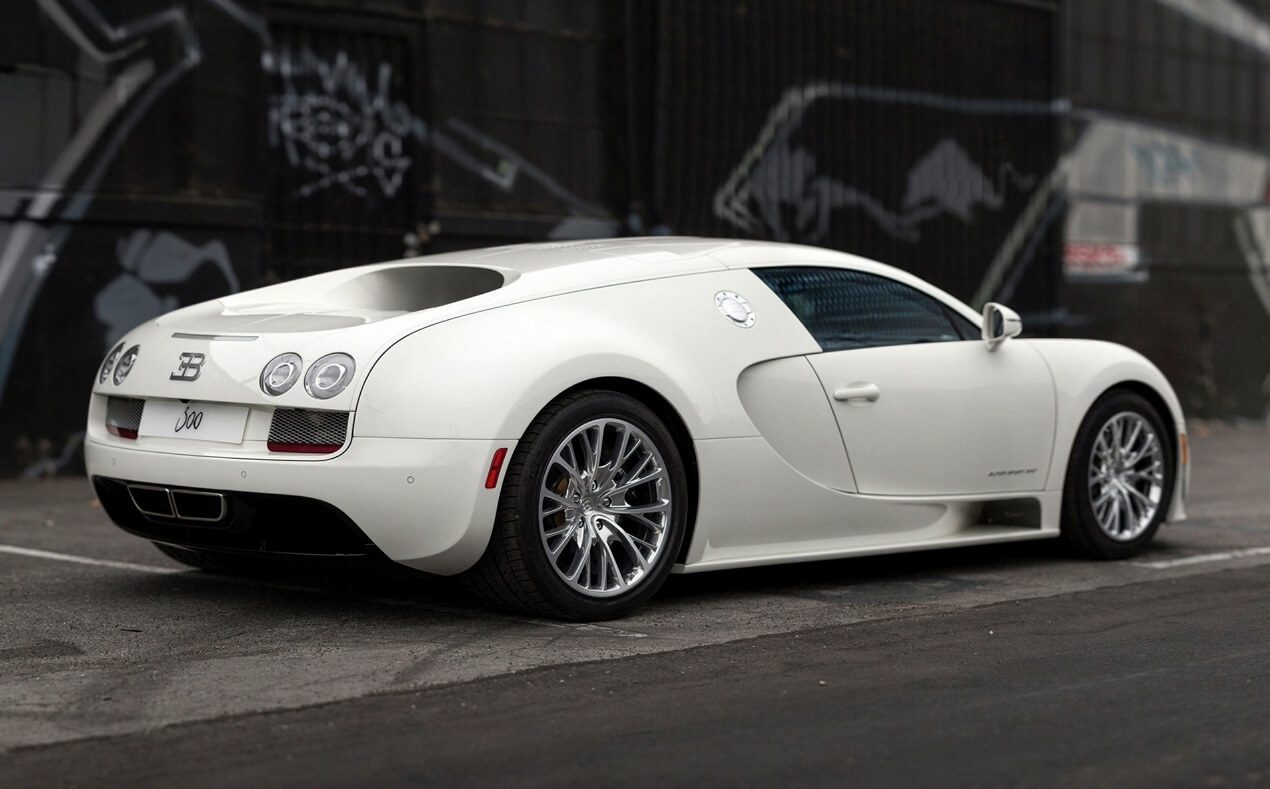
The Bugatti Veyron is a mid-engined, all-wheel-drive hypercar built by Bugatti in Molsheim, France, from 2005 to 2015. Its 8.0-litre W16 with four turbochargers produced 736 kW (1,001 PS) in the 16.4 coupé and 882 kW (1,200 PS) in the Super Sport, which reached 431.072 km/h in 2010. Bugatti built 450 cars in four main versions.
In short
- Production 2005–2015 in Molsheim: 252 coupés, 58 Grand Sport roadsters, 48 Super Sports and 92 Grand Sport Vitesses.
- 7,993 cc W16 engine with four turbochargers and ten radiators; seven-speed dual-clutch gearbox by Ricardo; permanent all-wheel drive.
- 408.47 km/h in April 2005 (16.4) and 431.072 km/h in 2010 (Super Sport); 0–100 km/h in about 2.5 seconds.
- Launch price €1,225,000; Super Sport and Grand Sport Vitesse €1,912,500.

Size at a glance
| Dimensions | Bugatti Veyron |
|---|---|
| Length | 4,462 mm175.7 in |
| Width | 1,998 mm78.7 in |
| Height | 1,204 mm47.4 in |
| Wheelbase | 2,710 mm106.7 in |
Specs by version
Engines
| Version | Engine | Gearbox | Drive | Production years |
|---|---|---|---|---|
| 8 L 16 cyl Automatic (AM-S7) · 2015 (EPA) | 8.0 l · 16 cyl 8,000 cc | 7-sp Dual-clutch | All-wheel drive | 2015 |
| 8 L 16 cyl Automatic (AM-S7) · 2014 (EPA) | 8.0 l · 16 cyl 8,000 cc | 7-sp Dual-clutch | All-wheel drive | 2014 |
| 8 L 16 cyl Automatic (AM-S7) · 2013 (EPA) | 8.0 l · 16 cyl 8,000 cc | 7-sp Dual-clutch | All-wheel drive | 2013 |
| 8 L 16 cyl Automatic (S7) · 2012 (EPA) | 8.0 l · 16 cyl 8,000 cc | 7-sp Automatic | All-wheel drive | 2012 |
| 8 L 16 cyl Automatic (S7) · 2011 (EPA) | 8.0 l · 16 cyl 8,000 cc | 7-sp Automatic | All-wheel drive | 2011 |
| 8 L 16 cyl Automatic (S7) · 2010 (EPA) | 8.0 l · 16 cyl 8,000 cc | 7-sp Automatic | All-wheel drive | 2010 |
| 8 L 16 cyl Automatic (S6) · 2008 (EPA) | 8.0 l · 16 cyl 8,000 cc | 6-sp Automatic | All-wheel drive | 2008 |
| Veyron 16.4 | 8.0 l · 16 cyl · Petrol 7,993 cc | 7-sp Dual-clutch | All-wheel drive | - |
Performance
Show all 8 versions
| Version | Fuel consumption |
|---|---|
| 8 L 16 cyl Automatic (AM-S7) · 2015 (EPA) | 23.5 l/100 km10.0 mpg US · 12.0 mpg UK |
| 8 L 16 cyl Automatic (AM-S7) · 2014 (EPA) | 23.5 l/100 km10.0 mpg US · 12.0 mpg UK |
| 8 L 16 cyl Automatic (AM-S7) · 2013 (EPA) | 23.5 l/100 km10.0 mpg US · 12.0 mpg UK |
| 8 L 16 cyl Automatic (S7) · 2012 (EPA) | 23.5 l/100 km10.0 mpg US · 12.0 mpg UK |
| 8 L 16 cyl Automatic (S7) · 2011 (EPA) | 23.5 l/100 km10.0 mpg US · 12.0 mpg UK |
| 8 L 16 cyl Automatic (S7) · 2010 (EPA) | 23.5 l/100 km10.0 mpg US · 12.0 mpg UK |
| 8 L 16 cyl Automatic (S6) · 2008 (EPA) | 23.5 l/100 km10.0 mpg US · 12.0 mpg UK |
| Veyron 16.4 | - |
Dimensions and weight
Show all 1 versions
| Version | Length | Width | Height | Wheelbase |
|---|---|---|---|---|
| Veyron 16.4 | 4,462 mm175.7 in | 1,998 mm78.7 in | 1,204 mm47.4 in | 2,710 mm106.7 in |
Verified Manufacturer and type-approval data from our catalog · Sources and methodology
Bugatti Veyron at a glance
The Veyron was the car that relaunched Bugatti under Volkswagen ownership. Volkswagen bought the Bugatti name in May 1998 and decided in 2001 to put the car into production. The target was more than 1,000 PS and over 400 km/h, figures no road car had reached. The name honours Pierre Veyron, a Bugatti development engineer and racing driver who won the 1939 24 Hours of Le Mans with Jean-Pierre Wimille. "EB" stands for Ettore Bugatti, and "16.4" for 16 cylinders and four turbochargers. The brand's story is in the history of Bugatti.

| Fact | Value |
|---|---|
| Maker | Bugatti Automobiles, Molsheim, Alsace, France |
| Owner at the time | Volkswagen Group |
| Production | 2005–2015 |
| Units built | 450 |
| Designer | Jozef Kabaň (exterior), chief designer Hartmut Warkuß |
| Layout | Mid-engine, all-wheel drive |
| Engine | 8.0 l W16, four turbochargers |
| Power | 736 kW (1,001 PS); 882 kW (1,200 PS) in Super Sport and Vitesse |
| Successor | Bugatti Chiron (2016) |
From concept cars to production
Bugatti showed a series of concept cars before the Veyron took shape. The EB 118 coupé appeared at the 1998 Paris show, the EB 218 saloon at Geneva in 1999, and the mid-engined 18/3 Chiron at Frankfurt in 1999, with an 18-cylinder engine. The EB 18/4 Veyron followed in Tokyo in October 1999. In 2000 the EB 16/4 Veyron, shown at Detroit, Geneva and Paris, introduced the W16 engine of the production car. Development took longer than planned, and the first customer cars appeared in 2005.

The W16 engine, gearbox and cooling
The engine is effectively two narrow-angle V8s joined on one crankshaft, with four turbochargers. In the standard car it produces 736 kW (1,001 PS) at 6,000 rpm and 1,250 Nm. A seven-speed dual-clutch gearbox built by Ricardo sends the power to all four wheels. Keeping this engine, its charge air and the drivetrain oils at the right temperature takes ten radiators in total.

| Parameter | 16.4 / Grand Sport | Super Sport / Grand Sport Vitesse |
|---|---|---|
| Engine | 7,993 cc W16, quad-turbo | 7,993 cc W16, quad-turbo |
| Power | 736 kW (1,001 PS) at 6,000 rpm | 882 kW (1,200 PS) at 6,400 rpm |
| Torque | 1,250 Nm | 1,500 Nm at 3,000–5,000 rpm |
| Gearbox | 7-speed dual-clutch (Ricardo) | 7-speed dual-clutch (Ricardo) |
| Drive | All-wheel drive | All-wheel drive |
| 0–100 km/h | about 2.5 s | about 2.5–2.6 s |
| Top speed | 408.47 km/h (record), 343 km/h normally limited | 431.072 km/h (record), 415 km/h limited |
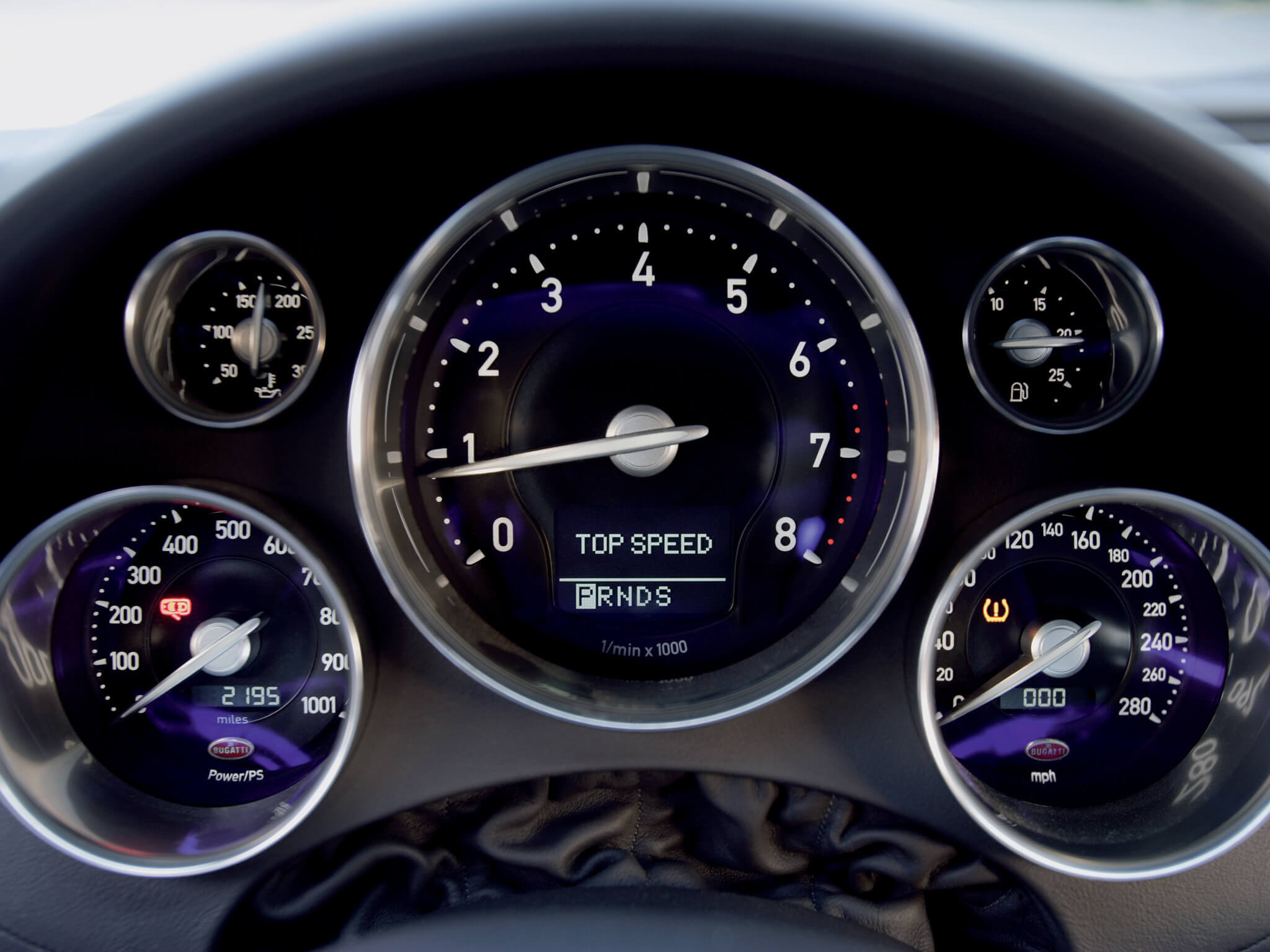
The old 1cars text adds 0–200 km/h in 7.3 seconds and 0–300 km/h in 16.7 seconds for the 16.4. It also describes a power gauge on the dashboard, marked up to 1,000 horsepower, that shows how much of the engine's output the driver is using.
Speed, aerodynamics and the top-speed key
The Veyron's aerodynamics change with speed. According to the old 1cars text, the rear wing rises at 220 km/h, which increases drag but adds downforce on the rear axle. In this handling mode the car also lowers its ride height from 125 mm to about 80 mm at the front and 95 mm at the rear. To go beyond the normal limit of 343 km/h, the driver must stop and turn a second key, the top-speed key, which lowers the car further and retracts the wing for minimum drag. Under hard braking the wing tilts up to act as an air brake.

The 16.4 reached 408.47 km/h at Volkswagen's Ehra-Lessien test track in April 2005, measured by German inspection officials. In 2010 the Super Sport averaged 431.072 km/h there, a record for a production car at the time; customer cars of that version are electronically limited to 415 km/h. In 2013 the Grand Sport Vitesse averaged 408.84 km/h with the roof off.
Size, weight and cabin
| Parameter | Metric | Imperial |
|---|---|---|
| Length | 4,462 mm | 175.7 in |
| Width | 1,998 mm | 78.7 in |
| Height | 1,204 mm | 47.4 in |
| Wheelbase | 2,710 mm | 106.7 in |
| Kerb weight | 1,838–1,990 kg (by version) | 4,052–4,387 lb |
With about 1,900 kg, the Veyron is heavy for a two-seater, mostly because of the engine, the all-wheel-drive system and the cooling equipment. It is built as a grand tourer as much as a sports car: the cabin is trimmed in leather, aluminium and carbon fibre, and every car was configured to its owner's wishes. Luggage space at the front holds little more than a soft bag. The tyres were developed specially for the car, with brakes using carbon-ceramic discs and eight-piston calipers. Fuel use is high: the US EPA rated it at 29 l/100 km in town and 17 l/100 km on the highway.
Veyron versions
| Version | Years | Units | Notes |
|---|---|---|---|
| Veyron 16.4 | 2005–2011 | 252 | Coupé, 736 kW (1,001 PS) |
| Veyron 16.4 Grand Sport | 2009–2015 | 58 | Targa roadster with removable roof |
| Veyron 16.4 Super Sport | 2010–2011 | 48 | 882 kW (1,200 PS), 431.072 km/h |
| Veyron 16.4 Grand Sport Vitesse | 2012–2015 | 92 | Roadster with the Super Sport engine |
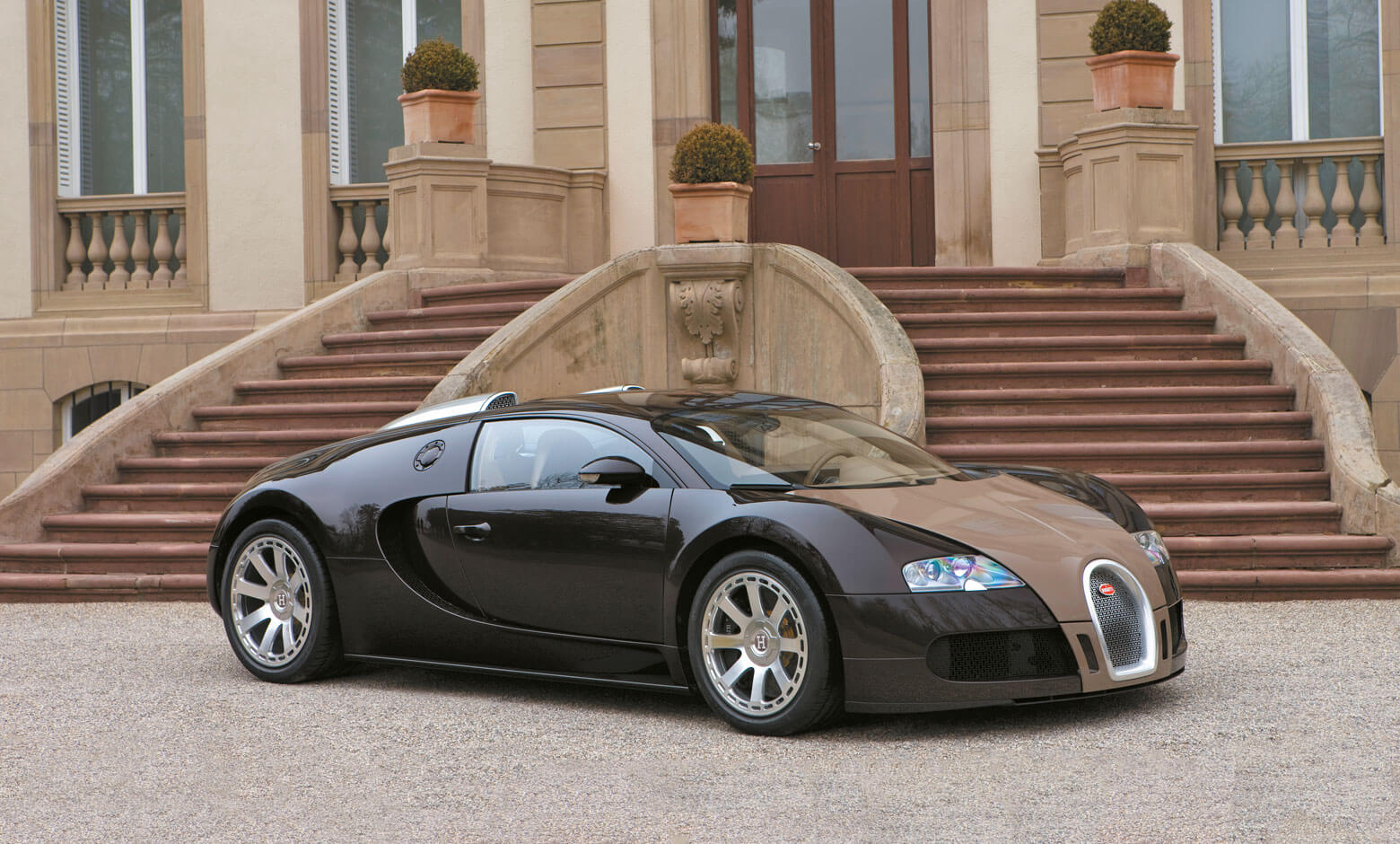
On top of these, Bugatti built many special editions. The old 1cars text lists the 2007 Pur Sang with bare carbon and aluminium bodywork and the 2008 Fbg par Hermès with an interior by Hermès. It also names the 2008 Sang Noir in black with an orange interior, the 2009 L'Édition Centenaire of four cars honouring Bugatti racing drivers, and the 2009 Nocturne. The last car, a Grand Sport Vitesse named "La Finale", was shown at the Geneva Motor Show in March 2015.

Bugatti Veyron compared with other hypercars
| Model | Years | Engine | Power | Top speed | Weight |
|---|---|---|---|---|---|
| Bugatti Veyron 16.4 | 2005–2011 | 8.0 l W16 quad-turbo | 736 kW (1,001 PS) | 408.47 km/h | about 1,888 kg |
| McLaren F1 | 1992–1998 | 6.1 l V12 | 461 kW (627 PS) | 386.4 km/h | 1,260 kg |
| Koenigsegg Agera R | from 2011 | 5.0 l V8 twin-turbo | 838 kW (1,140 PS) on E85 | 439 km/h (claimed) | about 1,435 kg |
| Bugatti Chiron | from 2016 | 8.0 l W16 quad-turbo | 1,103 kW (1,500 PS) | 420 km/h (limited) | – |
Compared with the McLaren F1, the Veyron has 60 per cent more power but weighs about 630 kg more. All-wheel drive and the dual-clutch gearbox make it much easier to drive fast. The Chiron kept the W16 but raised output to 1,500 PS. Our fastest cars ranking puts these figures in a wider context. At about 2.6 kg per kW, the Veyron 16.4 is lighter for its power than the McLaren F1 at 2.7 kg per kW, as the power-to-weight calculator confirms.

Popular comparisons
Bugatti Veyron in our rankings
- No. 1 of 201 · Most powerful cars of the 2000s (736 kW)
- No. 1 of 58 · Quickest cars of the 2000s, 0–100 (2.5 s)
- No. 1 of 56 · Fastest cars of the 2000s (408 km/h)
- No. 2 of 33 · Fastest French cars (408 km/h)
- No. 3 of 86 · Fastest coupes (408 km/h)
- No. 3 of 68 · Quickest coupes, 0–100 (2.5 s)
More powerful than 99% of ranked cars of the 2000s in the 1CARS catalog (No. 1 of 201).
Bugatti Veyron photos 33










Bugatti Veyron videos 4

Bugatti Veyron video 1

Crash test

Test drive
Video overview
FAQ
How fast is the Bugatti Veyron?
The Veyron 16.4 reached 408.47 km/h in April 2005. The Super Sport set a production-car record of 431.072 km/h in 2010; customer cars of that version are limited to 415 km/h. In normal driving mode, the standard car is limited to 343 km/h.
How much horsepower does the Bugatti Veyron have?
The Veyron 16.4 and Grand Sport have 736 kW (1,001 PS, 987 hp) and 1,250 Nm. The Super Sport and Grand Sport Vitesse produce 882 kW (1,200 PS, 1,183 hp) and 1,500 Nm.
How many Bugatti Veyrons were made?
Bugatti built 450 Veyrons between 2005 and 2015: 252 coupés, 58 Grand Sports, 48 Super Sports and 92 Grand Sport Vitesses, including the many special editions within those versions.
How much did the Bugatti Veyron cost?
At launch, the Veyron 16.4 and Grand Sport cost €1,225,000. The more powerful Super Sport and Grand Sport Vitesse were priced at €1,912,500, before options and individual specifications.
Why is the Bugatti Veyron called the 16.4?
The numbers describe the engine: 16 cylinders and four turbochargers. The Veyron name honours Pierre Veyron, the Bugatti engineer and driver who won the 1939 24 Hours of Le Mans.
Data sources
Data checked by an editor against the sources below.
- The text of this article (1cars archive)
- Wikipedia - Bugatti Veyron
- US EPA fueleconomy.gov - 34939.shtml
- US EPA fueleconomy.gov - 33614.shtml
- US EPA fueleconomy.gov - 32656.shtml
- US EPA fueleconomy.gov - 31619.shtml