 Bugatti Atlantic Concept
Specs, engines and history
Updated Published Sources (2) Report an error
By Felix Hartmann, Automotive Technology & EV Contributor Reviewed by Oleksandr Hnatiuk

Who would it have suited: our verdict
Our verdict · Felix Hartmann
The Atlantic would have suited buyers who wanted Bugatti craftsmanship without hypercar running costs: a two-seat GT for long journeys, with luggage space and a simpler V8. It would have competed with cars such as the Bentley Continental GT, the Aston Martin DBS Superleggera and front-engined Ferraris, rather than with the Chiron.
As a project, its value today is historical. It shows how close Bugatti came to a second, more usable model line in 2015, and why the brand stayed with limited W16 cars for the next decade. For readers interested in the name, the original Type 57SC Atlantic remains the more important car. All Bugatti models in our database are listed on the Bugatti brand page.
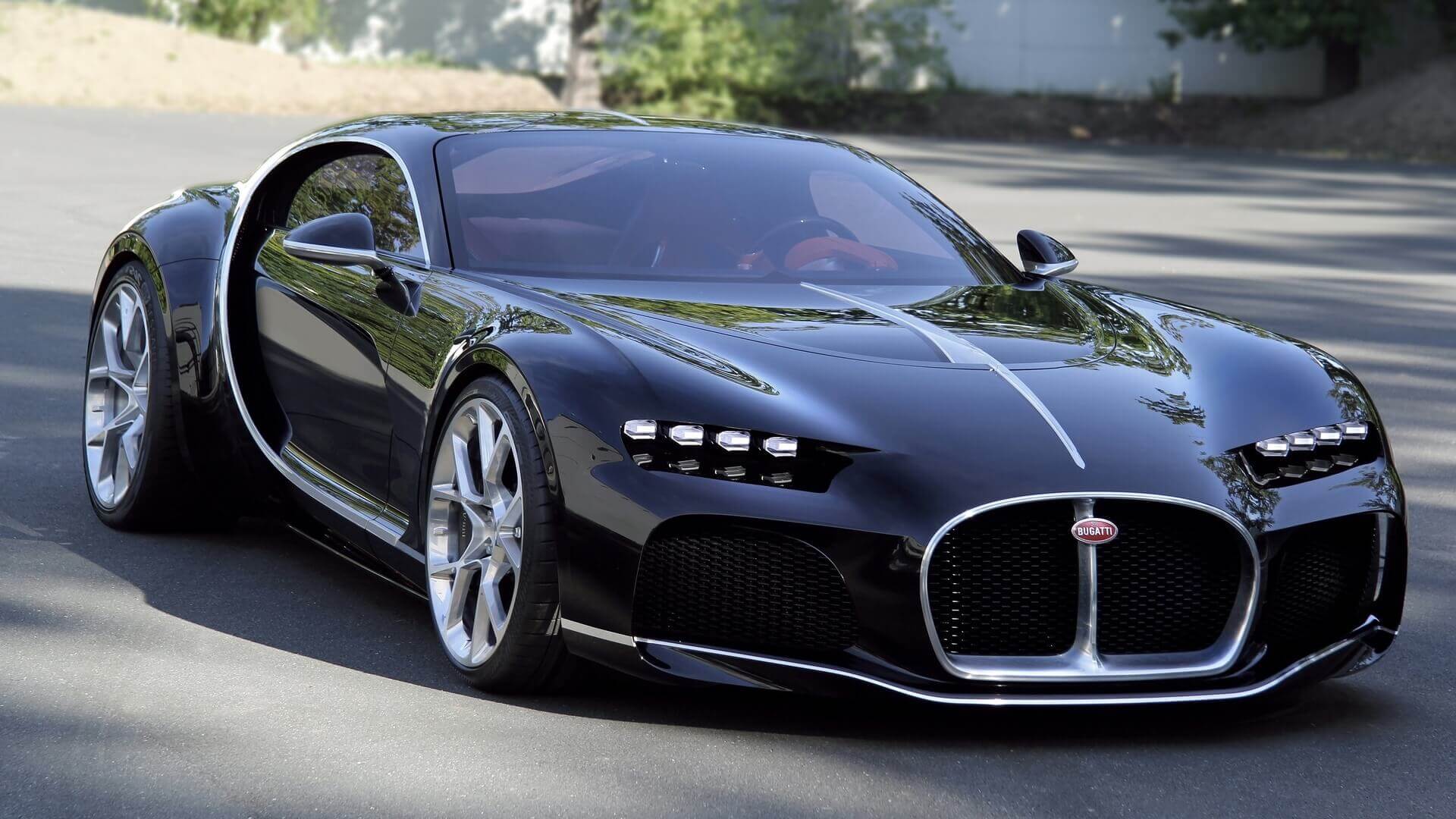
The Bugatti Atlantic is a two-seat, front-engined GT concept that Bugatti developed in 2015 as a second model next to the Chiron. It had a V8 engine, rear-wheel drive and a carbon-fibre monocoque. Its debut was planned for the Pebble Beach Concours d'Elegance in August 2015, but the project was stopped after the Dieselgate scandal and only revealed to the public in February 2020.
In short
- Concept for a smaller, more usable Bugatti, developed for about 18 months in 2014–2015; it did not reach production.
- Front-mounted V8 from the Volkswagen Group, rear-wheel drive through a transaxle, carbon monocoque, power-operated doors that swing upwards.
- Named after the 1936 Type 57SC Atlantic, a coupé of which only four were built.
- Cancelled when Dieselgate hit the Volkswagen Group in September 2015; Bugatti focused on the Chiron instead.
Bugatti Atlantic at a glance: what kind of car it was
Under Volkswagen ownership, from 1998, Bugatti built only two series models in two decades: the Veyron and the Chiron. Both are mid-engined hypercars with a quad-turbo W16. The Atlantic was a different idea: a front-engined grand tourer with a smaller engine, aimed at buyers who wanted a Bugatti they could use more often. The company's wider story is told in the history of Bugatti.

| Fact | Value |
|---|---|
| Type | Two-seat front-engined GT concept |
| Developed | 2014–2015 (about 18 months) |
| Planned debut | Pebble Beach Concours d'Elegance, August 2015 |
| Engine | V8 from a Volkswagen Group brand, front-mounted |
| Drive | Rear wheels, via a rear transaxle |
| Structure | Carbon-fibre monocoque |
| Status | Cancelled in 2015; revealed by Bugatti in February 2020 |
| Name | After the Type 57SC Atlantic of 1936 |
The public learned about the car in February 2020. Bugatti design chief Achim Anscheidt described it in interviews and the company released images of the Atlantic together with two other unseen projects.
Engine, drivetrain and planned performance
Bugatti has not published official figures for the Atlantic. What is known comes from the 2020 interviews and press reports:
| Parameter | Atlantic concept | Bugatti Chiron (for scale) |
|---|---|---|
| Engine position | Front | Mid |
| Engine | V8, twin-turbo according to press reports | 8.0 L quad-turbo W16 |
| Power | Not published | 1,103 kW (1,500 PS) |
| Drive | Rear-wheel drive, transaxle | All-wheel drive |
| Gearbox | Not published (old 1cars text: automated) | 7-speed dual-clutch |
| Body | Coupé, roadster considered | Coupé |

The transaxle puts the gearbox at the back, which spreads the weight more evenly between the axles; the same layout is used by many front-engined GT cars. Several outlets reported that a twin-turbo V8 was planned and that an electrified version drew on work from the Porsche Mission E project, which later became the Taycan. Bugatti did not confirm either detail, so treat them as reports rather than specifications.
In our ranking of the most powerful supercars the Chiron is ranked #3, behind two electric hypercars and as the most powerful car with a combustion engine on the list. The Atlantic was not meant to compete there; it was planned as the "everyday" model below it.
Design: the Type 57SC theme in a modern body
The design took the 1930s Atlantic as its model: a long bonnet, a short tail, strongly curved wings over the rear wheels and the horseshoe grille. The doors are power-operated and swing upwards, on a hinge similar to the one used on the Volkswagen XL1. According to the old 1cars text, the bodywork also had a large rear panel that lifts together with parts of the wings and roof to reach the luggage area, LED lights and large air intakes either side of the grille.

The concept avoided copying the original's best-known feature, the riveted seam running down the roof and tail. Instead, a raised line traced the same path along the body.
Interior and luggage space
Because the engine sits in front, the Atlantic had room for real luggage behind the seats. The old 1cars text mentions a set of four bespoke suitcases. The cabin used leather, carbon fibre and anodised aluminium; reports after the 2020 reveal described thick leather upholstery. The same old text describes heated electric bucket seats, a touch screen curving from the dashboard to the centre tunnel and a 16-speaker sound system. Bugatti did not confirm these interior details for a production car, as none was made.

Why the Atlantic was cancelled
Timing killed it. The Atlantic's Pebble Beach launch was postponed, and less than a month after the August 2015 event the Dieselgate emissions scandal broke at Volkswagen. Bugatti was the smallest and financially most fragile brand in the group. Its president at the time, Wolfgang Dürheimer, aimed to keep the company at break-even, and the business played safe for about two years.
The Chiron was too far advanced to stop and was unveiled at the Geneva Motor Show in March 2016. A second project, a larger front-engined W16 coupé, stayed at the sketch stage. Later, under Stephan Winkelmann, its spirit returned in the one-off La Voiture Noire of 2019, built on the Chiron, while limited editions such as the Divo and Centodieci were fast-tracked.
| Project | Year | Layout | Outcome |
|---|---|---|---|
| Veyron Barchetta | 2008 | Open two-seater on the Veyron Grand Sport | Not built |
| Atlantic | 2015 | Front-engined V8 GT | Cancelled after Dieselgate |
| W16 Coupé | mid-2010s | Front-engined GT with the Chiron's W16 | Sketches only |
| Chiron | 2016 | Mid-engined W16 hypercar | Series production |
| La Voiture Noire | 2019 | One-off on the Chiron, Atlantic tribute | Built and sold |
The original: Bugatti Type 57SC Atlantic
The name comes from one of the most famous Bugattis. The Type 57 range was designed by Jean Bugatti, son of the founder, and built from 1934 to 1940; about 710 cars were made, all with a 3.3-litre (3,257 cc) twin-cam straight-eight. The Atlantic coupé used the short Type 57S chassis with a 2,979 mm wheelbase. With a supercharger (SC), the engine produced about 149 kW (200 hp) and the car reached around 217 km/h.
Its forerunner, the 1935 Aérolithe show car, had a body of Elektron magnesium alloy. Elektron burns when welded, so the panels were riveted together, which produced the distinctive dorsal seam. The four production Atlantics of 1936–1938 had aluminium bodies but kept the riveted seam as a styling feature. The car was named after the pilot Jean Mermoz, a friend of the Bugatti family, who died when his flying boat was lost over the South Atlantic in December 1936.
Three of the four Atlantics survive. One belongs to the fashion designer Ralph Lauren and won Best of Show at Pebble Beach in 1990; another, chassis 57374, won the same award in 2003 and was sold in 2010 to a Californian collection for a reported sum in the tens of millions. The fourth, known as La Voiture Noire, vanished before the Second World War and is still missing.
| Atlantic | Delivered | First owner | Status |
|---|---|---|---|
| 57374 | September 1936 | Victor Rothschild | Survives; sold in 2010 |
| 57453 "La Voiture Noire" | October 1936 | Factory demonstrator | Missing; last recorded in February 1941 |
| 57473 | 1936 | Jacques Holzschuh | Survives after a 1955 crash and long rebuild |
| 57591 | May 1938 | Richard B. Pope | Survives, Ralph Lauren collection |

Rivals
Compare with…
Compare Bugatti Atlantic Concept with
- Lamborghini Egoista quick spec comparison
-
Ended 2013
- Years
- 2013
- Body
- Coupe
- Fuel
- Petrol
- Power
- 447 kW (608 PS)

FAQ
What is the Bugatti Atlantic concept?
It is a front-engined, two-seat GT that Bugatti developed in 2015 as a smaller model below the Chiron. It had a V8 engine, rear-wheel drive and a carbon monocoque. The car was not shown at the time; Bugatti revealed it in February 2020.
Why was the Bugatti Atlantic cancelled?
Its planned debut at Pebble Beach in August 2015 was postponed, and weeks later the Dieselgate scandal hit the Volkswagen Group. Bugatti, the group's smallest brand, cut risk and concentrated on launching the Chiron in 2016, so the Atlantic project was dropped.
What engine did the Bugatti Atlantic have?
It was planned with a front-mounted V8 from the Volkswagen Group, driving the rear wheels through a transaxle. Press reports describe a twin-turbo V8 and an electrified option, but Bugatti did not publish displacement or power figures.
How many Bugatti Type 57SC Atlantic cars were built?
Four Type 57SC Atlantic coupés were built between 1936 and 1938, after the Aérolithe show car of 1935. Three survive, including one owned by Ralph Lauren. The fourth, called La Voiture Noire, has been missing since before the Second World War.
Is the Bugatti La Voiture Noire related to the Atlantic?
Yes. The 2019 La Voiture Noire is a one-off tribute to the lost black Type 57SC Atlantic, built on the Chiron with its 1,103 kW (1,500 PS) W16. It grew out of the front-engined coupé ideas Bugatti had shelved in 2015.
Data sources
Data checked by an editor against the sources below.
- The text of this article (1cars archive)
- Autoblog - 2015 Bugatti Atlantic Canceled