
 Lamborghini Veneno
Specs, engines and history
Updated Published Sources (2) Report an error
By Felix Hartmann, Automotive Technology & EV Contributor Reviewed by Oleksandr Hnatiuk
- Built
- 2013–2014
- Top power
- 552 kW (751 PS)
- New price
- from about €3,570,000 (2013)
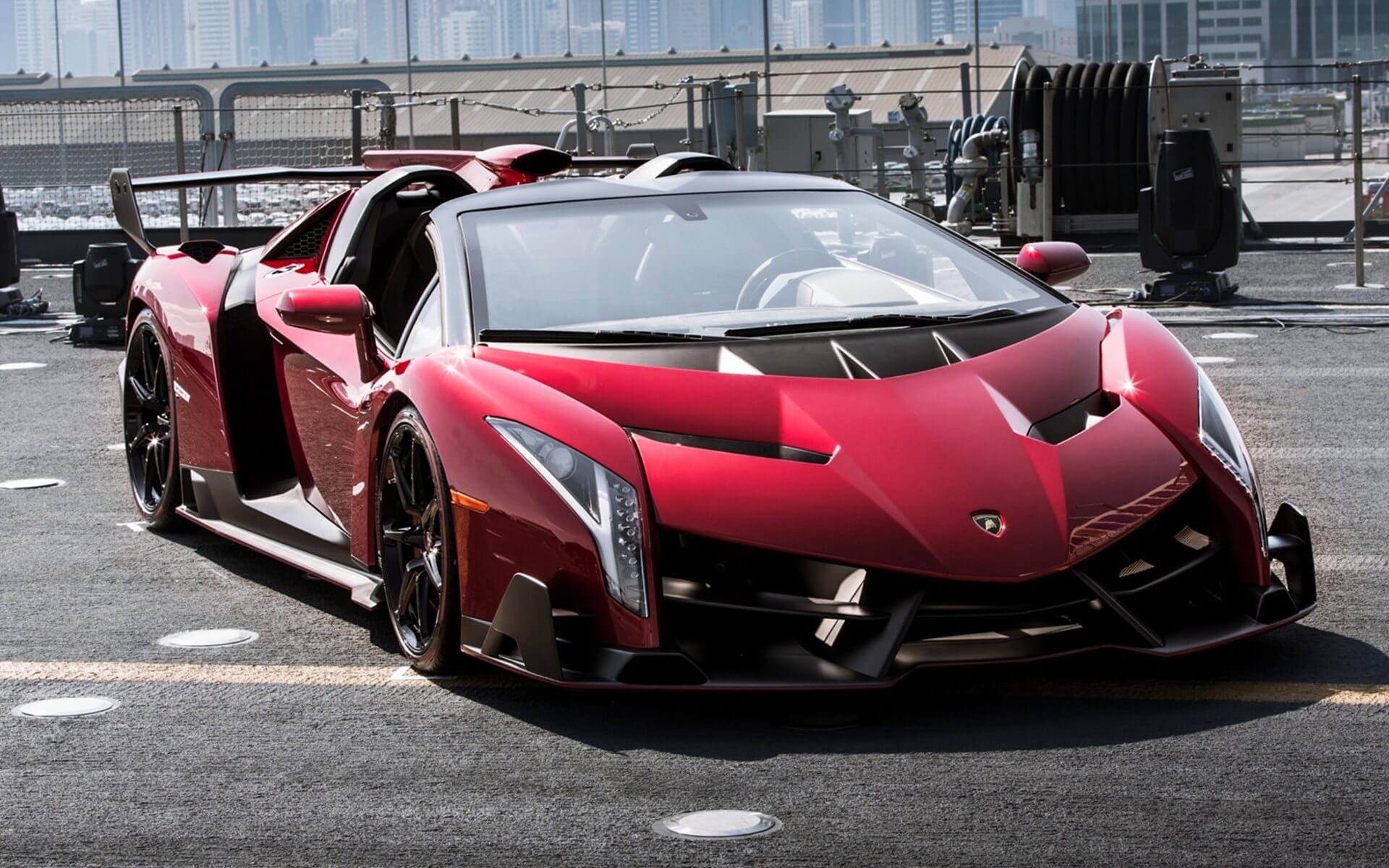
The Lamborghini Veneno is a limited-edition hypercar built to celebrate Lamborghini's 50th anniversary. Based on the Aventador, it was revealed as a coupé at the 2013 Geneva Motor Show and as a roadster in December 2013, with a 6.5-litre V12 producing 552 kW (750 PS). Only three or four coupés and nine roadsters were made, priced at €3 million and €3.3 million before tax.
In short
- Engine: 6,498 cc naturally aspirated V12 with 552 kW (750 PS) at 8,400 rpm and 690 Nm at 5,500 rpm.
- Gearbox: seven-speed ISR automated manual, four-wheel drive.
- Performance: 0–100 km/h in 2.8 s (coupé), top speed 355–356 km/h.
- Production: 3 customer coupés plus one kept by Lamborghini, and 9 roadsters.

Size at a glance
Ferrari LaFerrari
The Lamborghini Veneno is 318 mm longer, 83 mm wider and 49 mm taller than the Ferrari LaFerrari.
| Dimensions | Lamborghini Veneno | Ferrari LaFerrari | Difference |
|---|---|---|---|
| Length | 5,020 mm197.6 in | 4,702 mm185.1 in | +318 mm+12.5 in |
| Width | 2,075 mm81.7 in | 1,992 mm78.4 in | +83 mm+3.3 in |
| Height | 1,165 mm45.9 in | 1,116 mm43.9 in | +49 mm+1.9 in |
| Wheelbase | 2,700 mm106.3 in | 2,650 mm104.3 in | +50 mm+2.0 in |
McLaren P1
The Lamborghini Veneno is 432 mm longer, 129 mm wider and 23 mm lower than the McLaren P1.
| Dimensions | Lamborghini Veneno | McLaren P1 | Difference |
|---|---|---|---|
| Length | 5,020 mm197.6 in | 4,588 mm180.6 in | +432 mm+17.0 in |
| Width | 2,075 mm81.7 in | 1,946 mm76.6 in | +129 mm+5.1 in |
| Height | 1,165 mm45.9 in | 1,188 mm46.8 in | −23 mm−0.9 in |
| Wheelbase | 2,700 mm106.3 in | 2,670 mm105.1 in | +30 mm+1.2 in |
Specs by version
Engines
Performance
Show all 1 versions
| Version | 0–100 km/h | Top speed | Fuel consumption |
|---|---|---|---|
| 6.5 552 kW (751 PS) Coupe | 2.8 s 0–62 mph | 355 km/h221 mph | 25.0 l/100 km9.4 mpg US · 11.3 mpg UK |
Dimensions and weight
Verified Manufacturer and type-approval data from our catalog · Sources and methodology
Lamborghini Veneno at a glance
Lamborghini describes the Veneno as a road-going racing prototype. Its name means "poison" in Spanish and, following the brand's tradition, comes from a fighting bull: Veneno was a bull that became famous in 1914. The car shares its carbon-fibre monocoque, V12 engine and four-wheel-drive system with the Lamborghini Aventador, but almost every body panel is new. All models of the brand are in the Lamborghini catalogue.

| Fact | Coupé | Roadster |
|---|---|---|
| Premiere | Geneva Motor Show, March 2013 | 1 December 2013, aircraft carrier Cavour, Abu Dhabi |
| Number built | 3 for customers (4 in total) | 9 |
| Engine | 6.5 L V12, 552 kW (750 PS) | 6.5 L V12, 552 kW (750 PS) |
| Dry weight | 1,450 kg | 1,490 kg |
| 0–100 km/h | 2.8 s | 2.9 s |
| Price at launch (2013, before tax) | €3 million | €3.3 million |
Design and aerodynamics
The Veneno was shaped for maximum downforce and cooling. A huge carbon front splitter, air intakes all over the body, a large rear wing with a central fin and a massive diffuser dominate its look, and the lights have a Y-shaped signature. According to the old 1cars text, the front wings are designed to channel air to the radiators and brakes, the underbody is almost completely flat, and the wheels carry carbon rings that act as turbines to cool the carbon-ceramic brakes. The tyres are Pirelli, on 20-inch wheels at the front and 21-inch at the rear.

All three customer coupés are painted dark grey, each with accents on the wheels and diffuser in one colour of the Italian flag: red, white or green. The roadster has no roof at all, making it even more extreme.
Interior
The cabin follows the layout of the Aventador but with lighter materials. The old 1cars text describes carbon-fibre sports seats with a high degree of side support, four-point belts, a new steering wheel finished in three materials and a digital instrument display. Large areas of the interior are covered in Lamborghini's woven "CarbonSkin" material and Alcantara. As in the Aventador, the doors open upwards in Lamborghini's scissor style.

Engine, gearbox and performance
| Parameter | Metric | Imperial |
|---|---|---|
| Engine | 6,498 cc V12 (L539), naturally aspirated | 397 cu in |
| Power | 552 kW (750 PS) at 8,400 rpm | 740 hp |
| Torque | 690 Nm at 5,500 rpm | 509 lb-ft |
| Gearbox | 7-speed ISR automated manual | – |
| Drive | Four-wheel drive | – |
| 0–100 km/h | 2.8 s (coupé), 2.9 s (roadster) | 0–60 mph 2.8 s |
| Top speed | 355–356 km/h | 221 mph |
| Dry weight | 1,450 kg (coupé), 1,490 kg (roadster) | 3,197 lb / 3,285 lb |
The V12 develops 37 kW more than in the original Aventador LP 700-4, while the coupé is about 125 kg lighter, giving a power-to-weight ratio of 1.93 kg per PS. The ISR (Independent Shifting Rod) gearbox has seven speeds and paddle shifters. The old 1cars text lists independent suspension with horizontally mounted dampers, carbon-ceramic brakes and electronically controlled variable valve timing.

Veneno versus Aventador
| Parameter | Aventador LP 700-4 | Veneno coupé |
|---|---|---|
| Engine | 6.5 L V12 | 6.5 L V12 |
| Power | 515 kW (700 PS) | 552 kW (750 PS) |
| Dry weight | about 1,575 kg | 1,450 kg |
| Body panels | Aventador design | New, carbon fibre |
| Number built | Series production | 4 coupés, 9 roadsters |
The comparison shows how Lamborghini created the Veneno: it kept the proven chassis, gearbox and four-wheel drive of the Aventador, raised the engine output by 37 kW and cut about 125 kg through new carbon-fibre bodywork and lighter interior parts. The result is a car that is mechanically familiar but visually and aerodynamically unique.

Safety and electronics
Although it is a limited edition, the Veneno meets road-registration requirements. The old 1cars text lists front and side airbags for the driver and passenger, stability control with integrated ABS and traction control, and four-point seat belts. The engine management uses Lamborghini's own electronic injection system with ion-current analysis, and catalytic converters with lambda sensors keep the V12 within emissions limits.
Timeline

| Date | Event |
|---|---|
| 1963 | Lamborghini founded; the Veneno marks its 50th anniversary |
| March 2013 | Veneno coupé revealed at the Geneva Motor Show |
| 1 December 2013 | Veneno Roadster unveiled on the aircraft carrier Cavour in Abu Dhabi |
| 2013–2014 | Production of four coupés and nine roadsters |
Production and prices
At its launch in 2013, the Veneno coupé cost €3 million before tax, and the roadster €3.3 million before tax. Lamborghini built four coupés, one of which stays with the company, and nine roadsters. Because so few exist, the Veneno rarely changes hands, and our list of the world's most luxurious cars features it alongside other ultra-rare models.

The 50th anniversary
The Veneno was one of two special cars of Lamborghini's anniversary year, together with the single-seat Lamborghini Egoista. While the Egoista was built for the company itself, the Veneno was offered to a small group of customers. Its approach of creating extreme limited editions on existing underpinnings continued with later models such as the Lamborghini Centenario.

Rivals: how the Veneno compares
The Veneno belongs to the same small group of early-2010s hypercars as the McLaren P1, the Ferrari LaFerrari and the Koenigsegg Agera. Unlike the hybrid McLaren and Ferrari, it relies on a naturally aspirated V12 without electric assistance. Its strengths are dramatic styling, extreme rarity and the sound and response of the V12; its weaknesses are limited practicality and a price far above its technical relatives.

Rivals
Compare with…
Compare Lamborghini Veneno with
- Ferrari LaFerrari quick spec comparison
- McLaren P1 quick spec comparison
- Koenigsegg Agera R quick spec comparison
-
Ended 2018
- Years
- 2013–2018
- Body
- Roadster
- Fuel
- Hybrid
- Power
- 708 kW (963 PS)
-
Ended 2014
- Years
- 2011–2014
- Body
- Coupe
- Fuel
- Petrol
- Power
- 706–838 kW (960–1,139 PS)
-
Ended 2011
- Years
- 2010–2011
- Body
- Coupe
- Fuel
- Petrol
- Power
- 883 kW (1,201 PS)


Lamborghini Veneno in our rankings
- No. 1 of 48 · Fastest Italian cars (355 km/h)
- No. 3 of 112 · Widest coupes (2,075 mm)
- No. 5 of 147 · Fastest cars of the 2010s (355 km/h)
- No. 7 of 42 · Quickest Italian cars, 0–100 (2.8 s)
- No. 9 of 147 · Quickest cars of the 2010s, 0–100 (2.8 s)
- No. 9 of 105 · Fastest coupes (355 km/h)
Faster than 97% of ranked Italian cars in the 1CARS catalog (No. 1 of 48).
Lamborghini Veneno photos 20


Lamborghini Veneno videos 3

Lamborghini Veneno video 1

Lamborghini Veneno video 2

Lamborghini Veneno video 3
FAQ
How many Lamborghini Venenos were made?
Lamborghini built four coupés, three for customers and one kept by the company, and nine roadsters. Some sources give three coupés, counting only those sold to customers.
How much does a Lamborghini Veneno cost?
At its launch in 2013 the coupé cost €3 million and the roadster €3.3 million, both before tax. Later prices depend on private sales and auctions, as no new cars are available.
What engine does the Lamborghini Veneno have?
It uses a 6.5-litre naturally aspirated V12 based on the Aventador's, with 552 kW (750 PS) at 8,400 rpm and 690 Nm, a seven-speed ISR gearbox and four-wheel drive.
How fast is the Lamborghini Veneno?
The coupé accelerates from 0 to 100 km/h in 2.8 seconds and the roadster in 2.9 seconds. Lamborghini quotes a top speed of about 355–356 km/h for both body styles.
What does Veneno mean?
Veneno is Spanish for "poison". Like many Lamborghinis, the car is named after a Spanish fighting bull; the bull called Veneno became famous in 1914, during a bullfight in Andalusia.
Data sources
Data checked by an editor against the sources below.
- The text of this article (1cars archive)
- Wikipedia - Lamborghini Veneno


