
 Plymouth Barracuda
All generations, specs and history
Updated Published Sources (2) Report an error
By Sarah Whitmore, Senior Automotive Writer Reviewed by Oleksandr Hnatiuk

- Built
- 1964–1974
- Generations
- 3
- Top power
- 317 kW (431 PS)
Timeline
Barracuda generations
Click a generation for its own page
- Barracuda I 1964–1966 · Coupe · 75–175 kW (102–238 PS)
- Barracuda II 1967–1969 · Coupe, Convertible · 108–283 kW (147–385 PS)
- Barracuda III 1970–1974 · Coupe, Convertible · 93–317 kW (126–431 PS)
Newest first · 3 generations since 1964
-
1970

-
1967

-
1964


All generations by year: Barracuda III (1970–1974) · Barracuda II (1967–1969) · Barracuda I (1964–1966)
Which one is mine?
Pick the year of first registration to see which generation it is.
- Barracuda III 1970–1974
- Barracuda II 1967–1969
- Barracuda I 1964–1966
Which Plymouth Barracuda to buy
Our verdict · Sarah Whitmore
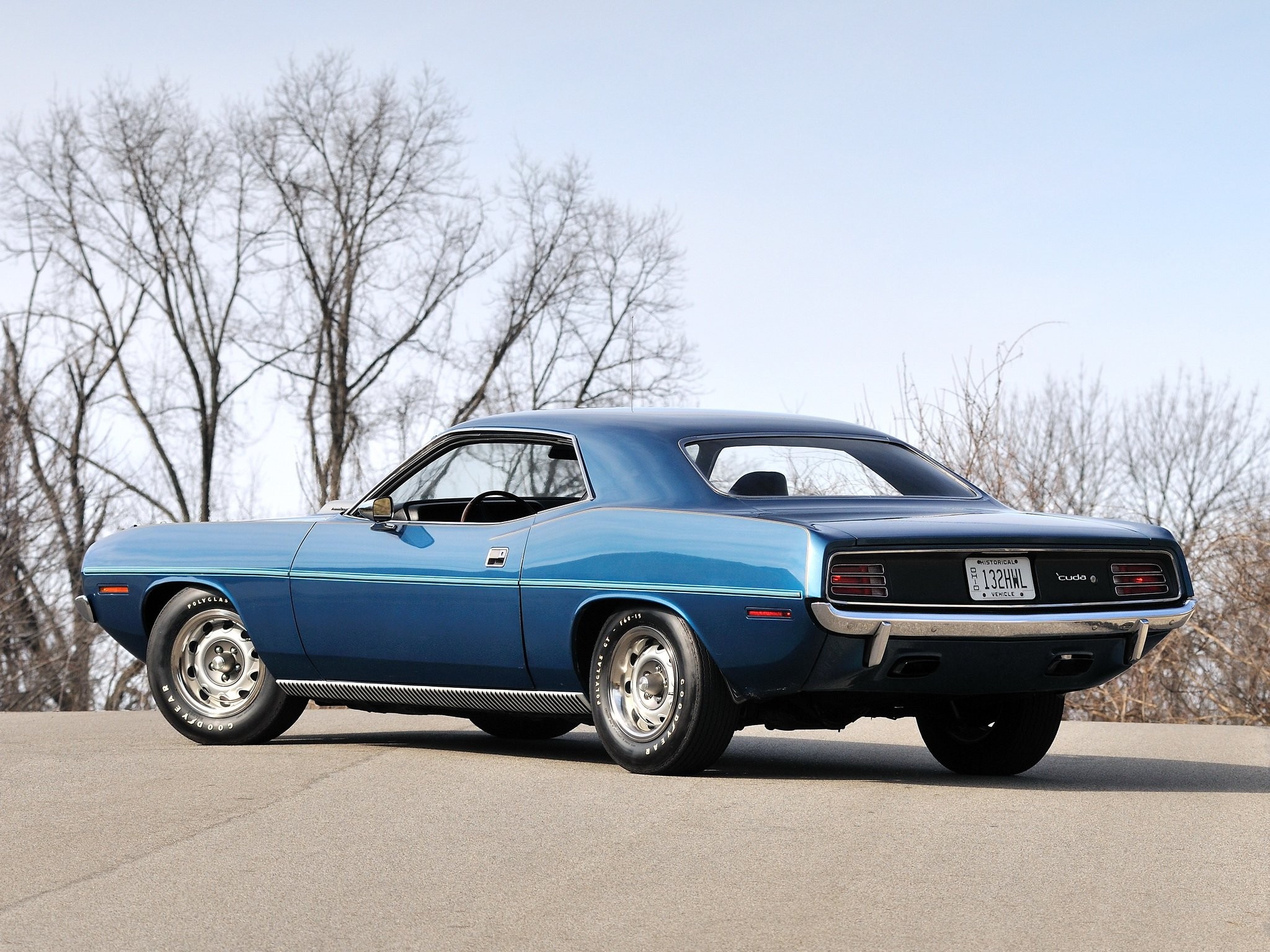
Today the Barracuda is a collector's car, and the right choice depends on budget and taste. First-generation cars with the slant-6 or 273 V8 are mechanically simple and share many parts with the Valiant. The second-generation convertible and fastback offer classic 1960s style. The 1970–1971 'Cuda with a 340, 383, 440 or Hemi V8 is the most sought-after: only thirteen 1971 Hemi 'Cuda convertibles were built, and one set a record at auction in 2014. When buying, check that the engine and trim match the car's documentation, because genuine high-performance versions are rare. A dedicated page covers the 1970 Plymouth Hemi 'Cuda.
The Plymouth Barracuda is a two-door pony car built by Chrysler's Plymouth division from 1 April 1964 to 1 April 1974. It began as a Valiant-based fastback, launched about two weeks before the Ford Mustang, and ended as the E-body Barracuda and 'Cuda, whose engines ranged from a 3.2-litre slant-6 to the 426 Hemi V8.
In short
- First generation (1964–1966): A-body fastback with a record-size rear window; slant-6 and 273 V8 engines.
- Second generation (1967–1969): fastback, notchback and convertible; engines up to the 383 and 440 V8.
- Third generation (1970–1974): E-body shared with the Dodge Challenger; hardtop and convertible; up to the 426 Hemi with 425 hp gross.
- Built in plants in Missouri, Michigan, California and Ontario; production ended in 1974.

Specs by version
Engines
Dimensions and weight
Show all 2 versions
| Version | Wheelbase |
|---|---|
| Barracuda I · 3.7 107 kW (145 PS) Coupe | 2,692 mm106.0 in |
| Barracuda II · 6.3 243 kW (330 PS) Coupe | 2,692 mm106.0 in |
Verified Manufacturer and type-approval data from our catalog · Sources and methodology
Plymouth Barracuda at a glance
The Barracuda was Plymouth's answer to the growing demand for compact sporty cars in the 1960s. It became one of the defining American muscle cars, especially in its 1970–1971 'Cuda form. The brand's story is told in the history of Plymouth, and other Plymouth models, including the Plymouth Road Runner, are in the Plymouth catalogue.

| Generation | Years | Platform | Wheelbase | Body styles | Engines |
|---|---|---|---|---|---|
| First | 1964–1966 | A-body (Valiant) | 2,692 mm (106 in) | Fastback hardtop | 170/225 slant-6, 273 V8 |
| Second | 1967–1969 | A-body | 2,743 mm (108 in) | Fastback, notchback, convertible | 225 slant-6; 273, 318, 340, 383, 440 V8 |
| Third | 1970–1974 | E-body | about 2,743 mm (108 in) | Hardtop coupé, convertible | 198/225 I6; 318, 340, 360, 383, 426 Hemi, 440 V8 |
First generation (1964–1966)
The first Barracuda went on sale on 1 April 1964 as a fastback two-door hardtop. Much of its body came from the Plymouth Valiant, including the bonnet, headlamp bezels, windscreen, doors, quarter panels and bumpers. The boot and some glass were new. Its huge rear window, developed with PPG, measured 1.34 m² (14.4 sq ft) and was the largest fitted to a standard production car up to that time.

Disc brakes and factory air conditioning arrived in 1965, along with the Formula S package, which added the Commando V8, suspension upgrades, larger wheels and tyres and a tachometer. For 1966 the car received new tail lamps, front sheet metal and an instrument panel, and the Barracuda fish emblem appeared. Plymouth sold 23,443 Barracudas in the short 1964 season, compared with 126,538 Mustangs.
| Engine | Displacement | Power (SAE gross) |
|---|---|---|
| Slant-6 170 | 2.8 L (170 cu in) | 101 hp (75 kW) |
| Slant-6 225 | 3.7 L (225 cu in) | 145 hp (108 kW) |
| 273 V8, two-barrel | 4.5 L (273 cu in) | 180 hp (134 kW) |
| 273 Commando V8, four-barrel | 4.5 L (273 cu in) | 235 hp (175 kW) |
The TorqueFlite automatic was offered, and 1964 was the last year for its push-button control.
Second generation (1967–1969)
For 1967 the Barracuda was redesigned by John E. Herlitz and John Samsen with "Coke-bottle" contours. It was still based on the A-body but rode on a longer 2,743 mm wheelbase, and it was offered as a fastback, a notchback coupé and a convertible. The fastback received a smaller, flush rear window and a steeper roofline.

| Engine | Power (SAE gross) | Years |
|---|---|---|
| 225 slant-6 | 145 hp (108 kW) | 1967–1969 |
| 273 V8 | 180–235 hp (134–175 kW) | 1967 |
| 318 V8 | 230 hp (172 kW) | 1968–1969 |
| 340 V8 | 275 hp (205 kW) | 1968–1969 |
| 383 V8 | 280–330 hp (209–246 kW) | 1967–1969 |
| 440 V8 | 380 hp (283 kW) | 1969 |
The 383 was available only with the Formula S package in 1967. For 1969 the 'Cuda trim arrived, based on the Formula S, with the 340, 383 or 440 Super Commando. In 1968 about fifty Super Stock fastbacks were built with the 426 Hemi for drag racing. Assembled by Hurst Performance, they had lightweight Chemcor side glass, fibreglass wings and bonnet, and no rear seats. Each was sold with a "not for public roads" notice.
Third generation (1970–1974)
The 1970 Barracuda moved to Chrysler's new E-body, a shorter and wider version of the B platform, shared with the Dodge Challenger but with no common exterior panels. The Valiant connection was gone, and the fastback was dropped in favour of a hardtop coupé and a convertible. Trims were the base Barracuda, the Gran Coupé and the high-performance 'Cuda, plus a low-priced Coupé from mid-1970 to 1971.

Third-generation engines
| Engine | Power | Years |
|---|---|---|
| 198 I6 (3.2 L) | 125 hp gross; 105 hp net | 1971 |
| 225 I6 (3.7 L) | 145 hp gross; 110 hp net | 1970–1972 |
| 318 V8 (5.2 L) | 230 hp gross; 150 hp net | 1970–1974 |
| 340 V8 (5.6 L) | 275 hp gross (290 hp Six Barrel, 1970); 240 hp net | 1970–1973 |
| 360 V8 (5.9 L) | 245 hp net | 1974 |
| 383 V8 (6.3 L) | 275–335 hp gross | 1970–1971 |
| 440 V8 (7.2 L) | 375–390 hp gross | 1970–1971 |
| 426 Hemi V8 (7.0 L) | 425 hp gross (317 kW) | 1970–1971 |
Gearboxes were a three-speed manual, a four-speed manual with an optional Hurst shifter and the TorqueFlite automatic. In 1970 most cars were V8 automatics, with 30,223 built, while 9,026 had a V8 and four-speed manual. The switch to net ratings from 1972 explains the much lower figures for the later years.
AAR 'Cuda and racing
The AAR 'Cuda takes its name from Dan Gurney's All American Racers team, which ran factory-backed Barracudas in the 1970 Trans-Am series for Gurney and Swede Savage. They took three pole positions but no wins; the best result was second at Road America. In Europe, Chrysler France raced four Hemi 'Cudas from 1970 to 1973.
Production and the end of the Barracuda
| Model year | Production |
|---|---|
| 1970 | 48,867 |
| 1971 | 16,492 |
| 1972 | 18,490 |
| 1973 | 19,281 |
| 1974 | 11,734 |
Production ended on 1 April 1974, exactly ten years after it began. The 1973 oil crisis, insurance surcharges on high-performance cars and new emissions rules ended the market for big-engined pony cars. A 1975 redesign with clay models inspired by the Plymouth Superbird was cancelled, and later reports of a revival under the Dodge brand have not led to a production car, although Dodge has filed trademarks for "Barracuda" and "'Cuda".

Dimensions and fuel use
| Parameter | Metric | Imperial |
|---|---|---|
| Wheelbase (1964–1966) | 2,692 mm | 106 in |
| Wheelbase (1967–1974) | 2,743 mm | 108 in |
| Rear window (1964–1966) | 1.34 m² | 14.4 sq ft |
| Largest engine | 7.2 L (440 V8) | 440 cu in |
| Highest output | 317 kW (426 Hemi) | 425 hp gross |
No official fuel-consumption figures exist for the period. As with other American cars of the time, V8 versions use considerably more fuel than the six-cylinder models. There is no all-wheel-drive or hybrid Barracuda; every car is rear-wheel drive.

Rivals: how the Barracuda compares
The Barracuda's main rivals were the Ford Mustang, including the Shelby GT500, the Chevrolet Camaro, the Pontiac Firebird and its own sister, the Dodge Challenger. Its strengths are the wide engine range up to the Hemi, the distinctive E-body styling and its rarity; its weaknesses are the slow sales of the first generation against the Mustang and the high fuel use of the big V8s. According to the old 1cars text, the Barracuda has appeared in the TV series Nash Bridges and films such as Gone in 60 Seconds and Fast & Furious 6.

Plymouth Barracuda evolution in numbers
Did you know?
- The Plymouth Barracuda ran for 10 years, from 1964 to 1974, over 3 generations in our catalog.
- The longest-running generation is the Barracuda III (1970–1974): 4 years.
- The biggest jump in power came with the Barracuda II: up to 283 kW (385 PS), 108 kW more than the Barracuda I.
Most powerful version, kW
Figures from the 1cars catalog: power is the strongest version of each generation; generations without the figure are left out.
Plymouth Barracuda: first vs latest generation
| Spec | Barracuda I | Barracuda III | Change |
|---|---|---|---|
| Years | 1964–1966 | 1970–1974 | 6 years apart |
| Most powerful version | 175 kW (238 PS) | 317 kW (431 PS) | +142 kW (+81%) |
Oldest and newest generation in the 1cars catalog. Power is the strongest version of each; other rows are shown only when both generations have the figure.
Rivals
Compare with…
Compare Plymouth Barracuda with
- Ford Mustang Fastback quick spec comparison
- Pontiac Firebird quick spec comparison
- Ford Mustang GT500 quick spec comparison
-
Classic
- Years
- 1964
- Body
- Coupe
- Fuel
- Petrol
- Power
- 202 kW (275 PS)
-
Ended 2002
- Years
- 1967–2002
- Body
- Coupe, Convertible
- Fuel
- Petrol
- Power
- 67–276 kW (91–375 PS)
4 generations
- I
- II
- III
- IV
-
Classic
- Years
- 1967–1970
- Body
- Coupe
- Fuel
- Petrol
- Power
- 265 kW (360 PS)
-
Ended 2024
- Years
- 1966–2024
- Body
- Coupe, Convertible
- Fuel
- Petrol
- Power
- 66–485 kW (90–659 PS)


Plymouth Barracuda in our rankings
- No. 5 of 117 · Most powerful cars of the 1970s (317 kW)
- No. 98 of 679 · Biggest engines: cars (6,300 cc · top 15%)
- No. 22 of 121 · Most powerful cars of the 1960s (283 kW · top 19%)
- No. 300 of 1056 · Most powerful cars (317 kW · top 29%)
- No. 69 of 210 · Biggest engines: coupes (6,300 cc · top 33%)
- No. 60 of 197 · Most powerful American cars (317 kW · top 33%)
More powerful than 93% of ranked cars of the 1970s in the 1CARS catalog (No. 5 of 117).
Plymouth Barracuda photos 13



Plymouth Barracuda videos 2

Plymouth Barracuda video 1

Plymouth Barracuda video 2
FAQ
How many generations of the Plymouth Barracuda are there?
There are three: the Valiant-based first generation from 1964 to 1966, the redesigned A-body second generation from 1967 to 1969, and the E-body third generation from 1970 to 1974.
Was the Barracuda launched before the Mustang?
Yes. The Barracuda went on sale on 1 April 1964, about two weeks before the Ford Mustang. The Mustang sold far better, with 126,538 cars in the 1964 season against 23,443 Barracudas.
What is the most powerful Plymouth Barracuda?
The 1970–1971 Hemi 'Cuda, with the 426 Hemi V8 rated at 425 hp gross (317 kW), is the most powerful. The 440 Six Barrel V8 offered up to 390 hp gross.
Is the Plymouth Barracuda available with all-wheel drive?
No. Every Barracuda is rear-wheel drive, with slant-6, V8 or Hemi engines and three-speed manual, four-speed manual or TorqueFlite automatic gearboxes. No hybrid or four-wheel-drive version was made.
What are the main rivals of the Plymouth Barracuda?
Its main rivals were the Ford Mustang, Chevrolet Camaro and Pontiac Firebird. From 1970 it also shared its E-body platform with the Dodge Challenger, its closest relative.
Data sources
Data checked by an editor against the sources below.
- The text of this article (1cars archive)
- Wikipedia - Plymouth Barracuda


